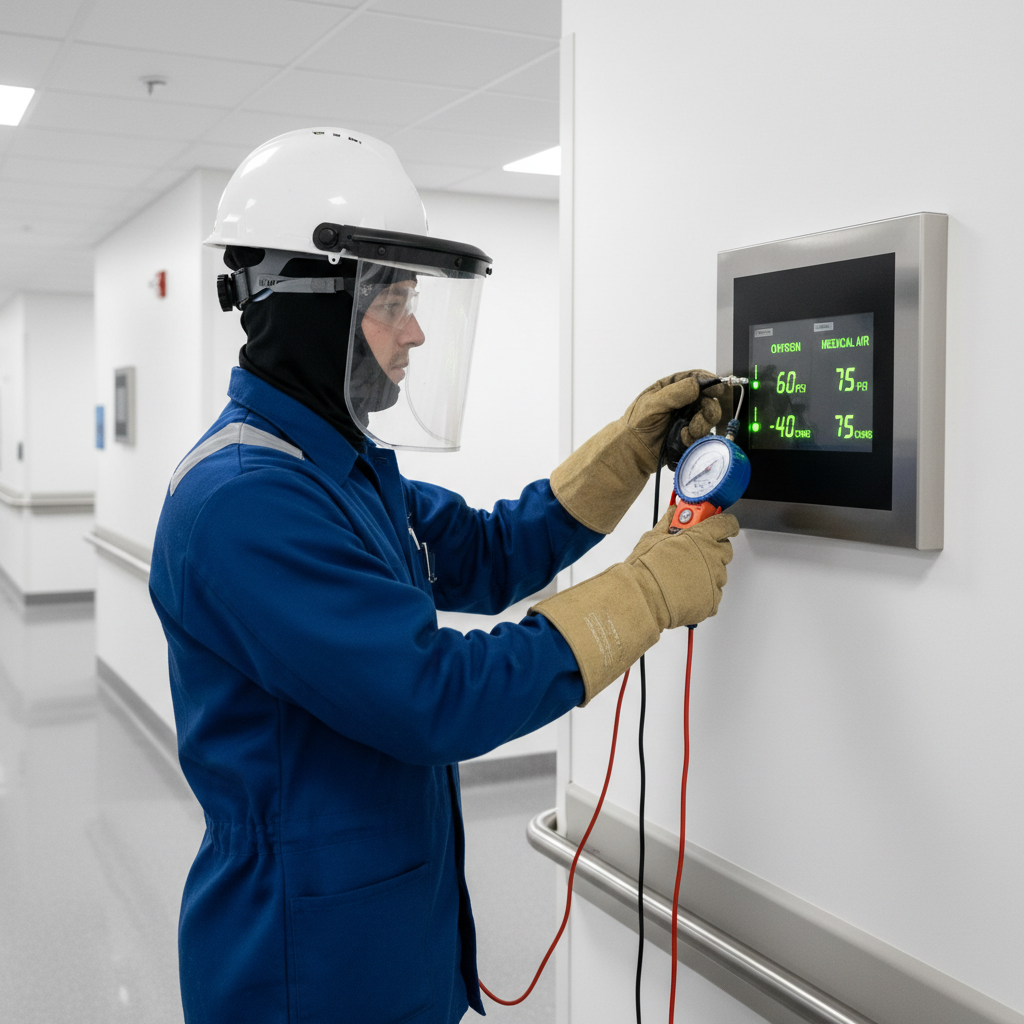
Master Alarm Panel Testing Kendall FL: NFPA 99 Guide
Master alarm panels are the central nervous system of any healthcare facility's piped medical gas infrastructure. When pressure drops in a critical care line, bulk liquid oxygen levels drop below a one-day supply, or a medical air compressor overheats, the master alarm panel is the first line of defense alerting staff before patient safety is compromised. For healthcare facilities in Kendall, Florida, ranging from surgical centers near Baptist Hospital to outpatient clinics and specialized care centers along North Kendall Drive, strict adherence to state and national life-safety codes is mandatory.
In this comprehensive guide, facility engineers, compliance directors, and clinical operations managers will learn the regulatory requirements, testing protocols, and retrofitting procedures for Category 1 and Category 2 master alarm panels. We examine NFPA 99 requirements, ASSE 6030 verification standards, physical testing workflows, and retrofit strategies for legacy BeaconMedaes, Amico, and Tri-Tech systems. Whether you are preparing for an AHCA survey or resolving persistent sensor faults, Medical Testing Solutions delivers the certified expertise needed to keep your facility fully operational and compliant.
The Regulatory Framework: NFPA 99 & ASSE 6000 Mandates
Medical gas alarm systems are governed by strict life-safety standards. In Florida, the Agency for Health Care Administration (AHCA) enforces NFPA 99 (Health Care Facilities Code), which dictates the design, installation, performance, and maintenance of all piped medical gas systems.
Under NFPA 99 (2021/2024 editions, Chapter 5), alarm systems are categorized by risk:
- Category 1 (Facility Risk Assessment indicates failure causes major injury or death): Requires two or more master alarm panels located in separate, constantly monitored locations.
- Category 2 (Facility Risk Assessment indicates failure causes minor injury): Requires at least one master alarm panel, with secondary notification pathways depending on facility architecture.
Section 5.1.9.2 mandates that each master alarm panel monitor all source systems (bulk liquid storage, manifold banks, medical air compressors, medical surgical vacuum pumps, and WAGD systems) as well as the main supply line pressures for all piped medical gases.
Why this matters for compliance: NFPA 99 Section 5.1.14.4 requires annual testing of all medical gas alarm panels. A single failed visual or audible indicator, or an uncalibrated pressure switch that fails to trigger during a bulk changeover, will generate an immediate AHCA survey citation or Joint Commission Requirement for Improvement (RFI).
Professional testing must be executed by credentialed personnel. The American Society of Sanitary Engineering (ASSE) Series 6000 standard governs these qualifications:
- ASSE 6010: Medical Gas Systems Installers.
- ASSE 6030: Medical Gas Systems Verifiers (required for new installations, retrofits, and major component testing).
- ASSE 6040: Medical Gas Systems Maintenance Personnel.
When scheduling master alarm panel testing in Kendall, FL, your testing partner must hold current ASSE 6030 or ASSE 6040 credentials to provide defensible compliance documentation during annual inspections. Learn more about our credentialed processes through our comprehensive medical gas verification services.
Master Alarm Panels vs. Area Alarm Panels: Key Differences
Facility managers often confuse the functional boundaries between master alarm panels and area alarm panels. Both are vital, but their operational roles and code requirements differ fundamentally.
| Diagram text |
|, |
| CENTRAL SOURCE EQUIPMENT |
| (Bulk LOX, Manifolds, Air Compressors, Vacuum Pumps) |
| MASTER ALARM PANELS (2) |
| Location A: Continuous Monitoring (e.g., Security) |
| Location B: Engineering / Facilities Office |
| * Monitors: Source supply status, bulk reserves, dew point, line pressure |
| AREA ALARM PANELS |
| Located outside Operating Rooms, ICUs, Sedation Suites |
| * Monitors: Local zone pressure (High/Low) downstream of Zone Valve Boxes |
Master Alarm Panels (NFPA 99, 5.1.9.2)
Master alarms monitor central equipment operating parameters and supply reserve levels. NFPA 99 requires two master alarm panels for Category 1 spaces:
- Location 1: Placed in the office or workspace of the individual responsible for medical gas systems maintenance (e.g., Facility Engineering office).
- Location 2: Placed in a constantly monitored location (24/7/365), such as a main security desk, telephone switchboard room, or central nurse monitoring station.
Master alarms notify operators of macro-level failures: high dew point in medical air, vacuum pump mechanical faults, backup manifold activation, liquid oxygen liquid level drops, and source pressure fluctuations exceeding ±20% of normal delivery pressure.
Area Alarm Panels (NFPA 99, 5.1.9.3)
Area alarm panels are localized. They monitor pressure variations in the specific pipeline zones feeding anesthetizing locations, critical care areas, deep sedation suites, and patient recovery wings.
Mounted directly outside operating rooms or at nurse stations, area alarms monitor pressure switches or digital transducers installed downstream of the zone valve box (ZVB). They alert clinical personnel if local pipeline pressures deviate by more than 20% above or below standard operating pressures (e.g., a drop below 40 psig on a 50 psig oxygen or medical air line).
Routine evaluation of both master and area alarms should be coordinated as part of your comprehensive annual medical gas inspections to ensure uninterrupted patient safety.
Step-by-Step Master Alarm Panel Testing Procedure
Testing master alarm panels is not a simple matter of pressing the "push-to-test" button on the front faceplate. The "test" button checks only the local LED lamps and audible buzzer circuitry; it does not verify that the field sensors, remote wiring, pressure switches, or auxiliary contacts operate when an actual failure occurs.
Medical Testing Solutions performs comprehensive physical testing that validates the signal path from the source equipment dry contacts to the central annunciator panel.
Step 1: Pre-Testing System Review & Notification
Before introducing test conditions, our ASSE 6030 verifier notifies the facility director, clinical charge nurses, security operations, and the central monitoring desk. Because physical testing involves generating real alarm signals, advance notification prevents false evacuation responses or unneeded supplier dispatch.
Step 2: Source Signal Verification & Physical Actuation
Each monitored parameter must be physically actuated at the source:
- Bulk Liquid Oxygen (LOX): Verify primary/secondary liquid levels and reserve bank pressures by manipulating the differential pressure switches or test manifold valves.
- Cylinder Manifolds: Simulate cylinder depletion to ensure the "reserve in use," "secondary bank active," and "high line pressure" contacts trip the master panel.
- Medical Air Compressors: Validate high discharge temperature switches, carbon monoxide (CO) alarms (tripping at ≥10 ppm per NFPA 99), and high dew point monitors (tripping at >32°F at 50 psig).
- Medical Vacuum & WAGD: Verify lead/lag mechanical faults and low vacuum conditions (falling below 12 in-Hg). Where clinical areas require waste anesthetic containment, coordinate these inspections with our specialized WAG chemical vapor monitoring procedures.
Step 3: Main Line Pressure Actuation
Main pipeline switches located upstream of all branch connections must be depressurized or pressurized using calibrated test kits to prove that high/low pressure alarms actuate within exact NFPA limits (20% deviation).
Step 4: Dual-Panel Synchronization & Silencing Controls
When a fault condition is simulated, both master panels must illuminate the proper visual label and sound an audible alarm (>80 dBA at 10 feet). We verify that:
- Silencing the alarm on Panel A does not silence the alarm on Panel B.
- The visual fault LED remains illuminated on both panels until the fault condition physically clears at the source.
- If a second, distinct alarm activates while the first is silenced, the audible alarm re-sounds.
Step 5: Power Failure & Auxiliary Battery Backup Testing
NFPA 99 Section 5.1.9.2.3 requires that master alarm panels connect to the essential electrical system (emergency generator life-safety branch). We simulate complete power disconnection to confirm:
- Panels switch to internal backup batteries (if equipped) or transfer cleanly to emergency generator power within 10 seconds.
- Common fault trouble signals activate if communication wiring is severed or shorted.
To maintain ongoing compliance, these verification workflows should feed directly into your facility's planned medical gas maintenance services.
Major Alarm Panel Manufacturers: Comparison & Evaluation
Kendall healthcare systems utilize a mix of vintage, legacy, and modern alarm panels. When older equipment fails or parts become obsolete, selecting the correct replacement platform is critical for long-term serviceability and building management system (BMS) integration.
Medical Testing Solutions inspects, services, and replaces systems from all tier-one manufacturers, including BeaconMedaes, Amico, and Tri-Tech Medical.
| Feature / Specification | BeaconMedaes MegaSys / MedTouch | Amico Alert-2 / Master Series | Tri-Tech Medical Genesis / Millennium |
|---|
| Primary Architecture | Microprocessor-based, digital touchscreen / modular LED | Microprocessor-based, LCD / LED modular annunciator | Digital microprocessor, graphic OLED / LED module |
| Network Protocols | BACnet/IP, Ethernet, Modbus | BACnet MSTP, Modbus, Ethernet | BACnet/IP, Modbus RTU, dry contacts |
| Field Wiring Type | Multi-conductor, Twisted-pair RS-485 or Ethernet | Twisted-pair RS-485, multi-pair direct dry contact | Multi-conductor direct contact or dynamic CAN bus |
| Sensor Interface | Direct 4-20mA, digital switch, transducer | 4-20mA, digital pressure switch, dry contact | Direct transducer (0-5V/4-20mA), dry contact |
| Retrofit Versatility | High (drop-in replacement modules for older MedPlus) | Very High (retrofits older legacy back-boxes cleanly) | High (compact back-box footprints, flexible frames) |
| Display Type | Color graphical touch interface | High-visibility LED with text display | OLED high-contrast display with LED indicators |
| NFPA 99 Compliance | Fully compliant (Latest Ed.) | Fully compliant (Latest Ed.) | Fully compliant (Latest Ed.) |
BeaconMedaes MegaSys and MedTouch Series
BeaconMedaes systems are common throughout South Florida hospitals. Legacy MegaSys units relied on multi-conductor dry contact points, while modern MedTouch panels utilize digital touchscreens with native BACnet connectivity. Common issues encountered in aging Beacon panels include failing ribbon cables, dimming LED segments, and proprietary sensor boards that are no longer supported. Upgrading to modern MedTouch annunciators allows facility teams to monitor gas pressure remotely via desktop web browsers.
Amico Alert-2 and Master Series
Amico is widespread across ambulatory surgery centers and clinical practices in Kendall due to its modular reliability and straightforward wiring schematics. The Alert-2 platform uses modular annunciator cards that can be added or rearranged without replacing the rough-in back-box. Amico panels offer drop-in retrofit packages that convert older competitor back-boxes into modern digital display systems in a single day, eliminating structural wall cuts in active corridors.
Tri-Tech Medical Genesis Series
Tri-Tech Medical provides exceptionally rugged master and area alarm systems known for bright OLED displays and long-life power conversion modules. Tri-Tech Genesis master alarms are designed with clear visual labeling, field-programmable input logic (normally open vs. normally closed switches), and rapid board replacement capabilities.
If your facility requires hardware updates or replacement modules, explore our vetted inventory in our medical gas products catalog or consult our certified installation team.
When to Repair vs. Replace Aging Alarm Panels
Facility directors frequently face the choice between sourcing costly replacement boards for obsolete alarm panels or investing in a total system upgrade. Below are clear operational criteria to guide that decision:
Indicators That Repair Is Feasible:
- Isolated Component Failures: A single blown LED indicator, damaged terminal block, or failed audible buzzer on an active product line where OEM components remain accessible.
- External Transducer / Switch Failure: The annunciator panel itself functions normally, but a remote 4-20mA pressure transducer or mechanical pressure switch at the manifold or vacuum pump has drifted out of calibration.
- Loose or Corroded Field Wiring: Signal degradation caused by terminal oxidation or vibration looseness that can be corrected by re-terminating and testing continuity.
Indicators That Full Replacement Is Required:
- Discontinued OEM Support: Legacy platforms (such as Ohio Medical, older Chemetron, or first-generation Puritan Bennett systems) where replacement circuit boards or power modules are unavailable.
- Corrupted Multi-Conductor Conduit Runs: Upgrading from old 20-wire multi-conductor runs to modern digital panels allows multiple signals to travel over a single shielded twisted-pair (RS-485) cable, saving thousands in labor costs during renovations.
- Building Automation (BAS/BMS) Integration Requirements: Older analog panels cannot communicate directly with modern HVAC and building control protocols without complex, failure-prone relay arrays. Modern Amico, Beacon, and Tri-Tech systems support native BACnet IP output.
- Corrosion or Environmental Damage: In South Florida's humid climate, panels located near loading docks, mechanical penthouses, or exterior bulk oxygen enclosures frequently suffer irreparable printed circuit board (PCB) trace corrosion.
When complete replacement is warranted, all work must be completed according to NFPA 99 guidelines and installed by ASSE 6010-credentialed professionals. Learn about our end-to-end capabilities for medical gas installation.
Common Alarm Testing Failures and Troubleshooting
During master alarm panel testing across Kendall, our technicians routinely diagnose and resolve several common systemic failures:
1. Inverted Alarm Logic (Normally Open vs. Normally Closed)
NFPA 99 requires alarm circuits to be designed on a "fail-safe" principle: wiring a circuit as normally closed (NC) ensures that if a signal wire is accidentally cut or pulled loose, the master alarm trips immediately, notifying staff of a circuit fault. We frequently uncover DIY repairs or non-certified contractor work where switches were wired normally open (NO), meaning a broken wire would permanently silence a critical alarm condition without anyone knowing.
2. Sensor Drift in High/Low Line Pressure Switches
Mechanical pressure switches rely on internal metal diaphragms and calibrated springs that experience mechanical fatigue over time. A line set to trip at 40 psig (for a 50 psig oxygen system) may drift down to 32 psig, allowing operating room pressures to drop to dangerous thresholds before an alarm triggers. Our technicians test and recalibrate or replace switches that fall outside code tolerances.
3. Dew Point and Carbon Monoxide Transducer Desensitization
Medical air compressors must be monitored for moisture (dew point) and toxic combustion gas (CO). Carbon monoxide electrochemical sensor cells have an active lifespan of approximately two to three years. If not calibrated annually with certified span gas, they drift, leading to false alarms or complete sensor blindness.
4. Communication Loss Between Dual Master Panels
In facilities with separate master panels at the security gatehouse and engineering plant, physical signal conduits running under parking lots or utility tunnels are vulnerable to water infiltration, ground loops, and electrical noise. Modernizing these links with opto-isolated converters or dedicated fiber runs eliminates intermittent phantom faults.
Local Compliance Considerations for Kendall & Miami-Dade County
Healthcare facilities operating in Kendall, including surgical centers near Dadeland, acute facilities along the Kendall Drive corridor, and clinics serving West Kendall, operate under the regulatory oversight of the Florida Agency for Health Care Administration (AHCA) and Miami-Dade Fire Rescue.
| Diagram text |
|, |
| LOCAL REGULATORY ECOSYSTEM: KENDALL, FL |
| FLORIDA AHCA (Agency for Health Care Administration) |
| * Enforces NFPA 99 & Florida Administrative Code (FAC 59A) |
| * Mandates verifiable, physical testing logs (not self-certifications) |
| MIAMI-DADE FIRE RESCUE LIFE SAFETY INSPECTORATE |
| * Physical inspection of visual/audible annunciator panels |
| * Emergency electrical transfer checks (<10 seconds to life-safety branch) |
| ASSE-CERTIFIED TESTING PARTNER (Medical Testing Solutions) |
| * ASSE 6030 verification & calibration reports filed in AHCA binder |
Key local enforcement items include:
- Florida Administrative Code (FAC 59A): Requires physical maintenance records of all medical gas equipment to be kept on-site for immediate inspection during state surveys. Self-certification checklists without instrument calibration certificates are rejected by state surveyors.
- High Humidity & Coastal Weather Environments: Tropical moisture and frequent electrical storm surges in South Florida cause voltage spikes that damage sensitive master alarm power supplies. Surge protection devices (SPDs) installed ahead of master panels are strongly recommended to prevent unexpected logic board failure.
- Hurricane Continuity & Emergency Transfer: Miami-Dade code enforces rapid transfer of master alarm panels to the emergency life-safety electrical branch during power interruptions. Panels must seamlessly maintain alarm memory across power switches without locking up or resetting.
Partnering with an established local testing firm ensures that your inspection paperwork aligns with the exact formats required by AHCA surveyors and local life-safety inspectors. Learn more about our comprehensive medical gas certification offerings tailored to Florida healthcare providers.
Ensure Your Facility Is Compliant Today
Master alarm panels are non-negotiable life-safety systems. Faulty wiring, uncalibrated pressure switches, or obsolete annunciator boards leave your healthcare facility vulnerable to AHCA citations, accreditation delays, and catastrophic patient safety events.
Medical Testing Solutions provides ASSE 6030-credentialed medical gas verification, annual testing, and turn-key alarm panel retrofits throughout Kendall, Miami-Dade County, and all of South Florida. Our factory-trained specialists service BeaconMedaes, Amico, Tri-Tech, and all legacy platforms to ensure absolute code compliance.
Contact Medical Testing Solutions today to schedule your annual inspection or request a rapid retrofit quote.