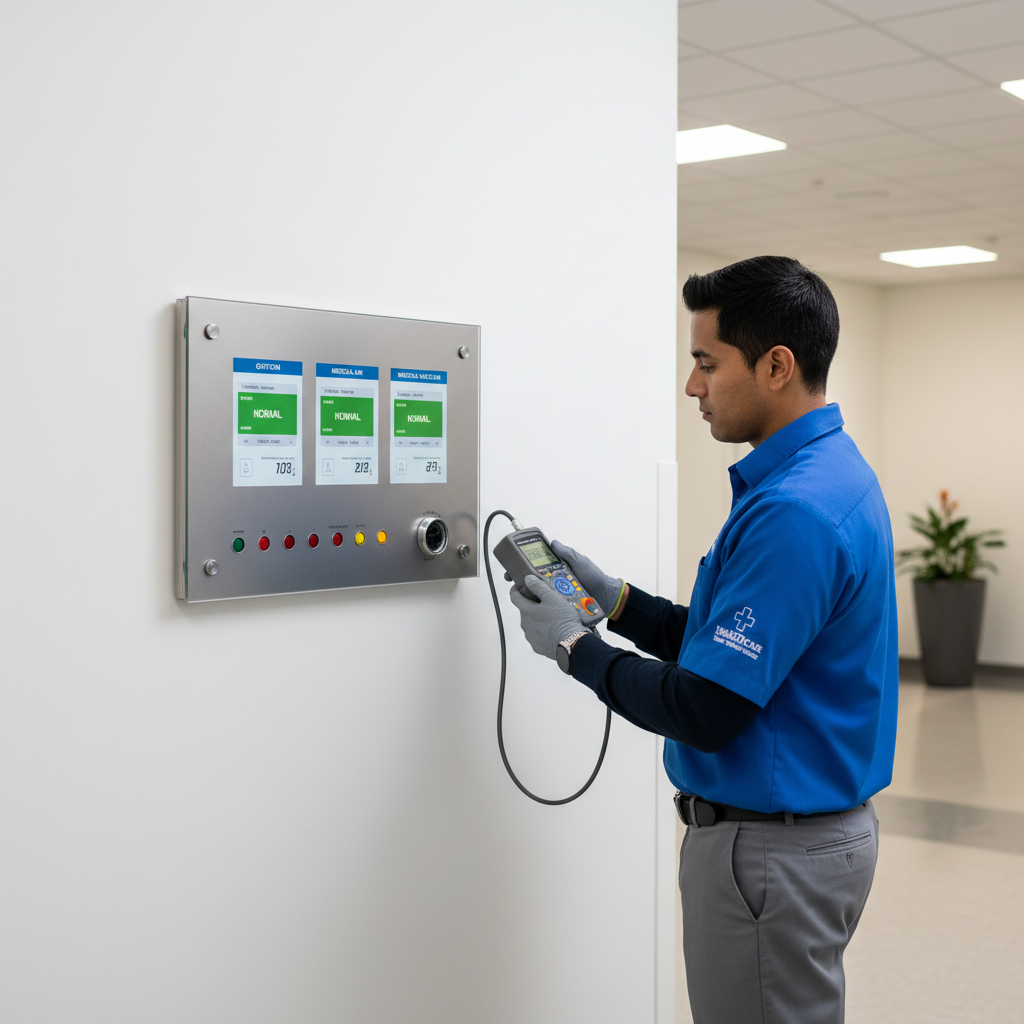
Master Alarm Panel Testing Hialeah FL: Complete Compliance Guide
Master alarm panels are the central nervous system of any healthcare facility's piped medical gas system. When line pressure drops in an operating suite or a liquid oxygen bulk tank reaches critical reserve levels, clinical staff rely entirely on immediate, unambiguous signals from these monitoring hubs. In Hialeah, Florida, home to major surgical centers, long-term acute care hospitals, and high-volume outpatient clinics, facility managers face rigorous municipal, state (AHCA), and federal scrutiny regarding life safety assets. Ensuring your alarms trip at the exact NFPA 99 thresholds is not merely administrative paperwork; it prevents catastrophic clinical events.
In this guide, you will learn the statutory testing protocols for Category 1 and Category 2 master alarms, understand the vital differences between master and area panels, compare modern panel retrofits (BeaconMedaes, Amico, and Tri-Tech), and explore the operational steps required to maintain full NFPA 99 code compliance across your Hialeah medical facility.
The Critical Role of Master and Area Alarm Panels in Life Safety
Medical gas alarms safeguard patients who cannot safeguard themselves. A ventilated patient under general anesthesia depends on continuous positive-pressure medical air and oxygen. If a line ruptures or a manifold fails to switch over, seconds count.
Under NFPA 99 (Health Care Facilities Code), alarm systems fall into two primary operational tiers:
- Master Alarm Systems: Monitor the source equipment and central supply pipeline status. They oversee the operational readiness of bulk cryogenic vessels, high-pressure cylinder manifolds, medical air compressors, vacuum pumps, and main line pressure transducers. Master alarms notify plant engineering, facility managers, and central dispatch of mechanical equipment faults before clinical delivery is compromised.
- Area Alarm Panels: Monitor pipeline pressures serving specific critical care zones, such as surgical suites, recovery rooms (PACU), intensive care units (ICU), and emergency departments. Located directly within the clinical environment (usually at a nurse station), area alarms give immediate localized warnings if line pressure rises or drops by more than 20% from normal working pressure.
Because Hialeah facilities operate under the regulatory umbrella of the Agency for Health Care Administration (AHCA) and the Florida Fire Prevention Code, master alarm integrity must be tested systematically. If an alarm panel fails to annunciate, mechanical failures transform into patient emergencies without warning.
Why this matters for compliance: NFPA 99 (2024 edition, Section 5.1.9) classifies medical gas pipeline alarm failures as life-threatening events. AHCA inspectors during annual surveys or statement-of-deficiencies audits will immediately cite facilities that lack physical, documented actuation records for every monitored master and area alarm signal.
Regulatory Framework: NFPA 99, ASSE 6030, and AHCA Mandates
Ensuring compliance for master alarm panel testing in Hialeah requires deep familiarity with several intersecting standards:
NFPA 99 Chapter 5 Requirements
NFPA 99 Section 5.1.9 dictates the mechanical and electrical specifications for Category 1 systems. Key operational mandates include:
- Dual Location Requirement (5.1.9.2): Category 1 master alarms must consist of two or more separate alarm panels located in at least two separate locations. One panel must be located in the office or workspace of the individual responsible for the maintenance of the medical gas system (e.g., the facility engineer's office). The second panel must be located in a location under continuous 24-hour observation (e.g., security control, telephone switchboard, or central nurse station).
- Independent Wiring: Each sensor/switch must wire independently to ensure a single wiring failure does not disable both master stations.
- Visual and Audible Annunciation: Master alarms must display separate indicators for each condition monitored, with a continuous visual indicator and an audible alarm rated at a minimum decibel level that sounds upon any fault condition.
- Mute/Re-alarm Features: When silenced by an operator, the audible alarm must re-sound if an additional alarm condition occurs on another monitored point.
ASSE Series 6000 Professional Qualifications
Testing, installation, and inspection cannot be performed by general maintenance personnel. The American Society of Sanitary Engineering (ASSE) sets strict qualification benchmarks:
- ASSE 6010: Certified Medical Gas Systems Installers perform physical panel retrofits and brazed connections.
- ASSE 6030: Certified Medical Gas Systems Verifiers perform the rigorous physical inspection, pressure actuation, and verification of panel points.
- ASSE 6040: Qualified Maintenance Personnel oversee internal periodic facility verifications.
Medical Testing Solutions deploys factory-trained, ASSE 6030-certified verification specialists to ensure every test meets these exact credentials. Learn more about professional qualification pathways through our comprehensive medical gas certification solutions.
Step-by-Step Master Alarm Panel Testing Methodology
Master alarm panels cannot be tested by simply pressing the "Lamp Test" button on the front faceplate. The lamp test verifies only that the internal LED bulbs and audible buzzers operate; it proves nothing about whether the field transducers, pressure switches, or pipeline transmitters are functional.
To satisfy AHCA surveyors and NFPA 99 Section 5.1.14.4, a physical actuation test must be executed. | Diagram text | |, | | Master Alarm Panel Testing Protocol Flowchart |
1. Source Signal Actuation
Field sensors connected to bulk systems, manifolds, compressors, and vacuum pumps must be physically tripped:
- High/Low Pressure Switches: Technicians isolate the pressure sensor from the active line using dedicated test ports and slowly bleed or pressurize the chamber to confirm the alarm initiates within a ±20% variance of normal line pressure (e.g., dropping below 40 psig or rising above 60 psig on a nominal 50 psig oxygen system).
- Liquid Level Indicators: The liquid level alarm switch on the primary and secondary cryogenic liquid containers must be actuated to ensure the "Liquid Level Low" visual and audible signals light up at both master panels.
- Reserve In-Use & Reserve Low: Technicians simulate reserve cylinder bank engagement to verify that switchover signals transmit instantaneously.
- Vacuum and Air Systems: High compressor temperature, lag-pump running, carbon monoxide (CO) breakthrough (monitoring levels above 10 ppm per NFPA 99 5.1.3.6.3.12), dew point rises above +39°F, and vacuum drops below 12 in-Hg must all be actuated at the source equipment.
2. Dual-Station Verification
When an alarm condition is initiated at the source, an ASSE 6030 verifier confirms that both master panels alarm simultaneously. The technician checks:
- Audible alert decibels.
- Proper labeling of the alarm point.
- Independent clearing: silencing one master station panel must not cancel the audible alarm on the second panel.
Routine testing should be coordinated during your facility's scheduled annual medical gas inspections to ensure no clinical disruptions occur.
Leading Alarm Panel Manufacturers: BeaconMedaes, Amico, and Tri-Tech
Healthcare facilities across Hialeah and South Florida utilize panels from three primary manufacturers. When an older panel fails or replacement parts become obsolete, selecting the right platform determines the ease of installation and total cost of ownership.
BeaconMedaes (Mega Systems / TotalAlert Series)
BeaconMedaes is one of the most widely deployed medical gas hardware manufacturers. Their modern TotalAlert Infinity line features digital touchscreens, embedded web servers, and Ethernet-based communication protocols.
- Pros: Highly aesthetic, offers remote monitoring via local network or smartphone alerts, excellent interface diagnostics, straightforward software point configuration.
- Cons: Higher upfront equipment cost, proprietary parts require certified technicians for board-level repairs.
Amico (Alert-2 & Master Series)
Amico panels dominate outpatient surgery centers and community hospitals throughout Miami-Dade County. The Alert-2 series utilizes microprocessor-based circuitry with modular 5-point, 10-point, or 20-point layout boards.
- Pros: Extremely durable, modular plug-and-play architecture, widely available replacement components, intuitive maintenance bypass functions.
- Cons: Legacy Alert-1 systems lack modern digital bus communication and require full retrofitting to integrate with modern building automation systems (BAS).
Tri-Tech Medical (Gen II & Gen III Series)
Tri-Tech Medical panels offer robust industrial build quality, often selected for replacement projects where durability and cost efficiency are primary concerns.
- Pros: Simple board designs, highly reliable solid-state switches, excellent technical support, straightforward BACnet integration.
- Cons: Smaller digital screen real estate compared to high-end BeaconMedaes systems, basic graphical interface.
Technical Comparison Table
| Feature / Metric | BeaconMedaes TotalAlert Infinity | Amico Alert-2 Series | Tri-Tech Medical Gen III |
|---|---|---|---|
| Primary Display | High-Res Color Touchscreen | Segmented LED / Digital LCD | LCD / Multi-Color LED |
| Max Monitored Points | Up to 60+ points modular | Up to 60 points per enclosure | Up to 64 points modular |
| Communication Protocol | Ethernet, BACnet/IP, Modbus | Ethernet, BACnet, dry contacts | BACnet IP / MSTP, Modbus |
| Remote Web Access | Native web-server built in | Optional gateway module | Optional interface module |
| Transducer Type | Digital bus addressable | Analog 4-20mA or digital bus | Analog / Solid-state digital |
| Best Suited For | Large acute care hospitals | Mid-size hospitals & ASCs | Surgery centers & clinics |
| Replacement Complexity | Low (with existing digital drops) | Very low (drop-in retrofit) | Very low (flexible enclosures) |
If your master panels frequently display false positives, flickering LED indicators, or communication dropout errors, your facility may need a retrofitted replacement. Medical Testing Solutions assists healthcare facilities from equipment selection through medical gas installation and final commissioning.
Area Alarm Panels vs. Master Alarm Panels: Key Differences
Facility managers sometimes confuse master and area alarms, especially in compact clinical suites. The following breakdown highlights their distinct engineering parameters: | Diagram text | |, | | MASTER vs. AREA ALARMS | | CRITERIA MASTER ALARM PANEL AREA ALARM PANEL | | Primary Function Source supply & central pipeline Local critical care pipelines | | Monitored Parameters Pressure, dew point, run status Line pressure exclusively | | Typical Location Engineering office & 24/hr desk Nurse stations, surgical cores | | Allowable Variance Set points defined by NFPA 99 Line pressure +/- 20% nominal | | NFPA 99 Chapter Section 5.1.9.2 Section 5.1.9.3 | | Code Quantity Minimum 2 panels per facility 1 panel per clinical zone |
Area Alarm Specifics
Area alarm panels monitor the pipeline distribution after the zone valve box. If a surgeon requests that an oxygen zone valve be shut off during an intraoperative fire emergency, the area alarm must actuate instantly to inform the staff that pipeline pressure is zero.
Area alarms require precise calibration of their local pressure sensors. During inspection cycles, verifiers connect calibrated gauges to ensure:
- Low-pressure trips engage precisely at 40 psig for 50 psig gases (Oxygen, Medical Air, Nitrous Oxide, Carbon Dioxide).
- High-pressure trips engage at 60 psig.
- Medical vacuum trips when suction levels drop below 12 in-Hg.
For facilities conducting minor sedation or specialized procedures, pipeline integrity is closely linked to equipment calibration. Review our specialized protocols for dental flowmeter repair and calibration to maintain continuous compliance across clinical operatories.