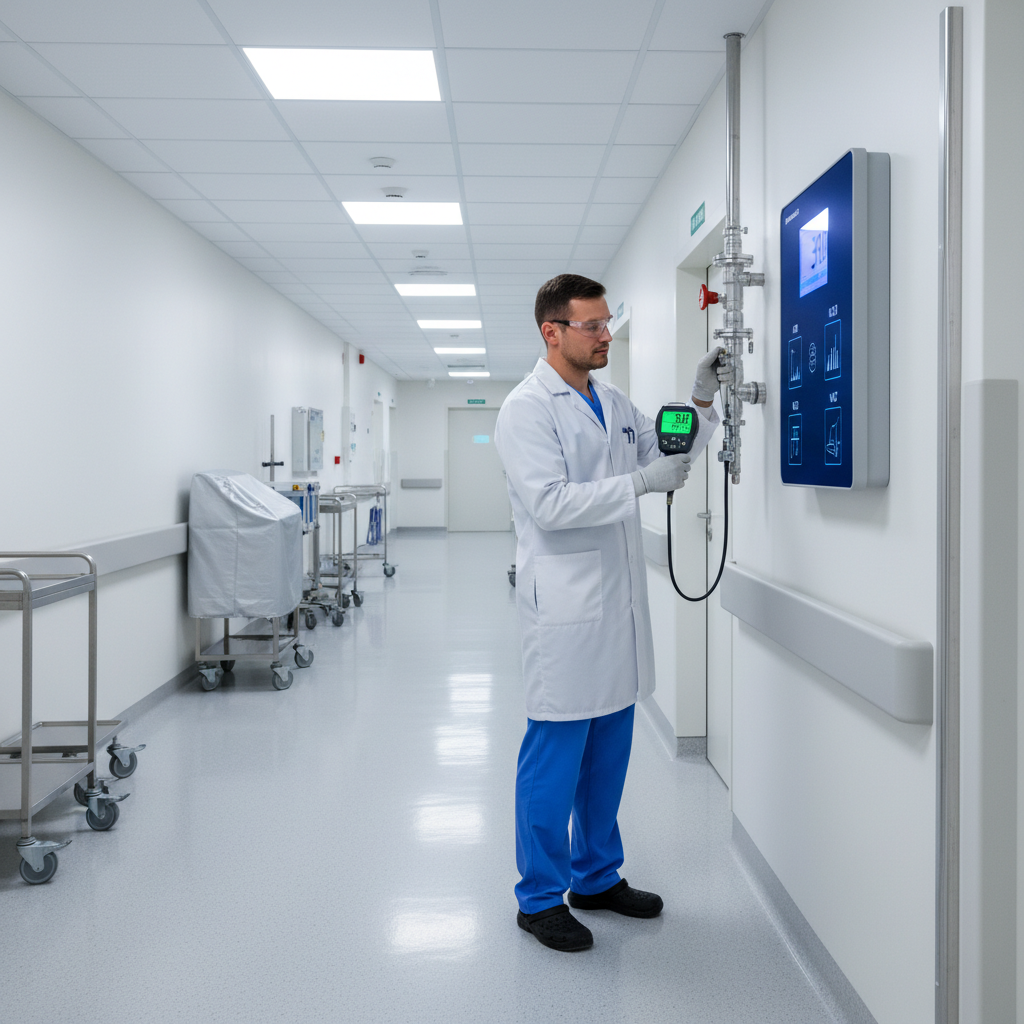
Master Alarm Panel Testing in Delray Beach, FL: Complete Guide
When a pipeline pressure drops or a bulk oxygen plant switches to its reserve bank, facility staff must know instantly. In Palm Beach County healthcare facilities, medical gas alarm panels serve as the sensory nervous system for life-support utility distribution. Whether you operate a surgical center on Linton Boulevard, a specialized outpatient clinic, or an acute care hospital, routine master alarm panel testing in Delray Beach, FL ensures your life-safety signals broadcast reliably before an emergency strikes.
In this comprehensive guide, ASSE-certified technicians break down NFPA 99 (Health Care Facilities Code) mandates for master and area alarm systems. You will learn the exact testing protocols required for Category 1 and Category 2 spaces, common wiring and sensor failure modes, retrofit procedures for leading legacy manufacturers like BeaconMedaes, Amico, and Tri-Tech Medical, and how compliant documentation protects your facility during AHCA and Joint Commission audits.
The Critical Role of Medical Gas Alarms in Patient Safety
Medical gas systems are unique utilities: patients cannot see, smell, or taste an interruption in medical air or an unexpected drop in oxygen pipeline pressure. Because piped gases support anesthetized, ventilated, and critical-care patients, system failures escalate to life-threatening emergencies within seconds.
The National Fire Protection Association (NFPA) categorizes medical gas alarm systems into two distinct operational layers under NFPA 99 Chapter 5:
- Master Alarm Panels: Monitor the central supply source equipment (bulk liquid cryogenic tanks, high-pressure manifold banks, medical air compressors, and vacuum pumps) as well as main pipeline operating pressures. NFPA 99 mandates at least two separate master alarm panels placed in distinct supervisory locations.
- Area Alarm Panels: Monitor critical pipeline pressures serving localized patient care areas, including operating rooms, post-anesthesia care units (PACU), intensive care units (ICU), catheterization labs, and general procedural suites.
A failure in either system blinds clinical and facility staff to catastrophic supply deprivations. Rigorous, certified functional testing is the only defensible method to ensure these relays, transducers, and audible annunciators trigger when lives depend on them.
Why this matters for compliance: The Florida Agency for Health Care Administration (AHCA) and CMS-deemed accrediting organizations like The Joint Commission cite missing or incomplete medical gas alarm test logs as immediate life-safety deficiencies. Under NFPA 99 (2012/2021 editions, Section 5.1.14.2), operational testing of all alarm signals must occur periodically with physical activation of source switches and pressure sensors.
NFPA 99 Regulatory Mandates for Master and Area Alarms
Meeting regulatory requirements in South Florida requires strict adherence to NFPA 99, ASSE Series 6000 qualifications, and Compressed Gas Association (CGA) guidelines. Routine testing must not rely merely on pushing the "lamp test" button; it requires verifying signal actuation from the primary sensor back to the annunciator panel.
Master Alarm Panel Signals (NFPA 99 Section 5.1.9.2)
Category 1 facilities must monitor specific critical conditions at two master alarm panels located in separate operational areas. One panel is typically housed in the primary engineering or facility office, while the second is situated in an area with continuous 24/7 observation, such as a telephone switchboard room, security dispatch, or nursing command station.
Key master alarm signals that must be physically verified include:
- Bulk Liquid Oxygen Systems: Liquid level low, main line pressure high/low (±20% from normal), reserve in use, reserve liquid level low, and reserve pressure low.
- High-Pressure Manifolds: Primary bank empty (changeover occurred), secondary bank in use, and reserve bank low.
- Medical Air Compressors: High discharge temperature (with auto-shutdown), aftercooler high water level, dryer failure (high dew point alarm at 35°F / 1.7°C), carbon monoxide (CO) levels exceeding 10 ppm, and back-pressure variations.
- Medical Vacuum Systems: Vacuum pump lag/running status and pipeline vacuum level dropping below 12 in-Hg.
- Waste Anesthetic Gas Disposal (WAGD): Low vacuum or producer lag activation. (Learn more about continuous room-level safety with our WAG chemical vapor monitoring services).
Area Alarm Panel Requirements (NFPA 99 Section 5.1.9.3)
Area alarms must be installed at clinical nurse stations or immediately outside anesthetizing locations. These panels monitor:
- Pressure fluctuations exceeding ±20% of normal line pressure (e.g., drops below 40 psig or surges above 60 psig on standard 50 psig pipelines).
- Critical medical vacuum levels dropping below 12 in-Hg.
- Area alarm sensors must be placed on the patient side of the zone valve box, ensuring that if a zone valve is manually closed in a fire, the area alarm immediately signals pressure loss to clinical personnel.
For facilities conducting their required annual medical gas inspections, verifying these alarm trip thresholds with calibrated test gauges forms the cornerstone of AHCA audit readiness.
Step-by-Step Procedure: How Certified Technicians Test Alarms
Comprehensive testing cannot be faked with jumper wires or software overrides. True compliance involves verifying mechanical-to-electrical signal transduction under the oversight of an ASSE 6030 certified verifier or ASSE 6040 maintenance technician. | Diagram text | |, | | ANNUAL ALARM TESTING WORKFLOW | | [Step 1: AHCA/Staff Notice] - → [Step 2: Calibrated Gauge Tapping] | | [Step 4: Central Annunciation] → - [Step 3: Controlled Pressure Bleed/Sim] | | [Step 5: Wiring & Power Loss] - → [Step 6: Signed ASSE 6030 Certification Log] |
1. Pre-Testing Coordination & Patient Area Isolation
Before initiating testing in an active Delray Beach clinical facility, technicians coordinate with nurse managers, respiratory therapy, and facilities engineering. Backup life-support cylinders are staged if pipeline supply valves require manipulation.
2. Calibrated Test Gauge Integration
Technicians tap into downstream pressure test ports or sensor tees using NIST-traceable calibrated digital pressure gauges. A digital pressure meter ensures that high- and low-pressure trip points match factory and code requirements to within ±1 psig.
3. Dynamic Physical Actuation
- Pressure Switches/Transducers: Technicians slowly bleed gas volume through controlled bleeder valves to test low-pressure points, monitoring the exact pressure at which the visual and audible signals engage.
- Source Equipment Alarms: Technicians manually simulate faults on the compressor or vacuum skid, such as shorting temperature sensors, isolating desiccant dryers, introducing test gas with certified CO balance, or activating mechanical float switches.
4. Verification at Dual Master Locations
As each alarm signal actuates at the mechanical source or pipeline, communication links are verified at both Master Panel A and Master Panel B. Technicians verify that:
- The audible horn sounds at or above required decibel thresholds.
- The visual LED/LCD indicator changes to an alarming red state with explicit text labeling.
- The silence button mutes the audible alarm while keeping the visual indicator flashing or continuously illuminated until the condition is cleared.
5. Area Alarm Trip Threshold Calibration
For area alarms serving surgical suites and sedation rooms, technicians verify that local zone pressure drops actuate the alarm promptly. If pressure transducers drift out of calibration, technicians recalibrate the sensor board or replace failing transducers immediately. (Facilities with isolated electrical systems can also integrate this with specialized line isolation monitor (LIM) testing to minimize clinical interruptions).
6. Power Outage & Circuit Integrity Verification
NFPA 99 Section 5.1.9.2.4 requires medical gas alarm systems to be powered from the facility’s Life Safety or Critical Branch of the emergency electrical system. Technicians simulate power interruptions to confirm that alarms transfer seamlessly without losing stored configurations, and they verify supervised wiring loops to ensure that a cut or disconnected wire triggers a "system fault" alarm.
Comparing Leading Alarm Manufacturers: Beacon, Amico, and Tri-Tech
Delray Beach surgical centers and hospitals operate with equipment from several major medical gas manufacturers. When evaluating replacements, expansions, or system migrations, understanding cross-brand functionality is essential.
| Feature / Specification | BeaconMedaes (MegaSystem / MedTouch) | Amico Corporation (Alert-2 / Alert-3) | Tri-Tech Medical (Vision-Matrix / Gen II) |
|---|---|---|---|
| System Architecture | Microprocessor-based, Ethernet/BACnet native | Digital modular, Ethernet / Modbus communication | Microprocessor, integrated web server & BACnet |
| Transducer Style | DISS specific, remote or local module mounting | Digital sensor modules with live pressure display | Remote sensor modules, quick-disconnect fittings |
| Display Technology | Color touchscreen graphical LCD | Color digital LED / Touchscreen LCD | High-visibility OLED / LCD numeric displays |
| Master Alarm Points | Up to 60+ points per panel via expansion cards | Up to 64 points per annunciator board | Up to 64 points; modular 8-point card segments |
| Network Capability | Connects to central building management system (BMS) | Bridges to central hospital automation networks | Native BACnet/IP for remote building monitoring |
| Retrofit Capability | Excellent retrofit boxes for legacy Medaes systems | Highly adaptable retrofit frames for any rough-in | Universal backbox retrofits with adapter plates |
| Typical Life Expectancy | 12–15 years | 12–15 years | 12–15 years |
BeaconMedaes Alarm Systems
BeaconMedaes systems are common in older hospital infrastructure throughout Palm Beach County. Legacy analog annunciators often feature hardwired incandescent or early LED bulb strips. Upgrading to the modern MedTouch series offers touch-screen diagnostics, live data logging, and building management system (BMS) integration, allowing clinical directors to review real-time historical trends.
Amico Alert Series
Amico Alert-2 and Alert-3 systems are widely deployed in regional surgery centers. They utilize modular sensor boards that display actual line pressure right on the face of area alarm panels, rather than relying solely on green/red indicator lights. When an Amico digital sensor drifts, individual transducer modules can be swapped without replacing the entire enclosure.
Tri-Tech Medical Vision-Matrix
Tri-Tech systems excel in retrofit applications. When facilities undergo renovations requiring medical gas installation (ASSE 6010), Tri-Tech retrofit kits allow technicians to slide new modular panels into existing wall rough-in backboxes, avoiding costly drywall demolition and structural repiping in active clinical corridors.
If your facility requires new replacement alarm hardware, explore compliant panel options in our medical gas products catalog.