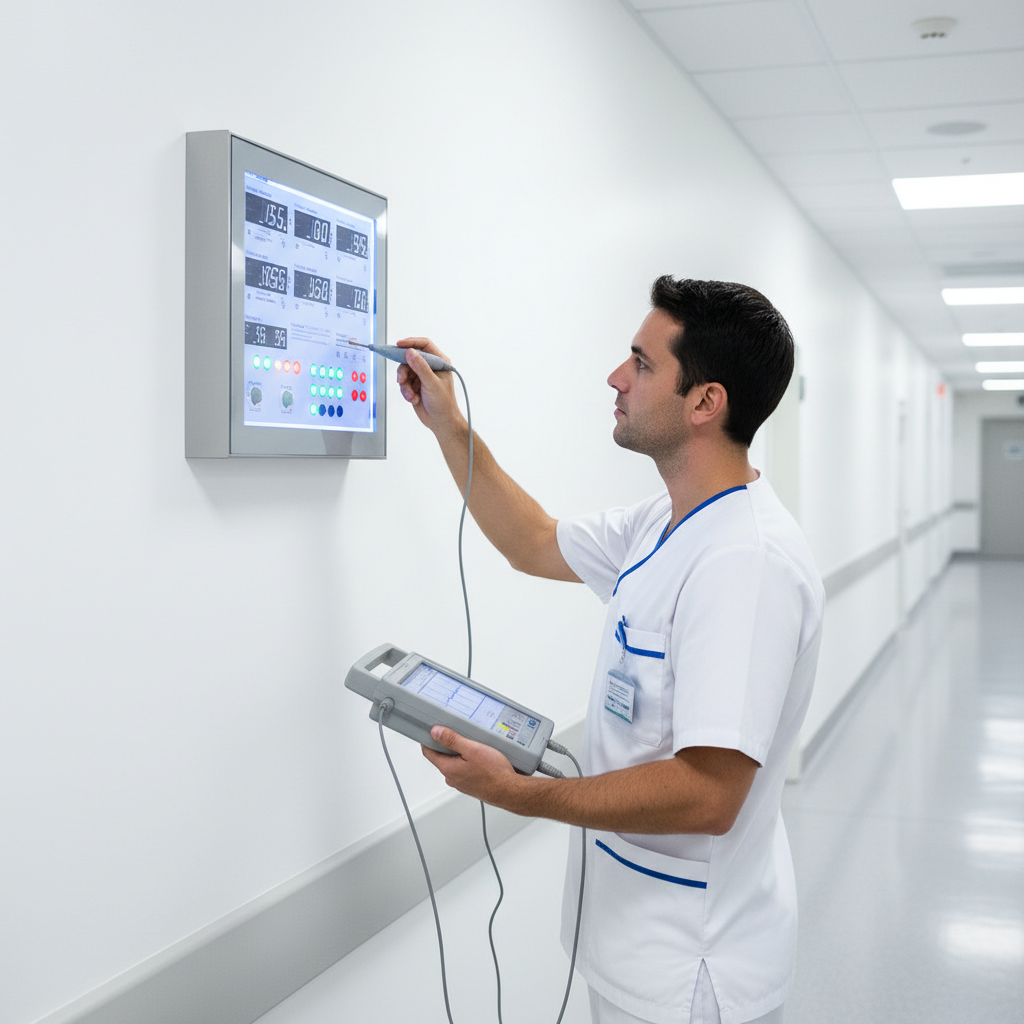
Master alarm panels are the central nervous system of any Category 1 or Category 2 piped medical gas pipeline system. When an oxygen bulk tank drops below critical reserves, a medical air compressor experiences high discharge temperature, or pipeline line pressure drifts outside safe operational bounds, hospital clinical and engineering teams depend entirely on immediate, unambiguous annunciation. In coastal South Florida healthcare environments, ranging from regional hospitals and outpatient surgical suites to freestanding emergency centers across Palm Beach County, flawless alarm performance is not just a best practice; it is an unyielding life safety mandate.
This guide provides facility directors, biomedical teams, and healthcare compliance officers with an exhaustive overview of master alarm panel testing in Boynton Beach, FL. You will examine the strict mandates of NFPA 99 Health Care Facilities Code, explore practical testing protocols across primary industry manufacturers (including BeaconMedaes, Amico, and Tri-Tech Medical), evaluate modern retrofits versus physical rebuilds, and learn how certified annual medical gas inspections protect patient safety and preserve regulatory accreditation.
1. NFPA 99 Mandates for Master Alarm Systems
The National Fire Protection Association establishes uncompromising criteria for piped medical gas alarm networks under NFPA 99 (Health Care Facilities Code), primarily articulated within Chapter 5 (Gas and Vacuum Systems). Healthcare facilities operating Category 1 piped distribution networks must maintain two independent master alarm systems positioned in separate, continually monitored locations.
Under NFPA 99 Section 5.1.9.2, master alarm panels monitor all central supply sources, pressure variations, and vital pipeline conditions. The standard enforces two separate physical monitoring points:
- Primary Clinical Surveillance Area: Typically situated within a constantly attended nurse station, emergency department intake console, or hospital communications dispatch center.
- Facility Operations/Engineering Surveillance Area: Situated in the main engineering control office, boiler plant watch station, or mechanical maintenance control hub.
| Diagram text |
|, |
| NFPA 99 Master Alarm Dual-Location Mandate |
| Location 1: Continuous Clinical Oversight |
| - 24/7 Telephone switchboard, main nursing console, or ED desk |
| Location 2: Central Facility Engineering |
| - Main mechanical office, central power plant, or BMS control |
| *Both panels must receive discrete signals over independent, |
| monitored wiring harnesses; shared circuits are non-compliant. |
Mandated Signals for Category 1 Systems
NFPA 99 Table 5.1.9.2.1 dictates explicit source monitoring inputs that must trigger an audible and visual signal at both master alarm panels:
- Bulk Cryogenic Liquid Systems (Oxygen, Nitrogen, Argon):
- Reserve in use (system operating on secondary source)
- Reserve contents low (less than an average day's supply remaining)
- Reserve failure or secondary liquid container low
- Liquid level low in primary supply vessel
- Medical Air Compressor Systems:
- High discharge air temperature (individual compressor alarm)
- Medical air dew point high (exceeding +2°C / +35°F at 50-55 psig)
- Carbon monoxide (CO) level high (exceeding 10 ppm)
- Compressor backup unit running (loss of operational reserve)
- Medical-Surgical Vacuum and WAGD Producers:
- Vacuum pump backup unit running (loss of operational reserve)
- Pipeline pressure deviations (±20% variance from nominal working pressure)
- High-Pressure Cylinder Manifolds:
- Changeover to secondary cylinder bank
- Secondary bank low / depleted reserve
Why this matters for compliance: The Joint Commission (TJC), DNV-GL, and the Florida Agency for Health Care Administration (AHCA) treat master alarm panel discrepancies as immediate life-safety citations. Failure to produce verifiable, timestamped documentation showing that each distinct sensor contact actually actuated the panel can result in Condition-Level Deficiencies during an unannounced survey.
2. Master Alarm Panels vs. Area Alarm Panels: Critical Distinctions
While master panels supervise the macro-level health of bulk sources and main line headers, area alarm panels protect compartmentalized clinical zones. Understanding the structural and functional divergence between these two tiers is vital when coordinating diagnostic testing.
| Diagram text |
|, |
| Source vs. Zone Monitoring |
| CENTRAL SUPPLY SOURCES (Bulk O2, Med Air, Vac, Manifolds) |
| ▼ |
| [ MASTER ALARM PANELS (2 Locations) ] |
| Supervises bulk volume, dew point, backup run, CO |
| Main Distribution Risers & Lateral Piping |
| ▼ |
| [ AREA ALARM PANELS (Local Zones) ] |
| Operating Rooms, Critical Care, Med-Surg Corridors |
| Supervises localized pressure swings (±20%) |
Area Alarm Systems (NFPA 99 Section 5.1.9.3)
Area alarms are located within direct eyesight and hearing distance of dedicated clinical staff inside specialized patient spaces. Key applications include:
- Operating Rooms (ORs) and Surgical Suites: Monitored outside or immediately inside the sterile perimeter.
- Intensive Care Units (ICUs, NICUs, PICUs): Positioned at dedicated staff consoles.
- Anesthetizing Locations: Supervised with independent digital readouts displaying pressure drops or surges exceeding ±20% of standard baseline operating pressure.
Master alarms, by contrast, monitor bulk source mechanics and main riser switchgear. Where an area alarm warns a surgical team that nitrous oxide or medical oxygen is dropping within their specific suite, the master alarm panel warns the plant operations engineer that the primary cryogenic bulk vessel has switched to vaporized emergency reserves across the entire campus.
Both systems require annual physical actuation under comprehensive medical gas testing and maintenance services to ensure complete downstream and upstream system integrity.
3. Leading Master Alarm Brands in South Florida Facilities
Healthcare facilities throughout Boynton Beach, Delray Beach, and the greater Palm Beach region utilize legacy and modern master panels across three premier medical gas manufacturers: BeaconMedaes, Amico Corporation, and Tri-Tech Medical. Each manufacturer employs proprietary board architectures, signal isolation modules, and field-transducer configurations.
| Diagram text |
|, |
| Major Master Alarm Platform Architecture |
| BeaconMedaes Amico Corporation Tri-Tech Medical |
| TotalAlert Infinity Alert-2 / D-Master Genesis Matrix / MegaView |
| - LonWorks / BACnet - Modular slide-in - Microprocessor boards |
| - High-res graphics - Hardwire dry ctc - Circuit-isolated logic |
| - Ethernet native - Color-coded LEDs - Direct BMS integration |
BeaconMedaes (TotalAlert, TotalAlert Infinity, MegaSys)
BeaconMedaes master systems are deeply entrenched in regional hospital systems.
- Key Architecture: Modern TotalAlert Infinity platforms utilize LonWorks and native BACnet IP or Ethernet infrastructure.
- Diagnostics: Touchscreen LCD graphical user interfaces display direct sensor telemetry, signal status, and historical data logs.
- Diagnostic Challenge: Sensor communications rely on digital network boards where moisture, transient electrical spikes, or oxidation on ribbon connectors can cause intermittent comms failures that mimic source equipment breakdowns.
Amico Corporation (Alert-2 Series, Master Digital Panels)
Amico remains an industry standard across private ambulatory surgical centers and hospital towers alike.
- Key Architecture: Amico Alert-2 configurations use modular, slide-in alarm modules featuring illuminated LED indicators and discrete tone generators.
- Diagnostics: Uses direct dry-contact relay closures paired with addressable microprocessor circuits.
- Diagnostic Challenge: Field technicians frequently encounter degraded power supply units (PSUs), broken tactile mute switches, and dry solder joints on legacy analog motherboards that trigger erroneous "System Fault" lights.
Tri-Tech Medical (Genesis Series, Matrix Panels)
Widely specified in new commercial builds and outpatient surgery suites.
- Key Architecture: Tri-Tech systems incorporate surface-mount microprocessor boards with clear digital pressure and state readouts.
- Diagnostics: Offers straightforward board swaps, robust dry-contact signal wiring terminal blocks, and straightforward integration with building automation systems (BAS).
- Diagnostic Challenge: Improper field loop resistance or failing 4-20mA transducer grounds will trigger erratic warning signals that require step-by-step diagnostic verification by an ASSE 6030 certified technician.
4. Step-by-Step Master Alarm Testing Protocol (NFPA 99 / ASSE 6030)
Simulating an alarm condition by merely pressing the "Test" button on the front of an alarm panel is one of the most dangerous and common shortcuts taken by unqualified personnel.
Important Code Note: NFPA 99 Section 5.1.14 explicitly requires that alarm signals be tested by actual physical activation of the field sensor, pressure switch, or dry contact. Pressing a panel-front lamp test button verifies only the LEDs and audible beeper, it does not verify the sensor wiring, field pressure switch, line continuity, or transducer responsiveness.
| Diagram text |
|, |
| Step-by-Step Master Alarm Field Testing Sequence |
| 1. Survey notification & AHU/BAS bypass coordination |
| 2. Calibrated digital test gauge installation at field sensors |
| 3. Controlled pressure bleeding / high-pressure gas introduction |
| 4. Verification of exact trip point (+/-20% tolerance) |
| 5. Timestamped cross-check of dual panel annunciations |
| 6. Visual inspection of circuit boards, terminal lugs, and wiring |
| 7. Complete loop restoration and ASSE 6030 compliance sign-off |
Executing an ASSE 6030 compliant physical test requires systematic, controlled procedures:
Step 1: Pre-Testing Operational Coordination
Before testing initiates, the ASSE 6030 testing specialist coordinates with the facility watch engineer and informs clinical dispatch personnel that master alarm panel testing is commencing. When alarm outputs are integrated into building management systems (BMS), those data points must be isolated to prevent unwarranted municipal emergency dispatches.
Step 2: Source Sensor Actuation (Liquid Oxygen & Manifolds)
To test bulk liquid reserve alarms, technicians isolate the sensing switch and vent or cycle the differential switch mechanism, proving that:
- The primary level indicator registers an amber/red alarm state when reaching designated minimum capacity.
- The automatic reserve switchover relay reliably initiates audible and visual indicators on both panels within the facility.
- Manifold secondary bank depletion switches actuate their respective dedicated indicator light without cross-talking into general source alarms.
Step 3: Mechanical Plant Simulation (Air & Vacuum)
- Medical Air Dew Point: A dry nitrogen zero-gas or calibration baseline gas tests the probe. The test verifies that dew point levels rising above +2°C (+35°F) at 50 psig trip the panel alarm instantly.
- Carbon Monoxide (CO): A certified canister of 10-15 ppm CO balance air is injected across the sensor intake cell to trigger the CO visual and audible warning at the mandated 10 ppm ceiling.
- High Discharge Temperature: Thermocouple circuit inputs are checked to ensure thermal over-temp switches actuate panel indicators before motor winding or pump head damage occurs.
- Vacuum Switch Actuation: The isolation valve on the vacuum sensor manifold is cracked or manually drawn down to verify that line pressures degrading past 12 in-Hg switch the alarm from green to flashing red.
Step 4: Independent Wiring & Transmission Verification
The ASSE 6030 inspector physically disconnects one communication conductor inside the field sensor harness. The panel must immediately report an open-circuit / wiring-fault trouble signal. This step proves that the circuit is supervised in accordance with NFPA 99 Section 5.1.9.2.3.
Step 5: Dual Annunciation and Mute Cross-Check
While the audible alarm sounds, the technician confirms:
- Both master panels illuminate simultaneously.
- The audible alarm decibel output measures within appropriate operational ranges (typically >80 dBA at 10 feet).
- Engaging the "Mute" or "Silence" button mutes only the audio component while leaving the visual LED illuminated.
- If a second, distinct alarm condition trips while the first is silenced, the audible warning re-sounds immediately.
5. Master Alarm Manufacturer Comparison Matrix
When assessing existing infrastructure or planning a facility upgrade, healthcare facility directors must balance backwards compatibility, network integration, and spare part availability.
| Specification Feature | BeaconMedaes TotalAlert Infinity | Amico Alert-2 Digital Series | Tri-Tech Medical Genesis Matrix |
|---|
| Communication Protocol | Ethernet, BACnet IP, LonWorks | Modbus, BACnet, Dry Contact | BACnet MSTP/IP, Modbus, Dry Contact |
| Display Technology | High-Res Color Touchscreen | Segmented LED + Text Modules | Backlit LCD / Digital LED Modules |
| Input Signal Types | 4-20mA, Dry Contact, Digital Comms | Direct Dry Contact, Transducers | 4-20mA Analog, Dry Contact Relays |
| Retrofit Ease (Upgrading) | Moderate (Requires mounting plate) | High (Direct fit into older back-boxes) | High (Flexible channel modules) |
| Field Transducer Calibration | Software-driven digital offset | Potentiometer / Board jumper | Digital menu push-button offset |
| NFPA 99 (2012–2024) Ready | Yes | Yes | Yes |
| Typical Life Expectancy | 12–15 Years | 10–14 Years | 12–15 Years |
Modernizing legacy infrastructure often requires retrofitting newer panels into older rough-in back-boxes without cutting dry-wall in clean environments. Selecting manufacturers with purpose-built retrofit trim rings and universal back-plates drastically reduces total installation time.
6. Common Master Alarm Failure Modes in Boynton Beach Facilities
Operating healthcare facilities in Palm Beach County presents specific physical and environmental challenges that degrade medical gas electronics over time. During diagnostic testing across Boynton Beach healthcare facilities, Medical Testing Solutions frequently resolves several predictable failure points:
| Diagram text |
|, |
| Top Master Alarm Failure Modes in South Florida |
| 1. High Humidity & Saline Air Corrosion |
| - Accelerates galvanic corrosion on terminal blocks & ribbons |
| 2. Transient Surge Damage (Lightning Capitol) |
| - Tropical storms induce voltage spikes via exterior wiring |
| 3. Degraded Backup Batteries & Failing Power Supplies |
| - Unfiltered ripple voltage destabilizes microprocessor logic |
| 4. Uncalibrated or Drifting Transducers |
| - Chronic false alarms caused by out-of-spec 4-20mA sensors |
| 5. Unsupervised Splices & Abandoned Wiring Loops |
| - Inadvertent parallel wiring runs that violate NFPA 99 isolation |
High Ambient Humidity and Coastal Corrosion
Boynton Beach sits alongside the Atlantic coastline. High relative ambient humidity combined with airborne marine salts accelerates galvanic corrosion across copper terminal blocks, board traces, and multi-pin ribbon cables. Micro-corrosion creates elevated loop resistance, generating phantom high-pressure or switchover warnings.
Severe Weather and Transient Lightning Surges
Central and South Florida experience some of the highest lightning strike densities in North America. Voltage transients induced across outdoor conduit runs, such as sensor wiring routed to bulk liquid oxygen pads or rooftop cooling manifolds, frequently knock out sensitive analog input circuit boards and fuse modules. Integrating dedicated surge protective devices (SPDs) compliant with NFPA 70 at the master panel input terminals is an essential mitigation measure.
Failing DC Power Supplies and Battery Backup Failure
Master alarms run on low-voltage direct current (typically 12V or 24V DC) supported by transformer power supply units (PSUs) and rechargeable sealed lead-acid or nickel-cadmium batteries. As power supplies age past year seven, internal capacitor leakage creates unfiltered AC ripple voltage. This electrical noise destabilizes onboard microprocessors, leading to random system lockups, unprompted audio chimes, and false system faults.
Out-of-Calibration Transducers
Pressure transducers and dew point sensors drift over time. A transducer sensing medical surgical vacuum that has drifted by just 3 in-Hg will fail to sound during a true system drop or, conversely, continuously alarm under normal operation, desensitizing nursing staff through alarm fatigue.
7. Retrofitting vs. Replacement: Strategic Options for Facility Directors
When a master alarm panel begins failing diagnostics, facility executives face a critical operational decision: attempt a component-level rebuild of the legacy board, or execute a planned system retrofit?
| Diagram text |
|, |
| Master Alarm Replacement Decision Matrix |
| Is the current system over 12 years old? |
| ├── YES ──> RETROFIT / FULL REPLACEMENT RECOMMENDED |
| - Sourcing legacy chips is costly and unreliable |
| - Modern BACnet/BMS networking required for AHCA |
| └── NO ──> EVALUATE COMPONENT REPAIR |
| - Are replacement motherboards available? |
| - Does the panel accept direct drop-in modules? |
| Are false alarms creating clinical disruption / alarm fatigue? |
| └── YES ──> REPLACE TRANSDUCERS & RETROFIT MOTHERBOARD |
The Pitfalls of Legacy Patchwork Repairs
Sourcing obsolete circuit boards from secondary brokers creates major regulatory liabilities. If a non-OEM or unauthorized repaired board fails during a clinical emergency, the facility is exposed to significant malpractice and compliance risk. Furthermore, older analog panels lack the communication protocols necessary to interface with modern Building Management Systems (BMS).
The Modern Retrofit Alternative
Leading manufacturers now engineer specialized retrofit modules. These kits permit an ASSE 6010 installer to remove the obsolete internal chassis of an old BeaconMedaes, Ohmeda, or Puritan Bennett panel while retaining the existing recessed back-box in the wall.
- Zero Drywall Cutting: Eliminates hazardous dust containment partitions in clinical zones.
- Rapid Cutover: Minimizes downtime of source alarm surveillance to a matter of hours instead of days.
- Modern Features: Delivers native BACnet data streaming, live digital pressure graphs, and automated internal data logging.
When planning a system replacement or line overhaul, facility teams engage certified specialists for medical gas installation (ASSE 6010) to protect structural piping, followed immediately by formal medical gas verification (ASSE 6030) before re-energizing patient gas lines.
8. Clinical and Surgical Considerations: Line Isolation and Wet Locations
In specialized clinical wings monitored by area alarms, such as operating rooms, cardiac catheterization labs, and emergency surgical suites, medical gas pipelines intersect directly with complex electrical infrastructure.
Why this matters for compliance: Under NFPA 99 Section 6.3.2.6, wet procedure locations require specialized power protections, including isolated power systems and continuous line isolation monitors. During comprehensive facility testing, medical gas integrity, vacuum levels, and electrical leakage isolation must be verified simultaneously to guarantee surgeon and patient safety during invasive procedures.
Faulty alarm grounds or cross-wired DC transducer lines running through shared conduits can introduce stray voltage into hospital grounding networks. Our certified engineers frequently perform concurrent line isolation monitor (LIM) testing alongside medical gas panel recertifications to ensure that isolated power circuits within the operating room perimeter maintain total dielectric resistance and zero leakage current.
9. Boynton Beach Healthcare Facility Checklist
Facility engineers in Boynton Beach must maintain comprehensive proof of compliance to satisfy AHCA, CMS, and accreditation surveyors. Below is an essential operational checklist to prepare your facility for its next survey cycle:
10. Why Partner with Medical Testing Solutions (MTS)?
Medical Testing Solutions (MTS) is South Florida’s recognized leader in complete medical gas lifecycle management. Headquartered in Fort Lauderdale, MTS delivers rapid-response, certified service across Boynton Beach, Boca Raton, West Palm Beach, and surrounding municipalities.
| Diagram text |
|, |
| Medical Testing Solutions (MTS) Advantage |
| ✓ ASSE 6030 Verifiers & ASSE 6010 Installers on Staff |
| ✓ Direct Equipment Sales: BeaconMedaes, Amico, Tri-Tech |
| ✓ Turnkey Upgrades: From Back-Box Retrofits to BMS Integration |
| ✓ Full Regulatory Audit Defense (AHCA, TJC, DNV, CMS) |
| ✓ NIST-Traceable Calibrated Precision Test Equipment |
Complete Medical Gas Authority
Medical Testing Solutions provides far more than superficial pass/fail checklists. We maintain an elite technical staff possessing deep expertise in:
- Turnkey Equipment Sales & Distribution: Through our extensive medical gas products catalog, we supply OEM panels, digital transducers, switches, manifold components, and replacement power supplies from BeaconMedaes, Amico, and Tri-Tech Medical.
- Full-Scale Compliance Testing: We perform accredited medical gas certification and annual inspections that withstand the scrutiny of AHCA, The Joint Commission, and municipal fire marshals.
- Certified Field Remediation: If an alarm fails testing, our crew identifies the root cause on-site, re-terminating corroded loops, calibrating drifting sensors, or replacing failing power supply modules without prolonged administrative delays.
Secure Your Medical Gas Compliance Today
Faulty master alarms put clinical operations, accreditation standings, and patient lives at risk. Whether you need an urgent troubleshooting service call, mandatory annual ASSE 6030 verification, or a comprehensive panel retrofit in Boynton Beach or across Palm Beach County, Medical Testing Solutions delivers prompt, certified field excellence.