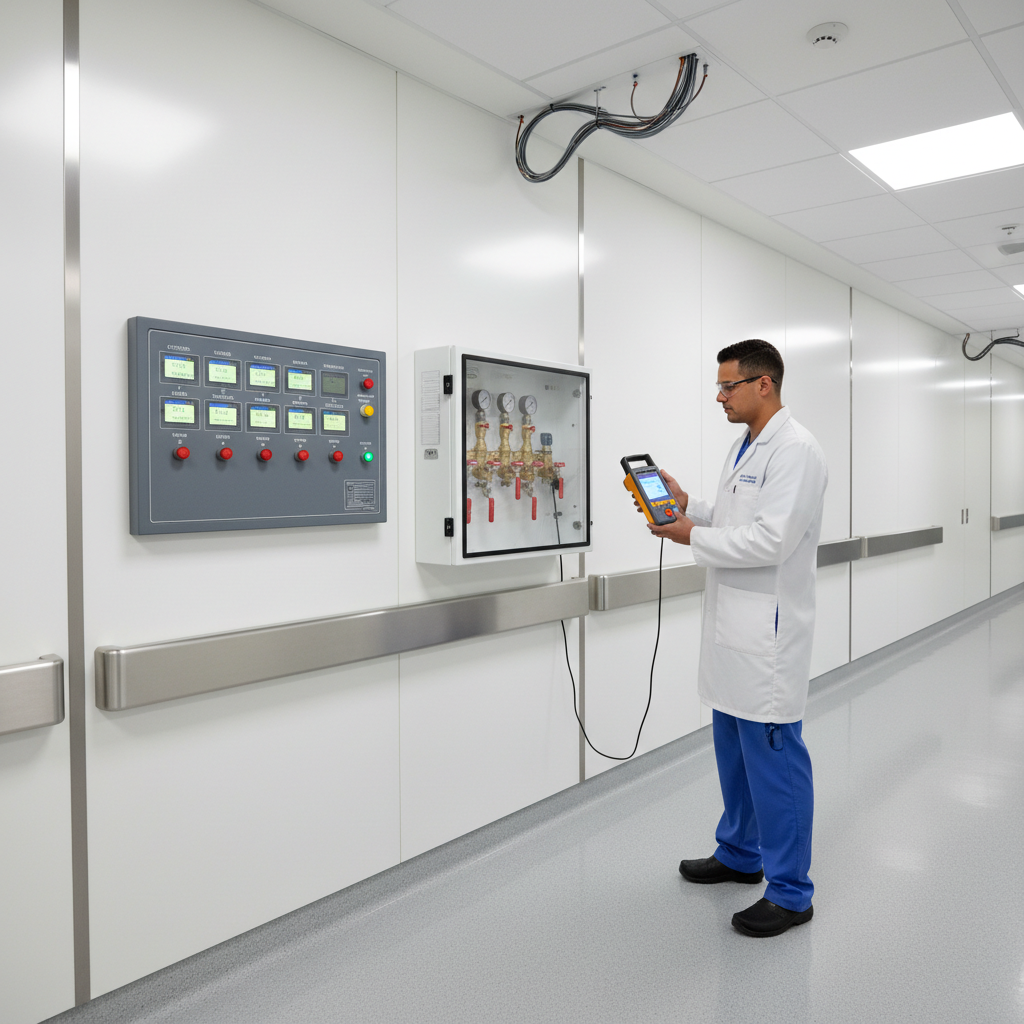
Master Alarm Panel Testing in Aventura, FL: NFPA 99 Guide
Master and area alarm panels serve as the primary early-warning defense for clinical gas delivery networks. In acute care centers, surgical suites, and outpatient facilities throughout Aventura, Florida, these life-safety monitors track bulk liquid oxygen levels, medical air compressor dew points, surgical vacuum pressure thresholds, and pipeline line pressures. A silent sensor failure, uncalibrated pressure transducer, or severed alarm wiring loop can jeopardize patient safety before surgical or nursing teams notice a clinical drop in pipeline supply.
This comprehensive guide breaks down the engineering requirements, regulatory standards, and field inspection protocols for master and area alarm panel testing in Aventura, FL. You will learn the exact testing frequencies mandated by NFPA 99 (Health Care Facilities Code), the critical functional differences between master and area panels, how to manage field retrofits across leading manufacturers like BeaconMedaes, Amico, and Tri-Tech Medical, and what ASSE-certified inspectors document during annual life-safety surveys.
The Critical Role of Medical Gas Alarm Systems in Clinical Facilities
Medical gas pipeline systems (MGPS) operate under continuous pressure or vacuum to support life-critical patient interventions. Whether supplying oxygen to a critical care ventilator, nitrous oxide to an ambulatory surgical center operating room, or high-volume suction to a trauma bay, these piped gases rely on zero-fail infrastructure. Master and area alarm panels monitor these variables 24 hours a day, 365 days a year.
NFPA 99 categorizes healthcare infrastructure into risk categories ranging from Category 1 (facilities where system failure can cause major injury or death) down to Category 4. Aventura hospitals, specialty surgical clinics, and high-acuity outpatient centers almost universally operate Category 1 or Category 2 piped gas networks. Within these facilities, alarm panels alert engineering staff to source equipment disruptions and inform clinical teams when line pressure fluctuates beyond operational limits.
Why this matters for compliance: AHCA (Florida Agency for Health Care Administration), CMS, and The Joint Commission scrutinize life-safety documentation during unannounced surveys. An untested, bypassed, or improperly labeled alarm panel is classified as an immediate life-safety deficiency under NFPA 99 Section 5.1.14.2.
NFPA 99 Code Requirements for Master vs. Area Alarm Panels
Understanding the technical mandates of NFPA 99 Chapter 5 is essential for healthcare facility directors and biomedical engineering personnel. The code establishes precise physical locations, operational parameters, and signal redundancies for master versus area alarm systems.
| Diagram text |
|, |
| HEALTHCARE GAS ALARM TOPOLOGY |
| [ BULK O2 / COMPRESSORS / VACUUM PUMPS / MANIFOLDS ] |
| v v |
| [ MASTER ALARM PANEL 1 ] [ MASTER ALARM PANEL 2 ] |
| Location: Engineering / BMS Location: 24/7 Monitored Station |
| Function: Central Plant Status Function: Source & Header Redund. |
| ===================== DISTRIBUTION PIPELINE ======================== |
| v v |
| [ ZONE VALVE BOX + AREA ALARM ] [ ZONE VALVE BOX + AREA ALARM ] |
| Location: ICU / Critical Care Location: Surgical Suites / OR |
| Function: Local Line Pressure Function: +/- 20% Pressure Drift |
Master Alarm Panels (NFPA 99 Section 5.1.9.2)
Category 1 facilities must maintain at least two master alarm panels connected to independent electrical branch circuits supplied by the emergency electrical system (critical branch).
- Dual Locations: One panel must be located in the office or workspace of the facility’s mechanical maintenance director or engineering control room. The second panel must be placed in a continuously monitored 24-hour location, such as central nurse dispatch, PBX telephone switchboard, security command, or emergency department reception.
- Dedicated Signals: Under NFPA 99 Section 5.1.9.2.3, each master alarm panel must display separate, non-aggregated visual indicators and audible alarms for specific central supply events. These include bulk cryogenic liquid level alarms, reserve cylinder header bank switches, medical air high dew point conditions, hydrocarbon trip events, and vacuum pump lag operations.
- Audible and Visual Annunciation: Master alarms must utilize distinct visual indicators (historically illuminated panels or modern digital LCD/OLED screens) paired with an audible tone rated at not less than 80 dBA at 3 feet. The system must feature an audible cancel button that silences the acoustic alarm while keeping the visual fault actively illuminated until the source fault is resolved.
Area Alarm Panels (NFPA 99 Section 5.1.9.3)
While master panels supervise the central mechanical and manifold rooms, area alarms monitor local pipeline conditions downstream of zone valve boxes.
- Strategic Placement: Area alarms must be positioned at nurses' stations or work centers directly serving patient treatment spaces. They are mandatory for critical care areas (ICUs, CCUs, PICUs), surgical suites, recovery rooms, emergency treatment bays, and anesthetizing locations.
- Pressure and Vacuum Limits: Area alarms monitor individual pipeline pressures. Under NFPA 99 Section 5.1.9.3.4, an alarm must trigger immediately whenever working gas line pressure drifts ±20 percent from normal system operating pressure (e.g., a drop below 40 psig or surge above 60 psig on a standard 50 psig medical oxygen or medical air line). For medical surgical vacuum, an alarm must actuate when vacuum levels decline to or below 12 inches of mercury (inHg).
- Zone Correlation: Every area alarm panel must physically correlate with the specific shutoff valves located within the adjacent zone valve box. If a zone valve box is pulled to isolate Operating Room 4, the corresponding area alarm must reflect the pressure decay for that room immediately.
To verify that piping, zone valves, and pressure switches align with the original architectural engineering specs, facilities schedule periodic medical gas verification services following ASSE 6030 protocols.
Step-by-Step Master Alarm Panel Testing Methodology (ASSE 6040/6030)
Physical inspection and electronic testing of alarm networks require specialized instrumentation and certified technicians. Testing cannot be completed by simply pressing the "push-to-test" lamp button on the front fascia. The lamp test only confirms LED or bulb continuity; it does not test pressure transducers, micro-switches, dry contacts, or signal relays.
At Medical Testing Solutions, our ASSE 6040 maintenance technicians and ASSE 6030 verifiers execute functional end-to-end signal testing using calibrated pneumatic simulators and high-precision digital gauges. Routine testing is typically incorporated into comprehensive annual medical gas inspections to ensure total facility compliance.
1. Pre-Testing Clinical Coordination and Redundancy Review
Before conducting master or area alarm panel testing in an active Aventura clinical facility:
- Coordinate with the clinical nursing supervisor and central plant engineering.
- Identify the secondary 24-hour monitoring station to ensure security or dispatch personnel do not silence or ignore legitimate facility alerts during testing.
- Review facility as-built piping and instrumentation diagrams (P&IDs).
2. Central Plant Source Equipment Signal Actuation
Master alarm signals originate at dry-contact pressure switches, differential pressure sensors, and equipment control transformers located in central utility spaces. Technicians test each discrete sensor:
- Bulk Cryogenic Liquid Level: Simulate low-liquid alarms via liquid level sensor transmitters to confirm that the master alarm triggers at the predetermined emergency reserve threshold.
- Manifold Reserve In-Use & Depletion: Vent the secondary and reserve cylinder banks using calibrated bleed ports to confirm that high-pressure manifold switches send distinct "Reserve In Use" and "Reserve Low" signals to both master panels simultaneously.
- Medical Air Compressors & Dryers: Bleed pressure to verify lag compressor cut-in signaling. Test carbon monoxide (CO) gas monitors using certified span gas to verify high CO concentration (>10 ppm) alarms. Sample line moisture to confirm high dew point warnings (>32°F / 0°C at 50 psig).
- Medical Surgical Vacuum: Throttle the central inlet manifold to verify minimum vacuum thresholds and ensure alternating pump lag alarms actuate when base pumps cannot maintain demand.
3. Area Alarm Transducer Calibration & Physical Pressure Drop Testing
For area alarms serving surgical suites and intensive care units:
- Connect an oil-free, calibrated digital test gauge with needle bleed assembly to the diagnostic DISS demand check port located on the sensor module.
- Slowly vent line pressure to determine the exact activation point of the low-pressure condition. Ensure the alarm annunciates at precisely 20% below standard working pressure (e.g., 40 psig for 50 psig gases; 128 psig for 160 psig instrument air).
- Introduce compressed oil-free nitrogen via the test assembly to confirm that high-pressure alarms trigger at precisely 20% above nominal line pressure (e.g., 60 psig for 50 psig systems).
- Measure vacuum drop using a negative-pressure test kit to confirm the visual and audible alarm fires at 12 inHg.
- Verify that muting switches function properly: silencing the acoustic horn must keep the visual status LED flashing or solid red until line pressure normalizes.
4. Wiring Continuity and Circuit Supervision
Under NFPA 99 Section 5.1.9.2.4, all alarm signal wiring must be supervised. Disconnecting or cutting a signal wire must trigger an audible and visual fault signal at the panel rather than silently disabling the alarm point. Technicians test fault supervision by disconnecting terminal blocks to confirm line-break detection.
| Diagram text |
|, |
| ALARM FAULT DETECTION WORKFLOW |
| Normal Operation: Closed Loop Circuit (Supervised Voltage Present) |
| Event A: Sensor Tripped -> Resistance Drops -> AUDIBLE/VISUAL ALARM |
| Event B: Wire Severed / Sensor Fails -> Circuit Opens |
| -> FAULT/TROUBLE ALARM (Audible + Visual Indication) |
Brand Comparison: BeaconMedaes, Amico, and Tri-Tech Medical
When replacing outdated analog annunciators or expanding clinical facilities in South Florida, choosing the right manufacturer determines operational reliability, Ethernet protocol compatibility, and ease of maintenance. Medical Testing Solutions sells, installs, and commissions systems across the three leading American medical gas manufacturers.
| Feature / Specification | BeaconMedaes (MegaSystem / MedTouch) | Amico (Alert-2 / Mirage Series) | Tri-Tech Medical (Vision-1 / Gen-2) |
|---|
| Display Technology | Color Touchscreen LCD (Ethernet-Ready) | High-Resolution Digital LED / LCD | Color Touchscreen LCD with Trend Graphing |
| Signal Capacity | Up to 60 points per panel assembly | Up to 64 points per master unit | Up to 128 points modular architecture |
| Communication Protocol | BACnet IP / Modbus / Dual Ethernet | BACnet MS/TP, BACnet IP, Ethernet | BACnet IP, Modbus RTU, Ethernet Web |
| Sensor Architecture | DISS Digital Pressure Sensor Modules | Microprocessor Compact Transducers | Compact Transducers with Internal Memory |
| Retrofit Versatility | High (Fits into existing legacy backboxes) | High (Direct-fit conversion plates available) | Exceptional (Universal conversion kits) |
| NFPA 99 Edition Compliance | NFPA 99 (2012, 2015, 2018, 2021, 2024) | NFPA 99 (2012, 2015, 2018, 2021, 2024) | NFPA 99 (2012, 2015, 2018, 2021, 2024) |
| Warranty Options | 3–5 Year Component Protection | 3–5 Year Equipment Coverage | 3–5 Year System Guarantee |
BeaconMedaes Systems
BeaconMedaes MedTouch and MegaSystem panels are engineered for advanced multi-facility integration. Featuring responsive color graphic touchscreens, these systems provide historical trend graphing, event logging, and integrated web servers. They allow facility managers in Aventura to view real-time pipeline pressure metrics on mobile or desktop browsers without separate software licensing.
Amico Alert-2 & Mirage Systems
Amico Alert-2 series microprocessor alarm panels remain an industry staple across Florida hospital networks. Their straightforward modular design allows facility staff to replace individual signal boards or pressure transducers without taking entire panels offline. Amico's Mirage panels blend flush into modern clinical spaces, offering sleek aesthetics for surgical corridors alongside dependable BACnet building automation integration.
Tri-Tech Medical Vision Series
Tri-Tech Medical panels stand out for their universal retrofit capabilities. When upgrading older legacy systems (such as decommissioned Chemetron, Ohmeda, or Puritan Bennett units), Tri-Tech provides customized adapter bezels and universal backbox configurations. This eliminates the need to demolish surrounding drywall, lower acoustical ceilings, or rebuild patient-floor infrastructure.
Explore our broad array of certified components in our medical gas products catalog or consult our team to spec your replacement alarm modules.
Retrofitting Outdated Alarm Panels: Engineering & Clinical Protocols
Many surgical centers and clinical towers in the Aventura area continue to operate legacy alarm systems with incandescent bulbs, analog needle gauges, and proprietary relay circuit boards. These outdated panels frequently suffer from brittle printed circuits, hard-to-source replacement bulbs, and lack of integration with modern Building Management Systems (BMS).
Upgrading an operational master or area alarm panel requires strict coordination to avoid interrupting critical patient care:
- Temporary Monitoring Protocols: Prior to de-energizing an active area alarm, establish a formal temporary life-safety procedure under NFPA 99 Section 5.1.14.1.2. Dedicated medical gas personnel must be stationed at zone valve assemblies with calibrated hand gauges, or digital telemetry monitors must be deployed to track gas pressures during the cutover window.
- Preserving Existing Structural Backboxes: Demolishing drywall inside clean surgical suites or active ICUs incurs severe dust containment, infection control risk assessment (ICRA), and negative-air machine expenses. Modern replacement panels from Amico, BeaconMedaes, and Tri-Tech feature front-loaded conversion frames designed specifically to anchor into existing backboxes without opening surrounding walls.
- Sensor Wire Interconnection: Legacy panels typically ran 18-gauge to 22-gauge multi-conductor cabling back to central manifold relays. Upgrading to digital panels allows technicians to reuse existing raceway conduits. They can convert legacy multi-pair wiring into digital RS-485 serial communication loops or twisted-pair Ethernet cables.
- Post-Conversion ASSE 6030 Verification: After installing new alarm panels, an independent ASSE 6030 certified verifier must execute complete system certification. This includes cross-connection checks, alarm actuation verifications, electrical grounding isolation tests, and labeling audits before returning the system to service.
When facility infrastructure projects require pipeline brazing or physical valve installations, our licensed field specialists execute end-to-end medical gas installation and mechanical tie-ins.
Common Alarm Failure Modes Identified During Aventura Inspections
Annual audits and preventive inspections across North Miami-Dade County regularly uncover preventable mechanical and electronic faults within medical gas alarm networks. Addressing these issues early prevents emergency clinical shutoffs and Joint Commission audit citations.
| Diagram text |
|, |
| TOP ALARM PANEL FIELD DEFICIENCIES |
| [32%] Transducer Drift (Uncalibrated, triggers outside +/- 20% limit) |
| [24%] Missing Source Signal Redundancy (Signal trips Panel 1, not 2) |
| [18%] Inaccurate Zone Labeling (Panel text doesn't match valve box) |
| [14%] Burned Out Indicators / Non-Supervised Wiring Faults |
| [12%] Physical Obstruction (Furniture/Carts blocking 24/7 view) |
1. Transducer Calibration Drift
Over years of continuous operation, piezo-resistive pressure transducers experience electronic drift. A transducer calibrated for a 50 psig oxygen line may not actuate its low-pressure alarm until pressure falls to 32 psig (a 36% drop), rather than at the code-mandated 40 psig threshold (a 20% drop). Annual recalibration using traceable pneumatic test standards is required to maintain sensor accuracy.
2. Disrupted Master Alarm Signal Redundancy
A frequent violation identified during hospital surveys is the loss of dual-master signaling. Often, a mechanical contractor connects a new bulk oxygen telemetry lead or medical air compressor fault contact to Master Alarm 1 in the facility control room, but fails to wire the corresponding relay to Master Alarm 2 at the 24-hour nursing or security dispatch station. Both panels must register independent visual and audible alerts for every code-mandated central supply parameter.
3. Inaccurate Room and Zone Labeling
Clinical floor plans evolve over time. Intensive care beds get reconfigured, procedure rooms are repurposed, and partition walls are rebuilt. However, alarm panel faceplates frequently retain outdated room numbers. Under NFPA 99, area alarm panels must accurately designate the exact rooms, surgical theaters, and bed spaces they supervise. If an alarm label says "OR 1 through OR 3," but physical pipeline renovations routed OR 3 to a separate zone, the panel fails compliance inspection.
4. Bypassed or Damaged Audio Buzzers
Nuisance alarms caused by uncalibrated transducers or minor line fluctuations sometimes lead staff to tamper with audio sounders. Inspectors periodically find acoustic horn leads disconnected, taped over, or physically damaged to silence warnings. Such modifications represent severe life-safety violations.
Beyond medical gas alarm infrastructure, operating rooms and procedural suites require complete environmental safety compliance. Facilities often bundle alarm surveys with line isolation monitor testing to validate wet-location electrical systems alongside medical gas distribution networks.
Regulatory Compliance: AHCA, The Joint Commission, and CMS Standards
Healthcare institutions in Aventura, FL must satisfy overlapping regional, state, and federal regulatory bodies. Meeting NFPA 99 requirements protects facilities during critical life-safety audits conducted by:
- The Florida Agency for Health Care Administration (AHCA): AHCA enforces Florida Building Code and NFPA 99 compliance across all licensed hospital facilities, ambulatory surgical centers, and skilled nursing homes. Any modifications to central alarm configurations require AHCA-approved engineering plan reviews and formal sign-offs from an ASSE 6030 certified verifier.
- The Joint Commission (TJC): TJC surveyors audit Environment of Care (EC) standard EC.02.05.09, which governs medical gas utility systems. Surveyors inspect historical testing logs, sensor calibration sheets, technician credentials, and alarm actuation reports.
- Centers for Medicare & Medicaid Services (CMS): CMS adopted the 2012 Edition of NFPA 99 across federal reimbursement oversight frameworks. CMS surveyors mandate strict adherence to documented maintenance intervals and traceable operational records for all Category 1 piped gas alarm circuits.
| Diagram text |
|, |
| ANNUAL INSPECTION AUDIT TRAIL CHECKLIST |
| [x] Calibration certification for digital pressure test gauges |
| [x] Master Panel 1 & 2 simultaneous signal verification sheet |
| [x] Discrete source signal trip point log (bulk, manifolds, plant) |
| [x] Area alarm +20% / -20% actuation recordings per zone |
| [x] Inspector ASSE 6040 / 6030 certification card numbers |
| [x] Deficiency resolution & re-inspection sign-off certificate |
To maintain continuous regulatory readiness, facilities implement structured medical gas maintenance services and archive all third-party inspection documentation in centralized compliance binders.
Why Partner with Medical Testing Solutions for Your Aventura Facility?
Medical Testing Solutions is an industry-leading medical gas equipment distributor and testing firm headquartered right here in South Florida (501 E Las Olas Blvd, Ste 300, Fort Lauderdale, FL). We deliver expert solutions across all facets of medical gas system reliability:
- Comprehensive ASSE Certifications: Our field specialists carry verified credentials across the ASSE 6000 standard, including ASSE 6010 Installers, ASSE 6030 Medical Gas Verifiers, ASSE 6035 Bulk Gas Verifiers, and ASSE 6040 Maintenance Personnel.
- Single-Source Equipment and Testing: Unlike third-party inspection agencies that only point out deficiencies, Medical Testing Solutions stocks replacement alarm boards, conversion plates, pressure transducers, and power supply units from Amico, BeaconMedaes, and Tri-Tech Medical. We detect, repair, and recertify faulty components during a single site visit.
- Rapid Regional Response in South Florida: Headquartered minutes north of Aventura, our technical response teams handle emergency alarm calls, retrofit consultations, and scheduled hospital life-safety inspections throughout Miami-Dade, Broward, and Palm Beach counties.
| Diagram text |
|, |
| MTS LIFE-CYCLE GAS SUPPORT |
| [ DESIGN & SALE ] → [ INSTALLATION ] → [ ASSE 6030 VERIFY ] |
| Beacon/Amico/Tri-Tech ASSE 6010 Pipework Pneumatic Testing |
| +, → [ MAINTENANCE ] →, + |
| Annual ASSE 6040 |
| Inspection & Recalibration |
Facility directors can confirm organizational credentials and system standards on our dedicated medical gas certification resource page.
Schedule Your Alarm Panel Testing & Modernization in Aventura, FL
Do not wait for an unannounced AHCA survey, Joint Commission inspection, or critical pressure failure to verify your medical gas alarm network. Medical Testing Solutions provides turnkey testing, sensor recalibration, emergency repairs, and full digital retrofits for hospitals, surgical centers, and outpatient clinics throughout Aventura and South Florida.
Call Medical Testing Solutions today at (754) 315-1078 or request a quote online to book your ASSE 6040 inspection or discuss panel replacement solutions with an ASSE-certified specialist.