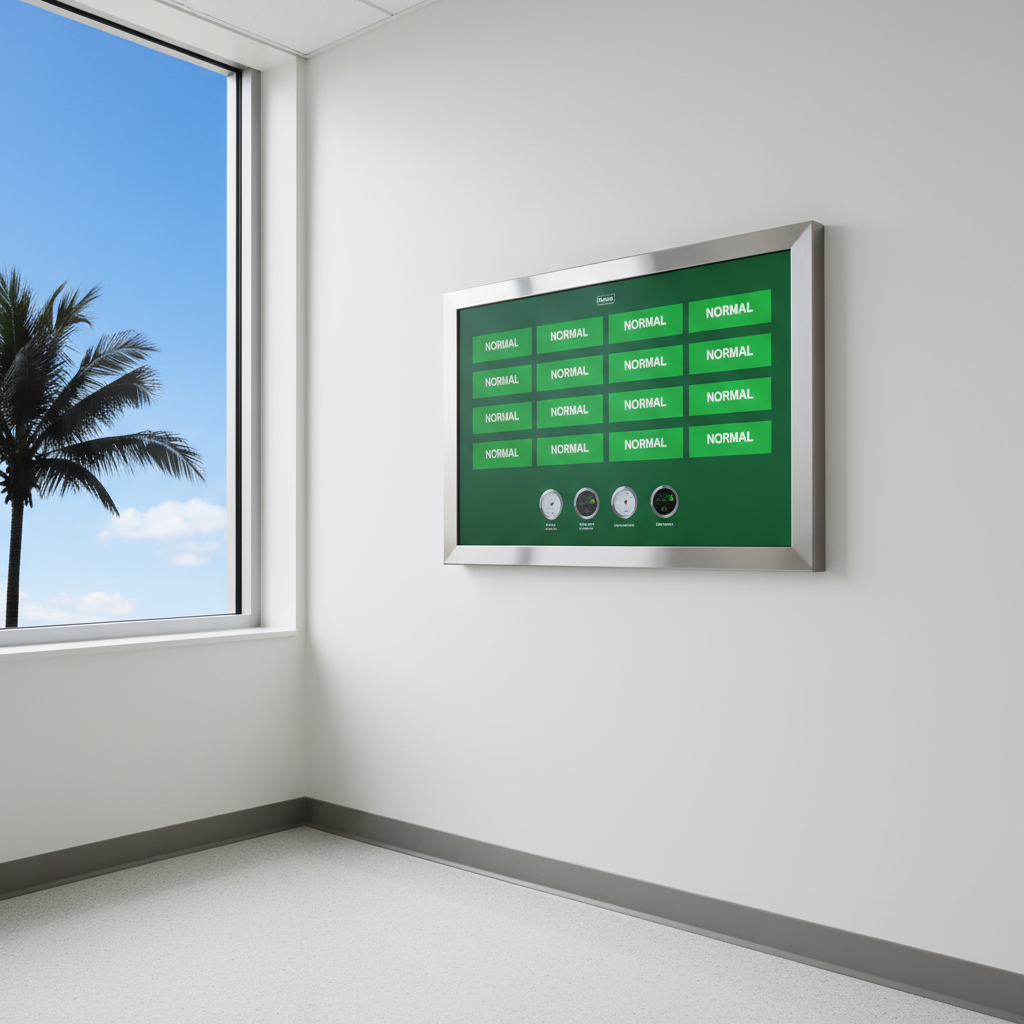
Master Alarm Panel Installation in Coral Springs: A Low-Voltage Retrofit Guide
Medical Testing SolutionsMay 29, 20268 min read
Share
Your facility's medical gas master alarm is the central nervous system of your entire life support infrastructure. It provides the critical, real-time data that facility managers and maintenance personnel need to ensure patient safety. When it fails, or as it nears its end-of-life, a swift and compliant upgrade isn't just recommended, it's essential. For hospitals and surgical centers in Coral Springs, Florida, planning a master alarm panel installation or retrofit requires a deep understanding of low-voltage systems, NFPA 99 code, and Florida-specific AHCA requirements.
This definitive guide walks you through the entire process. You will learn about the critical code requirements governing alarm installations in Broward County, the steps involved in a low-voltage retrofit, and how partnering with a local, Fort Lauderdale-based ASSE-certified company can significantly reduce costs while ensuring the highest level of compliance. We'll cover everything from initial assessment to final verification, providing the knowledge you need to manage your next project with confidence.
Why Your Coral Springs Facility Needs a Master Alarm Upgrade
Many healthcare facilities operate with systems installed decades ago. While reliable for their time, these legacy master alarms present growing risks related to aging components, compliance gaps with modern codes, and a lack of advanced monitoring features.
Aging Infrastructure and End-of-Life (EOL) Panels
Like any electronic equipment, alarm panels have a finite lifespan. Capacitors dry out, wiring becomes brittle, and replacement parts become scarce. An EOL panel is a ticking time bomb, liable to fail without warning, potentially leading to a catastrophic loss of monitoring capability during a medical gas emergency. Proactively retrofitting an aging system is a cornerstone of responsible facility management.
Evolving NFPA 99, TJC, and AHCA Standards
NFPA 99, the foundational code for healthcare facilities, is updated every three years. Modern editions contain specific requirements for alarm signaling, placement, and functionality that older panels may not meet. During annual inspections, The Joint Commission (TJC) and the Florida Agency for Health Care Administration (AHCA) surveyors are laser-focused on compliance. An outdated alarm system is a common, and easily avoidable, citation that can jeopardize accreditation.
The Benefits of Modern Digital vs. Analog Alarms
Modern digital master alarms offer significant advantages over their analog predecessors. They provide clearer, more specific real-time data on line pressure, source status, and potential leaks. Many digital panels feature Ethernet connectivity, allowing for remote monitoring and integration with the building management system (BMS). This enables facility managers at a large hospital system like Broward Health or Cleveland Clinic Florida to monitor multiple buildings from a single, centralized location.
Why this matters for compliance: Failure to meet current NFPA 99 standards can result in costly deficiencies during Joint Commission (TJC) surveys or AHCA inspections, potentially jeopardizing your facility's accreditation and ability to operate in Florida. AHCA inspectors must be able to verify that your systems satisfy OPS Form 3110 and Chapter 59A of the Florida Administrative Code.
Compliance is non-negotiable. An installation must be performed by the book to pass the final verification and receive the green light from state and federal regulators.
NFPA 99, Chapter 5: Piped Gas and Vacuum Systems
This chapter is the bible for medical gas systems. It mandates that a master alarm system must monitor the source of supply, the reserve supply, and the pressure in the main lines of all medical gas and vacuum systems. The alarms must be both audible and visual and located in an area where they are under continuous surveillance, such as the engineering office or security center.
ASSE 6000 Series: The Gold Standard for Installers
To ensure work is done correctly, NFPA 99 requires that installations be performed by individuals certified to the ASSE 6010 standard for Medical Gas Systems Installers. This certification ensures the technician has the proven knowledge and skill to work on these critical life-support systems. After the work is complete, a different, third-party technician certified to ASSE 6030 (Medical Gas Verifier) must perform a full system medical gas verification to confirm compliance.
Planning Your Low-Voltage Master Alarm Retrofit
A successful retrofit begins with a thorough plan. This process ensures minimal disruption to your facility and a seamless transition from the old system to the new one.
Step 1: System Assessment and Design
The first step is a comprehensive assessment of your existing system by a certified technician. This involves identifying all gas sources, mapping the current wiring, and determining the precise number of signals required for the new panel. Based on this assessment, the technician will design a new low-voltage wiring plan that meets all code requirements and integrates perfectly with your facility's layout.
Step 2: Selecting the Right Master Alarm Panel
Several reputable manufacturers produce high-quality, NFPA 99-compliant master alarm panels. The best choice for your facility will depend on your specific needs, number of required signals, and budget.
Here is a comparison of leading brands we frequently work with:
Feature
BeaconMedaes
Tri-Tech Medical
Amico
Model
TotalAlert Infinity
Series M
AIMS-M2 Master Alarm
Signal Capacity
Up to 60 signals
Up to 48 signals
Up to 64 signals
Display
Full-color touchscreen
LED with text display
Color LCD touchscreen
Connectivity
Ethernet (BACnet, web server)
Ethernet (optional)
Ethernet (BACnet, web server)
Compliance
NFPA 99, UL 1069
NFPA 99, UL 1069
NFPA 99, UL 1069
The Installation Process: An ASSE 6010 Technician's Perspective
The physical medical gas installation is a precise, multi-step process that must be executed flawlessly. Our ASSE 6010 certified technicians follow a strict protocol to ensure safety and compliance.
Pre-Installation Planning: We coordinate with your facility staff to schedule the work, minimizing disruption to patient care areas. A detailed "hot cutover" plan is often developed to keep essential services online during the transition.
Decommissioning the Old System: The old panel is safely disconnected and removed. This includes carefully labeling all existing wiring to ensure a smooth connection to the new system.
Running New Low-Voltage Wiring: New, low-voltage wiring is run from the source equipment (manifolds, vacuum pumps, air compressors) to the new master alarm location. All wiring is installed according to electrical codes and NFPA 99 standards.
Mounting and Connecting the New Panel: The new master alarm panel is securely mounted. The low-voltage signal wires are then meticulously connected to the appropriate terminals on the new panel.
Connecting Source Equipment Sensors: Pressure switches and sensors at the source equipment are wired into the new system. This is the most critical step for ensuring the alarm accurately reports system status.
Final Verification and Commissioning: Once the installation is complete, an independent ASSE 6030 Verifier from Medical Testing Solutions will conduct a thorough inspection and test every alarm point to certify that the system is 100% compliant and functioning as designed.
The MTS Advantage for South Florida Hospitals
As a company headquartered right here in South Florida, Medical Testing Solutions offers unique advantages to facilities in Coral Springs and across the state.
No Travel Fees: Huge Savings for Broward County
Our headquarters is located at 501 East Las Olas Blvd, Fort Lauderdale, FL 33301. Because our credentialed technicians are local, we never charge for travel, lodging, or per-diem expenses for any job in Florida. This typically saves our clients between 10% and 25% compared to hiring a company from Georgia or another state. Explore our services for the Fort Lauderdale area.
Local & Rapid Response Across Florida
Being local means we can be on-site faster. This is especially critical in the aftermath of a hurricane. NFPA 99 section 5.1.12 requires a full re-verification of medical gas systems after storm damage or a loss of source pressure. Our South Florida crews can mobilize immediately post-storm to help facilities from Jackson Memorial to Baptist Health get their systems re-certified and back online safely. We are proud to serve the entire state from our Florida hub.
Beyond Installation: Annual Testing and Maintenance
Your responsibility doesn't end after the installation. NFPA 99 requires regular testing and maintenance of your alarm systems. We partner with facilities to create custom programs for annual medical gas inspections and preventative medical gas maintenance services to ensure you remain compliant and your equipment remains reliable year after year.
Get Your Free Quote for Coral Springs Installation
An updated, fully compliant master alarm system is a critical investment in patient safety and facility reliability. If your Coral Springs facility is planning an upgrade, trust the local, certified experts at Medical Testing Solutions. We provide turn-key installation, verification, and maintenance services that are compliant, cost-effective, and tailored to the unique needs of Florida healthcare facilities.
Ready to upgrade your master alarm system? Contact Medical Testing Solutions today for a free, no-obligation quote. Call our Fort Lauderdale office at +1 (754) 315-1078 or request a quote online. We offer same-day dispatch for facilities throughout Coral Springs and Broward County.
'''
Frequently Asked Questions
A master alarm panel, as required by NFPA 99, monitors the entire piped medical gas system from a central location, like a maintenance office. It provides audible and visual alarms for critical changes in pressure, vacuum levels, or reserve supply status, ensuring patient safety.
In Florida, master alarm panel installation must be performed by an ASSE 6010 Certified Medical Gas Systems Installer. Post-installation, the system must be verified by an ASSE 6030 Certified Medical Gas Verifier to ensure it complies with NFPA 99 and AHCA standards.
Costs vary based on the panel model, number of signals, and complexity of the retrofit. However, by using a local Fort Lauderdale-based company like MTS, Coral Springs facilities can save 10-25% by avoiding travel, lodging, and per-diem fees charged by out-of-state firms.
Not necessarily. A skilled ASSE 6010 installation team can perform a "hot cutover" or phased installation to minimize disruption. The process is carefully planned to ensure medical gas services remain operational in critical patient care areas throughout the upgrade.
Master alarms provide a system-wide overview for facility staff. Area alarms are located within specific zones (e.g., an operating room wing, ICU) and alert the immediate clinical staff to problems affecting only their area, allowing for a more localized and rapid response.
Request a quote for your facility
Talk with Medical Testing Solutions about your next inspection, repair or equipment request.