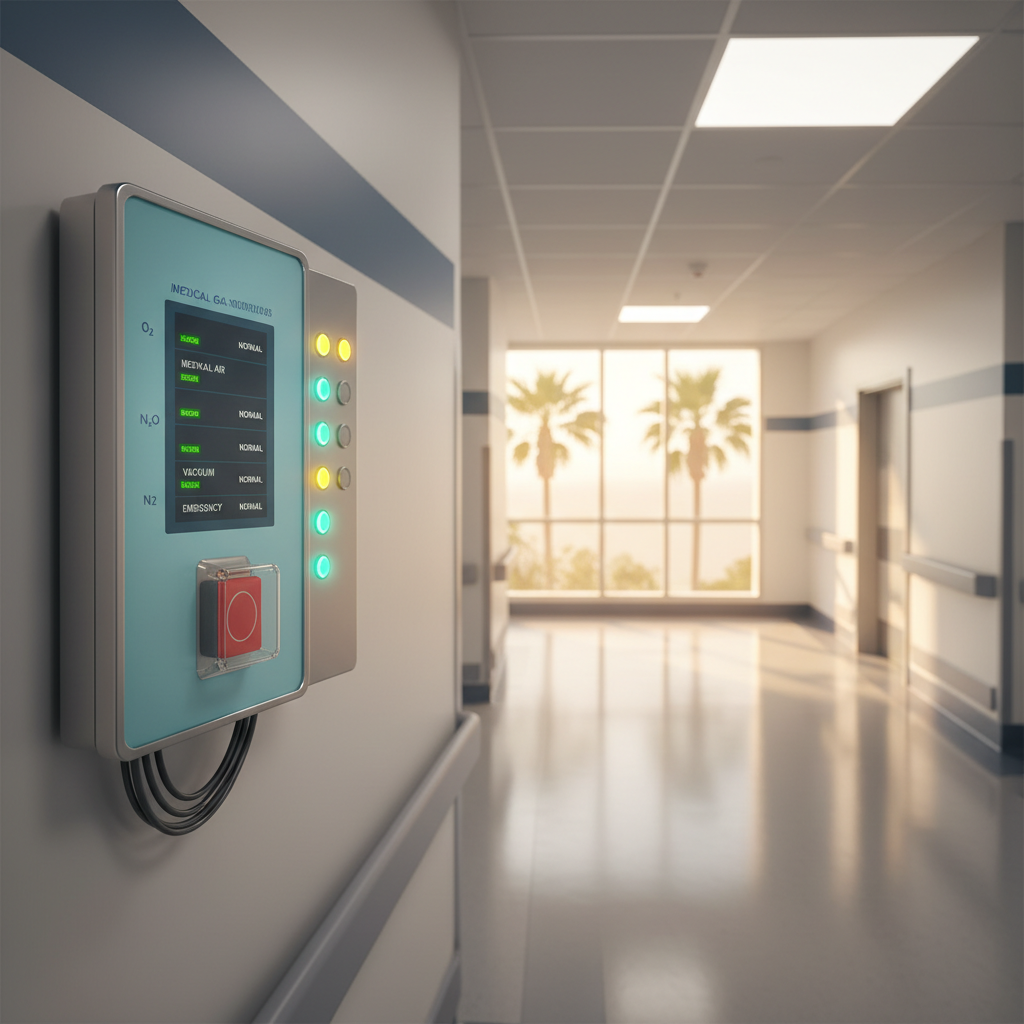
Medical gas master alarm panels are the central nervous system of your facility's life support systems. For a hospital or surgery center in Boca Raton, ensuring these panels are modern, functional, and compliant isn't just a best practice, it's a requirement for patient safety and regulatory approval. An outdated or malfunctioning alarm panel can lead to critical system failures going unnoticed, posing significant risks and inviting citations during a Joint Commission (TJC) or Agency for Health Care Administration (AHCA) survey. This guide provides a definitive overview for facility managers in Palm Beach County on planning and executing a low-voltage master alarm panel retrofit, ensuring full NFPA 99 compliance.
Medical Gas Service
Florida Service
Compliance & Standards
Master Alarm Panel Installation in Boca Raton: A Retrofit Guide
Medical Testing SolutionsMay 29, 20267 min read
Why Your Facility Can't Afford an Outdated Master Alarm
Running a healthcare facility in South Florida comes with unique challenges, from hurricane preparedness to stringent state regulations. Your medical gas alarm system is at the heart of navigating these challenges successfully. An upgrade from an older, high-voltage system to a modern, low-voltage master alarm panel is one of the most critical investments you can make.
Key drivers for an upgrade include:
- Patient Safety: Modern alarms provide more precise, reliable, and detailed information about the status of your medical gas sources, preventing potential patient emergencies.
- NFPA 99 Compliance: NFPA 99, Section 5.1.9, outlines the stringent requirements for medical gas warning systems. Older systems often fail to meet current standards for alarm points, labeling, and functionality.
- Avoiding Deficiencies: Alarm panel issues are a common finding during TJC and AHCA inspections. A non-compliant alarm system can jeopardize your facility's accreditation and lead to costly corrective action plans.
- Improved Maintenance: Low-voltage systems are safer and easier for technicians to work on, reducing maintenance time and costs.
Why this matters for compliance: The AHCA and The Joint Commission mandate strict adherence to NFPA 99. During an inspection, verifiers will physically test each alarm point. A "pass" requires the panel to activate correctly and for the signal to be received at all required locations. Failure to comply can result in a lengthy and expensive facility-wide corrective action plan.
Understanding NFPA 99 Master Alarm Requirements
NFPA 99 is the foundational code governing medical gas systems in the United States. For a facility in Boca Raton, compliance is verified against AHCA-specific requirements, which are built upon this code. The master alarm panel must indicate the status of all critical medical gas sources.
According to NFPA 99 (2018 ed.), Chapter 5.1.9.2, master alarm systems shall be installed to monitor the source and reserves for all medical gas systems. At a minimum, each master alarm panel must display a separate visual indicator for each condition monitored and produce an audible signal.
Key monitored points typically include:
- Medical Air Compressor Operation
- Medical Vacuum Pump Operation
- High/Low Pressure for Gas Manifolds (Oxygen, Nitrous Oxide, etc.)
- Changeover to Secondary/Reserve Supply
- High/Low Dew Point
- WAGD (Waste Anesthetic Gas Disposal) System Status
| Alarm Type | Monitored Condition | NFPA 99 Reference | Typical Location |
|---|---|---|---|
| Master Alarm | Source Equipment Status (e.g., Manifold Pressure High/Low, Change-over, Compressor On) | 5.1.9.2 | Maintenance Office, Security, continuously attended location |
| Area Alarm | Zone Pressure (e.g., OR Wing, Patient Floor) | 5.1.9.3 | Nurses' Station, area of use |
| Local Alarm | Equipment-specific fault (e.g., Compressor Over-temp) | 5.1.9.4 | At the source equipment itself |
Your Step-by-Step Guide to Master Alarm Retrofit Installation
This guide outlines the typical process for a low-voltage retrofit. Remember, while your in-house team might assist, the final connections and verification must be performed by a certified professional to be compliant.
Step 1: Project Planning and Assessment
Before any wires are pulled, a thorough assessment is crucial. An ASSE 6010 Certified Medical Gas Systems Installer should survey your existing system. This involves tracing current wiring, identifying all monitored points, and reviewing your facility's needs. This is the perfect time to evaluate if you need to add new monitoring points, especially if you've recently expanded or renovated areas like those seen in major systems like Broward Health or Cleveland Clinic Florida.
Step 2: Choosing the Right Low-Voltage Panel
Select a panel from a reputable manufacturer like BeaconMedaes, Amico, or Tri-Tech. Your choice should be based on the number of alarm points required, expandability for future growth, and compatibility with your existing sensors. As a leading provider of medical gas equipment, Medical Testing Solutions can help you select the most cost-effective and compliant panel for your Boca Raton facility.
Step 3: Running the Low-Voltage Cables
This is often the most labor-intensive part. New, low-voltage wiring must be run from each source equipment sensor (e.g., pressure switches on the oxygen manifold, vacuum pump sensors) to the designated master alarm panel location. All cabling must be installed neatly and in accordance with local building codes.
Step 4: Panel Mounting and Termination
The new master alarm backbox is mounted in a location that is under continuous surveillance, such as a security office or engineering control room. The low-voltage wires are then carefully terminated to the correct points on the panel's circuit board. This requires careful reading of the manufacturer's schematic to ensure a pressure switch for oxygen doesn't get wired to the medical air input.
Step 5: System Power-Up and Configuration
Once wiring is complete and double-checked, the panel can be powered on. Each alarm point is then configured and labeled according to the NFPA 99-required text. The system is tested locally by manually activating each sensor to ensure the panel displays the correct visual and audible alarm.
Step 6: Final ASSE 6030 Verification
This is the most critical step for compliance. A third-party ASSE 6030 Certified Medical Gas Verifier must perform a full system verification. This independent testing is non-negotiable and provides the official documentation required by AHCA, which must satisfy AHCA OPS Form 3110 and Chapter 59A of the Florida Administrative Code. The verifier will test every single alarm point and provide a detailed report for your records. Medical Testing Solutions provides comprehensive medical gas verification services across Florida.
MTS: Your Local Partner for Master Alarm Installation in Boca Raton
When it comes to specialized work like medical gas system installation, choosing a local, certified expert is key. Medical Testing Solutions is headquartered right here in South Florida at 501 East Las Olas Blvd, Ste 300, Fort Lauderdale, FL 33301. Our proximity is your advantage.
For facilities in Boca Raton, West Palm Beach, and Miami, choosing MTS for your medical gas installation means:
- NO Travel Fees: Unlike out-of-state competitors, we don't charge for travel, lodging, or per-diem. This typically saves our clients 10-25% on total project costs.
- Rapid Response: Our South Florida location allows for same-day dispatch for consultations and emergencies. After a hurricane, when NFPA 99 5.1.12 requires re-testing after storm damage, our crews are on-site faster than anyone.
- Local Expertise: We have extensive experience working with Florida facilities and are intimately familiar with AHCA and TJC requirements. From Jackson Memorial to Baptist Health, we understand the local landscape. We are your neighbors, not a company flying in from across the country.
Check out our services for the South Florida region to learn more.
Get Your Boca Raton Master Alarm Project Started
Don't wait for a surveyor to tell you your master alarm system is out of date. Proactively upgrading your system protects your patients, ensures compliance, and saves you from costly emergency repairs. The team at Medical Testing Solutions is ready to help you plan and execute a seamless retrofit.
Call our Fort Lauderdale office today at +1 (754) 315-1078 or request a free quote online to get started on your master alarm panel installation in Boca Raton. '''
Frequently Asked Questions
All master and area alarm panels must be tested annually as part of your facility's preventive maintenance program to meet TJC and NFPA 99 requirements. Medical Testing Solutions provides comprehensive annual medical gas inspections to keep you compliant.
While your staff can perform tasks like mounting the panel and running cables, the final system commissioning and a mandatory verification must be completed by an ASSE 6030 Certified Medical Gas Verifier to be compliant with Florida AHCA regulations.
The main costs are the panel hardware itself, the labor for installation and wiring, and the third-party verification. By choosing a local South Florida company like MTS, you completely eliminate travel-related costs, which can save you 10–25% compared to out-of-state firms.
Yes. From our headquarters in Fort Lauderdale, Medical Testing Solutions provides full medical gas services, including master alarm installation and certification, to all of Palm Beach County, including Boca Raton, Boynton Beach, and West Palm Beach.
Request a quote for your facility
Talk with Medical Testing Solutions about your next inspection, repair or equipment request.