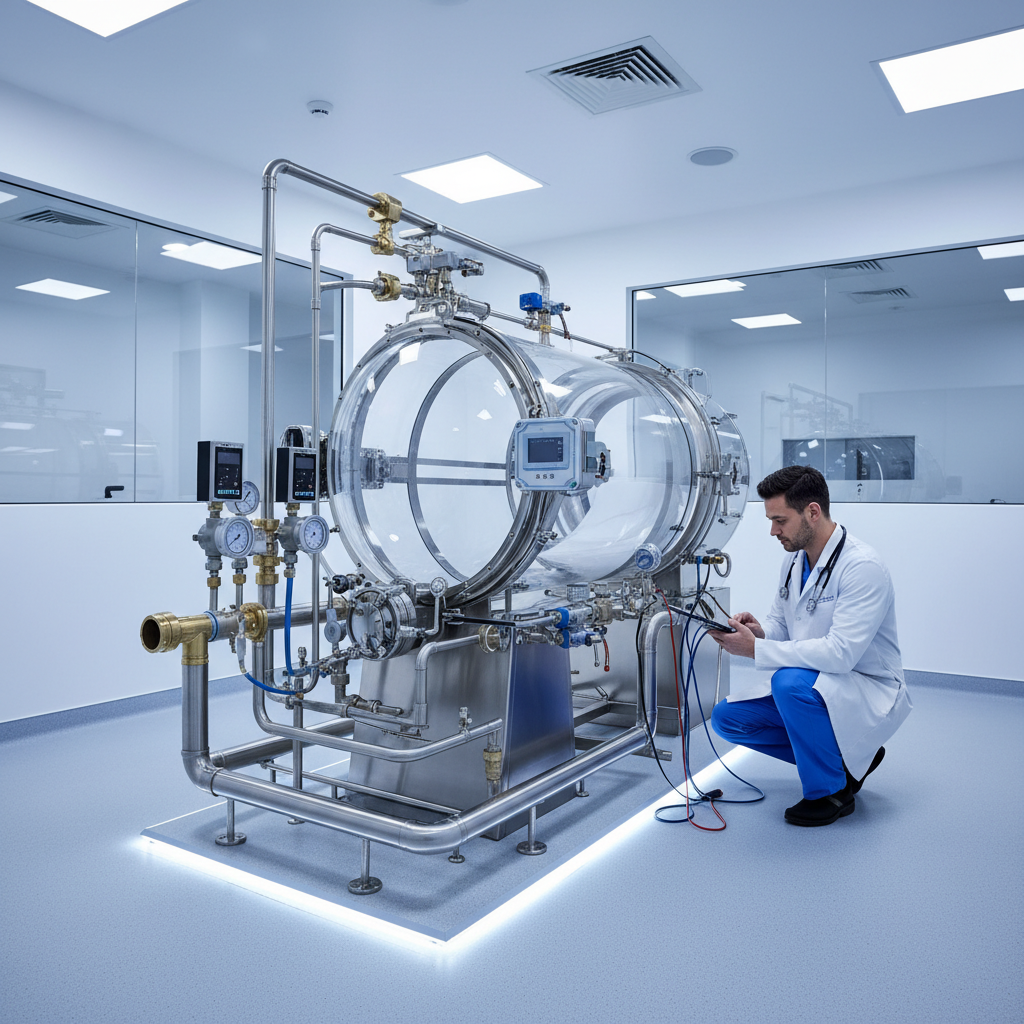
You walk into a clinical hyperbaric suite on a humid Tuesday morning and hear a faint, rhythmic hiss near the chamber's penetration plate. An ultrasonic leak detector confirms what your ear suspected: medical-grade oxygen is weeping past a weathered fluorosilicone O-ring on the patient exhaust line. Within twenty minutes of patient pressurization, the ambient room oxygen concentration creeps from 20.9% to 22.4%. That tiny fraction of a percentage turns an ordinary outpatient room into an oxygen-enriched hazard zone where cotton scrubs ignite with terrifying speed.
Hyperbaric oxygen therapy (HBOT) saves limbs and heals compromised tissue, but it does so by concentrating immense oxidative potential inside a pressurized vessel. A complete hyperbaric chamber oxygen safety inspection is your facility's frontline barrier against catastrophic ignition, equipment degradation, and regulatory shut-downs. Medical Testing Solutions inspects and verifies life-critical gas piping networks across the country, and we see firsthand how subtle plumbing oversights put patients and clinical staff at risk.
Keeping an HBOT facility safe requires deep familiarity with the pressure vessel itself and the complex upstream medical gas infrastructure feeding it. Here is what clinical directors, safety officers, and facility engineers must know to master their compliance cycles and protect their facilities.
The Regulatory Framework: NFPA 99 Chapter 14 and NFPA 53
Hyperbaric facilities do not operate under the same umbrella of baseline rules as standard patient treatment bays. While general piped medical gas systems fall under Chapter 5 of NFPA 99 (Health Care Facilities Code), hyperbaric facilities answer directly to Chapter 14, "Hyperbaric Facilities."
NFPA 99 divides hyperbaric chambers into two primary categories: Class A (multiplace chambers holding two or more people) and Class B (monoplace chambers designed for a single patient). Each classification brings distinct mechanical and gas safety demands. For instance, Class B monoplace chambers are typically pressurized with pure 100% medical oxygen, whereas Class A chambers are pressurized with breathing-quality compressed air while patients breathe pure oxygen through specialized masks or hoods.
Why this matters for compliance: NFPA 99 (2024 edition) Section 14.2.1.2 mandates that hyperbaric equipment, piping, and safety controls undergo recurring inspection, functional testing, and documentation. Failure to produce accredited third-party verification logs during an unannounced inspection by The Joint Commission or your local Authority Having Jurisdiction (AHJ) can trigger immediate suspension of clinical treatments.
Beyond NFPA 99, facilities must coordinate safety thresholds set by NFPA 53 (Recommended Practice on Materials, Equipment, and Systems Used in Oxygen-Enriched Atmospheres) and CGA (Compressed Gas Association) standards such as CGA G-4.1 for oxygen cleaning. The Compressed Gas Association establishes strict particulate and non-volatile residue thresholds. Even microscopic traces of hydrocarbon grease inside high-pressure copper supply tubing can cause violent compression combustion when exposed to pure oxygen surges.
A complete inspection does not stop at the chamber shell. It evaluates the entire gas journey from your bulk liquid cryogenic tanks or high-pressure cylinder headers, through the building's infrastructure, all the way into the patient compartment. Connecting your annual chamber checks with certified annual medical gas inspections guarantees that line pressures, safety relief valves, and emergency shut-offs perform seamlessly under actual operational demands.
Critical Upstream Oxygen Supply and Pressure Regulation Checks
The safest hyperbaric chamber in the world cannot protect occupants if the gas feeding it arrives at incorrect pressures or contains moisture and particulates. Monoplace chambers consume massive volumes of medical oxygen, often running dynamic flow rates between 240 and 400 liters per minute (L/min) at operating pressures up to 3.0 atmospheres absolute (ATA).
When inspectors examine the upstream delivery train, their primary focus centers on system sizing, regulator stability, and particulate management:
- Dynamic pressure drops across line regulators during simultaneous chamber flushes
- Dual-stage regulator diaphragms for micro-perforations or creep
- Cleanliness and certification tags on in-line bronze and stainless steel filters
- Sizing of cryogenic vaporizers to prevent liquid carryover during cold weather demand
- Automatic switchover manifold functionality under high-flow simulated loads
If an oxygen line regulator creeps by just 10 PSI over its set point, sensitive chamber flowmeters and pneumatic control logic can malfunction. Even worse, pressure spikes accelerate adiabatic heating across downstream elbows and orifices.
When your facility adds or retrofits an oxygen supply header for hyperbaric suites, the physical installation must comply with ASSE 6010 piping standards. We frequently see installations where standard hospital mechanical contractors run copper lines with improper brazing techniques or insufficient purging. Engaging certified specialists for your medical gas installation prevents carbon deposits and flux residues from contaminating your hyperbaric lines before the chamber ever receives its first commission test.
Penetration Plate, O-Ring, and Piping Integrity Verification
The penetration plate is the structural and pneumatic gateway of the hyperbaric chamber. Through this thick metallic bulkhead pass all high-pressure oxygen supply lines, ambient exhaust piping, pneumatic logic lines, biological monitoring cables, and emergency depressurization ports.
During an ASSE-aligned safety inspection, technicians subject this boundary to rigorous leak-decay and atmospheric monitoring. Penetration fittings must utilize oxygen-compatible elastomeric seals, typically specialized fluorosilicone or PTFE compounds. Standard Buna-N nitrile rubber seals, commonly found in general industrial plumbing, degrade rapidly in high-concentration oxygen environments. They dry out, embrittle, and eventually blow out or introduce flammable elastomer particulates into the gas stream.
Inspectors apply an approved, non-hydrocarbon bubble-leak detection solution (meeting MIL-PRF-25567 specifications) or use high-sensitivity ultrasonic acoustic probes to test every bulkhead connection. They inspect the physical piping supports anchoring the lines to the wall and floor. Because monoplace chambers exhaust high volumes of oxygen during purge cycles, mechanical vibrations can slowly loosen threaded compression fittings over hundreds of treatment hours.
Inspectors also review your facility's physical isolation valves. Every hyperbaric suite must possess an easily accessible emergency shutoff valve located immediately outside the room. Technicians verify that this valve operates smoothly, seals bubble-tight against full pipeline pressure, and carries unmistakable labeling that indicates exactly which chamber it isolates.
Electrical Grounding, Static Dissipation, and Isolated Power Systems
Oxygen enrichment transforms benign electrical sparks into catastrophic ignition sources. In an atmosphere containing greater than 23.5% oxygen, the minimum ignition energy required to spark a flame drops exponentially compared to ambient room air. For this reason, NFPA 99 enforces exceptionally strict electrical safety rules for all hyperbaric environments.
Static electricity represents an invisible threat. A comprehensive oxygen safety evaluation requires measuring resistance to ground across every metal component of the chamber, including patient stretchers, transfer gurneys, internal grounding straps, and exterior support skids. NFPA 99 Section 14.2.7 sets specific limits on electrical bonding resistance to ensure static charges dissipate safely into the building's grounding system before reaching spark potential.
| Diagram text |
|, |
| Static Resistance Benchmark: < 1.0 Ohm |
| Measured from patient conductive strap to building ground bus |
Furthermore, treatment rooms housing Class A chambers, or suites where patient monitoring leads enter the vessel, frequently operate on specialized isolated power systems. These systems prevent macro-shock to patients and eliminate ground-fault arcs that could ignite an oxygen-rich atmosphere. Line Isolation Monitors (LIMs) continuously calculate the hazard index of the isolated circuit.
Routine electrical testing must include certified line isolation monitor testing to verify that your hazard current thresholds remain within strict NFPA 99 parameters. If an electrical lead shorts inside or near an oxygen-ventilated vessel, an unmonitored ground return could initiate an internal fire flash. Testing these power isolation points alongside the gas system gives your clinical team total operational confidence.
Exhaust and Environmental Room Ventilation Safety
Where does the oxygen go after it leaves the patient vessel? In a Class B monoplace chamber, patient exhaust gas is nearly 100% oxygen, contaminated with patient moisture and volatile organic compounds from skin or exhalation. Dumping this gas into the general building HVAC plenum is illegal and exceptionally dangerous.
NFPA 99 Section 14.2.4.4 mandates that all hyperbaric chamber exhausts must vent directly to the outdoors at an exterior location away from all pedestrian areas, combustible structures, and building HVAC fresh-air intakes. The termination point must feature a dedicated insect screen and a weatherproof cap designed to prevent wind backpressure from disrupting chamber decompression profiles.
Inside the treatment room itself, atmospheric oxygen monitoring is non-negotiable. If a patient entry seal fails or an internal relief valve lifts, room oxygen concentrations can spike in seconds. Inspectors evaluate room air exchange rates, NFPA 99 typically mandates a minimum of 8 to 12 total air changes per hour with dedicated negative or neutral pressure balances, and calibrate the continuous ambient oxygen analyzers mounted on the walls.
These wall sensors must trigger audible and visual staging alarms if ambient oxygen levels exceed 22.0% to 23.5%. The technician verifies alarm relay setpoints, tests sample-draw pump flow rates, and recalibrates the zirconium oxide or electrochemical sensing cells using certified zero and span gases.
ASSE 6030 Inspection Protocol vs. Informal In-House Checks
Many clinical facilities rely on internal maintenance technicians to perform daily and weekly hyperbaric checklists. While daily checks are vital for pre-flight clinical safety, they do not replace formal credentialed inspections. In-house biomedical staff rarely have the calibrated instrumentation or specific code qualifications required to certify life-support gas systems under NFPA and ASSE standards.
An ASSE 6030 Medical Gas Systems Verifier carries extensive, tested knowledge of pipeline architecture, braze inspection, source capacity calculations, and contaminant analysis. The difference between an informal check and an ASSE-compliant verification touches every component of your medical gas system.
| Inspection Factor | In-House Daily Clinical Check | Professional ASSE 6030 Verification |
|---|
| Credential Standard | Manufacturer equipment operator training | ASSE 6030 Certified Verifier |
| Primary Scope | Vessel visual check, door seal check, daily logs | Source-to-chamber piping, purity, pressures, relief valves |
| Gas Analysis | None (operational reliance on wall gas) | Hydrocarbon, CO, CO2, moisture, and particulate testing |
| Safety Devices | Visual check of exterior pressure gauge | Bench-test or pop-test verification of relief valves |
| Leak Detection | Audible listening / door seal inspection | Calibrated ultrasonic acoustic & mass-flow decay testing |
| Regulatory Standing | Facility internal operational record | Defensible accreditation audit documentation (TJC, CMS) |
Relying entirely on internal inspections leaves facilities exposed during state health department and accreditation surveys. When Medical Testing Solutions performs third-party medical gas verification, our technicians produce thorough documentation packages that map every valve, identify specific component serial numbers, and verify exact gas purity levels at the chamber inlet.
Fire Suppression and Emergency Depressurization Systems
Fire inside an oxygen-enriched chamber is extraordinarily fierce. The combustion rate of typical materials accelerates by multiples of ten when the partial pressure of oxygen climbs. In Class A multiplace chambers, NFPA 99 requires an automatic deluge water spray system capable of discharging enormous water densities within split seconds of flame detection.
During an inspection, technicians test the water deluge system's pressure reservoirs, optical flame detector response times, and manually actuated abort switches. The system must deliver water at densities exceeding 2 to 3 gallons per minute per square foot over the entire floor area. In monoplace chambers, primary fire safety hinges on keeping ignition sources out of the vessel entirely and maintaining rapid, controlled emergency depressurization capabilities.
Inspectors verify that the emergency abort or emergency stop mechanism vents the vessel safely without causing catastrophic barotrauma to the patient's ears or lungs. The exhaust valve seats must not ice up or freeze during rapid pressure drops, a common thermodynamic pitfall caused by Joule-Thomson cooling as high-pressure gas expands through restricted orifices.
Technicians confirm that exhaust silencers and flame arrestors are clean, securely seated, and free from particulate buildup that could choke gas velocity during an emergency abort sequence.
Common Code Violations Discovered During Chamber Audits
Inspecting hyperbaric facilities across diverse clinical environments reveals clear patterns of non-compliance. Most violations do not stem from intentional shortcuts; they arise because medical gas infrastructure ages quietly, and facility managers lack specialized hyperbaric code training.
First among these issues is the installation of unapproved valves or flexible hoses. Maintenance crews looking to save time often order high-pressure flexible braided hoses from industrial hydraulic suppliers rather than medical gas suppliers. These industrial hoses contain internal elastomer liners and petroleum lubricants that can ignite under high-pressure oxygen service. Every single hose and fitting connected to hyperbaric oxygen supply lines must be stamped and certified as cleaned for oxygen service per CGA G-4.1.
Another frequent failure mode involves out-of-date or uncalibrated pressure relief valves. NFPA 99 requires overpressure relief valves on the chamber and supply headers to prevent vessel rupture. These mechanical valves use calibrated internal springs that drift over time due to thermal cycling and atmospheric oxidation. If your facility cannot produce documentation proving these valves have been tested or replaced within their specified life cycle (often every three to five years, depending on local AHJ and ASME boiler and pressure vessel codes), your suite will fail an accreditation audit.
Third is improper storage of materials within the hyperbaric room. Clinical teams frequently bring non-essential equipment, cardboard supply boxes, and plastic furniture into the chamber room. In an oxygen-enriched spill event, these secondary combustibles dramatically increase fire loading. Inspectors document room clearances, verify the proximity of certified fire extinguishers (typically water-mist units for Class A / electrical environments), and check that all electrical outlets within five feet of the chamber door meet explosion-proof or medical-grade splash standards.
Finally, documentation gaps represent an immediate red flag for regulatory auditors. Even if your equipment works properly, failing to log periodic maintenance, valve exercises, and filter changes violates NFPA 99 Chapter 14. Partnering with a dedicated team for ongoing medical gas maintenance services ensures all recurring test results, mechanical adjustments, and component replacements are logged in a single, audit-ready compliance binder.
Preparing Your Hyperbaric Facility for an ASSE Safety Audit
Preparing for a professional hyperbaric oxygen inspection requires coordination between clinical staff, safety directors, and facility engineering teams. Preparing your systems in advance minimizes patient schedule disruptions and ensures your verification proceeds smoothly.
Follow this preparation path before your inspection team arrives on site:
- Assemble Equipment Documentation: Gather all chamber manufacturer operating manuals, ASME vessel certification plates, pressure relief valve factory certificates, and historical gas consumption records.
- Review Gas Alarm Matrices: Ensure your master medical gas alarm panels and localized area alarms are labeled accurately and communicate with the building automation system (BAS).
- Inspect Room Clearances: Clear all pathways surrounding the chamber shell, emergency shutoff valves, and exterior exhaust lines to ensure technicians have full physical access.
- Log Sensor Calibration Records: Pull calibration logs for wall-mounted ambient oxygen monitors and ensure fresh replacement sensor cells are available if current units show voltage drift.
- Coordinate Clinical Downtime: Schedule your inspection window during a planned clinical shutdown to allow full-flow pressurization testing and emergency relief discharges without compromising patient treatment days.
A comprehensive safety audit should make your facility safer, verify mechanical systems, and reinforce your team's clinical confidence. When you rely on Medical Testing Solutions, you get specialized technicians who understand the tight tolerances of life-critical gas piping and pressure systems. From verifying bulk oxygen delivery headers to evaluating chamber penetration plates, we protect your patients and keep your operations fully aligned with current NFPA and ASSE standards.
Schedule your next hyperbaric chamber oxygen safety inspection with Medical Testing Solutions today by calling (754) 315-1078 or by visiting our request a quote portal.