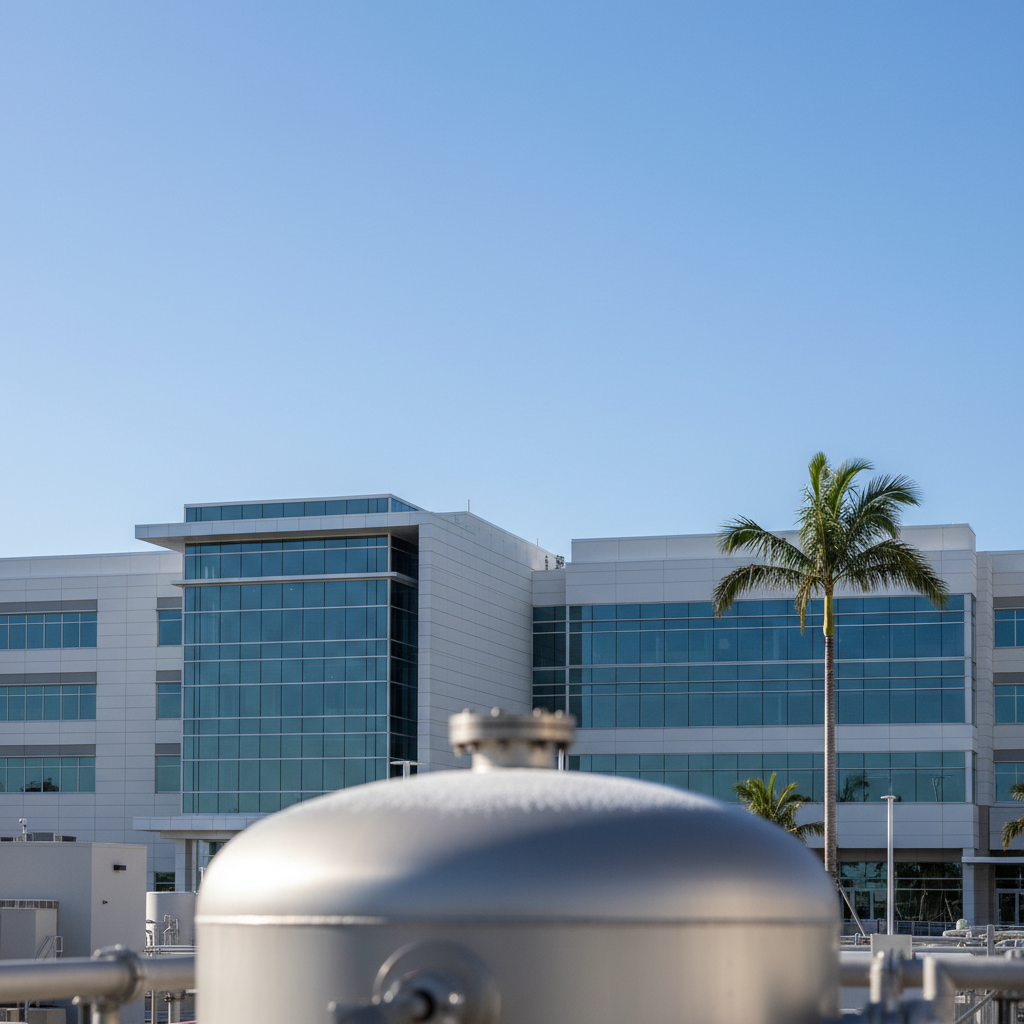
Hospital Oxygen System Installation in West Palm Beach, FL
Medical Testing SolutionsJune 5, 20267 min read
Share
A properly designed and installed medical oxygen system is the lifeblood of any hospital or healthcare facility. It is a fundamental component of patient care, critical for life support, and subject to stringent safety regulations. For facility managers and administrators in West Palm Beach and throughout South Florida, ensuring a new or upgraded oxygen system is installed correctly is a matter of patient safety, compliance, and operational integrity. This guide explains the entire process, from the initial design to the final verification, highlighting the critical standards from NFPA 99, ASSE International, and Florida-specific AHCA requirements.
You will learn the roles of bulk oxygen tanks, manifolds, and zone valves, the critical importance of ASSE 6010 certified brazing, and the steps involved in a final ASSE 6030 system verification. We'll also cover the unique advantages of using a local, Fort Lauderdale-based provider for your West Palm Beach project.
The Core Components of a Hospital Oxygen System
A hospital's medical oxygen system is more than just pipes in a wall. It is a complex assembly of components designed to deliver pure, life-sustaining oxygen at a precise, constant pressure to patient rooms, operating suites, and emergency departments. Key components include:
Primary Oxygen Source: Typically a large, outdoor cryogenic bulk tank (VIE - Vacuum Insulated Evaporator) that stores liquid oxygen (LOX) at very low temperatures. This is the most efficient solution for facilities with high, continuous demand.
Secondary/Reserve Source: An auxiliary manifold of high-pressure cylinders that automatically takes over if the primary source fails or is depleted. NFPA 99 requires this redundancy for safety.
Vaporizers: These heat exchangers convert the liquid oxygen from the bulk tank back into a gaseous state for delivery.
Main Control Panel & Alarms: The system's brain, monitoring pressure and automatically switching to the reserve source. It provides audible and visual alarms as required by NFPA 99 (e.g., "Reserve in Use," "High/Low Line Pressure").
Piping Distribution Network: A network of specially prepared, cleaned, and brazed copper piping that transports the oxygen throughout the facility.
Zone Valve Boxes: These are strategically placed valve assemblies that allow specific areas or "zones" of the hospital (like a wing, floor, or department) to be isolated for maintenance, repair, or in an emergency without shutting down the entire facility.
Station Outlets: The final delivery point in patient rooms, connecting to flowmeters and other medical devices. These are indexed by gas type to prevent cross-connection.
Why ASSE 6010 Certification is Non-Negotiable for Installers
The most critical phase of any medical gas installation is the joining of copper tubes and fittings. For oxygen systems, this process, brazing, is governed by the ASSE 6010 Medical Gas Systems Installers certification. This isn't regular plumbing.
An ASSE 6010 certified installer is a qualified professional who has undergone extensive training and passed a rigorous examination on the specific procedures for medical gas systems. Key responsibilities during installation include:
Proper Brazing Technique: Using a specific silver-brazing alloy (typically BCuP) and continuously purging the interior of the copper pipe with oil-free, dry nitrogen. This nitrogen purge is critical; it displaces oxygen from inside the pipe during the high-temperature brazing process, preventing the formation of toxic copper oxides on the interior pipe surface. These oxides can flake off, contaminating the gas stream and posing a severe risk to patients.
Adherence to NFPA 99 Standards: Following all installation requirements outlined in Chapter 5 of NFPA 99, "Gas and Vacuum Systems."
System Cleanliness: Ensuring all components are purchased "cleaned for oxygen service" and remain free of contaminants like oil, grease, or dirt throughout the installation process.
Why this matters for compliance: The Joint Commission (TJC) and the Florida Agency for Health Care Administration (AHCA) survey for compliance with NFPA 99. Using uncertified personnel for installation is a major red flag and can result in costly project delays, failed inspections, and potential liability. All verification reports in Florida must satisfy AHCA OPS Form 3110.
The Installation Process: A Step-by-Step Overview
A typical hospital oxygen system installation in West Palm Beach follows a structured, multi-phase approach to ensure safety and compliance.
System Design & Engineering: A qualified engineer designs the system based on the facility's size, patient bed count, and peak demand calculations, ensuring compliance with NFPA 99.
Source Equipment Installation: The bulk oxygen tank and vaporizer are installed outdoors on a concrete pad, and the reserve manifold is installed in a secure, designated room.
Piping Rough-In: ASSE 6010 certified installers run the main copper lines from the source, routing them to the various zones of the hospital.
Brazing & Nitrogen Purge: Each joint is meticulously brazed while maintaining the crucial nitrogen purge.
Zone Valve Box Installation: Valve boxes are installed to control individual zones, such as the ICU, ORs, or patient floors.
Station Outlet Installation: The final outlets are installed and connected to the piping system in each room.
Initial Pressure Testing: The installer performs initial pressure tests to check for leaks before the final verification.
ASSE 6030 Verification: The Final Step to Patient Safety
Once the installation is physically complete, the system cannot be used until it has been professionally tested and verified by a separate, unbiased third party. This process is governed by the ASSE 6030 Medical Gas Systems Verifiers standard.
Medical Testing Solutions (MTS) provides comprehensive medical gas verification services across Florida. An ASSE 6030 Certified Verifier will perform a battery of tests to confirm the system's integrity, purity, and proper function. This is not optional; it is required by NFPA 99 before a system can be placed into service.
Key Verification Tests
Test Category
Purpose
NFPA 99 Reference
Piping Purge
Forcefully purge the new piping with nitrogen to remove any particulate matter left from installation.
5.1.12.2.4
Standing Pressure Test
Pressurize the system with nitrogen to check for leaks in the piping over a 24-hour period.
5.1.12.2.6
Gas Concentration Test
Confirm that the outlets are delivering 100% oxygen and have not been cross-connected with other medical gases.
5.1.12.3.4
Particulate Test
Test the gas stream at the outlets for solid contaminants.
5.1.12.3.3
Alarm & Valve Testing
Verify that all master alarms, area alarms, and zone valves function as intended.
5.1.12.3.8
The Florida Advantage: Why Local Matters for West Palm Beach Hospitals
Healthcare facilities in West Palm Beach, from large systems like Cleveland Clinic Florida and Baptist Health to smaller clinics, face unique challenges. Choosing a local, Florida-based company for your oxygen system installation and verification provides significant advantages.
Medical Testing Solutions is headquartered at 501 East Las Olas Blvd, Fort Lauderdale, FL 33301. Being based in South Florida means our ASSE-certified teams can be on-site in West Palm Beach with no lead time.
This provides a major cost and speed advantage:
NO Travel Fees: We don't charge for travel time, mileage, or airfare anywhere in Florida.
NO Lodging or Per-Diem Costs: Our local presence eliminates the need for expensive hotel stays and daily allowances that out-of-state verifiers must charge.
Typical Savings of 10-25%: For most hospital projects, using MTS results in significant cost savings compared to competitors from Georgia or other states.
Hurricane Re-Verification: South Florida is prone to hurricanes. NFPA 99 (5.1.12) requires re-verification of a medical gas system if it loses pressure due to a breach or storm damage. Our Fort Lauderdale and West Palm Beach medical gas services teams can mobilize for emergency testing and re-certification immediately after a storm passes, a capability out-of-state firms cannot match.
As a local provider, we have deep familiarity with Florida AHCA requirements and maintain a close working relationship with officials in the region. We provide comprehensive documentation that satisfies TJC, AHCA, and all local authorities.
Get a Compliant Installation with Medical Testing Solutions
For over 40 years, Medical Testing Solutions has been the trusted partner for healthcare facilities throughout Florida. We are not just a testing company; we provide turnkey solutions for medical gas, including ASSE 6010 installation, ASSE 6030 verification, equipment sales, and ongoing maintenance.
Our deep expertise in NFPA, ASSE, and Florida AHCA regulations ensures your project is done right the first time. We are proud to serve the entire state from our South Florida headquarters. For more information on our services, visit our Florida services hub.
Don't risk patient safety or compliance on your next project. For a seamless, code-compliant hospital oxygen system installation in West Palm Beach, trust the local experts.
Call our Fort Lauderdale office today at +1 (754) 315-1078 or request a quote online for same-day dispatch in South Florida.
Frequently Asked Questions
ASSE 6010 is for Installers, the individuals who physically build the system and braze the pipes. ASSE 6030 is for Verifiers, the independent third-party inspectors who test the completed system for safety, purity, and function before it can be used for patient care.
The timeline varies greatly depending on the project's scale—a single-floor renovation may take a week, while a new hospital wing can take months. The verification phase typically takes several days to a week to complete all required NFPA 99 testing.
The Florida Agency for Health Care Administration (AHCA) requires that all medical gas systems comply with NFPA 99. The final verification report, including all test results, must be submitted to AHCA as part of the facility's licensure and inspection process (AHCA OPS Form 3110).
When copper is heated to brazing temperatures, it reacts with oxygen, forming a layer of black copper oxide. Continuously flowing nitrogen inside the pipe displaces oxygen, preventing this oxidation. This ensures the interior of the pipe remains clean and no toxic particulates can contaminate the medical gas delivered to patients.
While facilities staff can operate zone valves (i.e., open or close them), any maintenance, repair, or replacement of the valve itself must be performed by an ASSE 6040 Certified Medical Gas Maintenance technician and the system must be re-verified afterward.
Request a quote for your facility
Talk with Medical Testing Solutions about your next inspection, repair or equipment request.