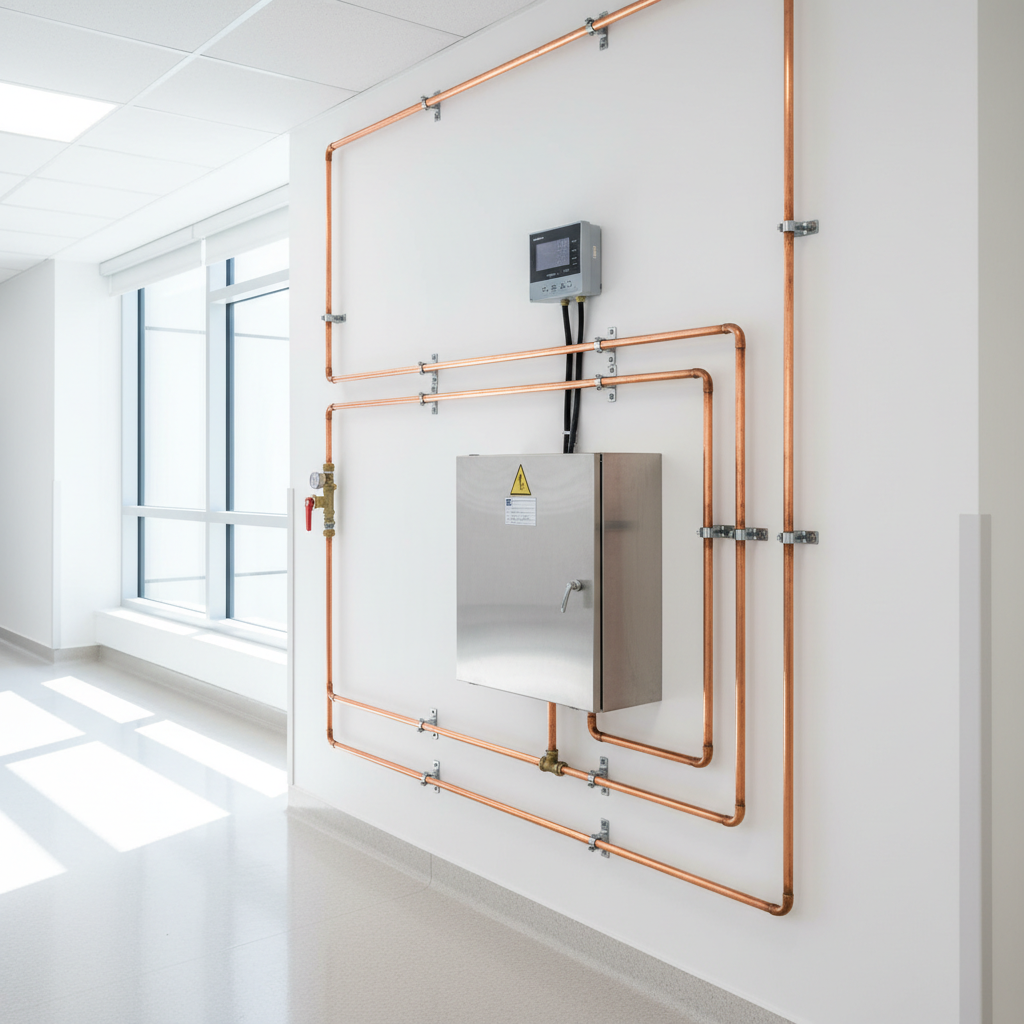
A hospital oxygen system installation in Virginia Beach, VA demands absolute precision, strict adherence to NFPA 99 healthcare facilities code, and specialized craftsmanship. From coastal humidity and corrosion concerns in the Hampton Roads area to the complex mechanical logistics of high-pressure liquid cryogenic bulk tanks, healthcare facility managers cannot afford shortcuts. A life-safety medical gas distribution network must deliver uninterrupted, medical-grade oxygen to emergency bays, intensive care units, and surgical suites without pressure drops, particulate contamination, or valve leaks.
This comprehensive guide breaks down the engineering, regulatory, and practical requirements for hospital oxygen system installation in Virginia Beach. You will learn the exact specifications for bulk cryogenic vessel siting, high-pressure reserve manifolds, zone valve box (ZVB) placement, ASSE 6010 nitrogen-purged brazing standards, and the non-negotiable ASSE 6030 third-party verification process required before commissioning.
The Regulatory Framework: NFPA 99, CGA, and Virginia Uniform Statewide Building Code
Medical gas infrastructure is not standard commercial plumbing. In Virginia, healthcare mechanical construction is governed by the Virginia Uniform Statewide Building Code (VUSBC), which incorporates the International Plumbing Code (IPC) and enforces NFPA 99 (Health Care Facilities Code), standard 2018, 2021, or 2024 editions depending on project permitting dates.
Oxygen is classified as a Category 1 (deep sedation or general anesthesia where system failure causes major injury or death) or Category 2 piped gas under NFPA 99 Chapter 5. Consequently, every component from the bulk pad to the terminal patient outlet must meet rigorous parameters established by:
- NFPA 99 (Chapter 5): Gas and Vacuum Systems.
- NFPA 55: Compressed Gases and Cryogenic Fluids Code (storage, location, and distances).
- CGA (Compressed Gas Association): Pamphlets G-4.1 (Cleaning Equipment for Oxygen Service) and M-1 (Guide for Medical Gas Installations).
- ASSE Series 6000: Professional qualifications standard governing installers (ASSE 6010), inspectors (ASSE 6020), and verifiers (ASSE 6030).
Why this matters for compliance: The Joint Commission (TJC), DNV GL, and the Virginia Department of Health (VDH) routinely audit piped oxygen infrastructure. Failure to present certified ASSE 6010 brazing documentation or an independent ASSE 6030 verification report can halt occupancy permits or invalidate hospital accreditation.
Bulk Liquid Oxygen (VIE) Siting and Installation in Hampton Roads
Large acute-care hospitals in Virginia Beach require bulk liquid oxygen systems, technically referred to as Vacuum Insulated Evaporators (VIE). Because Virginia Beach sits at sea level with high salt air exposure, sandy soil conditions, and hurricane vulnerability, engineering the outdoor bulk farm requires specialized local planning.
Foundation and Concrete Pad Engineering
Cryogenic bulk vessels (storing liquid oxygen at approximately -297°F) require a reinforced concrete pad engineered for both static structural loads and seismic/wind uplift ratings. Under NFPA 55 and NFPA 99 Section 5.1.3.5.11, the pad must extend beneath the vessel, the pressure-building vaporizers, and the tanker truck delivery unloading area.
Asphalt cannot be used anywhere within the liquid oxygen transfer zone. Spilled liquid oxygen saturates porous asphalt hydrocarbons, creating a high-risk flash-fire or detonation hazard under mechanical impact. Only noncombustible, monolithic concrete is code-compliant.
Setback Distances and Separation Requirements
NFPA 55 mandates precise spatial separations between the bulk oxygen storage pad and surrounding structures:
- 50 feet from places of public assembly.
- 25 feet from property lines.
- 10 to 15 feet from noncombustible hospital building walls (depending on fire-rating and opening protection).
- 50 feet from combustible liquids or above-ground flammable gas storage (such as fuel oil tanks for emergency generators).
- Clear overhead space with zero encroachment from high-voltage electrical lines.
Atmospheric Vaporizers and Coastal Corrosion Control
Liquid oxygen is drawn from the inner vessel and routed through ambient air aluminum finned vaporizers to convert the cryogenic liquid into room-temperature gas. In coastal Virginia Beach, airborne chlorides accelerate galvanic corrosion between dissimilar metals (e.g., aluminum vaporizers mated to stainless steel or copper headers).
System installation requires marine-grade structural brackets, 300-series stainless steel structural anchors, and continuous monitoring of vaporizer icing cycles during humid Virginia summers. Duplicate vaporizer banks with automated or manual changeover valves ensure one bank can defrost while the secondary bank sustains peak hospital demand.
High-Pressure Reserve Manifolds and Pressure Regulation
A bulk oxygen system cannot stand alone; it requires an emergency reserve to maintain supply if the primary vessel fails or requires emergency shutoff. NFPA 99 mandates a secondary source or an Emergency Oxygen Supply Connection (EOSC), along with an automatic manifold system.
Cylinder Manifold Specifications
The secondary supply typically consists of a high-pressure cylinder manifold operating at 2,000 to 2,600 psig. Medical Testing Solutions installs automatic switchover manifolds that utilize dual dual-stage line regulators to step supply pressure down to the nominal distribution pressure of 50 to 55 psig.
These manifolds must include:
- Automatic Changeover: Mechanical or electronic switching that flips banks seamlessly when the service bank reaches depletion without introducing downstream pressure dips.
- Local and Master Alarm Transducers: Intermediate and header pressure switches communicating directly with the facility’s medical gas alarm network.
- Venting Lines: Relief valve discharge lines piped directly outdoors away from air intakes, doors, and potential ignition sources.
For specialized outpatient surgical centers or smaller clinical networks across Virginia Beach, an automated micro-bulk or multi-cylinder high-pressure manifold may serve as the primary source rather than a massive cryogenic vessel. You can evaluate commercial and clinical supply options through the MTS products catalog.
Piping Network Architecture: Zone Valves, Risers, and Alarms
Once oxygen exits the bulk storage farm or manifold enclosure, it enters the hospital distribution grid. The design of this distribution network is dictated by safety zoning, flow calculations, and risk mitigation.
| Diagram text |
|, |
Main, Source, and Service Valves
NFPA 99 Section 5.1.4 requires specific valve hierarchies:
- Main Shutoff Valve: Located immediately outside the source building or bulk pad enclosure to isolate the entire supply.
- Source Valve: Placed inside the facility at the point of pipe entry.
- Service Valves: Located at the base of vertical risers to isolate dedicated wings or floors without disrupting adjacent hospital operations.
- In-Line Valves: Positioned to compartmentalize horizontal branch lines.
Zone Valve Boxes (ZVBs) and Area Alarms
Zone valve boxes isolate specific patient treatment areas during fires, emergencies, or maintenance.
- Accessibility: ZVBs must be visible and accessible at all times in public hallways, never behind locked doors, inside utility closets, or within patient rooms.
- Operating Pressure: Oxygen runs at a standard line pressure of 50 to 55 psig.
- Area Alarm Integration: NFPA 99 dictates that an area alarm panel must be installed adjacent to the ZVB it monitors. Pressure sensors must sample the gas downstream of the zone shutoff valve. If the valve is closed or line pressure swings ±20% (below 40 psig or above 60 psig), visual and audible alarms must trigger immediately at the nurses' station and building automation center.
Facilities planning expansions or renovations should review certified medical gas installation services to ensure line sizing calculations (diversity factors) support planned ICU or operative suite volumes.
Medical Gas Piping Comparison: Material and Joint Specifications
Proper material selection is critical to patient safety. Oxygen creates an intensely enriched atmosphere where particulate contaminants, oil films, or incorrect alloys will cause spontaneous combustion or mechanical failure.
| Feature / Standard | NFPA 99 Compliant Medical Oxygen Pipe | Standard Plumbing / HVAC Copper |
|---|
| Tubing Standard | ASTM B819 (Type K or L) | ASTM B88 (Type K, L, or M) |
| Cleanliness Standard | CGA G-4.1 (Factory cleaned, degreased, capped) | Uncleaned, residual manufacturing oils |
| Marking | Marked in blue (Type L) or green (Type K) with "OXY", "MED", "OXY/MED" | Standard ink stampings (plumbing/drainage) |
| Fittings | Factory cleaned, bagged cast bronze or wrought copper (ASME B16.22) | Standard boxed plumbing fittings |
| Joining Method | ASSE 6010 brazing with continuous purge or approved press fittings | Soft solder (lead/tin), standard brazing without purge |
| Brazing Alloy | BCuP series (silver/copper/phosphorus) without flux (copper-to-copper) | Low-temp soft solders, acid flux permitted |
| Allowable Flux | Strictly prohibited on copper-to-copper joints | Standard practice |
Medical Testing Solutions supplies and installs fully compliant ASTM B819 copper networks across clinical environments. For surgical areas running comprehensive monitoring programs, integrating clean supply lines with environmental monitoring solutions ensures air purity metrics remain intact alongside pipeline integrity.
ASSE 6010 Brazing Protocols: The Purge Procedure
The mechanical failure point in most unauthorized installations occurs during the brazing process. Under NFPA 99 Section 5.1.10.4, brazers must hold active certification under ASSE Standard 6010. Furthermore, their braze procedures and performance qualification records (PQR) must conform to ASME Section IX or AWS B2.2.
The Role of the Continuous Nitrogen Purge
When copper is heated to brazing temperatures (exceeding 1,100°F to 1,500°F) in the presence of air, the interior copper surface forms copper oxide scale. In a standard plumbing system, this scale simply flushes out with water. In an oxygen system, loose cupric oxide flakes travel down the pipeline, clog ventilator solenoids, ignite under high-velocity friction in oxygen streams, or enter a patient's lungs.
To prevent oxidation:
- Oil-Free Dry Nitrogen Purge: The line must be continuously swept with oil-free dry nitrogen (NFPA 99 requires <1% residual oxygen) during the entire heating and cooling cycle.
- Oxygen Analyzer Verification: Installers must verify the exhaust gas oxygen content with an analytical oxygen analyzer before striking the torch.
- No Flux on Copper: Copper-to-copper joints must be made using BCuP series brazing alloys without the use of chemical flux. Flux contains corrosive halides that deteriorate valves, foul regulators, and contaminate the pipeline. Flux is only permitted (and strictly controlled using BAg silver alloys) when brazing dissimilar metals, such as brass valves to copper pipe.
- Cooling Cycle: The nitrogen purge must remain flowing until the joint has cooled below 400°F to prevent oxidation behind the brazing pass.
Pre-Commissioning Testing: ASSE 6010 Installer Checks
Before third-party inspectors arrive, the ASSE 6010 mechanical installation crew must perform and document a rigorous sequence of quality assurance tests:
1. Initial Blow-Down
Each section of piping is blown down using oil-free dry nitrogen at high volume to eject any accidental particulate matter or dust introduced during rough-in.
2. Initial Pressure Test
Individual piping sections are pressurized with nitrogen to 1.5 times the working pressure (a minimum of 150 psig for a 50-psig oxygen line) and checked with an approved, non-reactive leak detection solution conforming to ASTM G186.
3. Standing Pressure Test (24 Hours)
Once the complete piping network is connected, including zone valves, the entire system is pumped to 20% above nominal line pressure (minimum 60 psig) with nitrogen, isolated from the source, and sealed for 24 hours. A calibrated digital gauge monitors baseline drift. Pressure variations must be reconciled with ambient temperature fluctuations using ideal gas laws:
$$\Delta P = P_1 \left(\frac{T_2}{T_1} - 1\right)$$
Any net pressure drop indicates a microscopic joint, packing, or seal leak that must be rectified before scheduling third-party validation.
ASSE 6030 Third-Party Verification: The Final Gatekeeper
A hospital cannot turn an oxygen system over to clinical use based solely on the mechanical contractor's word. NFPA 99 Section 5.1.12 mandates independent, third-party verification performed by certified ASSE 6030 verifiers who have no financial or operational affiliation with the installing mechanical contractor.
Medical Testing Solutions provides end-to-end medical gas verification services across the Mid-Atlantic and Southeast, testing systems under real-world clinical operational loads.
Core ASSE 6030 Verification Steps for Oxygen Systems:
- Cross-Connection Testing: Testing every station outlet in every department to ensure the oxygen line has not been accidentally crossed with medical air, nitrous oxide, or vacuum lines.
- Valve Closure Verification: Closing every zone valve box individually to confirm that it isolates only the designated rooms marked on the signage.
- Piping Purge and Particulate Analysis: Flowing every terminal outlet at 225 standard liters per minute (SLPM) onto a 0.45-micron white filter disc to certify zero particulate contamination.
- Pipeline Purity Testing: Utilizing infrared spectrometers, electrochemical sensors, and dew-point analyzers to confirm:
- Moisture Content: Dew point below -40°F (-40°C) at line pressure.
- Total Hydrocarbons: Less than 5 ppm.
- Halogenated Hydrocarbons: Non-detectable.
- Carbon Monoxide (CO): Less than 10 ppm.
- Carbon Dioxide ($CO_2$): Less than 500 ppm.
- Operational Flow and Pressure Drop: Checking individual outlets to guarantee delivery of at least 170 SLPM (or specialized high-flow rates for emergency and critical care areas) without exceeding allowable line pressure drops (maximum 5 psig drop from static line pressure).
- Alarm Calibration and Response Time: Verifying the mechanical set points of pressure switches and transducers on local, area, and master alarms to verify activation within NFPA 99 tolerances.
Following verification, facilities receive an exhaustive compliance dossier detailing all raw test data, outlet counts, serial numbers, and ASSE certifications. This record must be archived permanently for Joint Commission, CMS, and local AHJ (Authority Having Jurisdiction) inspection.
Following sign-off, facilities must maintain compliance by scheduling mandated annual medical gas inspections to monitor ongoing pipeline wear, gauge calibration, and valve seating.
Hospital Oxygen System Installation Cost and Engineering Factors
Budgeting an acute care or outpatient oxygen installation in Virginia Beach involves multiple civil, mechanical, and regulatory components. The table below outlines typical project scope considerations:
| Installation Component | Engineering Focus | Primary Code Reference | Key Cost / Timeline Factor |
|---|
| VIE Bulk Pad & Fencing | Structural concrete, blast clearance, vehicle crash posts (bollards) | NFPA 55 / NFPA 99 | Soil geotechnical conditions; civil access for large tanker delivery trucks |
| Vaporizer Manifold | Dual ambient finned banks, SS interconnecting pipe | CGA M-1 / NFPA 99 | Sizing for extreme winter peak defrost cycles and coastal air longevity |
| EOSC Enclosure | External emergency oxygen truck connection with check valves | NFPA 99 5.1.3.5.15 | Physical site distance to external drive lane; piping run length to main building |
| Interior ASTM B819 Risers | Type K/L copper, ASSE 6010 purged joints, ceiling fire-stopping | NFPA 99 5.1.10 | Ceiling access, containment barriers, off-hours phased installation |
| Zone Valve Boxes (ZVBs) | Dual-gauge, quarter-turn ball valves with extensions | NFPA 99 5.1.4 | Architectural modifications in hospital egress corridors; drywall finishing |
| Master & Area Alarms | Digital panels, Ethernet integration, dual transducer tie-ins | NFPA 99 5.1.9 | Low-voltage electrical wiring runs back to central security/engineering suites |
| ASSE 6030 Verification | 100% outlet testing, chemical purity analysis, documentation | NFPA 99 5.1.12 | Number of terminal outlets; off-hours testing requirements in active wings |
For long-term clinical safety and operational health, routine preventative maintenance must follow installation. Hospital operations teams can reference ongoing medical gas maintenance services to ensure bulk systems and manifolds deliver decades of safe clinical output.
Why Choose Medical Testing Solutions for Virginia Beach Installations
Medical Testing Solutions (MTS) provides turnkey medical gas infrastructure solutions. Rather than splitting accountability between standard mechanical pipe fitters, equipment vendors, and third-party inspectors, MTS brings unmatched, credentialed expertise to every stage of your oxygen distribution project:
- Credentialed Craftsmen: Every installer holds current ASSE 6010 qualification with documented brazing logs.
- Independent ASSE 6030 Verifiers: Uncompromising, comprehensive system analysis utilizing cutting-edge calibrated spectrometry and electronic flow measurement instruments.
- Equipment Supply and Lifecycle Support: From high-capacity manifold panels and zone valve assemblies to standard-compliant terminal wall outlets, MTS stocks and supports full pipeline ecosystems.
- Regulatory Peace of Mind: Our documentation packets satisfy the stringent requirements of the Virginia Department of Health, The Joint Commission, CMS, and local municipal fire marshals.
Whether you are constructing a new surgical tower near Princess Anne, updating historic clinical facilities near the Oceanfront, or building an outpatient surgical center in the Hampton Roads corridor, Medical Testing Solutions delivers compliant, life-supporting oxygen installations.
Plan Your Compliant Oxygen System Installation
Do not let improper installation procedures or uncertified brazing delay your hospital's operational readiness. Contact Medical Testing Solutions today to consult with our credentialed medical gas specialists, review your mechanical drawings, and schedule ASSE 6010 installation or ASSE 6030 verification services.