Hospital Oxygen System Installation in Spartanburg, SC: A Complete Guide
Installing or upgrading a hospital oxygen system is one of the most critical infrastructure projects a healthcare facility can undertake. For facilities in Spartanburg, South Carolina, a properly designed and installed medical gas system is not just a matter of operational efficiency but a fundamental requirement for patient safety and regulatory compliance. This guide provides a definitive overview of the process, from bulk oxygen storage and manifolds to the final zone valves at the patient bedside. We will cover the essential codes, certifications, and components you need to understand to ensure your facility's system is safe, reliable, and compliant with standards like NFPA 99.
Understanding the Core Components of a Hospital Oxygen System
A hospital's medical oxygen system is a complex network governed by strict regulations. It begins with a primary oxygen source and extends through a series of pipes, valves, and alarms to outlets in patient rooms and operating theaters. Understanding these components is the first step in a successful installation project.
Bulk Oxygen Supply
The heart of the system is the bulk liquid oxygen tank, typically located outside the facility. This cryogenic vessel stores oxygen in its liquid state at -297°F (-183°C). A vaporizer converts the liquid to gas before it enters the hospital's piping network. The size and placement of this tank are dictated by NFPA 99, Chapter 5, which outlines requirements for the central supply system.
Manifold Systems: The Critical Backup
What happens if the bulk tank fails or requires maintenance? That's the role of the manifold. An automatic switchover manifold connects a bank of high-pressure cylinders to the system, ensuring an uninterrupted oxygen supply. This secondary source is a non-negotiable safety feature, providing redundancy as mandated by NFPA 99.
Why This Matters for Compliance: NFPA 99, Section 5.1.3.4, explicitly requires a reserve supply for all medical gas systems. A properly installed and maintained manifold is essential for meeting this standard and ensuring continuous patient care during a primary source interruption.
The Distribution Network: Piping, Valves, and Alarms
From the source, the oxygen travels through a network of copper piping. The integrity of this piping is paramount.
- Main Lines & Risers: These are the large-diameter pipes that act as the system's arteries, running from the source and vertically through the building.
- Zone Valves: To isolate different areas of the hospital for maintenance or in an emergency, zone valve boxes are installed. This allows a specific wing or floor to be shut off without affecting the entire facility. Medical Testing Solutions offers expert installation of these critical components.
- Area and Master Alarms: These systems provide audible and visual warnings of pressure drops or other system failures. Master alarms monitor the main source, while area alarms monitor conditions within specific zones.
The Installation Process: ASSE 6010 Certification is Key
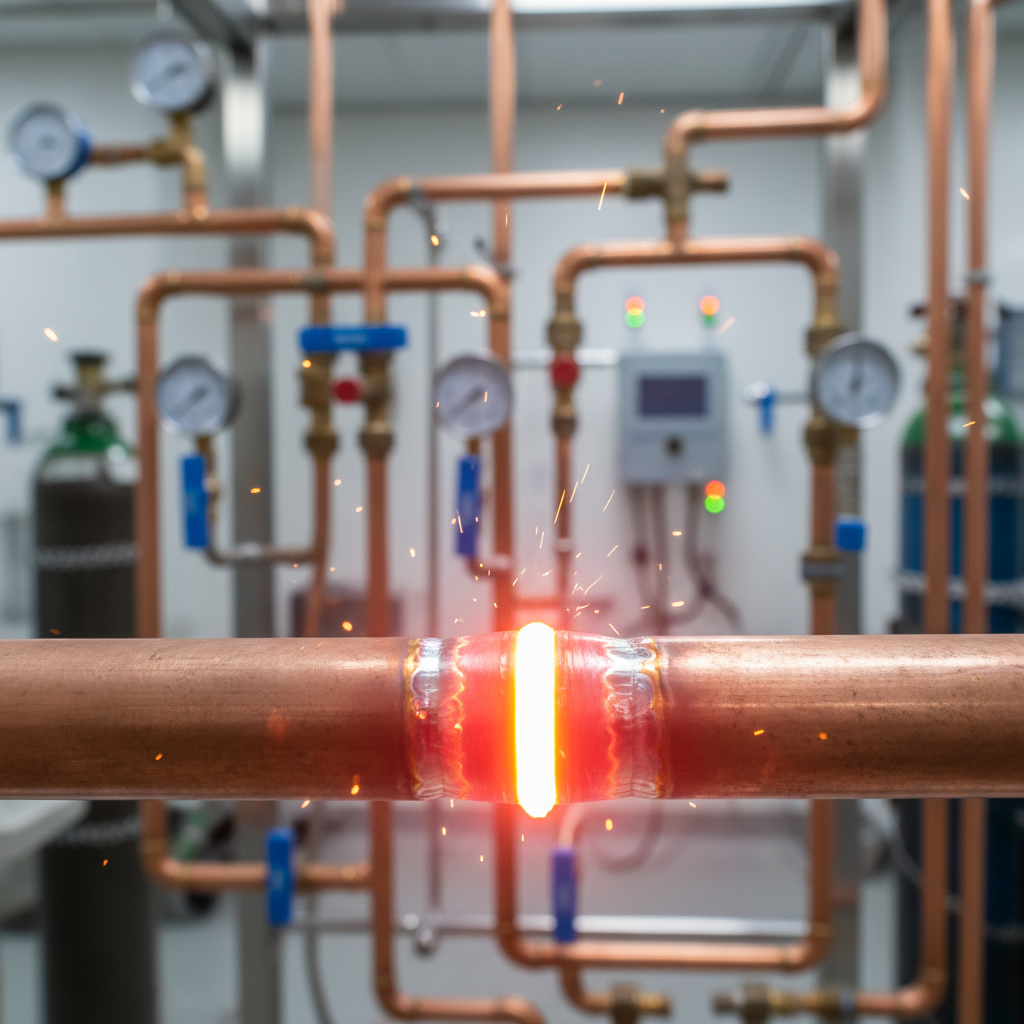
The most critical phase of the installation is the brazing of the copper pipes. This process creates the permanent, leak-proof joints that contain the high-pressure oxygen. It is not a job for a standard plumber; it requires a highly specialized and certified technician.
The Importance of Brazing and the ASSE 6010 Credential
NFPA 99 mandates that all installers of medical gas and vacuum systems be certified to ASSE Standard 6010. This certification ensures the individual has passed a rigorous written and practical exam on all aspects of system installation, including the specific procedures for brazing.
The brazing process itself involves heating the copper pipe and fitting and introducing a brazing alloy, which melts and is drawn into the joint by capillary action. During this process, an inert gas like nitrogen must be purged through the pipe to prevent the formation of copper oxides on the interior surface. These oxides can flake off and contaminate the gas stream or damage downstream equipment.
- Step 1: Precisely cut and de-burr the copper tubing.
- Step 2: Clean the tube end and fitting to ensure a perfect metal-to-metal fit.
- Step 3: Initiate a continuous nitrogen purge.
- Step 4: Apply heat evenly to the tube and fitting.
- Step 5: Introduce the brazing alloy to create a sealed joint.
- Step 6: Allow the joint to cool completely before stopping the nitrogen purge.
Medical Testing Solutions employs a team of ASSE 6010 certified installers who are experts in these precise procedures, ensuring every joint is perfect.
Installation Component Comparison
| Component | Function | NFPA 99 Reference | Common Brands | Installation Consideration |
|---|---|---|---|---|
| Bulk Tank | Primary liquid oxygen storage | Chapter 5.1 | Chart, Cryofab | Requires concrete pad, vaporizer, and security fencing. |
| Manifold | Secondary/reserve gas supply | Chapter 5.1.3.4 | BeaconMedaes, Harris, Tri-Tech | Must be in a dedicated room with proper ventilation. |
| Zone Valve Box | Isolates specific zones | Chapter 5.1.4.8 | Amico, BeaconMedaes, Ohio Medical | Must be accessible and clearly labeled for the area it serves. |
| Area Alarm | Monitors pressure in a zone | Chapter 5.1.9 | Tri-Tech, Amico, BeaconMedaes | Location must be continuously monitored by hospital staff. |