Skip to content
    New: Medical Gas Outlet Retrofit & Rebuild Matrix — cross-reference legacy Chemetron, Ohio Diamond, Puritan-Bennett & more →
    ASSE Certified 24/7
    Medical Gas Service
    Compliance & Standards

    Hospital Oxygen System Installation in Roanoke, VA: Code Standards

    Medical Testing SolutionsNovember 7, 202614 min read
    Share
    Hospital Oxygen System Installation in Roanoke, VA: Code Standards

    Hospital Oxygen System Installation in Roanoke, VA: Code-Compliant Engineering & Verification

    Planning a hospital oxygen system installation in Roanoke, VA requires balancing stringent healthcare facility codes with high-stakes clinical demand. Whether expanding a regional medical center in the Roanoke Valley, building an ambulatory surgical facility, or upgrading aging central piping infrastructure, patient safety relies entirely on system purity, pressure stability, and structural integrity.

    From bulk liquid cryogenic storage and emergency supply connections to interior distribution manifolds, Zone Valve Box (ZVB) assemblies, and clinical headwalls, every inch of medical gas piping must adhere to rigid life-safety standards. Medical Testing Solutions (MTS) provides turnkey equipment procurement, code consulting, and field execution across Virginia. In this comprehensive guide, healthcare facility directors, mechanical contractors, and clinical engineers will learn the step-by-step engineering principles, Virginia-specific regulatory frameworks, ASSE 6010 brazing protocols, and independent ASSE 6030 verification requirements necessary to deliver an uncompromising medical oxygen delivery network.


    1. Regulatory Framework: Virginia Building Codes and NFPA 99

    In Virginia, healthcare construction operates under the Virginia Uniform Statewide Building Code (VUSBC), which incorporates the International Building Code (IBC) and directly references NFPA 99: Health Care Facilities Code (specifically the 2012, 2015, or 2018/2021 editions depending on the exact project permit cycle and Virginia Department of Health guidelines). | Diagram text | |, | | Virginia Uniform Statewide Building Code (VUSBC) | | NFPA 99: Health Care Facilities Code | | - Chapter 5: Gas and Vacuum Systems | | - Category 1 (Life Support) Requirements | | ASSE Series 6000 CGA Guidelines | | - 6010 Installers - CGA G-4.1 (Clean) | | - 6030 Verifiers - CGA M-1 & P-18 | Under NFPA 99 Section 5.1, hospital medical oxygen is designated as a Category 1 piped gas system. A Category 1 failure is defined as any system interruption or contamination that could cause major injury or death to patients. Therefore, installing an oxygen network in a Roanoke hospital requires adherence to three critical regulatory pillars:

    1. NFPA 99 (Chapter 5): Dictates central supply sizing, minimum redundancy, valve placement, local and master alarms, and final piping verification testing.
    2. CGA (Compressed Gas Association) Standards: Governs bulk liquid storage setbacks (NFPA 55 / CGA M-1), cryogenic storage vaporizers, cylinder handling, and system cleanliness (CGA G-4.1).
    3. ASSE Series 6000 Professional Qualifications Standard: Mandates that tradesmen installing the piping hold active ASSE 6010 certification and that independent third-party inspectors hold ASSE 6030 credentials.

    Why this matters for compliance: The Virginia Department of Health (VDH) Office of Licensure and Certification, along with accreditation bodies such as The Joint Commission (TJC) and DNV, will immediately issue a statement of deficiencies or withhold certificate-of-occupancy clearances if brazing logs, purge records, or third-party ASSE 6030 verification reports are missing or non-compliant.

    When you contract medical gas installation services, your mechanical team must coordinate directly with local Roanoke municipal code inspectors and institutional risk management teams prior to torching the first joint.


    2. Bulk Liquid Oxygen (VIE) vs. High-Pressure Manifolds

    Selecting the central supply source depends on peak consumption, average volume per bed, and campus logistics. In Roanoke's medical infrastructure, ranging from flagship tertiary hospitals to outpatient cancer centers, source configurations generally fall into two categories:

    Bulk Cryogenic Liquid Oxygen (VIE Systems)

    Vacuum Insulated Evaporator (VIE) systems are the standard for acute-care hospitals with substantial inpatient beds, intensive care units (ICUs), and busy operating suites. A bulk liquid oxygen system stores liquid oxygen (LOX) at temperatures around -297°F (-183°C). The installation includes:

    • Primary cryogenic storage vessel.
    • Secondary reserve cryogenic vessel or an auxiliary high-pressure cylinder reserve manifold sized for at least a 24-hour peak supply (NFPA 99, Section 5.1.3.5.11).
    • Ambient atmospheric vaporizers configured in parallel circuits with automatic or manual switching to prevent frost buildup and pressure drop.
    • Pressure regulating manifolds dropping line pressure to the hospital main operating pressure (typically 50 to 55 psig).

    Bulk systems must also feature an Emergency Oxygen Supply Connection (EOSC) mounted on the building's exterior. This allows an emergency mobile tanker to feed the hospital's central distribution pipeline directly during catastrophic primary tank failures or supply chain disruptions.

    High-Pressure Cylinder Manifolds

    For standalone surgical centers, endoscopy suites, emergency clinics, or auxiliary wings, high-pressure gas cylinder manifolds are the more practical, cost-effective choice:

    • Fully Automatic Manifolds: Dual-bank systems that alternate banks automatically via pressure transducers and solenoids without downstream pressure fluctuations.
    • Header Configurations: Commonly staggered from $2 \times 2$ (4 cylinders) up to $10 \times 10$ (20 cylinders) using high-pressure copper or stainless steel pigtails equipped with CGA 540 connections and check valves.
    ParameterBulk Cryogenic Liquid Oxygen (VIE)Automatic High-Pressure ManifoldHybrid / Micro-Bulk System
    Typical ApplicationAcute-care hospitals (100+ beds), trauma centersAmbulatory surgery, specialty clinics, rural ERsCommunity hospitals (25-75 beds), large surgical centers
    Footprint RequirementExtensive exterior pad with truck access & NFPA 55 setbacksDedicated interior room with 1-hr/2-hr fire ratingCompact exterior pad or specialized gas room
    Initial Capital CostHigh (civil works, pads, piping, leasing)Moderate (manifold, headers, ventilation)Moderate-to-High
    Operating CostLowest cost per cubic foot of gasHigher cost due to cylinder leasing and laborModerate
    NFPA 99 RedundancyRequires primary, secondary, and reserve (or EOSC)Requires automatic switchover between primary and secondaryDual micro-bulk or liquid with high-pressure reserve
    Pressure StabilityContinuous 50–55 psig through dual dual-stage regulatorsElectronic monitoring with negligible switchover dropDual-stage line regulators with electronic monitoring

    Choosing the right system components is streamlined when working with a partner that distributes our products from industry-leading medical gas manufacturers alongside engineering expertise.


    3. Interior Distribution: Risers, Zone Valve Boxes, and Headwalls

    Once oxygen enters the facility from the bulk pad or manifold room, the interior piping network must be routed to deliver uninterrupted flow to every patient station. Designing this distribution network requires precise hydraulic calculations, branch sizing, and zone isolation planning.

    Distribution Risers & Main Lines

    Main oxygen pipelines typically run through interstitial spaces, ceiling plenums, or service corridors. Pipe sizing must factor in total connected load, diversity factors, and permissible friction loss so that the most remote clinical terminal unit receives at least 50 psig at maximum flow (minimum flow capacity of 200 LPM per outlet in critical care areas).

    Zone Valve Boxes (ZVB)

    Zone valve boxes provide immediate localized shutoff during room fires, maintenance shutdowns, or downstream emergencies. NFPA 99 mandates strict placement criteria:

    • Operating Rooms: A dedicated zone valve box must serve each individual operating room and be accessible immediately outside the surgical suite entrance.
    • Critical Care Areas: Dedicated valves must control ICUs, NICUs, and PACUs without isolating non-critical zones.
    • Egress Visibility: Valves must never be installed behind locked doors, inside utility closets, or down obscured utility corridors.
    • Sensory Identification: Each valve must be labeled with the specific gas ("OXYGEN"), operating pressure (50-55 psig), and the exact rooms and bed stations it controls. | Diagram text | |, | | MAIN SUPPLY RISER | | Floor Isolation Valve Floor Isolation Valve | | (Service Access Corridor (Service Access Corridor | | Zone Valve Box (ZVB) Zone Valve Box (ZVB) | | (Outside Operating Suite (Outside ICU/PACU Pod) | | Area Alarm Panel Area Alarm Panel | | (Nurse Station Console) (Nurse Station Console) | | Ceiling Booms / Headwall Patient Room Outlets | | Quick-Connect Terminals D.I.S.S. / Chemetron |

    Area and Master Alarm Integration

    Zone valve installations are electrically and mechanically twinned with Area Alarm Panels. NFPA 99 Section 5.1.9 requires area alarms to monitor line pressure immediately downstream of the zone valve. If line pressure fluctuates by $\pm 20%$ (dropping below 40 psig or spiking above 60 psig for a standard 50 psig system), an audible and visual alarm must trigger at the local nurses' station.

    Simultaneously, Master Alarm Panels, monitored at two separate 24/7 staffed locations (typically the hospital building automation engineering office and security dispatch), track bulk tank levels, line pressures, reserve status, and manifold switchovers.


    4. ASSE 6010 Installation: Brazing, Nitrogen Purging, and Materials

    Standard plumbing techniques have no place in a life-safety medical oxygen line. The combination of pure oxygen, elevated pressures, and hydrocarbons creates an extreme fire and explosion hazard. All piping must conform to strict fabrication guidelines governed by NFPA 99 Section 5.1.10.

    Material Specifications

    • Piping: Seamless copper tube conforming to ASTM B819, hard-drawn, marked either "Type K" or "Type L", and specifically cleaned and bagged by the manufacturer for medical gas service (labeled "OXY", "MED", or "OXY/MED").
    • Fittings: Wrought copper fittings conforming to ASME B16.22, or brazed socket fittings. Every fitting must be factory-cleaned, individually bagged, and kept capped until the exact moment of fit-up.
    • Cleaning Agents: If unsealed fittings or field cuts become contaminated, cleaning must follow CGA G-4.1 protocols using specialized non-hydrocarbon solvents; standard petroleum-based cutting oils are strictly prohibited.

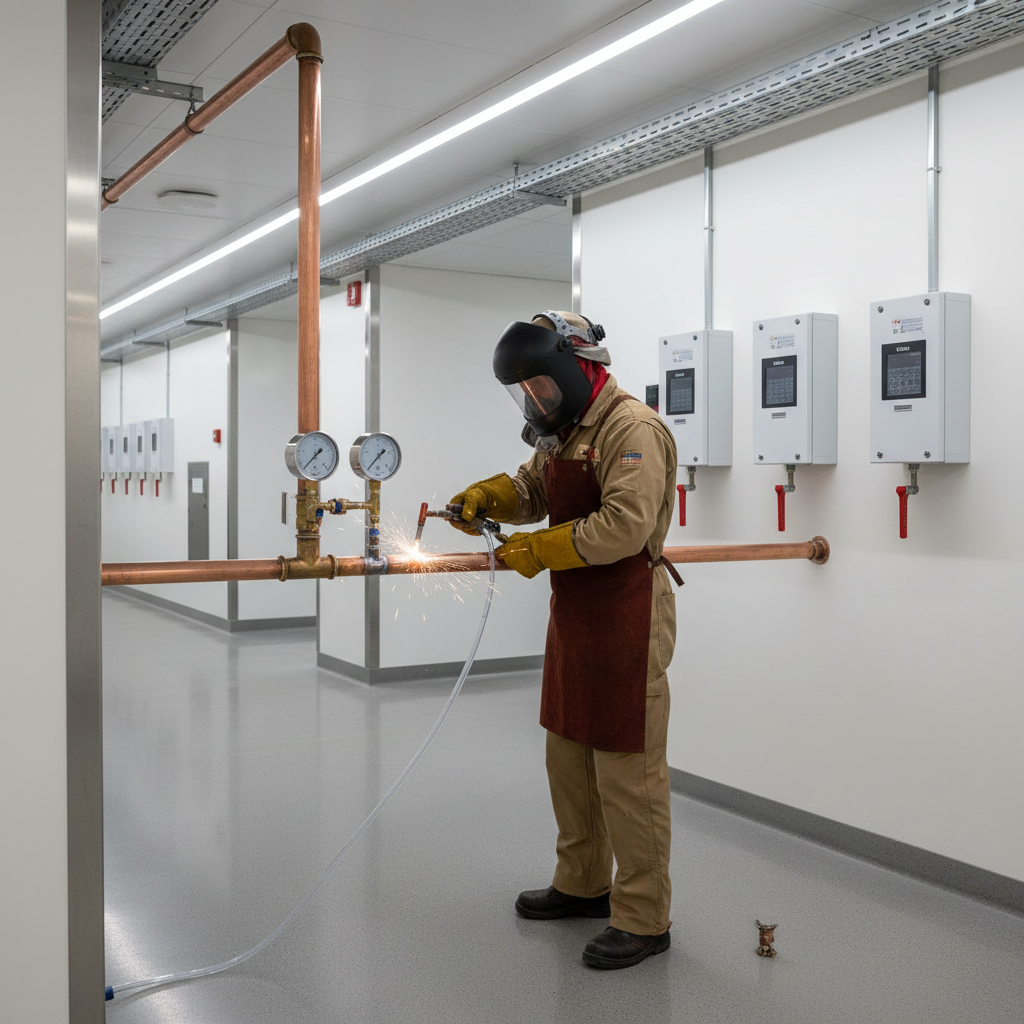
    The Nitrogen Purge Protocol (NFPA 99 Section 5.1.10.5.5)

    The most critical procedural step during copper brazing is the continuous dry nitrogen purge. When copper is heated to brazing temperatures (above 1,000°F / 538°C) in the presence of air, copper oxide scale immediately forms on the inner wall of the pipe. When oxygen later flows through the line, this scale flakes off, clogging terminal unit orifices, destroying ventilator valves, and potentially creating friction sparks in pure oxygen. | Diagram text | |, |

    1. Purge Gas Quality: Oil-free, dry Nitrogen NF must be used.
    2. Purge Flow Rate: The gas must flow continuously through the interior of the pipe at low pressure (typically 1 to 5 SCFH) to prevent atmospheric oxygen intrusion without chilling the joint.
    3. Oxygen Deficit Verification: Installers use an oxygen analyzer at the discharge point of the brazed run to verify that residual atmospheric oxygen is under 1% before applying heat.
    4. Brazing Filler Metal: BCuP series alloys (copper-phosphorus or copper-phosphorus-silver) without flux are required for copper-to-copper joints. Flux is strictly prohibited on copper-to-copper connections because residual flux corrosive salts degrade into systemic gas contaminants. Flux is only permitted (and strictly controlled) on dissimilar metals, such as copper-to-brass valve connections, using specialized BAg silver alloys.

    Following complete rough-in, the mechanical contractor must conduct initial pressure tests at 1.5 times the operating pressure (minimum 150 psig) using oil-free dry nitrogen for 24 hours to prove preliminary system tightness. To ensure complete compliance, hospitals in the Roanoke area rely on certified teams for medical gas maintenance services and installation management.


    5. The Critical Role of Independent ASSE 6030 Verification

    A mechanical contractor cannot sign off on their own work. NFPA 99 Section 5.1.12 explicitly mandates that before any medical gas piping network is placed into service or concealed behind drywall, it must undergo third-party ASSE 6030 Medical Gas System Verification. | Diagram text | |, | | ASSE 6030 VERIFICATION SUITE | | - Nitrogen purge at extreme flow rates to clear debris | | - 24-hour hold at 20% over working pressure (clean N2) | | - Systematically testing lines against Nitrous, Air, Vac | | - Actuating all ZVBs, Master & Area alarm cutouts (+/-20%) | | - Millipore particulate checks (<1 mg per 1,000 L) | | - Dew point (H2O), CO, CO2, and total halogenated organics |

    The Seven Phases of NFPA 99 System Verification

    Medical Testing Solutions provides end-to-end medical gas verification to ensure every station meets rigorous purity and structural standards:

    1. Initial Blowdown Test: High-velocity dry nitrogen is flushed through each outlet to dislodge any residual particulate or dust introduced during construction.
    2. Initial Cross-Connection Test: Individual gas pipelines are systematically pressurized and depressurized one at a time. The ASSE 6030 verifier confirms that when the oxygen line is pressurized, no pressure registers at medical air, nitrous oxide, carbon dioxide, or vacuum outlets.
    3. Standing Pressure Test: The piping network is pressurized to 20% above normal system operating pressure (typically 60–65 psig for oxygen) using dry nitrogen for a full 24-hour period. Adjusting for temperature variations, the system must display zero pressure drop.
    4. Valve Inspection and Operational Testing: Every zone valve box, line shutoff valve, and check valve is inspected for correct labeling, direction of flow, accessibility, and pressure drop.
    5. Alarm System Calibration & Functionality: Area alarm sensors are calibrated to verify visual and audible signals trip accurately when pressure drops to 40 psig or rises to 60 psig. Master alarm panel functions, switches, and remote communications are simultaneously validated.
    6. Piping Particulate & Purity Testing: Verifiers sample gas from remote outlets through a 0.45-micron Millipore filter. Particulate content must not exceed 1 mg per 1,000 liters. The gas is also tested for dew point (moisture content must not exceed -40°F/-40°C at 50 psig), total hydrocarbons, carbon monoxide, carbon dioxide, and halogenated solvents.
    7. Operational Concentration Test: Once nitrogen has been evacuated and the system is charged with USP grade medical oxygen, every single station outlet is analyzed with an electrochemical oxygen analyzer. The verifier must witness and record an oxygen concentration of 99.0% or greater at 100% of the patient terminal drops.

    6. Roanoke Regional Considerations: Permitting, Seismic, and Logistics

    Executing an oxygen system installation within Roanoke, Virginia presents specific regional considerations:

    • Local Permitting and Inspections: The City of Roanoke Planning, Building & Development Department enforces commercial mechanical and fire protection codes strictly. Plans must bear the stamp of a Virginia-registered Professional Engineer (PE). Plan reviews verify bulk tank separation distances from property lines, public ways, and building openings per NFPA 55 and IBC Chapter 4.
    • Geotechnical and Seismic Restraints: While Roanoke does not face the severe seismic activity of the Pacific coast, the western Appalachian mountain zone is classified under Seismic Design Categories B and C. NFPA 99 and IBC Section 1613 require seismic bracing for medical gas piping greater than or equal to 1-inch nominal diameter, as well as seismic-certified tiedowns for exterior bulk cryogenic tanks, vaporizers, and large cylinder manifolds.
    • Weather & Atmospheric Conditions: Roanoke experiences freeze-thaw cycles during Appalachian winters. Atmospheric vaporizers on bulk VIE pads must be calculated and elevated to prevent ice damming. Redundant ambient vaporizer circuits must be spaced adequately to allow natural thermal convection, avoiding line-chilling dropouts that cause liquid oxygen carryover into the indoor distribution main.
    • Specialized Clinical Areas: If the installation connects to hybrid operating suites, wet procedure rooms, or critical cardiac care facilities, mechanical designers must coordinate with electrical contractors. Where isolated power systems are installed in wet procedure rooms, ensure certified line isolation monitor testing is scheduled concurrently to achieve integrated operating room compliance.

    7. Ongoing Compliance: Annual Verification and Preventive Maintenance

    Achieving an initial certificate of occupancy is only the first step. Accrediting agencies, such as The Joint Commission under Environment of Care (EC) Standard EC.02.05.09, mandate continuous lifecycle tracking of all central piped gas systems. | Diagram text | |, | | Initial ASSE 6030 Verification | | (100% Outlets, Valves, Alarms) | | Annual Inspections Semi-Annual Checks | | - Secondary Leaks - Relief Valves | | - Flow/Pressure - Manifold Seals | | - Sensor Drift - Bulk Level Gauges | Hospitals must maintain a complete compliance binder containing:

    • The original ASSE 6030 verification certificate and pipe purge logbooks.
    • As-built mechanical drawings documenting every hidden riser, ceiling valve, and station terminal.
    • Documentation of annual medical gas inspections assessing physical condition, alarm trigger setpoints, leak rate decay, and headwall terminal unit retention force.
    • Routine calibration logs showing that pressure switches and transducers maintain sensitivity within design tolerances.

    By partnering with an organization that provides both comprehensive equipment solutions and lifetime facility certification, healthcare systems ensure that their infrastructure remains safe, compliant, and ready for immediate clinical delivery.


    Upgrade Your Roanoke Medical Gas Infrastructure with MTS

    Whether executing a new hospital wing expansion, retrofitting an existing zone valve layout, or preparing for an ASSE 6030 third-party commissioning inspection, Medical Testing Solutions delivers industry-leading expertise. Our team of certified ASSE 6010 installers and ASSE 6030 verifiers ensures your clinical gas networks are delivered on time, fully documented, and uncompromisingly safe.

    Contact our medical gas engineering team today:


    Frequently Asked Questions

    Under NFPA 99 Section 5.1.10.11.10, any individual brazing or assembling Category 1 medical gas piping must be qualified to ASSE Standard 6010. Furthermore, brazers must hold performance qualification testing documentation in accordance with ASME Section IX or AWS B2.2. Mechanical contractors must maintain copies of these active certifications on-site throughout the project in Roanoke.

    No. NFPA 99 Section 5.1.12.1.2 explicitly prohibits the installing contractor, system designer, or equipment manufacturer's sales distributor from performing the final ASSE 6030 system verification. Verification must be performed by an independent, certified ASSE 6030 Medical Gas Systems Verifier who has no financial or direct operational interest in the construction contract.

    Bulk oxygen storage falls under NFPA 55 (Compressed Gases and Cryogenic Fluids Code) and NFPA 99. Minimum separation distances depend on tank volume and whether fire walls are installed. Generally, bulk liquid oxygen tanks must be placed at least 25 to 50 feet away from property lines, public sidewalks, aboveground flammable liquid storage, and non-fire-rated building openings. Distances can be reduced using specifically engineered 2-hour or 4-hour fire barrier walls approved by the local Roanoke building official.

    According to NFPA 99 Section 5.1.12.3.7, the particulate test requires filtering a minimum of 1,000 liters (35 cubic feet) of test gas through a 0.45-micron filter. The test fails if the filter paper displays more than 1 milligram of particulate matter. Additionally, the gas stream must be completely free of oil, visible moisture, and hydrocarbon residues.

    Standard compressed air contains approximately 21% atmospheric oxygen and varying levels of moisture. Heating copper pipe in the presence of oxygen causes rapid interior oxidation, coating the interior surface with black cupric oxide scale. Piped dry nitrogen is an inert, chemically unreactive gas that displaces atmospheric oxygen inside the pipe, preventing interior scale formation during brazing.

    This article is provided for educational purposes and reflects industry standards as of publication. Always verify against current NFPA 99, CGA, and AHJ requirements. Medical Testing Solutions is ASSE-certified and ready to help — contact us for facility-specific guidance.

    Request a quote for your facility

    Talk with Medical Testing Solutions about your next inspection, repair or equipment request.

    Get a quote in 1 business day

    I agree to receive text messages from Medical Testing Solutions, L.L.C. at the phone number provided, including informational and marketing messages. Consent is not a condition of purchase. Message frequency varies. Message & data rates may apply. Reply STOP to opt out or HELP for help. See our Privacy Policy and Messaging Terms.

    Prefer to talk? Call (754) 315-1078

    Related articles