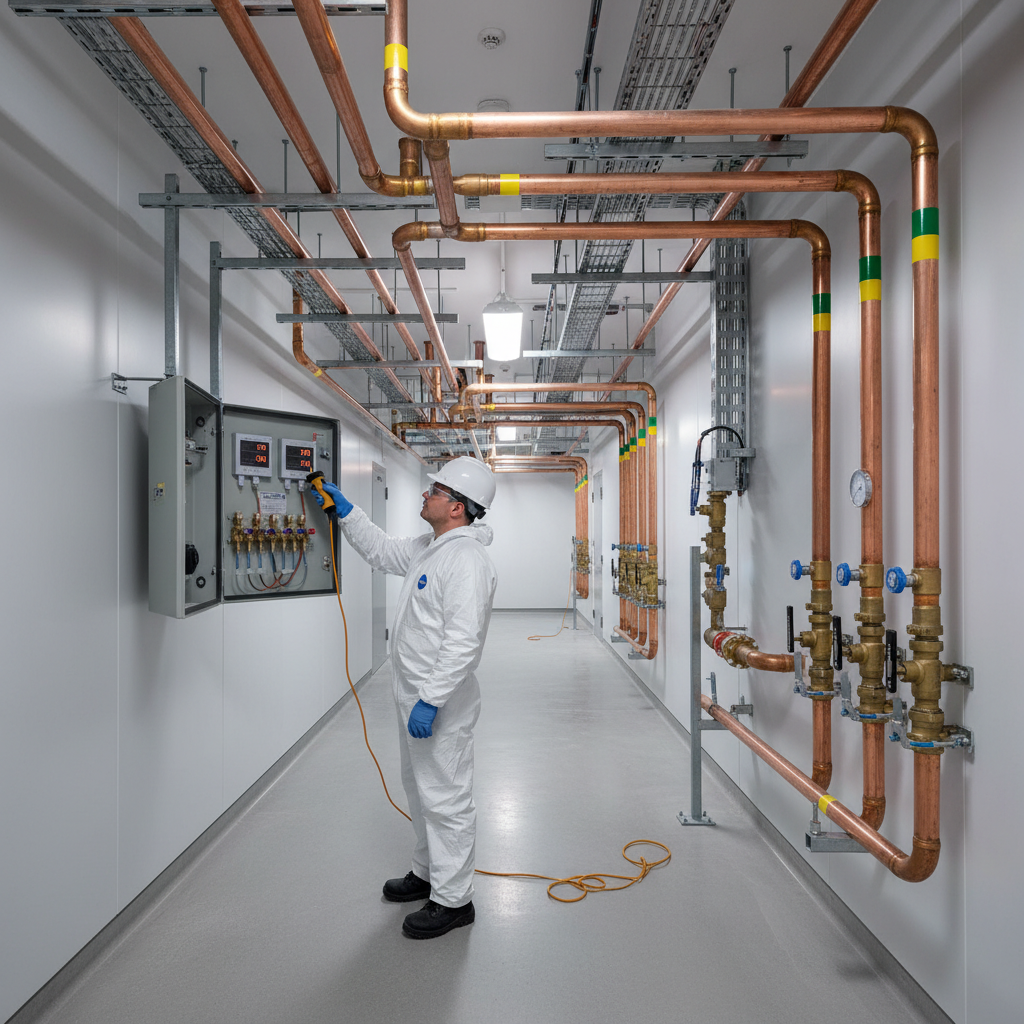
Hospital Oxygen System Installation Newport News VA
Planning and executing a hospital oxygen system installation in Newport News, VA demands strict compliance with life-safety codes, rigorous engineering, and precise field craftsmanship. Medical oxygen is classified as a Category 1 piped gas system under NFPA 99 (Health Care Facilities Code). A Category 1 failure can cause major injury or death to patients relying on continuous life support. Whether your facility is expanding surgical suites along the Hampton Roads medical corridor or retrofitting a central bulk liquid storage yard, every component, from cryogenic bulk tanks and high-pressure manifold reserves to branch lines, zone valve boxes, and area alarms, must be installed and validated without compromise.
In this guide, facility managers, healthcare mechanical engineers, and general contractors will learn the technical roadmap for medical oxygen pipeline installations in Newport News. We cover system design parameters, NFPA 99 (2021/2024 editions) and NFPA 55 requirements, Virginia Uniform Statewide Building Code (VUSBC) alignment, ASSE 6010 medical gas brazing procedures, and third-party ASSE 6030 verification testing.
Technical Fundamentals: Category 1 Oxygen Piping Architecture
Under NFPA 99 Section 5.1, medical oxygen delivery networks require dedicated central supply systems, dual-line pressure regulation, dual-source fail-safes, and continuous monitoring. In modern acute care hospitals, central oxygen infrastructure is broken into three critical domains:
- The Primary Source (Bulk Cryogenic Liquid System): Vacuum-insulated liquid oxygen (VIE/LOX) bulk tanks operating with ambient air vaporizers.
- The Secondary and Reserve Sources: Secondary liquid cryogenic vessels or auxiliary high-pressure gaseous cylinder manifolds capable of sustaining the facility's average daily demand during an interruption of the primary source.
- The Distribution Piping Network: ASTM B819 medical-grade seamless copper piping, master alarms, zone valve boxes (ZVBs), area alarm panels, and terminal station outlets.
Medical Testing Solutions (MTS) provides nationwide equipment sourcing and technical field services, supporting general contractors and hospital engineers throughout the Newport News and Tidewater region to design, source, and certify these mission-critical pipeline systems. | Diagram text | |, | | NFPA 99 Medical Oxygen Architecture | | +, + +, + | | Primary LOX Bulk Tank Secondary LOX / Reserve | | +, +, + +, +, + | | +, +, + | | [Dual Pressure Regulators] | | [Main Line Shutoff Valve] | | +, +, + | | Master Alarm Panel | | +, +, + | | [Risers & Main Distribution] | | +, +, + | | [Floor Shutoff Valve] [Floor Shutoff Valve] | | [Zone Valve Box (ZVB)] [Zone Valve Box (ZVB)] | | [Area Alarm Panel] [Area Alarm Panel] | | [Station Outlets (ICU/OR)] [Station Outlets (Patient Rooms)] |
Sizing and Siting Bulk Oxygen Systems in Newport News
Cryogenic bulk oxygen systems are governed by both NFPA 55 (Compressed Gases and Cryogenic Fluids Code) and NFPA 99 Chapter 5. Siting a bulk oxygen installation in Newport News requires navigating specific environmental, structural, and regulatory criteria unique to coastal Virginia.
Wind, Seismic, and Flood Loading
Newport News sits within a coastal exposure zone where high wind loads, seasonal tropical storms, and localized coastal flooding dictate foundation engineering. Concrete pad designs for bulk LOX tanks and atmospheric vaporizers must account for:
- Elevated wind load calculations in accordance with ASCE 7 and the Virginia Construction Code.
- Anchorage design capable of securing vertical cryogenic vessels weighing up to 40,000+ pounds when fully charged.
- Adequate clearance above local FEMA base flood elevations (BFE) to protect critical cryogenic valves, pressure relief assemblies, and telemetry units.
Distance Separation Requirements (NFPA 55 & NFPA 99)
Bulk oxygen storage pads require absolute physical separation from surrounding site hazards to mitigate combustion risks. Oxygen accelerates burning dramatically; organic compounds, hydrocarbons, and standard asphalt can ignite or explode on direct contact with liquid oxygen.
Key separation distances per NFPA 55 include:
- Asphalt Pavement: 0 feet of asphalt within 3 feet of LOX filling connections or pressure relief discharge outlets. Bulk pads and surrounding unloading ramps must be made of poured, non-combustible concrete.
- Property Lines & Buildings: Minimum 5 to 50 feet, depending on exterior wall fire-resistance ratings and opening protection (doors/windows).
- Combustible Materials & Vegetation: Minimum 25-35 feet from wood structures, brush, and landscaped greenery.
- Flammable Gas Storage: Minimum 50 to 90 feet from fuel gas cylinders or bulk hydrogen/propane storage tanks.
- Overhead Power Transmission: Minimum 50 feet horizontally from high-voltage transmission lines.
Emergency Oxygen Supply Connection (EOSC)
NFPA 99 Section 5.1.3.5.14 mandates that all hospitals relying on bulk oxygen have an Emergency Oxygen Supply Connection (EOSC). This is a secure, weather-protected physical connection mounted on the exterior of the hospital. If the primary bulk pad fails, suffers physical damage, or runs out of product, an emergency portable liquid trailer can be connected immediately without entering the facility.
The EOSC must feature:
- Physical protection from vehicular impact (bollards).
- A check valve to prevent backflow into the primary system.
- A manual shutoff valve.
- A pressure relief valve set upstream of the facility main shutoff.
- Connection to the master alarm system to annunciate when the emergency connection is in use.
High-Pressure Oxygen Manifolds & Reserve Architecture
Facilities that cannot accommodate a cryogenic bulk tank, or large medical centers needing localized emergency back-up, rely on automatic changeover high-pressure cylinder manifolds.
Under NFPA 99 Section 5.1.3.5.10:
- Manifolds must have two equal banks of high-pressure cylinders (typically standard H- or K-size cylinders containing USP medical oxygen at 2,000 to 2,640 psig).
- The system must provide automatic changeover from the depleted service bank to the full secondary bank without dipping below the line delivery pressure of 50 to 55 psig.
- Intermediate pressure relief valves and dual line regulators ensure continuous flow even during component service.
| Component Spec | Primary Cryogenic Bulk (VIE) | Automatic Changeover Manifold | Reserve Manifold (Auxiliary) |
|---|---|---|---|
| Typical Capacity | 1,500 to 11,000+ Gallons | 4 to 30 Cylinders (2x2 to 15x15) | Minimum 24-hour facility demand |
| Operating Pressure | 150 - 250 psig vessel / 50-55 psig line | 2,200 psig inlet / 50-55 psig line | 2,200 psig inlet / 50-55 psig line |
| Code Requirement | NFPA 99 Sec 5.1.3.5.11; NFPA 55 | NFPA 99 Sec 5.1.3.5.10 | NFPA 99 Sec 5.1.3.5.13 |
| Location | Exterior secure concrete pad | Dedicated 1-hr fire-rated room | Integrated with bulk yard or header |
| Ventilation | Outdoor ambient dissipation | Minimum 1 CFM/sq. ft. direct exterior | Outdoor or mechanically ventilated |
| Monitoring | Liquid level, reserve in use, line PSI | High/low line PSI, bank changeover | Reserve in use, low reserve contents |
When sourcing manifolds, engineers must ensure the changeover system uses medical-grade brass headers, stainless steel pigtails equipped with check valves, and digital monitoring nodes that tie directly into the hospital's Building Automation System (BAS) and the master alarm panels. You can explore standard compliance-rated manifolds within our medical gas products catalog.
Piping Network Installation: ASSE 6010 Brazing Standards
The medical gas distribution piping is the vascular system of the hospital. Installing medical oxygen lines requires specialized methods that diverge significantly from standard commercial plumbing or hydronic HVAC lines.
Medical Testing Solutions requires all pipeline contractors executing healthcare work to hold current ASSE 6010 (Medical Gas Systems Installer) certification. In Virginia, local building inspectors and healthcare facility commissioning authorities enforce strict adherence to ASSE Series 6000 standards.
Material Specifications
- Tubing: Must be seamless copper tube conforming to ASTM B819, Type K or Type L, marked specifically as "OXY," "MED," "OXY/MED," or "OXY/ACR."
- Cleanliness: Tubing must be factory-cleaned, degreased, and capped or plugged by the manufacturer to prevent particulate and hydrocarbon contamination.
- Fittings: Wrought copper fittings conforming to ASME B16.22, cleaned specifically for oxygen service per CGA G-4.1.
Why this matters for compliance: Introducing oils, grease, or particulate debris into an oxygen line creates an immediate risk of catastrophic ignition when pressurized with pure oxygen. Furthermore, airborne contaminants can be inhaled by critically ill patients. ASTM B819 piping guarantees zero hydrocarbon residue from manufacturing.
ASSE 6010 Nitrogen Purge Brazing Protocol
The single most critical mechanical procedure during an oxygen line installation is the continuous dry nitrogen purge.
When copper is heated to brazing temperatures (above 1,000°F / 538°C) in the presence of air, copper oxide scale immediately forms on the interior pipe walls. In a medical oxygen line, this scale flakes off, clogging downstream terminal valves, ventilator filters, and patient flowmeters. | Diagram text | |, | | ASTM B819 Tube >>>>>>>>>>>>>>>>>>>>>>>>>>>>>>>>>>>>>> ASTM B819 Tube | The installer must follow this explicit sequence:
- Purge Setup: Connect a cylinder of oil-free Dry Nitrogen (NFPA 99 Section 5.1.10.5.5) using a dedicated regulator and flowmeter.
- Displacement: Establish a continuous, low-pressure flow (typically 5 to 15 CFH) through the piping segment before applying heat. An oxygen analyzer should verify the exit gas contains less than 1% oxygen before striking the torch.
- Filler Metal: Use a BCuP (phosphorus-copper-silver) brazing alloy without chemical flux. Flux is prohibited on copper-to-copper joints because it leaves corrosive, toxic residues that cannot be flushed out of medical gas lines. Flux is only permitted (with ASSE 6010 approval) when joining copper pipe to brass or bronze valves, applied sparingly to the male fitting only.
- Active Maintenance: Maintain the nitrogen purge until the joint cools below oxidation temperature (dark heat).
- Post-Braze Inspection: Visually inspect joints for complete fillet formation and absence of burn-through.
For complex hospital wing modernizations, facilities often contract our specialized team for turnkey medical gas installation services to ensure all brazing procedures meet ASSE 6010 criteria.