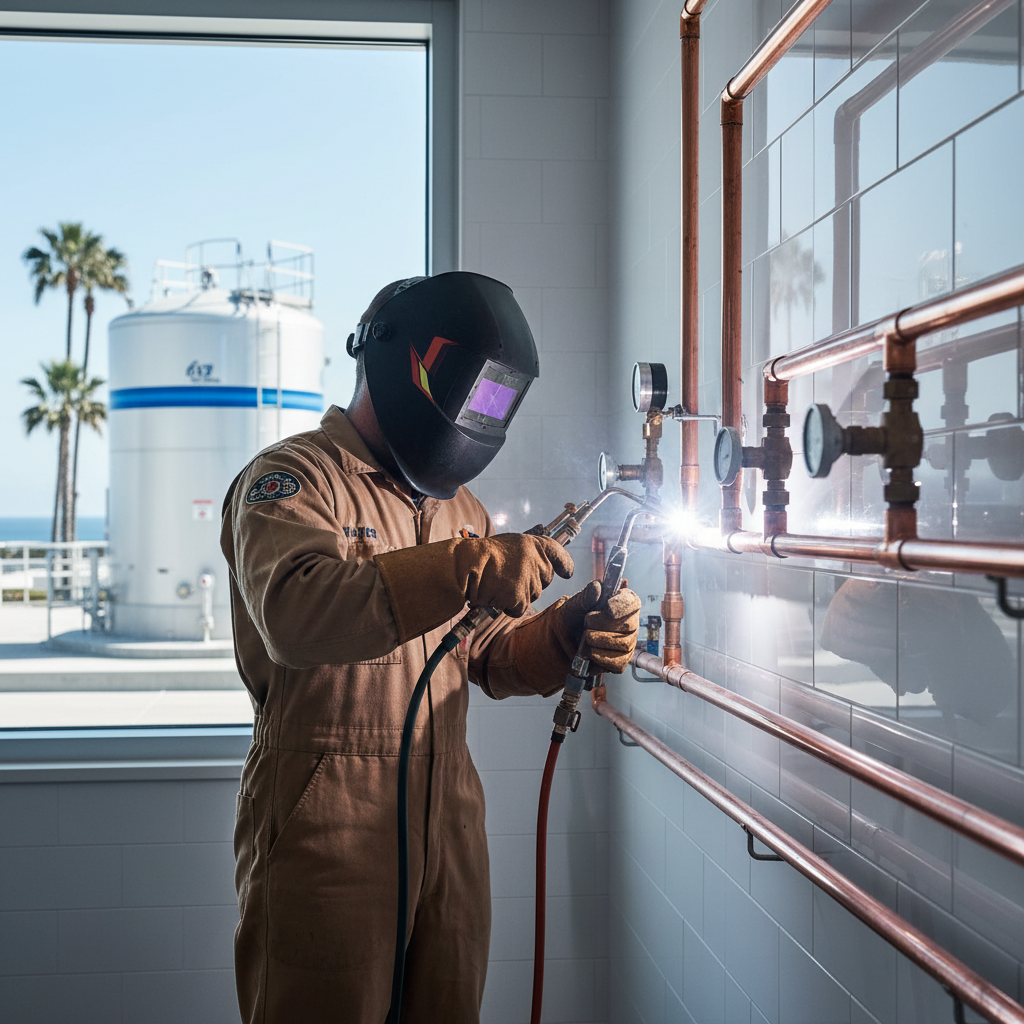
Hospital Oxygen System Installation Myrtle Beach SC: Turnkey Guide
Executing a compliant hospital oxygen system installation in Myrtle Beach, SC requires navigating strict technical parameters, coastal environmental factors, and rigorous regulatory codes. Whether outfitting a new surgical wing along the Grand Strand, expanding an intensive care unit, or upgrading bulk liquid storage to meet Category 1 facility demands, your pipeline infrastructure cannot afford procedural shortcuts.
Medical gas pipeline systems (MGPS) carry zero margin for error. A single contaminated joint, miscalculated pressure drop, or improperly placed zone valve threatens patient safety and triggers immediate regulatory citations from the South Carolina Department of Health and Environmental Control (DHEC) or The Joint Commission. This guide outlines the engineering, code compliance, brazing protocols, and third-party verification required for clinical oxygen delivery systems. From NFPA 99 (2021/2024 editions) mandates to coastal corrosion mitigation, discover the critical requirements governing bulk systems, manifolds, zone valves, and final ASSE 6030 acceptance testing.
The Regulatory Framework: NFPA 99, CGA, and South Carolina DHEC
In South Carolina, hospital infrastructure must satisfy overlapping tiers of federal, state, and local requirements. Medical oxygen systems are classified under NFPA 99: Health Care Facilities Code according to patient risk categories:
- Category 1 (Critical Care): Failure of the oxygen supply will cause major injury or death to patients (e.g., operating rooms, ICUs, emergency departments).
- Category 2 (General Care): Failure will cause minor injury or discomfort (e.g., general medical-surgical wards).
- Category 3 & 4: System failure has no physical impact on patients.
Most Myrtle Beach acute care facilities operate strictly under Category 1 protocols. Section 5.1 of NFPA 99 outlines central supply system arrangements, piping materials, shutoff locations, and monitoring architecture.
Furthermore, bulk oxygen storage configurations must adhere to NFPA 55 (Compressed Gases and Cryogenic Fluids Code) and standards published by the Compressed Gas Association (CGA), notably CGA M-1 (Guide for Medical Gas Installations at Consumer Sites) and CGA G-4.1 (Cleaning Equipment for Oxygen Service).
Why this matters for compliance: South Carolina DHEC Division of Health Facilities Construction conducts strict plan reviews and onsite surveys. Non-compliance with NFPA 99 Chapter 5 or unverified brazing logs will halt facility licensure and delay Certificates of Occupancy indefinitely.
Bulk Liquid Oxygen (VIE) Systems vs. High-Pressure Manifolds
Selecting the right central oxygen source depends on clinical demand, peak flow rates, and physical footprint. In Horry County, facilities typically utilize one of two primary supply designs, or a hybrid of both.
| Diagram text |
|, |
| TYPICAL HOSPITAL BULK SOURCE |
| +, + +, + +, + |
| Primary Bulk VIE Tank - → Secondary Storage - → Emergency Oxygen |
| (Liquid Cryogenic) (Reserve Liquid/Cyl) Connection (EOSC) |
| +, + +, + +, + |
| +, → Main Line →, + |
| [ Source Valve ] |
| ( Building Main ) |
1. Vacuum-Insulated Evaporator (VIE) Bulk Storage
Large hospitals utilize bulk liquid oxygen tanks installed outdoors on engineered concrete pads. Cryogenic liquid oxygen expands roughly 860 times when transitioning to gas, making it the most cost-effective solution for facilities with continuous high consumption.
- Main & Reserve Requirements: NFPA 99 Section 5.1.3.5.4 mandates an operational reserve supply. If the primary liquid container goes offline or drops below normal operating thresholds, the secondary supply must switch over automatically without line pressure disruption.
- Emergency Oxygen Supply Connection (EOSC): All Category 1 facilities fed by bulk systems must have an exterior EOSC (NFPA 99 5.1.3.5.13). This allows temporary mobile oxygen tankers to connect directly to the building pipeline during catastrophic failures, contamination events, or natural disasters.
2. High-Pressure Gas Cylinder Manifolds
Used in ambulatory surgery centers, specialized clinics, or as the reserve bank for smaller healthcare facilities:
- Automatic Switchover: Utilizes dual banks of high-pressure cylinders (typically 2,000 to 2,400 psig). When the operational bank depletes, a differential pressure shuttle switchover activates the reserve bank automatically.
- Header Architecture: Manifold headers must be manufactured from oxygen-compatible brass or stainless steel, equipped with check valves at each pigtail connection to prevent backflow during cylinder exchanges.
Supply Comparison: Bulk Liquid vs. High-Pressure Manifold
| Specification / Requirement | Bulk Cryogenic Liquid (VIE) | Automatic Cylinder Manifold |
|---|
| Facility Size Suitability | Mid-to-large hospitals (>50 beds) | Surgery centers, small clinics (<30 beds) |
| Operating Pressure | 50 to 55 psig (post-vaporizer) | 50 to 55 psig (secondary regulator) |
| Footprint Requirement | Extensive exterior pad with security fence | Dedicated, fire-rated interior gas room |
| NFPA 55 Separation Distances | Strict clearances (10–50 ft from hazards) | Standard 1- to 2-hour fire-rated enclosures |
| EOSC Mandate | Mandatory for Category 1 systems | Optional (unless system exceeds bulk thresholds) |
| Initial Capital Expenditure | High (civil works, pads, piping, telemetry) | Moderate (manifold, headers, line regulators) |
| Ongoing Gas Cost | Significantly lower per 100 cu ft | Higher due to cylinder handling/rentals |
Planning a source upgrade? Explore our full suite of medical gas products for industrial-grade manifolds, headers, and bulk regulating equipment.
Coastal Considerations for Horry County Installations
Installing a medical gas pipeline in Myrtle Beach demands special engineering to counter Atlantic coastal conditions. Salt spray, high humidity, and hurricane threats can rapidly degrade infrastructure if not mitigated.
- Atmospheric Vaporizer Corrosion: External ambient vaporizers are prone to rapid salt-induced oxidation. Specifications for coastal Myrtle Beach facilities should mandate heavy-wall structural marine-grade aluminum alloys or epoxy-coated components to prevent premature fin degradation.
- Exterior Piping Supports: Bulk discharge piping and EOSC runs exposed to the elements must utilize 316 stainless steel struts, clamps, and hardware. Unprotected zinc-plated carbon steel hardware rusts quickly in salt air, compromising pipeline anchoring.
- Seismic and Wind-Load Engineering: Horry County requires high wind-load ratings (often 140+ mph design wind speeds) under the International Building Code (IBC). Bulk tanks, vaporizers, and elevated pipe racks require site-specific structural engineering stamps to ensure survivability during major coastal storms.
Piping Architecture: Mains, Risers, and Zone Valve Boxes
Once oxygen exits the source supply at 50–55 psig, it routes through a strictly orchestrated distribution network.
| Diagram text |
|, |
Valve Placement Mandates (NFPA 99 Section 5.1.4)
- Source Valve: Placed directly at the central supply connection point to isolate the entire source.
- Main Line Valve: Positioned where the main pipe enters the building, accessible to emergency personnel.
- Riser Valves: Installed at the base of every vertical pipeline riser to isolate multi-story branches without disabling horizontal mains.
- Zone Valve Boxes (ZVBs): Placed outside the spaces they serve. In critical locations like operating rooms or ICUs, the ZVB must be situated immediately outside the entrance, fully visible, unobstructed, and labeled with specific area boundaries.
Sizing and Pressure-Drop Dynamics
Oxygen lines must be sized to limit dynamic pressure drop to under 5 psig across the entire distribution network during peak calculated flow. Undersized mains starve surgical booms, clinical ventilators, and hyperbaric suites when operational demands peak.
Our certified team at Medical Testing Solutions handles complete turnkey medical gas installation services, optimizing line sizing, valve layouts, and pressure drops from the initial BIM modeling stage to final pipe hangers.
ASSE 6010 Installation: Brazing, Purging, and Materials
The mechanical integrity of medical oxygen piping relies entirely on metallurgical purity and certified craftsmanship. Contractors cannot treat medical gas like plumbing or HVAC systems.
Copper Pipe Standards: ASTM B819
Only seamless copper tube marked Type K or Type L, cleaned and bagged specifically for medical gas service per ASTM B819, is permitted for field installation. Factory cleaning removes all residual manufacturing hydrocarbons. If oil or organic grease contacts pure oxygen under line pressure, catastrophic auto-ignition and pipeline explosions can result.
The ASSE 6010 Standard
Every pipe fitter handling and brazing your medical gas lines must hold an active ASSE 6010 Medical Gas Systems Installer credential. ASSE 6010 mechanics undergo rigorous testing in cleanroom piping protocols, continuous purge execution, and vacuum brazing techniques.
Continuous Nitrogen Purging: Zero Cupric Oxide
When copper is heated to silver brazing temperatures (1100°F–1500°F) in the presence of air, cupric oxide scale forms instantly on the interior pipe walls. This black, flaky particulate travels downstream, shredding regulator seats, jamming zone valves, and clogging life-support equipment.
To prevent this:
- NFPA 99 Section 5.1.10.5.5 mandates a continuous, positive-pressure shield of oil-free, dry Nitrogen NF flowing through the pipe during all heating and brazing operations.
- Installers must monitor the purge with an oxygen analyzer to ensure interior O2 concentrations remain below 1% before torch application.
- Purging must continue until the joint cools below color heat.
- Joints must be fabricated using silver brazing filler metal conforming to AWS A5.8 (BCuP series) without chemical flux. Flux is prohibited on copper-to-copper joints because its corrosive residue cannot be removed from closed pipeline networks.
Alarm Architecture: Area and Master Alarm Integration
Medical oxygen pipeline integrity must be constantly monitored by dual, redundant alarm architectures governed by NFPA 99 Section 5.1.9.
Master Alarm Panels
Two independent master alarm panels must be installed in separate locations staffed 24/7/365, such as the hospital central security control and the primary engineering plant office. The master alarms monitor:
- High and low line pressure (±20% variance from normal 50 psig operating pressure).
- Bulk cryogenic liquid levels and operational reserve status.
- Automatic manifold switchover signaling cylinder bank depletion.
- Emergency Oxygen Supply Connection (EOSC) active status.
Area Alarm Panels
Installed inside clinical stations (ICU nursing stations, surgical control desks, cath labs). Area alarms continuously monitor local pipeline pressures downstream of the zone valve boxes. Visual and audible indicators fire whenever pressure fluctuates ±20% (below 40 psig or above 60 psig for oxygen).
When clinical environments incorporate isolated electrical systems, facility managers must verify line isolation alongside gas panels. Learn more about our specialized line isolation monitor testing protocols for operating suites.
The Verification Mandate: ASSE 6030 Third-Party Acceptance
Installing the piping is only half the battle. Prior to placing any medical oxygen line into clinical service, South Carolina law and NFPA 99 Chapter 5 mandate exhaustive third-party verification by an ASSE 6030 Medical Gas Systems Verifier.
| Diagram text |
|, |
| ASSE 6030 ACCEPTANCE TESTING LIFECYCLE |
| [ Installer Pressure Tests ] ──▶ Initial Blowdown & Pre-Purge |
| [ 24-Hour Standing Pressure Test ] ─────────┼──▶ (20% over operating) |
| [ Cross-Connection Hazard Audits ] ─────────┼──▶ (Absolute line separation) |
| [ Particulate, Moisture & Halogen Scans ] ──┼──▶ (Purity validation) |
| [ Clinical Concentration Testing ] ─────────┴──▶ (99.0%+ O2 at every outlet) |
The verifier cannot be the installing contractor, the system designer, or an employee of the mechanical firm. Complete independence is non-negotiable. Medical Testing Solutions maintains dedicated verification teams operating throughout the Carolinas to deliver objective, accredited assessments.
Learn about our independent medical gas verification services for health systems.
Crucial ASSE 6030 Verification Steps
- System Standing Pressure Test: The complete pipeline is pressurized with oil-free dry Nitrogen NF to 20% above the normal operating pressure (60 psig for 50 psig lines) and locked down for a full 24-hour standing test. Pressure charts are logged to confirm zero line leakage.
- Cross-Connection Testing: Verifiers systematically test every gas outlet and inlet to guarantee that medical oxygen distribution lines have not intersected with medical air, nitrous oxide, carbon dioxide, or vacuum lines.
- Particulate and Purity Testing: Dry nitrogen is blown through each terminal outlet at high velocity onto clean white cloth filters to verify zero cupric oxide, dust, or moisture residue per NFPA 99 5.1.12.3.8.
- Operational and Gas Concentration Audits: Following the nitrogen purge, the entire system is charged with medical-grade oxygen. Using high-precision analyzers, every individual wall outlet, ceiling column, and surgical boom is tested. Medical oxygen must measure 99.0% or higher oxygen concentration, with zero traces of volatile hydrocarbons, halogenated solvents, or carbon monoxide.
Step-by-Step Procedure: The Hospital Oxygen System Installation Lifecycle
Following a standardized procedure prevents installation errors and guarantees compliance with Horry County and South Carolina building codes.
Step 1: Pre-Construction Engineering and Plan Approval
Submit architectural and mechanical plans to SC DHEC Division of Health Facilities Construction. Calculate total connected clinical loads, peak flow demands, and determine bulk VIE pad sizing versus automated manifold requirements under NFPA 99 and CGA standards.
Step 2: Source Infrastructure and Pad Pouring
Pour engineered exterior concrete footings for bulk VIE tanks or configure interior, fire-rated manifold rooms with compliant mechanical ventilation. Anchor vaporizers and EOSC boxes with marine-grade 316 stainless steel to withstand Myrtle Beach's coastal winds and salt exposure.
Step 3: Distribution Piping and ASSE 6010 Brazing
Route ASTM B819 Type K/L medical-grade copper tubing through risers, horizontal corridors, and patient rooms. Mechanics holding active ASSE 6010 certifications braze all fittings with BCuP silver filler under a continuous, analyzer-verified dry nitrogen purge.
Step 4: Valve Box and Outlet Rough-In
Install accessible zone valve boxes outside surgical suites, critical care zones, and standard patient wards. Secure terminal outlets, console rough-ins, ceiling pendant lines, and run shielded wiring for area alarms and master alarm sensors.
Step 5: Installer Initial Pressure Testing
The installing contractor conducts initial blow-downs with oil-free dry nitrogen to clear particulate debris, followed by a preliminary 150 psig static pressure test for a minimum of 4 hours to confirm joint integrity before drywall closure.
Step 6: Independent ASSE 6030 Verification and Commissioning
An independent ASSE 6030 credentialed technician executes the full testing battery: 24-hour standing pressure test, cross-connection checks, particulate filtration analysis, and final oxygen concentration audits.
Step 7: Final Documentation and DHEC Sign-Off
Assemble the final testing package, including installer brazing logs, ASSE 6010 certificates, ASSE 6030 formal verification binders, and system line drawings. Submit this documentation to DHEC and facility leadership for immediate clinical commissioning.
Post-Commissioning: Ongoing Maintenance and Accreditation
Passing initial ASSE 6030 verification does not conclude your regulatory responsibilities. Centers for Medicare & Medicaid Services (CMS) conditions of participation, DHEC, and The Joint Commission require documented, ongoing maintenance regimes.
- Semi-Annual and Annual Inspections: Zone valve boxes, master alarms, area alarms, pressure relief valves, and automatic switchovers must undergo periodic operational testing. Learn more about our accredited annual medical gas inspections.
- Preventative Servicing: Leaking pigtails, aging flexible connectors, and sticking outlet poppet assemblies must be serviced proactively. Review our comprehensive medical gas maintenance services to keep your facility audit-ready.
- Personnel Credentials: Facility staff responsible for daily pipeline monitoring should earn credentials under ASSE 6040 (Medical Gas Maintenance Personnel) or ASSE 6020 (Medical Gas System Inspectors). Discover our training frameworks via medical gas certification.
Partner with Certified Medical Gas Leaders
Building or renovating a hospital oxygen delivery system requires uncompromising technical precision. From equipment procurement to ASSE 6010 certified installation and independent ASSE 6030 third-party verification, Medical Testing Solutions delivers complete, turnkey medical gas solutions throughout Myrtle Beach and across South Carolina.
Protect your patients, safeguard your accreditation, and ensure absolute NFPA 99 compliance from day one.
Ready to discuss your hospital oxygen system installation in Myrtle Beach, SC?
Call our engineering and compliance specialists today at (754) 315-1078 or request a project quote online.