Hospital Oxygen System Installation Hilton Head SC: The Definitive Guide
A compliant, resilient hospital oxygen pipeline is the operational backbone of any acute healthcare facility. In coastal South Carolina environments like Hilton Head Island, designing and installing life-safety medical gas infrastructure demands strict adherence to NFPA 99 healthcare facility codes, specialized brazing protocols, and comprehensive third-party verification. Whether an acute care hospital is expanding critical care wings, an outpatient surgical pavilion is opening on the island, or a regional health system is upgrading aging central supply infrastructure, engineering precision is mandatory.
In this guide, healthcare facility directors, mechanical contractors, and clinical engineers will learn the end-to-end process of hospital oxygen system installation in Hilton Head, SC. We examine bulk liquid oxygen (VIE) pads, high-pressure reserve manifolds, zone valve box configurations, and emergency oxygen supply connections (EOSC). We also break down mandatory credentials, specifically ASSE 6010 installation and ASSE 6030 independent verification, and the unique coastal environmental factors governing Lowcountry medical gas engineering.
1. Regulatory Framework: NFPA 99, CGA, and South Carolina DPH Mandates
Medical gas piping is not standard commercial plumbing; it is classified under national codes as a manufactured drug delivery system. In South Carolina, healthcare construction falls under the regulatory oversight of the South Carolina Department of Public Health (DPH, formerly DHEC) Division of Health Facilities Construction, which enforces the International Building Code (IBC), NFPA 101 (Life Safety Code), and NFPA 99 (Health Care Facilities Code).
NFPA 99 Category 1 vs. Category 2 Risk Assessments
Before a single copper tube is cut, the facility must establish its risk category under NFPA 99 Chapter 4:
- Category 1 (Deep Sedation, Critical Life Support): Systems where equipment failure causes major injury or death to patients or caregivers. Acute hospitals, trauma centers, and intensive care units require Category 1 dual-source redundancy, emergency supply tie-ins, and continuous pressure monitoring.
- Category 2 (Moderate Sedation, General Care): Systems where failure causes minor injury. Outpatient clinics and diagnostic centers often fall here.
For hospital oxygen system installation in Hilton Head, SC, acute patient rooms, surgical suites, and emergency departments are strictly Category 1.
Compressed Gas Association (CGA) Standards
Bulk cryogenic installations must meet CGA guidelines alongside NFPA standards:
- NFPA 55: Compressed Gases and Cryogenic Fluids Code (establishing outdoor storage perimeter setbacks).
- CGA G-4.1: Cleaning Equipment for Oxygen Service (ensuring zero hydrocarbon residue).
- CGA M-1: Standard for Medical Gas Supply Systems at Health Care Facilities.
Why this matters for compliance: South Carolina DPH inspectors will not grant a Certificate of Occupancy without signed, stamped verification reports demonstrating that every brazed joint, valve, and source component complies with NFPA 99 (2012, 2018, or 2021 editions, depending on the active state-adopted building cycle).
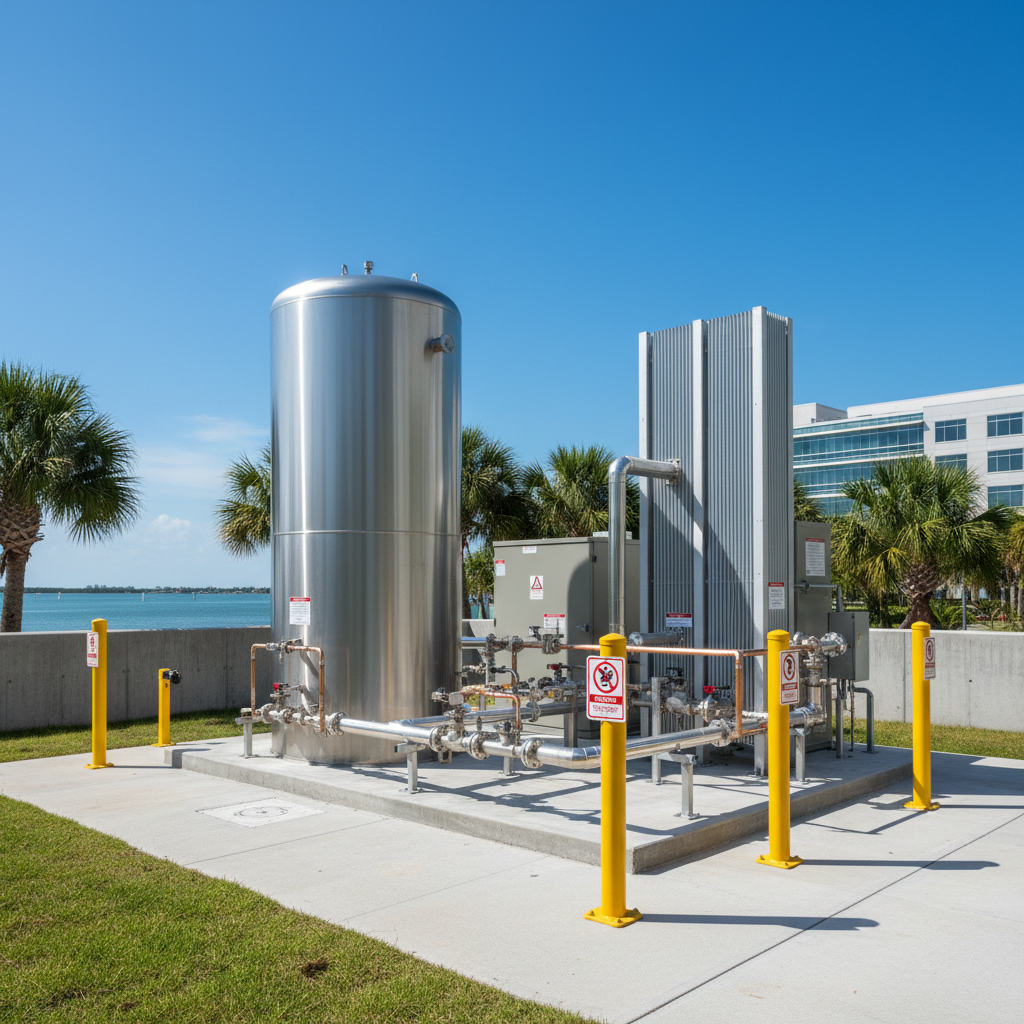
2. Primary Source Infrastructure: Bulk Liquid Oxygen (VIE) and Pad Engineering
Most hospitals rely on a Vacuum Insulated Evaporator (VIE) or bulk liquid oxygen storage system as their primary supply. Oxygen is stored as a liquid at approximately -297°F (-183°C) and vaporized into gas at distribution pressure (typically 50–55 psig).
| Diagram text |
|, |
| TYPICAL HOSPITAL OXYGEN SUPPLY |
| [Primary Bulk VIE Tank] - → [Ambient Vaporizers] |
| [Secondary VIE Tank/Cyl] → [Reserve Manifold] |
| [Exterior EOSC Pad], → [Line Pressure Regulators (50-55 psig)] |
| v |
| [Main Facility Shutoff] |
| v |
| [Risers & Zone Valve Boxes (ZVBs)] |
Hilton Head Coastal Engineering Considerations
Installing bulk oxygen systems on Hilton Head Island requires special structural and environmental considerations:
- Seismic and High-Wind Tie-Downs: Per ASCE 7 and local coastal building codes, outdoor bulk tanks and ambient vaporizers must withstand Category 3 to Category 5 hurricane wind loads (up to 140–150 mph design gusts). Concrete pads require reinforced post-tensioned foundations or deep helical pilings depending on local sandy soil bearing capacities.
- Atmospheric Salt Corrosion: Coastal marine environments accelerate oxidation. Pressure relief valves, regulator bodies, structural support frames, and exterior piping must feature corrosion-resistant stainless steel, heavy brass, or marine-grade protective coatings.
- NFPA 55 Separation Distances: The bulk pad must maintain minimum clear zones from property lines, public sidewalks, building openings, parked vehicles, and flammable materials. In dense resort or barrier island layouts, real estate is tight; engineered fire barriers are frequently required to meet code allowances where property boundary setbacks cannot be achieved.
Emergency Oxygen Supply Connection (EOSC)
NFPA 99 Section 5.1.3.5.13 mandates that all Category 1 facilities with bulk oxygen supply systems must have an exterior Emergency Oxygen Supply Connection. The EOSC provides a physical connection point for a temporary mobile liquid oxygen tanker if the main tank experiences catastrophic vacuum failure or contamination.
- Located on the exterior building wall in an authorized vehicle-accessible area.
- Enclosed in a locked, weather-tight box.
- Equipped with reverse flow check valves, a pressure relief valve, and an integrated connection to the facility's master alarm system to annunciate when the emergency connection is pressurized.
3. Secondary and Reserve Manifolds: High-Pressure Cylinder Banks
NFPA 99 Category 1 systems require an operating reserve or secondary supply capable of supporting facility demand for an uninterrupted duration, typically a minimum of 24 hours of average consumption.
When designing the medical gas installation, contractors install high-pressure cylinder reserve manifolds. These manifolds feature:
- Dual-Bank Automatic Throwover: Automatic changeover regulators switch from the depleted bank to the reserve bank when primary supply pressure drops below a preconfigured threshold, without causing downstream delivery pressure fluctuations.
- Heated Header Bars: High-flow oxygen draw can freeze unregulated expansion points. Heated headers ensure continuous gas vaporization during high-demand surges.
- NFPA 99 Gas Storage Room Compliance: Cylinder rooms must have two-hour fire-rated construction, dedicated exterior mechanical exhaust ventilation operating continuously (producing at least 1 CFM per square foot with dedicated intake), and electrical fixtures rated for safety around concentrated oxidizers.
4. Distribution Piping, Zone Valve Boxes, and Station Outlets
Once oxygen enters the facility interior, distribution networks rely on specialized materials and meticulous routing practices.
| Diagram text |
|, |
| Master Alarm Panel (Continuously Monitored) |
| 4-20mA / Dry Contact |
Piping Material Specifications
Piping used for medical oxygen must strictly adhere to ASTM B819, Standard Specification for Seamless Copper Tube for Medical Gas Systems.
- Must be hard-drawn Type L or Type K seamless copper.
- Must be factory-cleaned, purged, and capped to prevent organic or particulate contamination.
- Standard plumbing Type M copper or uncleaned ACR tube is a code violation that presents a serious ignition hazard in high-pressure pure oxygen environments.
Zone Valve Boxes (ZVBs) and Area Alarms
Zone valve boxes isolate specific clinical zones during emergencies (e.g., structural fires) or maintenance. Under NFPA 99:
- Surgical Suites: Anesthetizing locations must have their own dedicated zone valve box located outside the entrance to each operating room suite, readily accessible to clinical staff without entering the sterile field.
- Critical Care Areas (ICU/CCU/NICU): ZVBs must isolate critical nursing units so that maintenance in adjacent wings does not disrupt respiratory therapy in active care areas.
- Area Alarm Integration: Area alarm panels must be placed at the primary nurses' station monitoring the zone served by the ZVB. The sensors must monitor pressure variances of ±20% from the normal 50 psig operating level (alarming at ≤40 psig and ≥60 psig).
For comprehensive facility safety, clinical areas utilizing specialized equipment often coordinate gas alarms with electrical isolation systems; facilities can read about line isolation monitor testing to ensure complete wet-procedure compliance.
5. Technical Comparison: Sizing, Pipe Schedules, and Component Standards
Selecting correct component specifications prevents pressure drop during peak clinical usage (e.g., multiple ventilators operating simultaneously during seasonal patient surges).
| Component / Parameter | Category 1 Acute Care (Hospital) | Category 2 Ambulatory Surgery Center | Governing Standard |
|---|
| Primary Source | Cryogenic Bulk Liquid (VIE) with Dual Ambient Vaporizers | High-Pressure Manifold or Micro-Bulk Cylinder Bank | NFPA 99 (5.1.3), CGA M-1 |
| Emergency Connection | Required (Exterior EOSC with Master Alarm Tie-In) | Not Required (unless designated critical surgery center) | NFPA 99 (5.1.3.5.13) |
| Piping Specification | ASTM B819 Type L (Internal) / Type K (Underground/Risers) | ASTM B819 Type L | ASTM B819, NFPA 99 (5.1.10.1) |
| Brazing Flux Allowance | Prohibited on Copper-to-Copper (BCuP Alloys Only) | Prohibited on Copper-to-Copper (BCuP Alloys Only) | NFPA 99 (5.1.10.4.1.5) |
| Purge Gas During Braze | Oil-Free Dry Nitrogen (NFPA 99 Grade) | Oil-Free Dry Nitrogen (NFPA 99 Grade) | NFPA 99 (5.1.10.4.1.11) |
| Operating Pressure | 50–55 psig (Dynamic line pressure) | 50–55 psig (Dynamic line pressure) | NFPA 99 (Table 5.1.11) |
| Installer Qualification | ASSE 6010 Certified Medical Gas Installer | ASSE 6010 Certified Medical Gas Installer | ASSE Series 6000 |
| Verifier Qualification | ASSE 6030 Independent Third-Party Verifier | ASSE 6030 Independent Third-Party Verifier | ASSE Series 6000 |
Selecting high-quality source equipment and outlets is critical. Facilities procuring valves, consoles, or headwalls can review specialized options through our medical gas products catalog.
6. ASSE 6010 Brazing Protocol: Nitrogen Purging and Joint Integrity
The joint assembly phase represents the highest operational risk in a medical oxygen system installation. When copper is heated to brazing temperatures (typically 1,100°F to 1,500°F / 593°C to 816°C) in the presence of atmospheric oxygen, cuprous oxide scale immediately forms inside the pipe. When pure oxygen flows through the line later, this scale flakes off, clogging ventilator filters, scoring regulator seats, or acting as an incendiary particulate in high-velocity oxygen streams.
| Diagram text |
|, |
| >>> Nitrogen Flow (0.5-2.0 SCFH) >>> → Displaces Atmospheric O2 |
The Strict ASSE 6010 Nitrogen Purge Protocol
Under NFPA 99 Section 5.1.10.4, all copper-to-copper joints must be brazed using AWS BCuP series filler metal (copper-phosphorus-silver) without the use of chemical flux. Flux contains corrosive halides and binders that leave combustible residues inside oxygen lines.
The ASSE 6010 brazer must execute the following procedure:
- End Preparation: Cut pipe ends square using sharp tubing cutters; deburr carefully. Clean tube ends and fitting sockets with non-shedding abrasive pads (clean Scotch-Brite) down to bare, bright metal. Do not use standard steel wool or oil-contaminated rags.
- Purge Setup: Introduce oil-free, dry nitrogen into the piping assembly before applying heat. The purge must flow continuously through the joint during heating, brazing, and cooling until the metal returns to black heat.
- Oxygen Displacement Verification: Use an oxygen analyzer at the open discharge end of the pipe assembly to confirm that ambient oxygen is reduced to less than 1.0% before igniting the torch.
- Purge Velocity: Maintain a gentle bleed (typically 0.5 to 2.0 SCFH). High-velocity purge gas chills the joint, causing cold-shuts, porosity, or blowouts through the molten alloy.
- Joint Assembly: Apply BCuP brazing alloy evenly around the socket until a complete fillet forms around the entire circumference. Allow the joint to air cool naturally; quenching with water alters the metallurgical grain structure and induces joint stress.
At Medical Testing Solutions, our installation teams operate in strict accordance with ASSE 6010 standards, ensuring clean, scale-free piping runs on every hospital phase.
7. ASSE 6030 Verification: Testing, Particulate Clearance, and Purity Analysis
NFPA 99 Section 5.1.12 stipulates that before any medical gas piping is pressurized for clinical care, it must undergo third-party verification by an ASSE 6030 Certified Medical Gas Verifier.
Crucial Conflict-of-Interest Provision: The verification agency must be completely independent of the installing mechanical contractor and the design engineer. An installer cannot certify their own work. Medical Testing Solutions provides standalone, independent medical gas verification services across the Southeast to satisfy this strict mandate.
| Diagram text |
|, |
| ASSE 6030 VERIFICATION SEQUENCE |
| 1. Standing Pressure Test → 24-hr nitrogen hold at 1.2x working pressure |
| 2. Cross-Connection Test → Individual gas line pressure differential check |
| 3. Piping Purge Test → High-velocity particulate blowdown |
| 4. Operational Flow Test → Dynamic outlet flow (minimum 3.5 SCFM @ drop) |
| 5. Gas Concentration & Purity-> Verifying 99.0%+ O2, zero halogen/hydrocarbon |
| 6. Alarm Annunciation → Master, Area, and Source alarm verification |
1. Initial and Standing Pressure Tests
- Installer's Initial Pressure Test: Performed by the ASSE 6010 installer at 1.5 times working pressure (typically 150 psig for medical oxygen) with oil-free nitrogen prior to closing up walls.
- 24-Hour Standing Pressure Test: Performed with all valves, outlets, and adapters installed. The piping is pressurized to 20% above normal working pressure (60 psig for a 50 psig system) for 24 hours. Temperature corrections are factored mathematically; any pressure drop outside thermal equilibrium constitutes a leak that must be remediated.
2. Cross-Connection Testing
In hospitals with oxygen, medical air, nitrous oxide, carbon dioxide, and vacuum lines, crossed piping can prove fatal. Verifiers depressurize all systems except one, applying test pressure sequentially, and verify discharge at every single terminal unit throughout the hospital to confirm zero cross-contamination.
3. Particulate Purge and Cleanliness Testing
Each station outlet is purged at high flow rates using dry nitrogen through a white filter paper target. The discharge must be completely free of debris, particulates, copper dust, or discoloration.
4. Gas Purity and Concentration Testing
Once the piping is purged and tied into the primary oxygen source, verifiers conduct gas chromatography and chemical sensor analysis:
- Oxygen Concentration: Must certify at ≥99.0% USP grade oxygen.
- Hydrocarbons: Total hydrocarbons must measure <5 ppm.
- Halogenated Compounds: Zero allowable residue.
- Carbon Monoxide and Dioxide: Verified within stringent pharmacopeia limits.
- Dew Point: Moisture must not exceed -40°F (-40°C) at operating line pressure.
Following completion, Medical Testing Solutions issues official ASSE 6030 documentation packages, providing the signed validation logs necessary for South Carolina DPH health facility sign-off and Joint Commission survey readiness.
8. Ongoing Lifecycle: Commissioning, Alarms, and Preventative Maintenance
Verification is the beginning, not the end, of pipeline compliance. South Carolina hospitals must integrate the new installation into their continuous compliance and maintenance schedules.
Master Alarm and Building Management System (BMS) Integration
NFPA 99 Section 5.1.9 requires two separate master alarm panels located in areas of continuous 24/7 surveillance (typically the facilities engineering control office and the hospital main security/communications desk).
- Alarm Points for Bulk Oxygen: Low liquid level, low reserve supply pressure, primary supply changeover, and high/low main line delivery pressure (±20%).
- Wiring Requirements: Class 1, supervised hardwired sensor lines designed so that a cut wire or power loss triggers an immediate fault condition.
Post-Occupancy Compliance and Maintenance
Following successful occupancy, the Joint Commission and CMS demand documented periodic testing:
- Annual System Inspections: All master alarms, area alarms, zone valves, and pressure regulators must undergo certified functional testing every 12 months. Facilities can schedule these comprehensive evaluations through our annual medical gas inspections team.
- Routine Preventative Maintenance: Source manifold changeover mechanisms, regulator diaphragm seals, and station outlet quick-connect O-rings require proactive replacement through scheduled medical gas maintenance services.
- Comprehensive Facility Certification: Hospitals maintaining documentation across multidisciplinary departments can verify long-term asset health through our site-wide medical gas certification programs.
Partner with Medical Testing Solutions for Your Hilton Head Facility
Executing a flawless hospital oxygen system installation requires specialized engineering knowledge, certified installation teams, and rigorous independent verification. Whether you are constructing a greenfield surgical facility on Hilton Head Island, replacing an aging bulk supply manifold, or requiring turnkey NFPA 99 compliance oversight, Medical Testing Solutions delivers complete medical gas lifecycle support.
Our ASSE 6010 installation specialists and ASSE 6030 third-party verifiers ensure your healthcare facility remains safe, fully documented, and ready for clinical care.