Hospital Oxygen System Installation in Greenville, SC: A Comprehensive Guide for Healthcare Facilities
Installing or upgrading a hospital oxygen system is a mission-critical infrastructure project that directly impacts patient safety and facility compliance. For healthcare facilities in Greenville, SC, a properly installed medical oxygen system is not just a utility, it's the lifeblood of patient care. This guide provides a definitive overview of the process, from planning and component selection to final verification, ensuring your system is installed correctly, safely, and in full compliance with national standards. You will learn the key components, the critical role of ASSE-certified technicians, and the verification processes required by NFPA 99.
At Medical Testing Solutions, we specialize in the complete lifecycle of medical gas systems, from ASSE 6010 certified installation to final ASSE 6030 verification. Our deep expertise ensures your Greenville, SC facility’s oxygen system is built for reliability and compliance from day one.
Understanding the Core Components of a Hospital Oxygen System
A compliant hospital oxygen system is comprised of several interconnected subsystems. Understanding each component is crucial for planning a successful installation.
Bulk Oxygen Supply
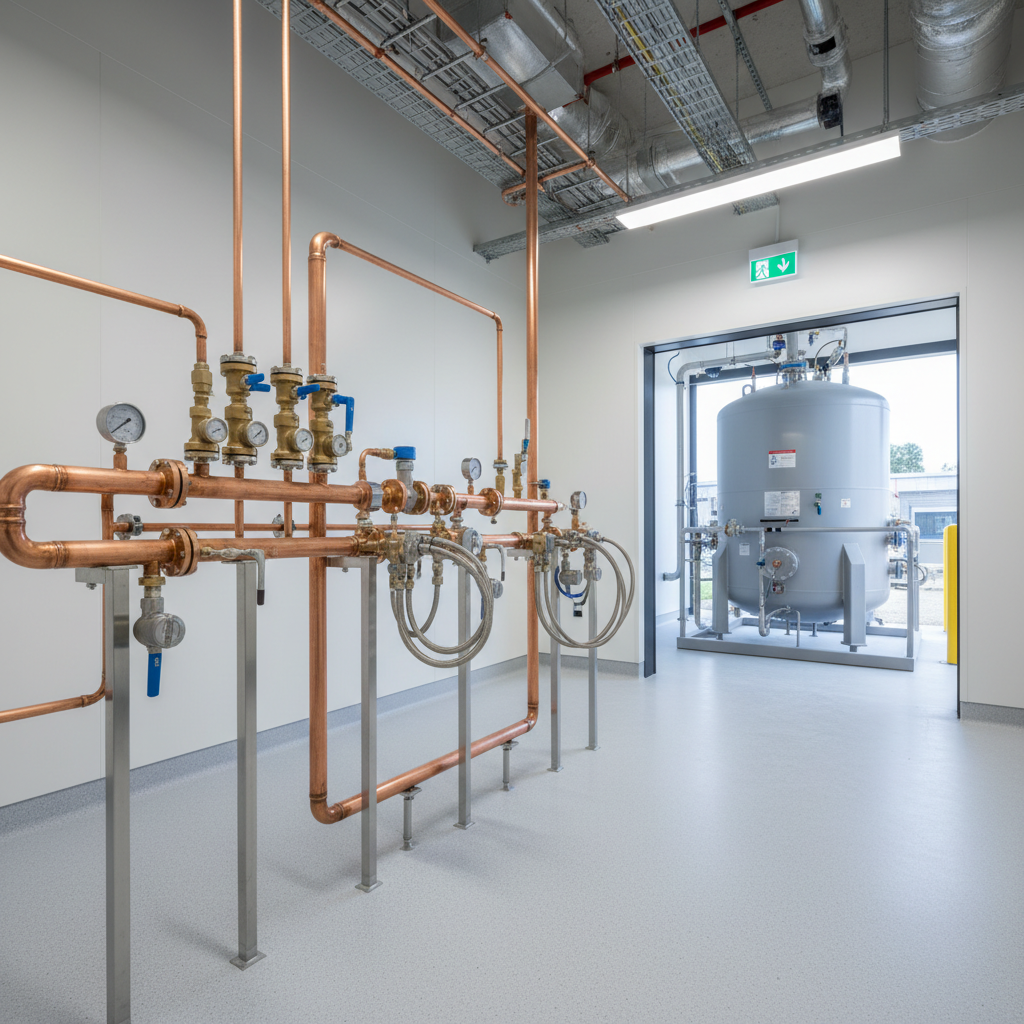
The primary source for most hospitals is a cryogenic bulk oxygen tank (a vacuum-insulated evaporator or VIE). This is the most efficient and cost-effective method for storing the large volumes of liquid oxygen (LOX) a hospital requires. Key considerations include:
- Sizing: The tank must be sized to meet the hospital's peak demand, with a sufficient reserve. Sizing calculations are based on bed count, ventilator usage, and other high-flow therapy systems.
- Location: NFPA 99, Chapter 5, dictates strict placement requirements for outdoor bulk tanks, considering distance from buildings, doors, windows, and potential ignition sources.
- Safety: The system includes pressure relief valves, vaporization coils to convert liquid to gas, and telemetry systems to monitor tank levels.
Manifold Systems
Manifolds provide redundancy and a secondary source of supply. They consist of high-pressure cylinders connected to a central control panel.
- Primary Purpose: They automatically switch from the primary bulk supply if pressure drops or the bulk tank is being refilled.
- Types: A common configuration is a primary and secondary bank of cylinders. When the primary bank is depleted, the system automatically switches to the secondary bank, triggering an alarm to signal that the primary bank needs replacement.
- NFPA 99 Requirement: Manifolds are not optional; they are a required safety feature to ensure an uninterrupted supply of oxygen.
Alarms and Monitoring
Master alarms, area alarms, and local alarms are the nervous system of the medical gas network. Per NFPA 99 (5.1.9), these systems provide immediate warnings of system failures or pressure deviations.
- Master Alarms: Located in areas with 24/7 surveillance (e.g., engineering, security), they monitor the main supply sources.
- Area Alarms: Monitor pressure and vacuum in specific zones or departments (e.g., ICU, OR, ED).
- Local Alarms: Monitor specific equipment, like a manifold, to indicate when it has switched to its secondary bank.
The Critical Role of ASSE 6010 Certified Installation
Simply having the right components is not enough; they must be installed by qualified professionals. This is where ASSE 6010 certification comes in.
What is ASSE 6010 Certification?
ASSE 6010 is a certification for Medical Gas Systems Installers. A certified individual has demonstrated competence in all aspects of medical gas and vacuum system installation, including the crucial process of brazing.
Why This Matters for Compliance: Using non-certified personnel for installation is a direct violation of NFPA 99 (5.1.10.11.10.1). A facility that cuts corners on certified labor is putting patients at risk and is guaranteed to fail the mandatory system verification. Insurance carriers may also deny claims related to incidents involving improperly installed systems.
The Art and Science of Brazing
Brazing is the process of joining copper pipes using a filler metal at high temperatures. In a medical gas system, this process must be flawless.
- Nitrogen Purge: During brazing, an inert gas like nitrogen must be continuously passed through the pipes. This displaces oxygen, preventing the formation of copper oxides on the interior surface of the pipe.
- Contamination Risk: If this step is skipped, toxic black flakes of copper oxide can be blown into the system, potentially reaching a patient’s lungs. This is a catastrophic failure that requires a complete and costly teardown of the affected piping.
- Technique: An ASSE 6010 certified installer understands the precise temperatures, flow rates, and techniques required for a clean, strong, and leak-free joint.