Understanding Hospital Oxygen System Installation
A reliable medical oxygen system is the lifeblood of any healthcare facility. From the emergency room to the operating theater, a steady supply of medical-grade oxygen is critical for patient care. But what goes into a compliant hospital oxygen system installation in Greensboro, NC? This guide provides a definitive overview, from bulk oxygen storage to the final verification.
This article will walk you through the essential components, governing codes like NFPA 99, and the critical roles of ASSE 6010-certified installers and ASSE 6030-certified verifiers. Understanding these elements is crucial for ensuring your facility's system is safe, efficient, and fully compliant.
Core Components of a Hospital Oxygen System
A hospital's medical gas system is more than just pipes in a wall. It's a complex network comprising a primary supply, secondary supply, and a series of valves and alarms to ensure uninterrupted delivery. Key components include:
- Bulk Oxygen Tank: The primary source, typically a large cryogenic vessel located outside the facility.
- Vaporizer: Converts the liquid oxygen (LOX) from the bulk tank into a gaseous state.
- Main Manifold: A high-pressure headered system of cylinders used as a secondary or reserve supply.
- Source Valves & Alarms: Master alarm panels that monitor the system's pressure and status.
- Main Piping & Risers: The large-diameter pipes that transport the gas from the source into and up through the building.
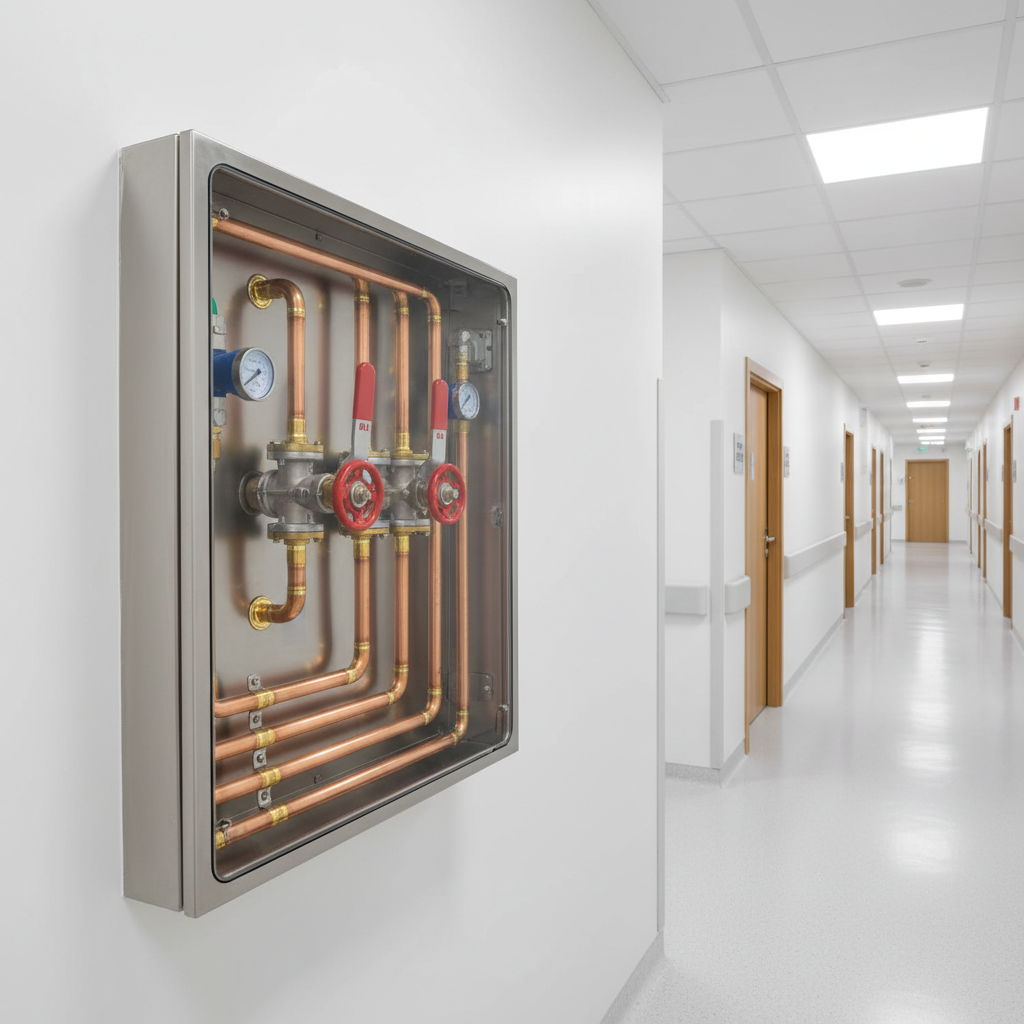
- Zone Valve Boxes: Sectional control valves that allow specific areas (e.g., a floor or department) to be isolated for maintenance or emergencies.
- Terminal Units: The final connection point in patient rooms, such as DISS connectors on the wall.
The Blueprint for Compliance: NFPA 99 Standards
The National Fire Protection Association's NFPA 99, Health Care Facilities Code, is the foundational document for medical gas systems in the United States. It outlines the minimum requirements for the design, installation, testing, and maintenance of these critical systems.
For an oxygen system installation, several key chapters apply:
- Chapter 4: Risk Categories: Facilities must assess the risk to patients if the system fails. Most hospital applications fall under Category 1, requiring the most stringent level of design and installation.
- Chapter 5: Gas and Vacuum Systems: This is the core chapter, detailing requirements for everything from source equipment and piping to alarms and terminals.
- Chapter 11: Gas Equipment: Covers the specifics of manufactured assemblies and equipment.
Why this matters for compliance: Failure to adhere to NFPA 99 can result in significant safety risks, costly project delays, and the inability to achieve certification for your facility. Working with a team that has deep NFPA 99 expertise, like Medical Testing Solutions, is non-negotiable.
The Art and Science of ASSE 6010 Brazing
Properly joining the copper piping is arguably the most critical hands-on part of the installation. NFPA 99-2018 (5.1.10.4) requires that all brazing on medical gas lines be performed by individuals certified to the ASSE Standard 6010, Medical Gas Systems Installers Professional Qualification Standard.
What is Brazing?
Brazing is a metal-joining process where a filler metal is heated above its melting point and distributed between two or more close-fitting parts. For medical gas piping, this process must be meticulously clean to prevent contamination.
The Nitrogen Purge
During brazing, an inert gas like nitrogen must be continuously purged through the pipes. This prevents the formation of cupric oxide (black soot) on the interior of the pipe, which could otherwise be blown into the system and harm patients or damage equipment.
An ASSE 6010-certified installer understands the precise flow rates and techniques required to create a clean, strong, and leak-free joint every time. This is a cornerstone of a safe medical gas installation.