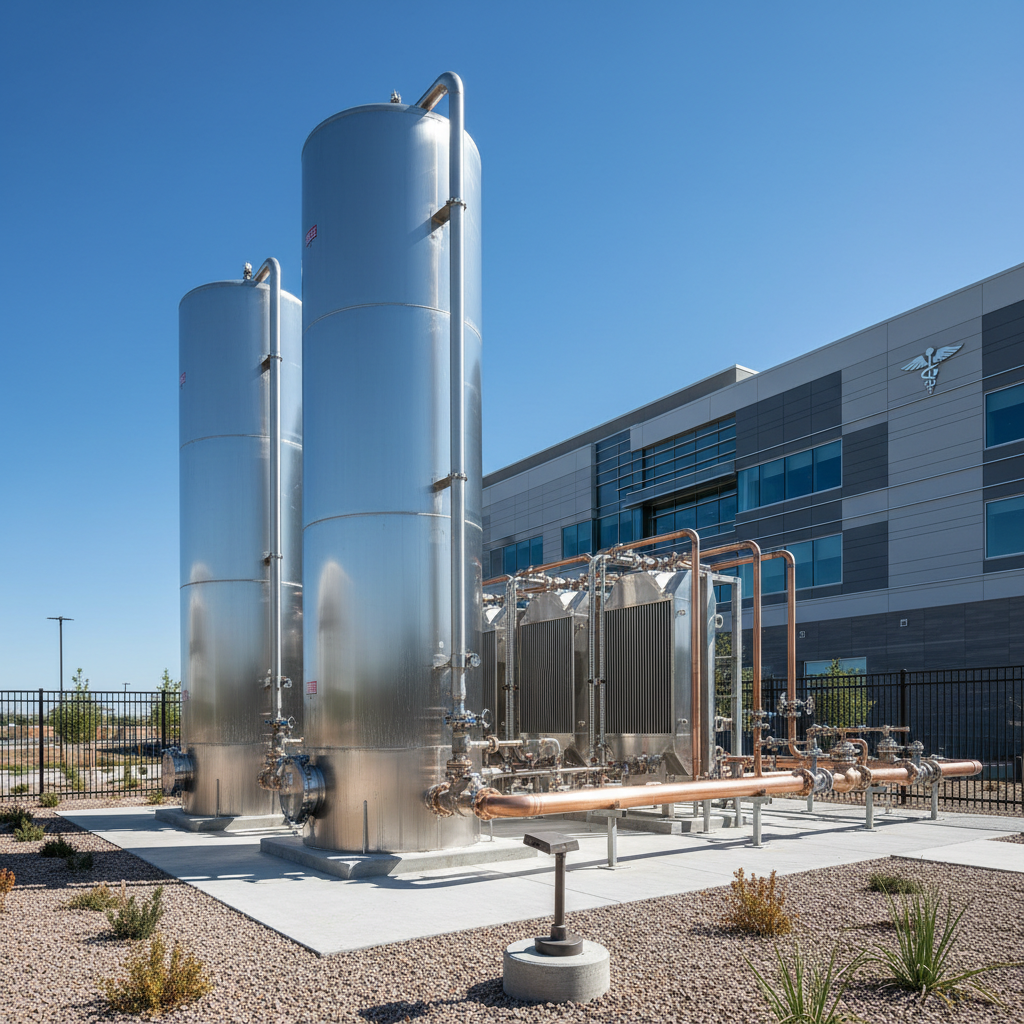
A compliant hospital oxygen system installation in Florence, SC, requires rigorous engineering, strict adherence to South Carolina Department of Health and Environmental Control (DHEC) healthcare facility regulations, and seamless execution under NFPA 99 (Health Care Facilities Code). Whether constructing a new clinical tower, modernizing an intensive care unit (ICU), or expanding a regional surgical pavilion in the Pee Dee region, healthcare facilities cannot afford errors in life-support pipeline infrastructure.
This guide delivers an authoritative engineering and installation blueprint for hospital engineering directors, mechanical contractors, and healthcare facility managers. You will examine the critical technical requirements of central medical oxygen systems, spanning bulk cryogenic liquid storage tanks, secondary high-pressure manifolds, distribution piping, zone valve boxes (ZVBs), and area alarm panels. We cover ASSE 6010 installer standards, critical nitrogen purge brazing techniques, required NFPA 99 standing pressure tests, and mandatory third-party ASSE 6030 medical gas verification required before patient use.
The Critical Infrastructure of Hospital Oxygen Systems
In modern acute-care hospitals, medical oxygen is categorized as a Category 1 piped medical gas system under NFPA 99 Section 5.1. A Category 1 designation applies to facilities where an interruption or failure of the gas supply will place patients in immediate danger of severe injury or death.
| Diagram text |
|, |
| BULK LIQUID OXYGEN SUPPLY (VIE / LOX) |
| Primary Cryogenic Vessel + Reserve Liquid Cylinder |
| EMERGENCY OXYGEN SERVICE CONNECTION |
| (EOSC) - Exterior Facility Pad Access |
| MAIN LINE PRESSURE CONTROL |
| Dual Regulators & Master Alarm Sensors |
| RISER & DISTRIBUTION MAINS |
| Type "K" or "L" Medical Gas Copper Tubing |
| ZONE VALVE BOX (ZVB) ZONE VALVE BOX (ZVB) |
| Surgical Suite Branch ICU / Ward Branch |
| AREA ALARM PANEL AREA ALARM PANEL |
| Local Pressure Sensing Local Pressure Sensing |
| PATIENT GAS OUTLETS PATIENT GAS OUTLETS |
| Ceiling Columns / Walls D.I.S.S. / Quick-Connect |
Hospital oxygen systems operate on a tiered, redundant supply design consisting of:
- Primary Cryogenic Bulk Storage: Vacuum-insulated evaporator (VIE) tanks holding liquid oxygen (LOX) at cryogenic temperatures (-297°F).
- Secondary/Reserve Storage: Auxiliary bulk liquid tanks or automatic switchover high-pressure cylinder manifolds providing an uninterrupted supply during primary system maintenance or peak demand events.
- Emergency Oxygen Service Connection (EOSC): A code-mandated exterior connection enabling a temporary mobile liquid or cylinder trailer to feed the hospital's distribution main during catastrophic bulk plant failures.
- Distribution Pipeline Network: Medical gas-cleaned, degreased ASTM B819 seamless copper tubing conveying gas at a nominal line pressure of 50 to 55 psig (pounds per square inch gauge).
- Control and Safety Valves: Source valves, main line valves, riser valves, and zone valve boxes that compartmentalize clinical departments to facilitate maintenance and isolate emergencies.
- Alarm and Monitoring Instrumentation: Master alarm panels in continuous-occupancy locations (security desks, central plant control rooms) and area alarm panels monitoring local line pressure variations outside patient rooms and operating theaters.
Medical Testing Solutions provides turnkey support throughout this lifecycle, supplying certified pipeline hardware and specialized medical gas installation and engineering oversight.
Site Selection and Bulk Oxygen Storage Regulations
Installing a bulk cryogenic oxygen vessel in Florence, SC, involves local zoning, building codes, NFPA 55 (Compressed Gases and Cryogenic Fluids Code), and NFPA 99 Chapter 5.
Cryogenic bulk storage locations must balance delivery accessibility with rigid separation distances. Because oxygen accelerates combustion, bulk systems cannot be installed indoors or adjacent to environmental hazards.
Why this matters for compliance: NFPA 55 Chapter 9 mandates minimum separation distances between bulk liquid oxygen supply systems and common physical exposures to prevent catastrophic fires or site structural collapses during an incident.
Bulk Pad Clearance Requirements
Under NFPA 55 and NFPA 99, bulk liquid oxygen supply systems must maintain specific clear zones:
- 50 Feet: From combustible exterior walls, openings in non-combustible walls, and property lines.
- 25 Feet: From parkable areas, parked vehicles, and public sidewalks.
- 35 Feet: From municipal storm drains, catch basins, and sewer manholes (to prevent cold, dense oxygen vapor from settling in underground confined spaces).
- 10 Feet: From public walkways, clear paths, and building egress paths.
- 75 Feet: From above-ground storage of flammable or combustible liquids.
Bulk pads must be poured with reinforced concrete designed to handle the heavy static load of loaded LOX vessels and dynamic axle loads of delivery transports. Bituminous (asphalt) surfaces are prohibited beneath cryogenic oxygen transfer points, truck parking pads, and vaporizer areas. Spilled liquid oxygen can saturate volatile hydrocarbons in asphalt, producing an impact-sensitive explosive matrix.
Florence, SC Environmental and Permitting Realities
In Florence and the broader Pee Dee region, climate conditions impact pad engineering:
- High Heat and Humidity: Accelerated ambient thermal exchange increases LOX boil-off rates, requiring precise sizing of ambient atmospheric vaporizers to maintain proper gas vaporization without exterior line freeze-up.
- Seismic and Wind Anchoring: South Carolina's geological baseline requires structural anchoring engineered to local building code seismic ratings and 115+ mph hurricane-speed wind gusts.
- DHEC Construction Approvals: Before construction begins, mechanical drawings must be submitted to the South Carolina Department of Health and Environmental Control (DHEC) Bureau of Health Facilities Licensing to ensure compliance with S.C. Regulation 61-16 (Standards for Licensing Hospitals).
High-Pressure Manifolds and the EOSC: Redundancy Systems
NFPA 99 mandates continuous redundancy for Category 1 medical gas systems. If the primary supply experiences catastrophic vacuum degradation, contamination, or mechanical failure, the secondary and reserve supplies must activate automatically with zero drop in downstream delivery pressure.
| Diagram text |
|, |
| PRIMARY LOX BULK VESSEL |
| SECONDARY LOX OR MANIFOLD |
| (Automatic Changeover at 50-55 psig Line) |
| EMERGENCY OXYGEN SERVICE CONNECTION (EOSC) |
| (Exterior Wall Box with Check Valves) |
High-Pressure Cylinder Manifolds
For surgical centers, long-term acute care wings, or smaller community hospitals across Florence County, an automatic high-pressure manifold may serve as the secondary or reserve system.
- Dual-Bank Configuration: Features an active bank and a reserve bank of high-pressure oxygen cylinders (DOT-3AA 2400 psig).
- Automatic Changeover: Utilizes differential pressure switches and dual-stage stainless steel regulators to execute a seamless switchover when the primary bank depletes below predetermined thresholds.
- Electrical Classification: Manifold control cabinets must be rated NEMA 4 or NEMA 12, running through isolated medical emergency circuits with local visual and audible indicators communicating with the master alarm.
The Emergency Oxygen Service Connection (EOSC)
NFPA 99 Section 5.1.3.5.14 mandates that every building connected to a bulk oxygen system must incorporate an EOSC. If a major freeze, delivery strike, or vessel rupture occurs, a mobile liquid cylinder transport can connect to the facility's main distribution line from outside the building.
The EOSC requires:
- Enclosure: A weather-tight, locked, tamper-resistant recessed or surface-mounted enclosure located on the building's exterior in an area accessible to emergency transport vehicles.
- Physical Connections: An emergency connection port with a check valve, manual isolation ball valve, and pressure relief valve piped upstream of the main line shutoff valve.
- Alarm Signal Monitoring: Electrical interlock microswitches that actuate the master alarm system the moment the EOSC is engaged or when its internal access door is opened.
Zone Valve Boxes (ZVBs) and Area Alarm Architecture
From the central supply, oxygen travels through vertical risers and horizontal distribution pipelines to clinical departments. Controlling this network demands zone valve boxes and area alarms positioned according to life safety codes.
| Diagram text |
|, |
| ZONE VALVE & ALARM LAYOUT |
| [ MAIN CORRIDOR WALL - EASILY ACCESSIBLE TO NURSING STAFF ] |
| +, + +, + |
| ZONE VALVE BOX (ZVB) AREA ALARM PANEL |
| [O2 Shutoff Valve] O2: 52 PSI [NORMAL] |
| Quarter-Turn Lever |
| Gage 0-100 PSIG High Alarm: >60 PSI |
| Breakable Window Handle Low Alarm: <40 PSI |
| +, +, + +, +, + |
| +, , + |
Zone Valve Box (ZVB) Placement
Zone valve boxes contain quarter-turn, full-port, double-seal ball valves with extensions cleaned for oxygen service. They provide localized shutoff capability so clinical or emergency personnel can isolate oxygen flow to a single department during a localized fire, maintenance operation, or structural emergency without interrupting life support in adjacent wings.
Under NFPA 99:
- Operating Rooms: Every operating room must possess a dedicated zone valve box located immediately outside the entrance of that surgical theater. One valve cannot control multiple ORs.
- Critical Care Areas: Dedicated ZVBs must isolate ICUs, CCUs, neonatal suites, and catheterization labs.
- Corridor Clearance: Zone valves must be installed in main corridors outside patient rooms, readily accessible at all times. They cannot be installed behind locked doors, within janitor closets, or across deep utility rooms.
- Height Placement: Installed between 36 inches and 60 inches above the finished floor to allow rapid access for staff.
Area Alarm Systems
Area alarm panels must be placed at continuously monitored clinical locations, typically the centralized nurse station serving the designated patient zone.
- Pressure Limits: Per NFPA 99 Section 5.1.9.3, the area alarm must sound an audible alarm and illuminate a non-cancelable visual alarm whenever local medical oxygen pressure drops 20% below normal (below 40 psig on a 50 psig baseline) or climbs 20% above normal (above 60 psig).
- Transducer Location: Pressure transducers must be connected to the pipeline strictly downstream of the respective zone valve. If an engineer turns off the zone valve, the alarm panel serving those patient outlets must trigger.
When updating existing clinical branches, verify that older pneumatic sensor lines are retrofitted with modern digital pressure transducers to maintain compliance with current NFPA 99 code cycles.
Technical Specifications: Equipment and Components
Selecting compliant components is essential for system longevity and patient safety. The table below outlines standard equipment specifications for Category 1 hospital oxygen installations.
| Component | Standard Reference | Construction Spec | Operational Parameters |
|---|
| Cryogenic Vessel | ASME Section VIII, CGA M-1 | Double-walled, vacuum insulated, perlite/super-insulation, 304 SS inner | 150 - 250 psig MAWP, -297°F liquid O2 storage |
| Distribution Piping | ASTM B819, NFPA 99 | Seamless Copper Type K or L, factory cleaned, plugged, and sealed | 50 - 55 psig operational working pressure |
| Zone Valve Boxes | NFPA 99, MSS SP-110 | Full port, 3-piece ball valve, bronze/brass body, Viton/PTFE seals | 600 WOG rating, dual purge ports, 1/4 turn shutoff |
| Area Alarms | NFPA 99, UL 1069 | Microprocessor-based, digital readout, dual transducers, isolated power | ±20% setpoints (40 psig Low / 60 psig High) |
| Patient Gas Outlets | NFPA 99, CGA V-5 | D.I.S.S. (Diameter Index Safety System) or Quick-Connect (Chemetron, Ohmeda) | 50 psig nominal, >100 L/min dynamic flow capacity |
| Check & Relief Valves | CGA G-4.1, NFPA 99 | Brass/bronze, soft seat, bubble-tight seal, factory degreased | Relief set at 50% above line pressure (75-80 psig) |
ASSE 6010 Installation: Brazing and Nitrogen Purge Procedures
The mechanical installation of hospital medical gas piping carries zero tolerance for joint contamination. Substandard installation practices cause downstream particulate blockages, regulator failure, or catastrophic pipe fires.
Installing contractors must be certified under ASSE Standard 6010 (Professional Qualifications Standard for Medical Gas System Installers).
| Compressed NFPA | Purge Gas | Type B819 Copper Tube | Purge | Gas Exhaust |
|---|
| Dry Nitrogen (NF) | ==========> | Heat Applied: BCuP-5 Rod | =====> | Reading: <1% |
| Regulator: 2-5 psi | | Continual Inert Purge | | Oxygen Level |
The Physics of Fluxless Brazing
Unlike standard plumbing or HVAC piping, NFPA 99 Section 5.1.10.5 strictly forbids the use of flux when brazing copper-to-copper medical gas distribution joints. Under direct torch heat, chemical flux leaves corrosive residues, generates hazardous toxic fumes, and creates carbonaceous scale inside the pipe. When mixed with pure oxygen, flux residue can ignite.
- Filler Alloy: Installers must use a copper-phosphorus or copper-phosphorus-silver brazing alloy meeting AWS A5.8 (typically BCuP-5, containing 15% silver, or BCuP-4). The phosphorus acts as the natural deoxidizing agent on bare copper.
- Dissimilar Metals: When joining copper tube to brass or bronze valves, flux is permitted, but it must be an approved, non-toxic, water-soluble medical gas flux applied thinly to the male fitting only, preventing any internal capillary migration.
Continuous Inert Nitrogen Purge
Whenever heat is applied to copper in the presence of ambient air, internal copper oxidation instantly takes place, producing black, flaky cupric oxide scale. If these flakes break off inside a hospital oxygen line, they will clog patient ventilators, shred anesthesia flowmeters, and cause valve seal failures.
To eliminate oxidation, ASSE 6010 installers maintain a continuous, low-pressure, dry nitrogen purge throughout the brazing process:
- Gas Quality: Purge gas must be oil-free, dry Nitrogen NF (National Formulary).
- Purge Velocity: Nitrogen is introduced at a low velocity (typically 2 to 5 standard cubic feet per hour) through an open line end using a calibrated flowmeter and regulator. High-velocity blasts displace the braze alloy and create joint voids.
- Oxygen Depletion Monitoring: Before applying heat, installers verify that the atmosphere inside the copper tube is less than 1% oxygen using an oxygen analyzer at the discharge point.
- Cool-Down Retention: The nitrogen purge must remain flowing through the interior of the assembly until the joint has cooled below 500°F (below the threshold of oxidation).
Mandatory Testing Protocols: Installer Verification
Following mechanical installation and prior to requesting third-party ASSE 6030 verification, the installing contractor must perform and document two non-negotiable initial tests:
1. Initial Blowdown and Cleaning Test
After the piping is erected, each run must be cleared of loose mechanical particles. The ASSE 6010 installer opens and flushes every individual pipe leg using dry, oil-free Nitrogen NF. A clean white paper cloth or filter disk is held over the open joint or outlet during discharge to ensure zero particulates or staining are observed.
2. Initial Pressure Test (Standing Pressure Test)
Before outlets, valves, and transducers are closed behind finished drywall:
- Test Gas: Oil-free, dry Nitrogen NF.
- Test Pressure: 1.5 times the operational working pressure, or a minimum of 150 psig.
- Duration: Maintained continuously for 24 hours.
- Criteria: Zero allowable drop in test pressure, accounting for direct ambient temperature variations via the ideal gas law:
$$P_2 = P_1 \times \left(\frac{T_2}{T_1}\right)$$
Where pressures ($P$) are absolute and temperatures ($T$) are measured in Kelvin or Rankine.
NFPA 99 Section 5.1.12 dictates that no medical gas pipeline system can be activated, pressurized with operational gas, or accepted for patient care until it is comprehensively verified by an independent, third-party ASSE 6030 Certified Medical Gas Verifier.
The verification company cannot be the mechanical contractor who installed the pipe, nor can they be the design engineer of record. This preserves strict structural objectivity.
At Medical Testing Solutions, our credentialed ASSE 6030 verifiers execute full-scope testing using laboratory-grade analyzers.
| Diagram text |
|, |
| ASSE 6030 THIRD-PARTY VERIFICATION |
| CROSS-CONN. 24-HR STANDING CONTAMINANT & |
| TESTING PRESSURE TEST PURITY TESTING |
| Zero Crossings 20% Over Oper. Hydrocarbons = 0 |
| Between Systems Press. (60 psig) Moisture < -40°F |
Key ASSE 6030 Verification Procedures
1. Cross-Connection Testing
Verifiers pressurize the hospital oxygen pipeline system while venting, running vacuum on, or monitoring all adjacent pipeline systems (Medical Air, Nitrous Oxide, Nitrogen, Carbon Dioxide, and Medical Vacuum). Every single gas terminal outlet and inlet across the entire hospital is physically tapped to confirm that oxygen discharges solely from oxygen wall couplers and that no cross-connections occurred during rough-in brazing.
2. Final 24-Hour Standing Pressure Test
With all terminal outlets installed and zone valves open:
- The system is pressurized to 20% above nominal line pressure (60 psig for a standard 50 psig oxygen system) with dry Nitrogen NF.
- Monitored for 24 hours using a calibrated digital test gauge.
- Any pressure degradation outside calculated thermal expansion limits fails the inspection.
3. Piping Purge and Flow Testing
Each outlet is blown down at high dynamic flow rates (exceeding 100 liters per minute) to clear transient particles trapped near the terminal housing. System dynamic flow drops are measured to prove adequate internal pipe diameters were engineered from the source riser.
4. Contaminant and Dew Point Analysis
The pipeline is audited for chemical purity.verifiers sample the system using specialized photoionization detectors, catalytic gas chromatographs, and electrochemical sensors to measure:
- Total Hydrocarbons: Must not exceed 5 ppm.
- Carbon Monoxide (CO): Must not exceed 5 ppm.
- Carbon Dioxide ($CO_2$): Must not exceed 500 ppm.
- Water Vapor / Dew Point: Must not exceed -40°F (-40°C) at 50 psig.
- Particulate Matter: No particles larger than 1 micron permitted per 1,000 liters.
5. Operational Gas Concentration Testing
After the nitrogen purge gas is completely displaced and pure liquid oxygen fills the system, verifiers validate the gas purity at every clinical outlet. The ASSE 6030 technician verifies that each oxygen terminal outlet delivers a minimum of 99.0% Medical Oxygen USP, confirming the absence of residual nitrogen pockets.
Regional Compliance: South Carolina DHEC and Florence Permitting
Navigating a hospital oxygen project in Florence, South Carolina, requires synchronizing municipal and state-level healthcare enforcement frameworks.
| Diagram text |
|, |
| FLORENCE, SC REGULATORY PIPELINE |
| SC DHEC HEALTH FACILITIES LICENSING (REG 61-16) |
| Plan Review, Life Safety Assessment, Engineering Sub |
| CITY OF FLORENCE CODES ENFORCEMENT |
| Building, Electrical, Structural Foundation Permits |
| ASSE 6010 CERTIFIED MECHANICAL BRAZING |
| Contractor Installation & Internal Testing |
| ASSE 6030 INDEPENDENT SYSTEM VERIFICATION |
| Final Testing Report & Certified Documentation |
| FINAL DHEC ON-SITE OCCUPANCY INSPECTION |
| Clinical Activation for Patient Care |
South Carolina DHEC Bureau of Health Facilities Licensing
Under South Carolina Regulation 61-16, hospitals must submit comprehensive design drawings prior to beginning pipeline modifications or new construction.
- DHEC plan reviewers audit the architectural arrangement of zone valves, access clearings, emergency pad approaches, and area alarms.
- Mechanical engineering drawings must explicitly detail line sizes, pipe drops, material selections, and source capacity equations.
- Prior to patient occupancy, DHEC field inspectors perform a final life safety walk-through. A comprehensive third-party ASSE 6030 verification binder must be presented on-site to secure operational sign-off.
City of Florence Codes Enforcement
Local municipal code approvals focus on the structural, fire, and electrical safety of exterior oxygen pad infrastructure:
- Pad Permits: Mechanical and building permits issued by the City of Florence Codes Enforcement Division cover seismic foundation footings, concrete compression test certifications, and perimeter security fencing.
- Electrical Tie-Ins: Master alarms, vaporizers, and telemetry instrumentation must tie into the hospital's Emergency Life Safety branch per NFPA 70 (National Electrical Code) Article 517.
- Electrical Safety Verification: When operating suites or wet procedure locations are upgraded alongside medical gas expansions, facility teams must also complete annual line isolation testing via line isolation monitor testing to preserve isolated power protection per NFPA 99.
Commissioning, Maintenance, and Certification Lifecycle
Securing the final ASSE 6030 verification report and DHEC occupancy permit marks the transition from construction to ongoing facility management. NFPA 99 Chapter 5 requires continuous maintenance, periodic testing, and meticulous recordkeeping.
To safeguard system integrity across its operational lifespan:
- Routine Operational Maintenance: Implement an ongoing protocol through professional medical gas maintenance services to replace worn secondary seals on patient outlets, adjust regulator seats, lubricate high-pressure valves, and calibrate alarm sensors.
- Annual Comprehensive Inspections: Ensure accredited inspectors conduct annual medical gas inspections to test every zone valve, confirm master alarm actuation speeds, and verify that gas delivery concentrations comply with USP medical standards.
- Facility Recordkeeping: Maintain an unbroken documentation trail. DHEC and The Joint Commission (TJC) auditors routinely inspect initial ASSE 6030 verification binders, quarterly pressure logs, and annual re-certification certificates during surveys.
Our team at Medical Testing Solutions supplies the specialized diagnostic equipment, terminal outlet hardware, and recurring maintenance contracts required to keep Florence hospitals compliant year-round.
Executing a hospital oxygen system installation in Florence, South Carolina, requires precise engineering, certified trade execution, and independent verification. Medical Testing Solutions provides the certified hardware, field testing, and regulatory support your facility needs to maintain total compliance.
Whether you need initial ASSE 6010 mechanical guidance, system hardware sourcing, or comprehensive ASSE 6030 third-party verification, our team delivers the certified expertise your healthcare facility demands.
Plan your upcoming medical gas installation or verification project with our certified team: