Skip to content
    New: Medical Gas Outlet Retrofit & Rebuild Matrix — cross-reference legacy Chemetron, Ohio Diamond, Puritan-Bennett & more →
    ASSE Certified 24/7
    Medical Gas Service
    Compliance & Standards

    Hospital Oxygen System Installation in Chesapeake, VA: The Complete Code & Engineering Guide

    Medical Testing SolutionsNovember 6, 202617 min read
    Share
    Hospital Oxygen System Installation in Chesapeake, VA: The Complete Code & Engineering Guide

    Hospital Oxygen System Installation Chesapeake VA: Code & Process

    Designing, piping, and commissioning a centralized hospital oxygen supply requires flawless execution. In healthcare facilities across Chesapeake, Virginia, from regional trauma centers and outpatient surgical towers to community acute care hospitals, medical oxygen is classified as a life-support drug. A single compromised brazed joint, particulate contaminant, or cross-connection can lead to catastrophic patient outcomes or devastating fire hazards.

    Executing a compliant hospital oxygen system installation in Chesapeake, VA demands strict adherence to the latest editions of NFPA 99 (Health Care Facilities Code), CGA (Compressed Gas Association) standards, and Virginia Uniform Statewide Building Code (VUSBC) requirements. This guide covers the complete engineering and compliance pathway for acute oxygen systems: from bulk cryogenic liquid vessels and high-pressure manifold infrastructure to ASSE 6010-certified brazing, zone valve box (ZVB) placement, area alarm integration, and mandatory third-party ASSE 6030 verification testing.


    The Regulatory Framework: NFPA 99, CGA, and Chesapeake Building Codes

    In Virginia, healthcare construction and mechanical piping fall under the Virginia Uniform Statewide Building Code (VUSBC), which integrates the International Plumbing Code (IPC), International Building Code (IBC), and references NFPA 99 for health care facilities. Medical oxygen systems are designated as Category 1 (Facility Category 1) piping networks when patient sedation, critical life support, or general anesthesia depends on continuous delivery. | Diagram text | |, |

    Key Regulatory Standards Governing Installation:

    • NFPA 99 (Chapter 5): Governs gas and vacuum systems, establishing Category 1 through Category 4 criteria, piping materials, joints, valving, alarms, and testing protocols.
    • ASSE Series 6000 (Standard 6010): Specifies the professional qualifications required for medical gas system installers. Uncertified mechanical plumbers are legally prohibited from joining medical gas lines.
    • ASSE Series 6000 (Standard 6030): Defines the professional qualifications for independent, third-party medical gas verifiers who inspect and certify the system before clinical use.
    • CGA M-1: Standard for medical gas supply systems at health care facilities.
    • CGA G-4.1: Cleaning equipment for oxygen service to prevent catastrophic hydrocarbon fires.
    • NFPA 55: Compressed gases and cryogenic fluids code, which dictates external bulk oxygen storage clearances, property lines, and vehicle protection.

    Why this matters for compliance: Under NFPA 99 § 5.1.10.11.10, all brazing on medical gas systems must be executed by personnel qualified under ASSE Standard 6010, utilizing an active nitrogen purge. Failure to maintain an inert purge during brazing produces copper oxide scale that flakes into the gas stream, blinding patient ventilators and destroying critical life-support delivery devices.


    Core System Architecture: Bulk Oxygen, Vaporizers, and Emergency Connections

    Acute care hospitals require large volumes of continuous gaseous oxygen delivered at a nominal line pressure of 50 to 55 psig. The source infrastructure dictates the entire mechanical footprint outside the building envelope. | Diagram text | |, | | TYPICAL NFPA 99 BULK OXYGEN SOURCE SCHEMATIC | | +, + +, + | | Primary Cryogenic Reserve Cryogenic | | Liquid Cylinder or High-Pressure | | (VIE) Manifold Bank | | +, +, + +, +, + | | v v | | +, + +, + | | Ambient Vaporizer Auxiliary Reserve | | Banks Vaporizer | | +, +, + +, +, + | | +, +, + | | v | | +, + | | Pressure Control Assembly | | (Dual Line Pressure Regs) | | +, +, + | | +, +, + | | v v | | +, + +, + | | EOSC (Pad/Wall) Main Source Valve | | (Check Valves/Relief) (Lockable / Mon.) | | +, + +, +, + | | v | | To Facility Riser |

    1. Bulk Cryogenic Liquid Systems (VIE)

    Bulk oxygen storage utilizes Vacuum Insulated Evaporator (VIE) vessels storing liquid oxygen at temperatures below −297°F (−183°C). The system typically features:

    • Primary Vessel: Operates as the active operational liquid source.
    • Secondary/Reserve Vessel or High-Pressure Reserve: An independent reserve supply sized to provide a minimum of 24 hours (often engineered to 48–72 hours) of emergency demand per NFPA 99 § 5.1.3.5.11.
    • Ambient Air Vaporizers: Fin-style aluminum convective heat exchangers installed in duplex banks. They convert liquid oxygen into gas without external electrical power, equipped with automatic timer-controlled alternation to prevent ice accumulation and loss of capacity during high-demand events.

    2. Emergency Oxygen Supply Connection (EOSC)

    NFPA 99 mandates an EOSC for all Category 1 facilities where the central supply is located outside or away from the building. The EOSC serves as an exterior, physical hook-up station for a temporary liquid or high-pressure mobile tanker trailer during catastrophic bulk system failures or routine cryogenic tank recertification.

    • Located on the building exterior in an area physically accessible to emergency transport tankers (e.g., hospital loading docks).
    • Includes check valves, pressure relief valves set at appropriate thresholds, a local pressure gauge, and physical padlock security to prevent tampering.

    3. High-Pressure Cylinder Manifolds

    For surgical centers, freestanding emergency departments, or specialized clinics throughout the Tidewater region where bulk liquid tanks are impractical, gas designers utilize fully automatic high-pressure cylinder manifolds. These feature dual-bank headers (e.g., 2x4, 2x6, or 2x10 cylinder layouts) utilizing CGA-540 connections, with auto-switchover mechanisms that alternate banks seamlessly when cylinder pressure drops below preset thresholds.


    Distribution Piping: Materials, ASSE 6010 Brazing, and Purging

    Medical gas piping is fundamentally different from commercial domestic water or hydronic HVAC lines. The material, joining methodology, and cleanliness requirements are rigidly enforced.

    Tubing Specifications

    Per NFPA 99 § 5.1.10.1, all oxygen piping must be hard-drawn, seamless copper tube conforming to ASTM B819, standard specification for seamless copper water tube for medical gas systems.

    • Available in Type K (thickest wall, typically required for underground, main risers, or higher-pressure systems) or Type L (standard for interior distribution branch lines).
    • The tubing must arrive on site cleaned for oxygen service, factory plugged or capped at both ends, and clearly marked with green (Type K) or blue (Type L) ink bearing the stamp "OXY," "MED," "OXY/MED," or "OXY/ACR."

    Joining Protocols and ASSE 6010 Brazing

    Trained pipefitters performing the work must hold a current ASSE 6010 Medical Gas Installer certification. Mechanical joints, push-connect fittings, and soft solders are strictly prohibited on Category 1 distribution piping.

    1. Cutting & Deburring: Pipe ends must be cut square using clean wheel cutters (no abrasive cutoff wheels that throw particulate matter). All internal and external burrs must be mechanically removed using clean de-burring tools without introducing shavings into the lumen.
    2. Cleaning: Even factory-cleaned tubing must be visually inspected. If fittings show oil, grease, or oxidation, they must be washed with hot water and non-ionic medical-grade surfactant, rinsed with clean water, and dried thoroughly before assembly.
    3. Continuous Inert Purge: While making the brazed joint, the interior of the pipe must be actively purged with Oil-Free Dry Nitrogen NF. The flow rate must be maintained between 1 to 5 standard cubic feet per hour (SCFH) to displace atmospheric oxygen. The oxygen content inside the piping must measure below 1% before heat is applied.
    4. Brazing Filler Metal: Joints must be joined using brazing filler metals belonging to the BCuP series (copper-phosphorus or copper-phosphorus-silver) without the use of chemical flux. Flux is prohibited on copper-to-copper joints because corrosive residues cannot be flushed out of medical gas networks. For copper-to-brass or copper-to-bronze connections (such as valve bodies), flux is permitted only if applied strictly to the male fitting surface to avoid interior migration.

    When facilities upgrade medical systems, experienced contractors rely on turnkey medical gas installation services to ensure every joint adheres strictly to ASSE 6010 procedures and passes destructive and non-destructive quality tests.


    Valve Placement: Source, Main, Riser, and Zone Valve Boxes (ZVBs)

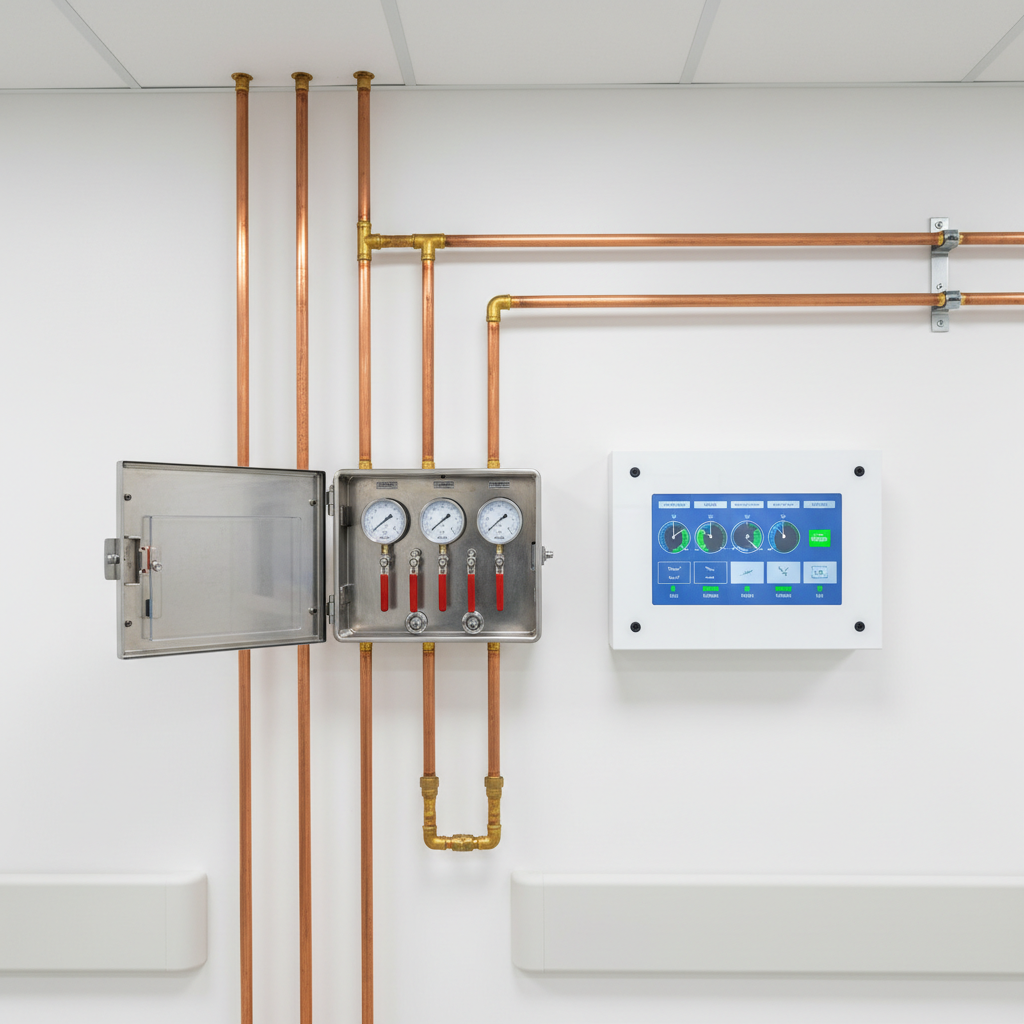
    Valves allow clinical teams and maintenance engineers to isolate specific wings, floors, or zones during remodeling, pipeline maintenance, or life-safety emergencies (such as surgical suite fires). | Diagram text | |, |

    Valve Classification and Rules Under NFPA 99:

    • Source Valve: Placed at the bulk tank/manifold connection to isolate the entire source assembly from the facility piping.
    • Main Line Valve: Placed at the point where the supply line enters the hospital building structure.
    • Riser Valves: Installed at the base of every vertical riser supplying multiple floors.
    • Branch/Service Valves: Installed off the riser to isolate entire horizontal wings or departments.
    • Zone Valve Boxes (ZVBs): Located immediately outside the zones they protect (e.g., surgical suites, intensive care units, emergency bays).

    Critical Rules for Zone Valve Box Installation:

    1. Egress Location: ZVBs must be mounted in a common hallway or wall space immediately visible and accessible to staff exiting the clinical zone without passing through the hazard area.
    2. Direct Line-of-Sight: ZVBs must control only outlets located on the same floor and within that specific departmental smoke/fire compartment.
    3. Labeling Requirements: The faceplate must be legibly labeled with the gas type ("OXYGEN"), pressure rating, and the specific rooms or terminal units controlled (e.g., "OR 1 through OR 4 Only").
    4. Emergency Operation: Valves are quarter-turn, full-port, ball-style valves featuring a secure acrylic window designed to be quickly pulled or broken away for emergency gas shutoff by clinical nursing or surgical staff.

    Alarm Integration: Master Panels, Area Panels, and Transducers

    An oxygen system requires automated 24/7/365 electronic surveillance. NFPA 99 outlines two primary alarm tiers: Master Alarms and Area Alarms. | Diagram text | |, | | NFPA 99 CATEGORY 1 ALARM TOPOLOGY | | [Bulk Tank Liquid Levels] ──┐ | | [Reserve Cylinder Pressure]─┼──► [Master Alarm 1] ──┐ | | [Main Line Pressure Switch] ┘ (Plant Ops / Eng) | | ├──► Redundant Network Loop | | (Building Automation / BMS) | | [Master Alarm 2] ──┘ | | (Security / 24-Hr Station) | | [Zone Valve Box Sensor] ───────► [Area Alarm Panel] | | (Nurses Station / Surgical Suite Corridor) | | * Visual Red Flashing Light | | * >80 dBA Audible Tone | | * Numerical Digital Pressure Readout (e.g. 52 psig) |

    Master Alarm Systems

    Hospitals must maintain two separate Master Alarm panels placed in distinct continuous-supervision locations:

    • Location 1: The primary facilities maintenance/engineering office.
    • Location 2: A 24-hour monitored location, such as the hospital security command center or switchboard.

    Oxygen Signals Monitored by the Master Alarm:

    • Bulk liquid oxygen operational level low (re-order signal).
    • Reserve liquid or high-pressure cylinder bank pressure low.
    • Reserve supply active (in-use notification).
    • Line pressure deviation (±20% variance from nominal 50–55 psig).
    • Dew point alarm (if integrating with medical air delivery paths).

    Area Alarm Systems

    Area alarm panels continuously supervise terminal line pressures for specific clinical environments:

    • Placement: Located at nursing stations, surgical control desks, or directly adjacent to the ZVBs they monitor.
    • Transducers: Pressure sensors/transducers must be piped into the medical gas distribution network on the patient side of the zone valve. If the zone valve is closed during an emergency, the area alarm must instantly identify the pressure drop.
    • Alarm Thresholds: The alarm signals both audible (minimum 80 dBA at 10 feet) and visual warnings if line pressure drops below 40 psig (low pressure) or spikes above 60 psig (high pressure).

    Comparison of Medical Gas Valves, Regulators, and Infrastructure

    Selecting the appropriate equipment requires matching physical room constraints, pipeline volumes, and long-term maintenance protocols.

    ComponentStandard / Code SpecMaterial RequirementsPlacement / UsagePrimary Failure Mode / Maintenance Risk
    Zone Valve Box (ZVB)NFPA 99 § 5.1.4.4
    ASSE 6010
    Forged brass body, full-port, 3-piece ball valve, Teflon (PTFE) seatsCorridor entryways outside ICUs, ORs, PACUs, ERsSeat leakage past the seal; unmonitored closed valves starved of gas
    Bulk Tank RegulatorsCGA G-4.1
    ASME Section VIII
    Stainless steel or bronze bodies, fluorocarbon diaphragmsHigh-flow external cryogenic vaporizer padDiaphragm fatigue; cryogenic freeze-up due to severe convective frosting
    Automatic ManifoldsNFPA 99 § 5.1.3.5
    CGA V-1
    Brass header bar, CGA-540 pigtails with check valvesSecondary emergency reserves or primary supply for smaller clinicsMicro-leaking pigtail O-rings; mechanical relay/solenoid switchover failure
    Area Alarm PanelsNFPA 99 § 5.1.9.4
    UL 1069 Listed
    Microprocessor-based digital display, visual LEDs, piezoceramic hornNursing stations and surgical team observation stationsSensor transducer drift; wiring disconnect from the remote sensor block
    Terminal OutletsNFPA 99 § 5.1.5
    CGA V-5 (DISS)
    Brass body, gas-specific indexing pin, double O-ring sealHeadwalls, boom arms, ceiling drops, surgical columnsPrimary latch wear; degraded secondary elastomer seals causing continuous hissing

    During facility retrofits or surgical floor renovations, hospital facility directors often evaluate specialized surgical equipment. If facility planners also upgrade surgical or dental operatories nearby, integrating dental flowmeter repair and calibration or dedicated line configurations ensures the gas infrastructure performs across all specialty clinics.


    Step-by-Step Installation & Commissioning Process

    Every medical oxygen piping line must pass through five rigorous engineering phases prior to clinical patient admission. | Diagram text | |, |

    1. Initial Pipe Preparation & Rough-In

    • Route ASTM B819 copper lines through dedicated risers and overhead structural trapeze systems. Maintain clear mechanical separation from electrical conduits, domestic hot water lines, and steam piping.
    • Secure piping using copper-plated or plastic-coated tube hangers spaced according to MSS SP-58 and NFPA 99 span tables (typically every 6 to 10 feet depending on pipe diameter) to prevent hydraulic sag and vibration stress.

    2. Initial Blowdown & Joint Testing

    • Before attaching terminal station outlets, alarm transducers, or zone valves, the installer must perform an initial high-volume line blowdown using oil-free dry nitrogen at a minimum pressure of 100 psig.
    • A clean white cloth or paper target is held over each open tube discharge. The discharge must demonstrate zero discoloration, debris, moisture, or particulate matter.

    3. Standing Pressure Test (Installer Test)

    • After all components are brazed and rough valves attached, the installer pressurizes the piping network with oil-free dry nitrogen to 1.5 times the maximum working pressure (a minimum of 150 psig for standard 50 psig oxygen distribution lines).
    • The system is isolated and monitored for 24 continuous hours. Temperature changes are recorded to correct for thermal gas expansion/contraction. The baseline pressure drop must be exactly zero after thermal adjustment.

    4. Third-Party ASSE 6030 Verification

    • Once the installer signs off on the preliminary pressure test, an independent ASSE 6030-certified verifier takes ownership of system testing. The installing contractor is legally barred from self-verifying their own work.
    • Comprehensive testing includes cross-connection checks, valve shutoff integrity, alarm threshold trips, particulate analysis, dew point verification, and final concentration testing.
    • Learn more about these regulatory mandates by reviewing our dedicated medical gas verification services.

    Verifying the System: Independent ASSE 6030 Inspection Protocol

    ASSE 6030 certification is the absolute backstop of patient safety. Medical Testing Solutions provides fully independent, credentialed inspection teams that perform standard-by-standard documentation across every inch of newly laid medical gas infrastructure. | Diagram text | |, |

    The Inspection Protocols:

    1. Cross-Connection Testing: Verifiers systematically pressurize oxygen lines to 50 psig while depressurizing all other adjacent pipelines (Nitrous Oxide, Medical Air, Vacuum, Carbon Dioxide) to 0 psig. Every single outlet is mechanically indexed and evaluated with pressure sensors to confirm that zero cross-contamination exists between parallel pipeline networks.
    2. Valve Closure and Identification: Every source valve, riser valve, and zone valve is physically closed to prove complete shutoff and confirm that its physical label matches the precise clinical zone it isolates.
    3. Purity and Moisture Testing: Verifiers run gas samples from the most remote terminal drops through analytical gas chromatography and specialized analyzers:
      • Total Non-Methane Hydrocarbons: Less than 5 ppm.
      • Moisture (Dew Point): Must not exceed −40°F (−40°C) at system pressure.
      • Carbon Monoxide (CO): Less than 10 ppm.
      • Carbon Dioxide (CO2): Less than 500 ppm.
    4. Gas Concentration Check: The pipeline is thoroughly purged of nitrogen and charged with clinical-grade medical oxygen (USP). Every terminal outlet is sampled with a calibrated paramagnetic or galvanic oxygen analyzer to verify that final delivered concentrations meet or exceed 99.0% O2.

    Following successful completion of testing, Medical Testing Solutions issues an exhaustive engineering report and regulatory documentation package fulfilling all The Joint Commission, CMS, and local Virginia building code inspection requirements.


    Cost Analysis: Budgeting for a Hospital Oxygen Retrofit in Chesapeake

    Capital expenditure budgeting for an oxygen system replacement or expansion in Chesapeake requires accounting for local labor classifications, site access constraints, and existing structural realities. | Diagram text | |, | | ESTIMATED PROJECT CAPITAL ALLOCATION (TYPICAL 4-OR RETROFIT / 20-BED EXPANSION) | | Bulk Pad / Civil Work: [████████] 15% | | Source Regulators / Manifold:[██████████] 20% | | Distribution Piping (Copper):[█████████████] 25% | | ASSE 6010 Specialized Labor: [████████████████] 30% | | ASSE 6030 Verification: [█████] 10% |

    Estimated Cost Breakdown Table

    System Phase / ComponentScope DescriptionEstimated Budget Range (Low to High)Primary Cost Drivers
    Bulk Pad & Civil WorkReinforced concrete pad, security fencing, crash bollards, vehicle clearances$25,000 – $65,000Soil stability in Tidewater region, crane access, blast setbacks
    Vaporizers & RegulationDuplex finned ambient vaporizers, auto-switch assembly, EOSC station$18,000 – $42,000System capacity (SCFH flow rating), seismic/wind tie-downs
    Interior ASTM B819 PipingMains, horizontal branch lines, pipe supports, inert gas purging$15 – $45 per linear footPipe diameter (1/2" up to 3"), ceiling accessibility, containment
    Zone Valve Boxes & Panels1- to 5-valve assemblies, dual transducer boxes, trim$1,800 – $4,500 per ZVB unitRecessed vs. surface mount, gas sensor integration type
    Area & Master AlarmsDigital master stations, local floor panels, BMS network dry contacts$3,500 – $9,000 per panelWiring distances, conduit runs, integration with hospital software
    ASSE 6010 Certified LaborSpecialized brazing fitters with active certificates$95 – $165 per hourOvertime rates, ICRA containment setup, regional labor pool
    ASSE 6030 VerificationIndependent 100% outlet verification, lab gas analysis, final signoff$4,500 – $15,000+ per projectTotal number of terminal units, gas types, multi-phased shifts

    Facility engineers planning renovations alongside oxygen installs often schedule line isolation monitor testing in wet surgical locations to minimize procedural downtime and consolidate life-safety verifications into a single mechanical shutdown window.


    Operating and Maintaining Hospital Oxygen Systems

    Commissioning is not the end of the compliance journey. Under NFPA 99 Chapter 5, hospital operational permits require comprehensive preventative maintenance schedules to protect clinical integrity and avoid accreditation citations from CMS or The Joint Commission. | Diagram text | |, |

    Required Inspection Frequencies:

    • Daily Inspections: Facilities personnel must physically monitor and log operational pressures, liquid oxygen vessel levels, and inspect vaporizers for severe icing conditions.
    • Quarterly Maintenance: Exercising critical shutoff valves, cycling EOSC security locks, and verifying alarm panels with manual pressure tests.
    • Annual Testing: NFPA 99 § 5.1.14 mandates annual operational checks across all station outlets, master alarms, and area alarms. Outlets must be tested for mechanical latching integrity and internal secondary check leakage.

    Hospitals simplify compliance oversight by scheduling recurring annual medical gas inspections and enlisting qualified technicians for targeted medical gas maintenance services across all downstream components.


    Expert Medical Gas Installation and Verification in Chesapeake, VA

    Planning a hospital expansion, surgical tower modernization, or ambulatory center piping project in Chesapeake or the greater Hampton Roads region requires proven technical expertise. Medical Testing Solutions delivers end-to-end medical gas infrastructure: from selling top-tier medical equipment to providing certified ASSE 6010 installation, emergency troubleshooting, routine maintenance, and turnkey ASSE 6030 verification.

    Call Medical Testing Solutions today at (754) 315-1078 to speak directly with an ASSE-certified specialist, or visit our online contact portal to submit construction drawings and request an immediate project proposal. Ensure total code compliance and patient safety from the very first drop.


    Frequently Asked Questions

    An ASSE 6010 Installer is a qualified mechanical tradesperson trained and certified to braze, construct, and install medical gas delivery systems under NFPA 99. An ASSE 6030 Verifier is an independent, third-party specialist certified to inspect, audit, purity-test, and commission the piping system. Per NFPA 99, the verifier cannot be an employee of the installing contractor, ensuring totally unbiased life-safety auditing.

    NFPA 99 strictly prohibits chemical flux on copper-to-copper joints because flux contains corrosive chlorides and chemical binders. Once inside a closed system, flux residues cannot be flushed out reliably. In the presence of pure oxygen, dried flux residue acts as a dangerous fuel source that can cause catastrophic internal pipeline ignition, while also threatening patient airway safety if dislodged into clinical ventilation gear.

    Under NFPA 99 § 5.1.14, medical gas alarms, valves, and terminal outlets must undergo functional inspections at least annually. This entails testing audible/visual alarm trip thresholds with calibrated digital pressure sources, validating pressure sensor accuracy, cycling valve handles to verify smooth mechanical operation, and inspecting outlet latch mechanisms for physical wear.

    No. Standard commercial or residential plumbing and mechanical licenses do not legally qualify a technician to install or braze medical gas systems. Any pipefitter working on healthcare life-support lines must hold an active ASSE 6010 Medical Gas Installer certification, with up-to-date documentation showing proof of braze continuity and qualification under ASME Section IX welding criteria.

    Bulk oxygen setbacks are dictated by NFPA 55, NFPA 99, and CGA M-1 standards based on vessel volume. Standard parameters require clear physical separation from combustible materials (usually 50 feet), non-combustible exterior walls (10 to 25 feet depending on openings/fire-ratings), property lines (25 feet), and vehicle thoroughfares. The enclosure must also include heavy-duty steel safety bollards, locked security fencing, and clear egress paths for cryogenic delivery trucks.

    This article is provided for educational purposes and reflects industry standards as of publication. Always verify against current NFPA 99, CGA, and AHJ requirements. Medical Testing Solutions is ASSE-certified and ready to help — contact us for facility-specific guidance.

    Request a quote for your facility

    Talk with Medical Testing Solutions about your next inspection, repair or equipment request.

    Get a quote in 1 business day

    I agree to receive text messages from Medical Testing Solutions, L.L.C. at the phone number provided, including informational and marketing messages. Consent is not a condition of purchase. Message frequency varies. Message & data rates may apply. Reply STOP to opt out or HELP for help. See our Privacy Policy and Messaging Terms.

    Prefer to talk? Call (754) 315-1078

    Related articles