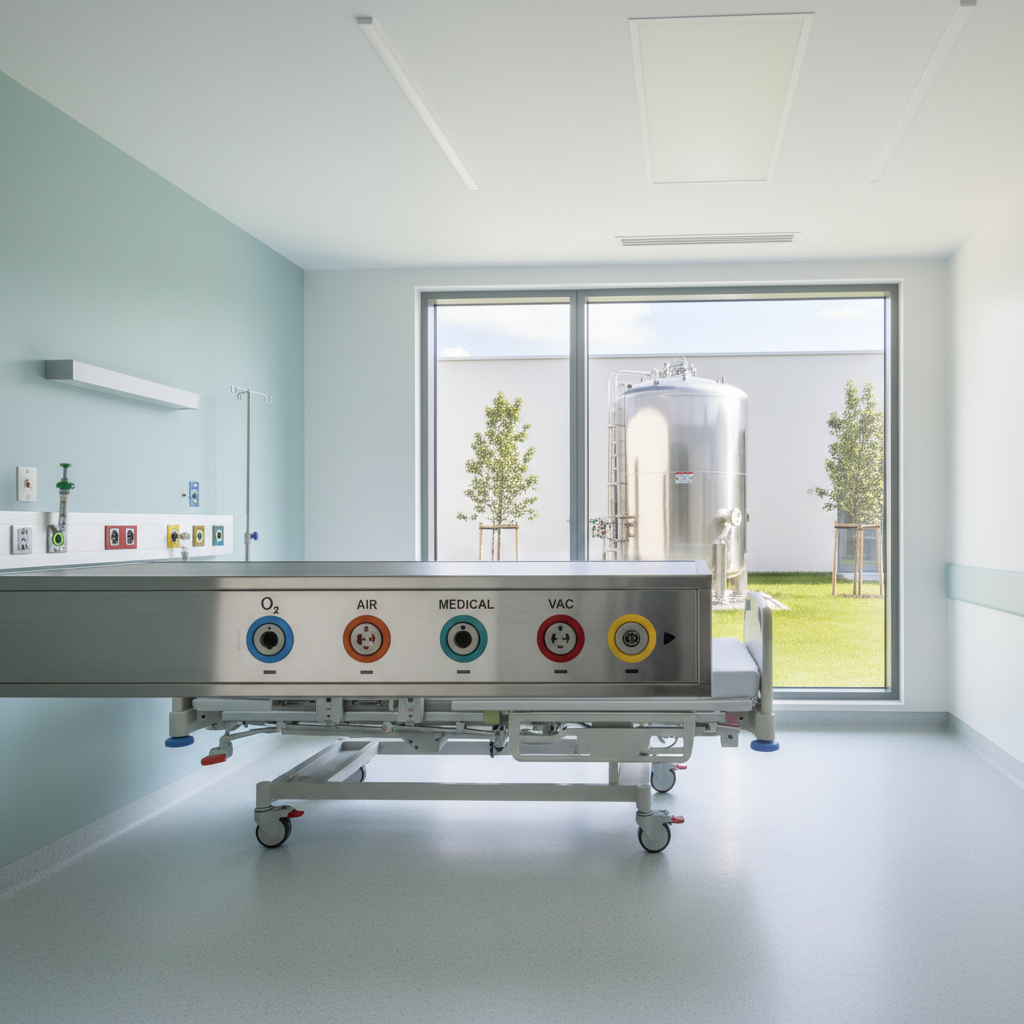
What is a Hospital Oxygen System?
A hospital oxygen system is a life-sustaining utility, a complex network of components designed to deliver medical-grade oxygen reliably to patient bedsides, operating rooms, and other critical care areas. Unlike portable cylinders, a central system provides a continuous, dependable supply sourced from a main storage unit. For a facility in Cary, NC, a properly executed hospital oxygen system installation is not just a construction project; it's a critical step in ensuring patient safety and regulatory compliance. This process involves much more than just connecting pipes. It encompasses meticulous planning, precise execution by ASSE 6010 certified installers, and rigorous testing confirmed by an ASSE 6030 verifier.
This guide will walk you through the essential components, installation processes, and compliance standards governing hospital oxygen systems. You will learn about the roles of bulk oxygen tanks, manifolds, alarms, and the critical procedures like brazing and third-party verification that ensure the system is safe for patient use.
Key Components of a Hospital Oxygen System
A hospital's medical oxygen system is more than just pipes in the walls. It's an integrated system where each part plays a crucial role. Understanding these components is the first step in a successful installation.
1. Bulk Oxygen Supply
The heart of the system is the bulk oxygen storage unit. Most hospitals use a cryogenic bulk tank, which stores liquid oxygen (LOX) at temperatures below -300°F (-184°C).
- Vessel: A large, vacuum-insulated vessel, similar to a giant thermos, stores the LOX.
- Vaporizers: Ambient air vaporizers convert the liquid oxygen into a gaseous state for delivery through the pipeline.
- Economizer: A circuit that helps manage pressure and reduce waste by preferentially using gas from the vapor space of the tank before sending liquid to the vaporizer.
For facilities with lower demand, high-pressure gas cylinder manifolds may be used as the primary source, though this is less common for full-scale hospitals.
2. Manifolds: The Backup and Reserve System
Per NFPA 99, all central supply systems must have a secondary and often a tertiary backup. This is the role of the manifold. It's a bank of high-pressure cylinders that automatically activate if the primary bulk supply fails or is depleted.
- Primary Manifold: Can be the main source for smaller clinics.
- Secondary Manifold (Backup): Automatically switches on if the bulk tank pressure drops.
- Reserve Manifold (Emergency): A separate, manual or automatic system for catastrophic failures.
Properly configured manifolds are a non-negotiable part of ensuring an uninterrupted oxygen supply.
3. Alarms and Monitoring
Master and area alarm panels are the nervous system of the medical gas network. They provide audible and visual warnings for changes in pressure or supply status.
- Master Alarms: Located in a 24/7 monitored area, they signal issues with the main supply source (e.g., "Bulk Oxygen Low," "Manifold Changeover").
- Area Alarms: Installed in critical care locations like ICUs or ERs, they monitor pressure in specific zones (e.g., "High/Low Pressure - ICU North Wing").
4. The Piping Network & Zone Valves
The distribution network consists of medical-grade copper piping that transports the oxygen from the source to the patient rooms.
- Main Lines: Large diameter pipes that run from the source.
- Risers: Vertical pipes that distribute gas to different floors.
- Branch Lines: Smaller pipes that feed specific zones or rooms.
- Zone Valve Boxes: These are critical for emergency shutdowns and maintenance. A valve box allows staff to shut off the gas supply to a specific area (a single room, a wing, or an entire floor) without affecting the rest of the facility. This is essential for both patient safety during a fire and for service procedures. Medical Testing Solutions offers comprehensive medical gas maintenance services that rely on the proper function of these valves.
Why This Matters for Compliance: NFPA 99 (Health Care Facilities Code) provides extensive requirements for the design, installation, and performance of medical gas systems. Failure to adhere to these standards, particularly regarding source equipment, alarms, and valve placement, can result in failed inspections, costly rework, and significant risks to patient safety.
The ASSE 6010 Installation Process
The installation of a medical oxygen system is governed by the ASSE 6000 series of standards. The credential for installers is ASSE 6010 Medical Gas Systems Installer. You should never allow uncertified personnel to perform this work.
Step 1: Pre-Installation Planning & Coordination
Before a single piece of pipe is installed, a detailed plan is essential. This involves coordination between the facility, the architect, mechanical engineers, and the certified installation team. The plan ensures that pipe routing, component placement, and structural supports meet all code requirements and logistical needs of the Cary, NC hospital.
Step 2: Brazing the Copper Piping (The "Purge and Braze")
This is the most critical hands-on part of the installation. Per NFPA 99, all joints in medical gas piping must be brazed, not soldered. Brazing creates a much stronger, leak-proof joint capable of withstanding the system's pressures.
- Nitrogen Purge: During brazing, a continuous flow of oil-free, dry nitrogen must be passed through the pipe. This "purge" displaces oxygen, preventing the formation of copper oxides on the interior surface of the pipe. These black, flaky oxides can otherwise dislodge and contaminate the system, posing a severe risk to patients.
- Proper Technique: The ASSE 6010 certified installer uses an oxy-acetylene torch and a brazing alloy (typically a copper-phosphorus or silver-based alloy) to heat the joint and create a permanent, sealed connection.
This specialized procedure is a core competency of any legitimate medical gas installation provider.
Step 3: Component Installation
Once the piping network is in place, the team installs the primary components: the bulk tank, manifolds, alarm panels, and zone valve boxes. Finally, the terminal outlets (such as DISS, Ohmeda, or Chemetron) are installed in the patient rooms.
| Component Comparison | Typical Use Case | NFPA 99 Requirement | Key Consideration |
|---|---|---|---|
| Cryogenic Bulk Tank | Large hospitals, high volume | Must have primary & secondary source | Siting, concrete pad, security |
| High-Pressure Manifold | Smaller clinics, backup source | Required as backup for bulk systems | Cylinder size & quantity, automatic changeover |
| Zone Valve Box | Per-floor, per-department | Required to isolate zones for maintenance/emergency | Clear labeling, accessibility, integration with alarms |
| Area Alarm Panel | Critical care areas (ICU, OR) | Required for all anesthetizing locations | Monitors pressure in a specific branch line |