Hospital Oxygen System Installation Alexandria VA: Compliance Guide
Designing and executing a compliant medical oxygen distribution network requires precise engineering, specialized brazing, and rigorous third-party verification. For healthcare facility managers, mechanical contractors, and clinical directors in Northern Virginia, managing a hospital oxygen system installation in Alexandria, VA demands strict adherence to NFPA 99 (Health Care Facilities Code), ASSE Series 6000 standards, and Virginia state building codes. From sizing cryogenic bulk liquid tanks and micro-bulk systems to running pipeline through risers and terminating at surgical zone valve boxes, every mechanical joint directly influences patient safety.
In this comprehensive guide, you will learn the regulatory framework governing oxygen systems, the exact procedural distinctions between bulk supplies and high-pressure manifolds, critical ASSE 6010 brazing protocols, zone valve placement logic, and the essential role of independent ASSE 6030 third-party verification. Whether retrofitting an existing facility near Seminary Hill or constructing a greenfield surgical hospital along the Route 1 corridor, this manual details how to execute a fully compliant clinical oxygen installation.
Regulatory Framework: NFPA 99, ASSE 6000, and Virginia Codes
Medical gas pipeline systems are classified as life-safety systems. In Alexandria, healthcare mechanical installations fall under the Virginia Uniform Statewide Building Code (VUSBC), which incorporates the International Plumbing Code (IPC) and enforces NFPA 99: Health Care Facilities Code (2018/2021 editions depending on the municipal permitting cycle).
The foundational codes dictate not just how equipment operates, but who is legally qualified to touch it:
- NFPA 99 Chapter 5 (Gas and Vacuum Systems): Establishes Category 1 (critical care, where gas failure causes major injury or death) through Category 4 criteria. Hospitals are Category 1 facilities, mandating complete dual-source redundancy, reserve supplies, and extensive emergency monitoring.
- NFPA 55 (Compressed Gases and Cryogenic Fluids Code): Governs bulk oxygen storage systems located outdoors or in dedicated mechanical rooms, dictating required setbacks from property lines, building openings, patient egress pathways, and flammable materials.
- CGA (Compressed Gas Association) Standards: Pamphlets such as CGA M-1 (Guide for Medical Gas Supply Systems at Health Care Facilities), CGA G-4.1 (Cleaning Equipment for Oxygen Service), and CGA P-18 establish purity and handling baselines.
- ASSE Series 6000 Professional Qualification Standard:
- ASSE 6010: Medical Gas Systems Installers (brazers and pipefitters).
- ASSE 6020: Medical Gas Systems Inspectors (facility/jurisdictional oversight).
- ASSE 6030: Medical Gas Systems Verifiers (independent third-party final commissioning).
- ASSE 6040: Medical Gas Systems Maintenance Personnel.
Why this matters for compliance: NFPA 99 section 5.1.10.11 explicitly requires that installers be qualified under ASSE 6010, and section 5.1.12.1.1 mandates that all verification tests be conducted by an independent ASSE 6030 verifier before the system is placed in clinical operation. Bypassing certified labor invalidates your occupancy permit and exposes facilities to severe liability under Joint Commission or CMS audits.
Primary Supply Sources: Bulk Liquid vs. High-Pressure Manifolds
Selecting the primary medical oxygen source depends directly on the facility's average peak flow requirements, total bed capacity, and physical lot constraints in Alexandria. | Diagram text | |, |
1. Bulk Cryogenic Liquid Oxygen (VIE)
For mid- to large-sized acute care facilities such as Inova Alexandria Hospital or regional trauma centers, cryogenic liquid storage (Vacuum Insulated Evaporator or VIE) is the standard. Liquid oxygen is stored at approximately -297°F (-183°C) under pressure (150–250 psig).
- Components: Vacuum-jacketed storage vessel, ambient atmospheric vaporizers to convert liquid back to gas, pressure regulation skids (dual-line regulators stepping down to 50–55 psig distribution pressure), an economizer circuit, and a liquid or high-pressure cylinder reserve.
- NFPA 99 Redundancy: Category 1 requirements stipulate an operating supply, a secondary supply, and an emergency reserve supply. If the main cryogenic tank fails, the secondary supply or high-pressure reserve manifold must automatically switch online without pressure disruption.
- Emergency Oxygen Service Connection (EOSC): Mandated by NFPA 99 §5.1.3.5.13 for bulk systems. Located on the exterior of the building, an EOSC allows a temporary trailer-mounted bulk liquid or high-pressure tank to be tied into the main building pipeline during maintenance or catastrophic source failures.
2. High-Pressure Cylinder Manifolds
For outpatient surgical centers, freestanding emergency rooms, and specialty clinics throughout Northern Virginia, high-pressure cylinder manifolds are the preferred primary source:
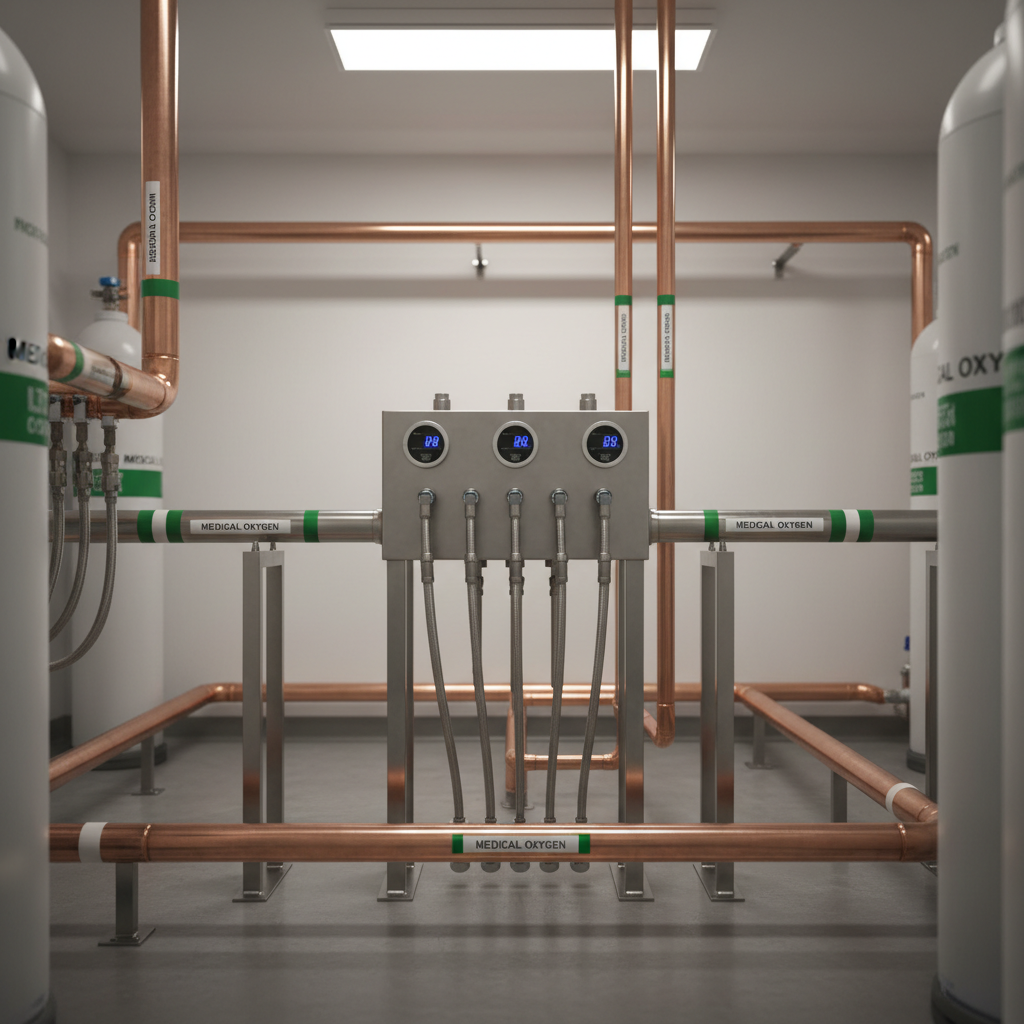
- Automatic Switchover Manifolds: Feature two banks of high-pressure cylinders (typically 2,000 to 2,600 psig). When the primary bank depletes to a predetermined setpoint, an internal differential sensor automatically switches to the secondary reserve bank without pressure drop to patient rooms.
- Reserve Configurations: Category 1 facilities utilizing manifolds require either a 2x2, 4x4, or larger configuration paired with an integrated emergency reserve header (minimum 24-hour supply).
- Header Bar & Pig-tails: Pigtails must be copper or Teflon-lined stainless steel rated for high-pressure oxygen, equipped with CGA 540 connections and individual check valves to prevent gas backflow during cylinder swaps.
Explore the complete technical lineup of source equipment in our products catalog to review manifold controllers and bulk gas control hardware.
Supply Source Comparison
The following table contrasts the major oxygen infrastructure configurations for commercial healthcare projects:
| System Parameter | Cryogenic Bulk Liquid (VIE) | Micro-Bulk Liquid Tank | High-Pressure Auto-Manifold |
|---|---|---|---|
| Typical Facility Size | Large Acute Care (>100 beds) | Ambulatory / ERs (15–50 beds) | Outpatient / ASCs (1–15 ORs) |
| Primary Pressure | 150 – 250 psig | 100 – 200 psig | 2,000 – 2,600 psig |
| Distribution Pressure | 50 – 55 psig | 50 – 55 psig | 50 – 55 psig |
| Footprint Requirements | Large outdoor concrete pad, fences | Exterior or outdoor alcove pad | Indoor gas storage room (1-hr rated) |
| Code Setback Rules | NFPA 55, severe property setbacks | NFPA 55, moderate setbacks | NFPA 99 room ventilation rules |
| EOSC Required? | Yes (NFPA 99 §5.1.3.5.13) | Recommended / Dependent on beds | No (optional) |
| Refill Mechanism | Liquid transport tanker | Route truck transfer | Cylinder exchange (manual) |
| Reserve Redundancy | Liquid/Cylinder reserve bank | Automatic manifold reserve | Integral secondary manifold bank |
ASSE 6010 Copper Pipeline Installation & Brazing Protocols
The distribution pipeline carrying medical-grade breathing oxygen is subject to strict chemical and mechanical joining standards. Medical Testing Solutions provides factory-trained, certified technicians specializing in complete medical gas installation to ensure zero contaminants compromise the network.
1. Material Specifications
- Tubing: Must be seamless copper tube compliant with ASTM B819 (Standard Specification for Seamless Copper Tube for Medical Gas Systems). Only Type L (hard drawn, marked in blue) or Type K (hard drawn, marked in green) are permitted.
- Cleaning & Packaging: ASTM B819 tubing is pre-cleaned by the manufacturer for oxygen service to remove oils, grease, and particulate matter, sealed with end plugs, and bagged.
- Fittings: Wrought copper fittings compliant with ASME B16.22, similarly pre-cleaned and bagged for oxygen service per CGA G-4.1.
2. The Nitrogen Purge Requirement
During the brazing process, high heat causes copper to react with atmospheric oxygen, forming cupric oxide scale inside the pipe. When oxygen flows through the system later, this abrasive scale can dislodge, destroying medical gas regulators, clogging flowmeters, and traveling straight to ventilated patients.
NFPA 99 §5.1.10.5.5 strictly mandates:
- An active continuous purge with oil-free dry nitrogen (NF) must be maintained through the piping during all heating and brazing operations.
- The oxygen concentration inside the purged pipe must remain below 1% to completely prevent internal oxidation.
- Installers utilize an oxygen analyzer at the discharge port to confirm nitrogen displacement before touching a torch to the joint.
- Purge pressure must be kept low (typically 1–2 psi) to prevent pinholes or pressure blowouts in the molten filler metal.
3. Filler Metals and Technique
- Brazing Alloys: Must meet AWS A5.8 standards. Acceptable alloys are BCuP series (copper-phosphorus or copper-phosphorus-silver) without flux when joining copper-to-copper.
- Flux Prohibitions: Flux contains corrosive chemicals that cannot be completely flushed from closed medical systems. Flux is strictly prohibited on copper-to-copper joints. Flux (specifically AWS BAg series compatible flux) is only permitted when brazing copper tube to dissimilar metals (such as brass or bronze valve bodies), and must be applied sparingly to the external male tube surface only, leaving the interior entirely clear.