Hospital Nitrogen System Testing in Wellington, FL: A Complete Guide
Surgical nitrogen (NF) is a critical medical gas used to power pneumatic surgical tools, from drills and saws to dermatomes. When a hospital in Wellington, Florida, installs or modifies a nitrogen system, it's not enough to simply connect the pipes. To ensure patient safety and regulatory compliance, that system must undergo rigorous verification and testing by certified professionals. This process, governed by stringent codes like NFPA 99, confirms the system's integrity, pressure, and, most importantly, the purity of the gas delivered to the operating room.
This guide will walk you through the essential requirements for hospital nitrogen system testing in Wellington. We'll explore the specific tests involved in an ASSE 6030 verification, the importance of purity analysis, and how Medical Testing Solutions ensures your facility meets or exceeds all applicable standards, protecting both your patients and your organization.
Understanding the "Why": NFPA 99 and Nitrogen System Safety
The National Fire Protection Association (NFPA) 99, Health Care Facilities Code, is the cornerstone of medical gas safety. It establishes the minimum criteria for the installation, performance, and maintenance of medical gas systems. For nitrogen systems used to power surgical equipment (Nitrogen NF), the code is uncompromising. These systems operate at high pressures (typically 160-200 psi), and any failure, from a leaky pipe to gas contamination, can have immediate and severe consequences during a surgical procedure.
NFPA 99 mandates that any new, modified, or repaired medical gas system must be thoroughly verified by a party other than the installer, credentialed to the American Society of Sanitary Engineering (ASSE) 6030 standard. This third-party verification is a non-negotiable step before the system can be used for patient care.
Why This Matters for Compliance: Failure to perform and document proper system verification after an installation or modification is a direct violation of NFPA 99. This can lead to costly project delays, failed inspections by accreditation bodies like The Joint Commission, and significant liability risks. Proper testing is a foundational requirement for a compliant healthcare environment.
The ASSE 6030 Verification Process for Nitrogen Systems
An ASSE 6030 Certified Medical Gas Verifier follows a systematic, multi-step process to ensure a nitrogen system is safe and ready for use. While the full verification includes dozens of individual checks, the core procedures for a surgical nitrogen system involve the following critical tests.
Initial System Inspection
Before any gas is introduced, the verifier conducts a visual inspection of the entire installation. This includes:
- Piping: Confirming the use of correct, cleaned, and brazed Type K or L copper tubing.
- Labeling: Ensuring all pipes are correctly labeled "Nitrogen NF" with the direction of gas flow indicated.
- Component Checks: Verifying that the source equipment (manifolds or cylinders), regulators, pressure relief valves, and zone valve boxes are correctly installed and accessible.
Standing Pressure Test
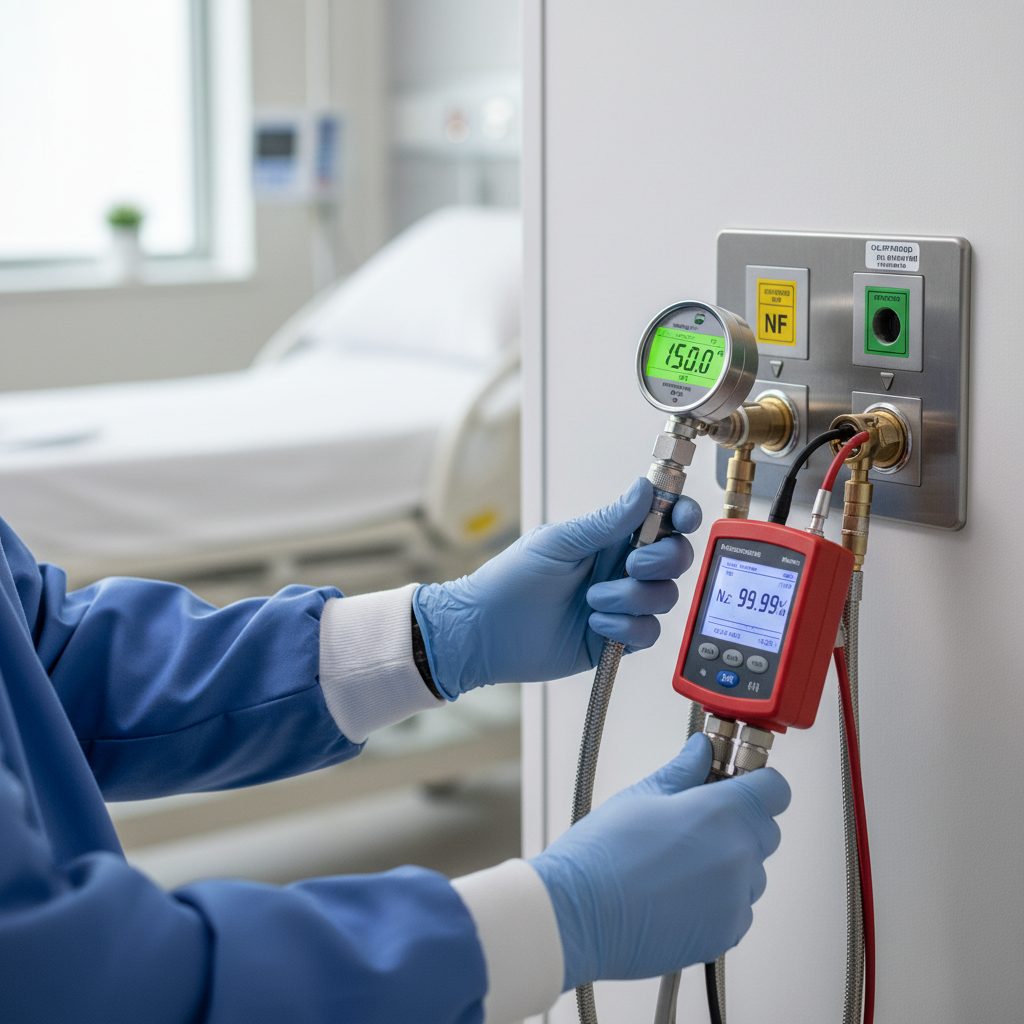
This is the first of two crucial pressure tests. The system is filled with oil-free, dry nitrogen to 1.5 times the system working pressure (or a minimum of 150 psig). The system is then completely isolated from the nitrogen source and must hold that pressure for 24 hours with virtually no loss. This test confirms the integrity of the brazed joints and connections, ensuring there are no leaks.
Cross-Connection Test
This test is performed to guarantee that the nitrogen system is not connected to any other medical gas system (e.g., oxygen, medical air). The verifier pressurizes only the nitrogen system and then checks every other medical gas outlet in the facility to ensure no nitrogen is flowing from them. This critical step prevents a catastrophic gas mix-up that could harm a patient.
For comprehensive system safety, Medical Testing Solutions performs this test on all medical gas systems in the facility, a best practice for ensuring total isolation between services. For more details on system-wide testing, see our page on annual medical gas inspections.
Final Pressure Test & Valve Operation
After the cross-connection test, the verifier confirms that all zone valves and mainline valves function correctly and that the system holds its final design operating pressure. This ensures that individual areas can be isolated for maintenance without disrupting the entire facility and that the pressure delivered to the terminal outlets is correct.