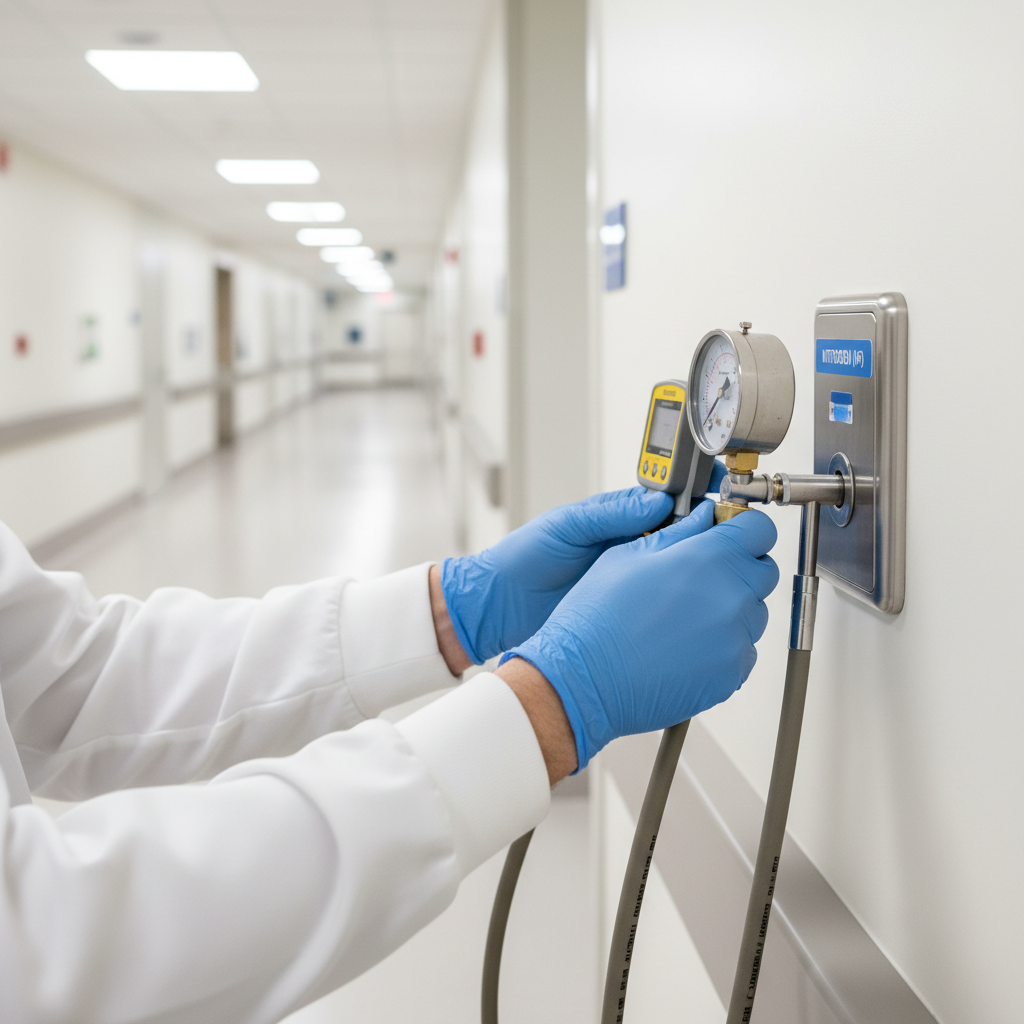
Understanding Surgical Nitrogen (NF) Systems in Hospitals
Nitrogen (N₂) in its medical, USP/NF (United States Pharmacopeia/National Formulary) grade form, is a critical utility in modern healthcare facilities. While it doesn't have the direct life-support role of oxygen, surgical nitrogen is indispensable for powering a wide range of pneumatic surgical tools. These instruments, from saws and drills to dermatomes and staplers, rely on a consistent, high-pressure, and contaminant-free source of nitrogen to function correctly in operating rooms. A loss of pressure or the introduction of contaminants can lead to immediate equipment failure, jeopardizing patient safety and surgical outcomes. Therefore, rigorous testing and verification of these systems are not just best practices; they are mandated by code.
This guide will walk you through the essential requirements for hospital nitrogen system testing in Miramar, FL, focusing on initial verification, ongoing purity testing, and the standards that govern system safety and compliance, such as NFPA 99 and the ASSE 6000 series. You'll learn what to expect during a system verification, why particulate and purity testing is critical, and how to maintain your system for long-term reliability.
The "Why": NFPA 99 and ASSE 6000 Series Standards
The entire framework for medical gas safety, including nitrogen systems, is built upon a foundation of codes and standards. For any hospital in Miramar, or anywhere in the United States, these are not optional.
NFPA 99: The Health Care Facilities Code
The National Fire Protection Association's NFPA 99 is the cornerstone of medical gas regulation. It outlines the minimum criteria for the installation, performance, and maintenance of medical gas and vacuum systems. Key sections relevant to nitrogen systems include:
- Chapter 5: Gas and Vacuum Systems: This chapter details requirements for everything from source equipment (like nitrogen manifolds) to the piping distribution network and terminal outlets in patient care locations.
- System Verification (NFPA 99, Chapter 5.1.12): Before a new or modified nitrogen system can be put into service, it must undergo a comprehensive verification process performed by a party technically competent and experienced in the field, certified to the ASSE 6030 standard. This isn't a suggestion; it's a mandate to ensure patient safety.
Why this matters for compliance: Failure to comply with NFPA 99 can result in citations from accrediting organizations like The Joint Commission (TJC), CMS, or AHCA. More critically, it creates significant patient safety risks. Proper medical gas certification is your primary evidence of compliance.
ASSE 6000 Series: Personnel Certification
The American Society of Sanitary Engineering (ASSE) 6000 series provides the certification standards for the individuals who work on medical gas systems. The key certifications for this work are:
- ASSE 6010 Certified Installer: For personnel who install the physical piping and components.
- ASSE 6030 Certified Verifier: For the credentialed third-party expert who performs the final system testing and verification.
When you hire a company like Medical Testing Solutions for medical gas verification, you are engaging ASSE 6030 Certified Verifiers who have the specialized training and equipment to execute the NFPA 99 testing procedures.
Initial System Verification: The ASSE 6030 Process
Putting a new nitrogen system online or using a system that has been modified requires a meticulous, multi-step verification process. This must be performed by an ASSE 6030 Certified Verifier. The goal is to confirm that the system is safe, leak-free, has no cross-connections, and delivers the correct, pure gas to every outlet.
Here are the typical steps involved:
- Initial Blowdown: The system is purged with high-volume, oil-free nitrogen to remove any construction debris from the piping.
- Initial Pressure Test: The system is pressurized to 1.5 times the working pressure (but not less than 150 psig) and checked for any pressure loss over a set period, confirming the integrity of the joints.
- Cross-Connection Test: Each medical gas system in the facility is individually pressurized, and all other systems are checked to ensure no gas is flowing between them. This is a critical test to prevent, for example, nitrogen from being delivered through an oxygen outlet.
- Piping Purge Test: The system is purged again to ensure all particulate matter is removed. A white filter is used at the outlets to visually check for contaminants.
- Standing Pressure Test: A 24-hour test is conducted at the normal operating pressure to confirm there are no small, slow leaks in the system.
- Gas Purity and Identification: This is where the verifier confirms the gas is what it purports to be. The verifier will test for nitrogen identity, purity (must be ≥99.0%), and the concentration of various potential contaminants.
- Final Tie-In: The final connection is made from the source equipment (e.g., nitrogen cylinder manifold) to the newly verified distribution piping.