Skip to content
    New: Medical Gas Outlet Retrofit & Rebuild Matrix — cross-reference legacy Chemetron, Ohio Diamond, Puritan-Bennett & more →
    ASSE Certified 24/7
    Buying Guides
    Compliance & Standards

    Fume Hood vs. Benchtop Ventilation in a Mohs Lab: A Definitive Comparison

    Medical Testing SolutionsAugust 6, 20267 min read
    Share
    Fume Hood vs. Benchtop Ventilation in a Mohs Lab: A Definitive Comparison

    Introduction: The Critical Role of Ventilation in Mohs Labs

    Mohs micrographic surgery labs handle hazardous chemicals, most notably xylene, a solvent used for processing tissue specimens. Inhaling xylene vapor can pose significant health risks to laboratory personnel. Therefore, effective ventilation is not just a best practice, it is a mandatory safety and compliance requirement. The primary challenge for lab managers is selecting the most appropriate and cost-effective engineering control to minimize exposure. This article provides a definitive comparison of the three primary ventilation solutions: ducted fume hoods, ductless (carbon-filtered) hoods, and local exhaust "benchtop" ventilators. We will explore the mechanics, ideal use cases, compliance considerations, and operational costs of each, empowering you to make an informed decision for your Mohs laboratory.

    Understanding the Hazard: Xylene Exposure in Mohs Procedures

    Xylene is the workhorse solvent for clearing and deparaffinizing tissue slides in histology. However, it is a volatile organic compound (VOC). The Occupational Safety and Health Administration (OSHA) has set a permissible exposure limit (PEL) for xylene at 100 parts per million (ppm) over an 8-hour time-weighted average (TWA). The National Institute for Occupational Safety and Health (NIOSH) recommends a lower limit of 100 ppm as a TWA and a 150 ppm short-term exposure limit (STEL). Chronic exposure can lead to respiratory irritation, neurological effects, and other health issues. Effective engineering controls are the most reliable way to keep ambient xylene levels well below these legal limits.

    Why this matters for compliance: NFPA 99, Health Care Facilities Code, classifies laboratories as areas where hazardous materials are handled. Section 15.6 requires that ventilation be adequate to "confine and exhaust" fumes from flammable or hazardous chemicals. Failing to provide proper ventilation can result in non-compliance and endanger staff.

    Option 1: The Ducted Fume Hood

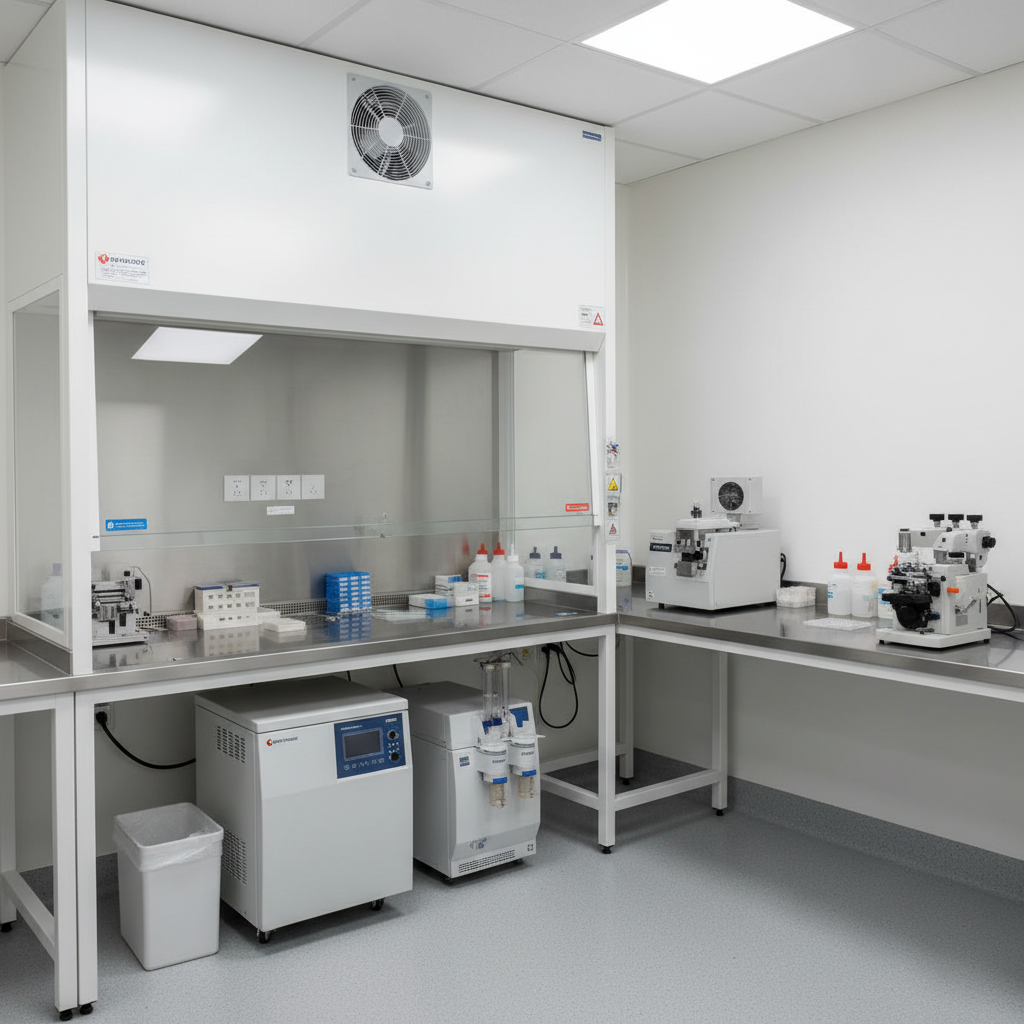
    A ducted fume hood is the gold standard for chemical containment. It is a ventilated enclosure that connects via ductwork to a dedicated exhaust fan, typically mounted on the roof. This system captures contaminants at the source and expels them directly outside the building, ensuring they cannot re-enter the workspace.

    How It Works

    • Containment: The hood creates a negative pressure environment. Air from the laboratory is drawn into the front opening of the hood, across the work surface, and up into the ductwork.
    • Exhaust: A powerful blower pulls the contaminated air away from the user and safely disperses it outdoors, away from air intakes.
    • Face Velocity: The speed of the air moving into the hood opening is known as face velocity. For chemical hoods, this is typically maintained between 80 and 120 feet per minute (FPM) to ensure effective capture without creating turbulence.

    Pros & Cons

    • Pros: Highest level of protection, removes all chemical types without filter limitations, robust and reliable.
    • Cons: High upfront installation cost (ductwork, fan, roofing), requires significant building modification, ongoing energy costs to run the fan and replace conditioned air.

    For labs with a high volume of slide preparation or those using a wide variety of chemicals, a ducted fume hood offers the most comprehensive protection. Medical Testing Solutions offers ASSE 6010 certified medical gas installation services, ensuring your system is integrated correctly from the start.

    Option 2: The Ductless Fume Hood

    Ductless hoods, also known as carbon-filtered enclosures, offer an alternative when external ducting is impractical or too expensive. These units draw contaminated air through a set of filters, typically a pre-filter for particulates and an activated carbon filter to adsorb chemical vapors, before recirculating the cleaned air back into the laboratory.

    How It Works

    • Filtration: Air is pulled into the enclosure, passing through a thick bed of activated carbon. The carbon's porous structure provides a massive surface area where xylene molecules are trapped (adsorbed).
    • Recirculation: After passing through the filters, the "scrubbed" air is returned to the room.

    Pros & Cons

    • Pros: Lower initial cost, easy to install (no ductwork), portable.
    • Cons: Limited to specific chemicals (xylene is suitable, but not all chemicals are), ongoing cost of filter replacement, risk of filter saturation and breakthrough if not properly managed, does not remove humidity or heat.

    A key part of using a ductless hood is a rigorous chemical exposure monitoring program. Regular monitoring of filter saturation and ambient air quality is critical to ensure the hood is providing adequate protection.

    Option 3: Benchtop Fume Extractors

    For very small or low-volume labs, a benchtop fume extractor (also called a "snout" or local exhaust ventilator) can be a viable, targeted solution. These are small, portable devices with a flexible arm and a capture hood that is placed directly over the staining dish or slide processor.

    How It Works

    • Source Capture: The nozzle is positioned just inches from the chemical source to capture vapors before they can escape into the breathing zone.
    • Filtration/Exhaust: Like ductless hoods, most benchtop units use carbon filters to clean the air before recirculating it. Some models can be ducted to the outside.

    Pros & Cons

    • Pros: Lowest initial cost, highly portable, targets specific points of use.
    • Cons: Very limited capture area, highly dependent on correct placement, not suitable for large-scale work, may not be sufficient on its own to meet overall room ventilation requirements.

    These are best used for intermittent tasks, supplementing a room's general ventilation system. They are often seen in smaller dermatology clinics performing Mohs.

    Comparison Table: Fume Hood vs. Ductless vs. Benchtop

    FeatureDucted Fume HoodDuctless (Carbon) HoodBenchtop Extractor
    Protection LevelHighestHigh (with proper filter management)Low to Moderate (source capture only)
    InstallationComplex, requires ductworkSimple, plug-and-playSimple, plug-and-play
    Upfront CostHigh ($10,000 - $30,000+)Moderate ($4,000 - $10,000)Low ($1,000 - $3,000)
    Operating CostModerate (energy for fan)High (filter replacement, monitoring)Low (filter replacement)
    Chemicals HandledVirtually allLimited to chemicals the filter can adsorbLimited
    Best Use CaseHigh-volume labs, diverse chemical useLabs where ducting is not feasibleLow-volume, intermittent tasks

    Verification and Maintenance Cadence

    Regardless of the system chosen, regular performance verification is required. This is not a "set it and forget it" piece of equipment.

    • Initial Verification: Upon installation, a system must be tested to ensure it meets its design specifications. This is part of an ASSE 6030 Medical Gas Verification process.
    • Annual Certification: Fume hoods should be recertified at least annually. This involves:
      • Face Velocity Measurement: Checking that the airspeed at the hood opening is within the safe range (e.g., 80-120 FPM).
      • Smoke Test: A visual test to confirm airflow patterns are drawing air into the hood effectively.
      • Filter Checks (Ductless): For ductless units, this includes checking the filter's saturation level.

    Medical Testing Solutions provides comprehensive annual medical gas inspections and certification for all types of laboratory ventilation systems, ensuring your facility remains safe and compliant.

    Conclusion: Making the Right Choice for Your Mohs Lab

    Choosing between a ducted fume hood, a ductless enclosure, or a benchtop extractor for your Mohs lab comes down to balancing protection, practicality, and cost. For new constructions or labs with high throughput, a ducted fume hood is the undeniable best choice for safety. For existing labs where structural changes are impossible or cost-prohibitive, a ductless hood provides an excellent and compliant alternative, provided a strict filter management and monitoring program is in place. Benchtop extractors are best reserved for small, targeted applications and should not be relied upon as the sole means of chemical vapor control.

    Ultimately, protecting your staff from hazardous chemical exposure is paramount. For expert guidance on selecting, installing, and certifying the right ventilation system for your Mohs lab, contact the ASSE-certified professionals at Medical Testing Solutions.

    Contact Us

    Ensure your lab is safe and compliant. Contact Medical Testing Solutions for a consultation or to schedule your annual ventilation system verification.

    Call us today at +1 (754) 315-1078 or request a quote online.

    Frequently Asked Questions

    Fume hoods should be certified upon installation and then at least annually to ensure they are providing adequate face velocity and containment. Some jurisdictions may require more frequent testing.

    No. Ductless hoods rely on carbon filters that are effective for specific chemicals like xylene, but not for all. Always consult the manufacturer's chemical compatibility chart and never use them for unknown substances.

    The generally accepted standard for chemical fume hoods is a face velocity between 80 and 120 feet per minute (FPM). This ensures contaminants are captured without creating unsafe turbulence.

    Generally, no. A benchtop unit only provides source capture and is insufficient as the primary engineering control for a room where volatile chemicals are used regularly. It is best used for small, intermittent tasks.

    Fume hood testing and certification should be performed by a qualified professional, such as an ASSE 6030 Certified Medical Gas Verifier, who has the calibrated equipment and expertise to measure airflow accurately and interpret safety standards.

    NFPA 99 (Health Care Facilities Code) and ANSI/ASSP Z9.5 (Laboratory Ventilation) are key standards. They provide the framework for designing, operating, and maintaining safe laboratory ventilation systems.

    This article is provided for educational purposes and reflects industry standards as of publication. Always verify against current NFPA 99, CGA, and AHJ requirements. Medical Testing Solutions is ASSE-certified and ready to help — contact us for facility-specific guidance.

    Request a quote for your facility

    Talk with Medical Testing Solutions about your next inspection, repair or equipment request.

    Get a quote in 1 business day

    I agree to receive text messages from Medical Testing Solutions, L.L.C. at the phone number provided, including informational and marketing messages. Consent is not a condition of purchase. Message frequency varies. Message & data rates may apply. Reply STOP to opt out or HELP for help. See our Privacy Policy and Messaging Terms.

    Prefer to talk? Call (754) 315-1078

    Related articles