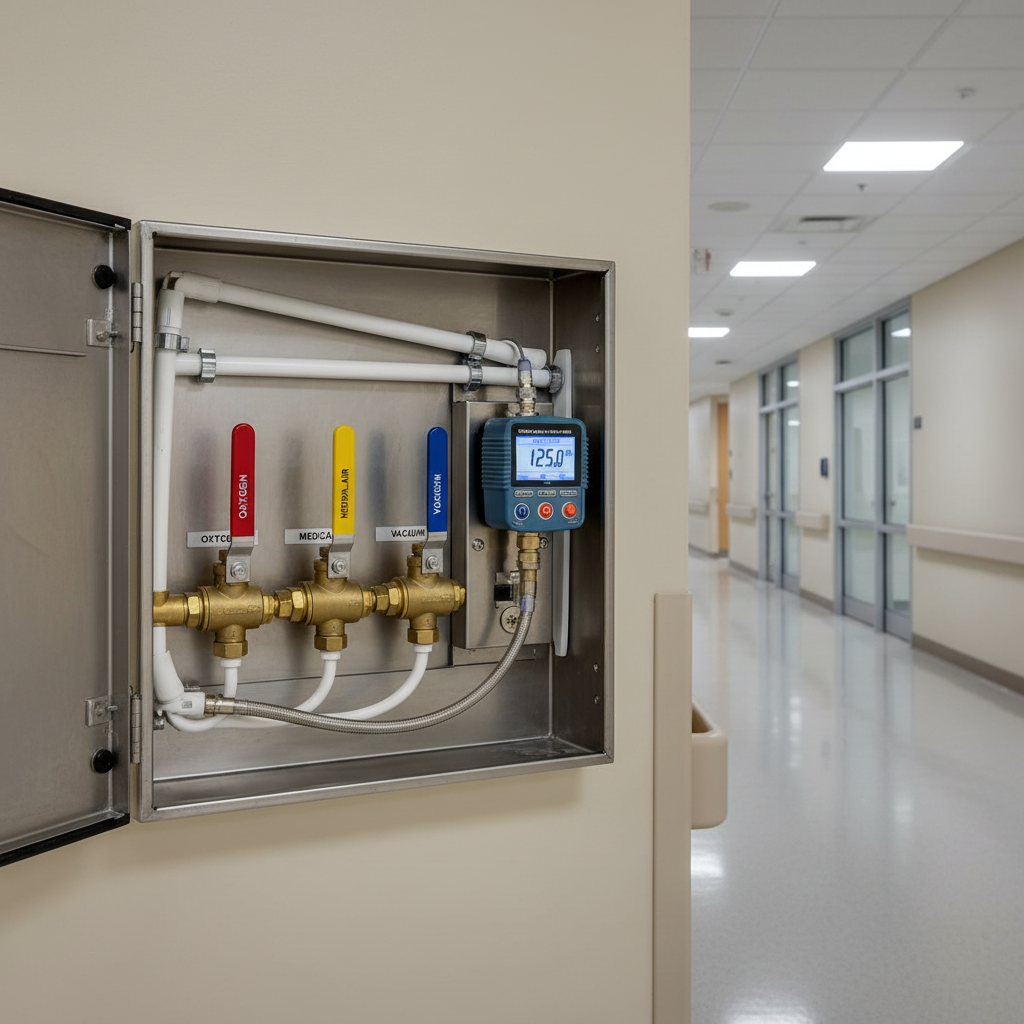
When you throw the handle on an intensive care unit zone valve to ninety degrees, the downstream pressure gauge should hold or drop as gas is consumed. If you attach a bleeder test tool to a patient station outlet and that gauge refuses to drop to zero, you have a bypassing seat seal. In high-acuity facilities across Lee County, discovering a creeping valve during an active oxygen leak or an urgent headwall rebuild turns a routine isolation into a complex operational emergency. Planning for emergency medical gas repair Tupelo MS hospitals require means understanding how critical care zone valve seals fail and how secondary regulator bypass manifolds keep patient lines pressurized without compromising NFPA 99 safety boundaries.
Medical Gas Service
Compliance & Standards
Emergency Medical Gas Repair Tupelo MS: Zone Valve Seals & Bypass
Medical Testing SolutionsNovember 12, 20269 min read
Why Critical Care Zone Valve Seals Fail to Isolate
Medical gas zone valves utilize three-piece, full-port ball designs engineered so the central body swings out for inline maintenance without cutting the brazed copper tubing. Inside that brass housing, the chrome-plated or stainless steel ball rests against two polymeric seats, accompanied by stem packing rings and end-cap body seals. Under NFPA 99 (Section 5.1.4.1.6), all materials exposed to positive-pressure oxygen at gauge pressures below 300 psi must remain compatible with oxygen service and free of hydrocarbon lubricants.
Most critical care zone valves remain fully open in the 90-degree position for a decade or longer without being cycled. Over time, several mechanical degradations attack those internal elastomers:
- Cold flow and compression set: Polytetrafluoroethylene (PTFE) seats slowly deform under constant spring or union-nut compression, losing the memory required to seal tightly when the ball rotates closed.
- Copper oxide scoring: If a past pipe modification lacked a continuous nitrogen purge during brazing, microscopic cupric oxide flakes travel down the pipeline and embed into the soft PTFE seat face, scratching a bypass channel across the ball when actuated.
- Stem O-ring desiccation: Dry medical air and USP oxygen strip moisture from fluorocarbon (Viton) stem seals, leading to stem blow-by when the handle is turned under 50 to 55 psi line pressure.
- Union nut torque relaxation: Thermal cycling inside hospital corridor walls can slightly loosen the swing-out body bolts, allowing external weeping or internal pressure migration past the outer body O-rings.
When a facility engineer closes the ICU zone valve to repair a damaged wall outlet and hears continuous hissing through the disassembled latch valve, the ball seat is compromised. You cannot rebuild a zone valve while its upstream riser remains at 50 psi unless an upstream riser valve or main branch shutoff can isolate that floor.
PTFE vs. Viton Valve Seal Kits and Oxygen Compatibility
Selecting the wrong repair kit during an urgent shutdown creates severe fire and contamination hazards. Valve manufacturers engineer specific elastomer compounds for distinct contact points within the three-piece valve assembly.
| Seal Material | Typical Valve Location | Oxygen Compatibility & Thermal Rating | Primary Failure Mode in Medical Gas Service |
|---|---|---|---|
| Virgin or Reinforced PTFE (Teflon) | Primary ball seats and thrust washers | Non-flammable in 100% oxygen at 50-55 psi; high Auto-Ignition Temperature (AIT > 750°F) | Cold flow deformation and scoring from pipeline particulates |
| FKM / Fluorocarbon (Viton) | Stem O-rings and external body union seals | High oxygen compatibility under NFPA 99; stable against dry gas oxidation | Compression flattening and embrittlement after 10+ years |
| Buna-N (Nitrile) | Vacuum-only valves or low-pressure non-oxidizing tools | Poor oxidizing resistance; prohibited in high-pressure oxygen due to low AIT | Rapid hardening, cracking, and catastrophic ignition risk in O2 |
| EPDM | Non-medical water or low-pressure utility air | Degrades in hydrocarbon traces; generally avoided in USP oxygen trim | Swelling and elastomer sloughing into the gas stream |
Technicians performing seal replacements must verify that every replacement seat and O-ring arrives factory-cleaned and bagged for oxygen service in accordance with CGA G-4.1. If a stem seal requires minimal lubrication during reassembly, only fluorinated PFPE greases (such as Krytox) rated for oxygen service may touch the brass or elastomer components.
If your facility engineering team is battling a weeping shutoff or failing transducer, scheduling professional medical gas maintenance services restores positive isolation before an unexpected unit shutdown occurs.
Executing a Safe Zone Valve Seal Rebuild Under NFPA 99
Rebuilding a leaking critical care zone valve demands coordination between biomedical engineering, respiratory therapy, and certified medical gas personnel. Because the zone valve box itself is the failure point, technicians must trace the piping schematic back to the vertical riser valve or branch main valve serving that wing. Closing a branch main often affects adjacent zones, requiring temporary portable cylinders or ventilator bridging for patients outside the immediate ICU pod.
Once clinical teams transfer patients to portable supply and upstream pressure is locked out and tagged out, the ASSE 6040 maintenance technician bleeds the isolated piping segment to zero gauge pressure through a furthest downstream outlet. The technician removes the valve box window frame, unbolts the top and bottom union nuts (or removes the swing-out flange bolts on four-bolt designs), and pivots the center body out of the pipeline without bending the rigid Type K or L copper tube.
Why this matters for compliance: Under NFPA 99 (Section 5.1.12), any breach of the medical gas pipeline or repair of a zone valve assembly requires targeted corrective verification testing before returning the zone to patient care. Simply opening the upstream riser and checking for bubbles with leak detector fluid does not satisfy life-safety code requirements.
After installing the factory-sealed PTFE seats, stem packing, and body O-rings, the technician torques the body bolts to the manufacturer's specification to prevent over-compressing the new PTFE seats. If you over-torque the union nuts on a three-piece valve, the ball will bind and require excessive lever force during an actual fire emergency.
Managing Secondary Regulator Bypass Loops During Emergencies
While zone valves govern clinical patient corridors, line pressure regulators at the bulk oxygen pad, manifold room, or branch riser assemblies step variable supply pressures down to the standard 50 to 55 psi delivery range (or 160 to 185 psi for nitrogen surgical instrument systems). When a final line pressure regulator begins to creep, allowing downstream pressure to drift past 65 psi and trip the high-pressure area alarm, or freezes shut under high surgical demand, facility teams rely on the regulator bypass loop.
NFPA 99 requires final line pressure regulators to be installed in duplex parallel configurations so either regulator can handle 100 percent of the peak calculated demand while the sibling regulator is isolated for repair. Look closely at your manifold room or bulk pad final line assembly and verify how the parallel loop is valved:
- Full duplex parallel regulating loops: Two identical regulators sit side by side, each flanked by an upstream and downstream ball valve, with relief valves positioned downstream of the regulators and upstream of the downstream isolation valves.
- Legacy raw-bypass valves: Older hospital piping sometimes includes a manual three-valve bypass loop around a single regulator. Opening a raw bypass valve without an inline backup regulator feeds unthrottled supply pressure directly toward the building riser, a dangerous configuration that must be replaced during system upgrades.
- Changeover seating drift: Even in compliant duplex parallel headers, leaving both regulator paths open simultaneously at the exact same spring tension causes both regulator seats to chatter and wear prematurely. One regulator should be set at nominal line pressure (for example, 53 psi) while the standby parallel regulator is set 2 to 3 psi lower (50 psi) for automatic takeover, or fully isolated ready for manual switchover.
When switching to the parallel standby regulator to rebuild a creeping primary diaphragm, open the standby isolation valves slowly before closing the malfunctioning branch. Abruptly slamming a high-pressure isolation valve open sends an adiabatic compression wave against the regulator diaphragm, generating heat and risking seat scorching in oxygen service.
Mandatory ASSE 6030 Testing After Valve or Regulator Repair
Any time a technician opens the pipeline envelope to replace internal zone valve seats or swap a faulty line regulator cartridge, foreign air enters the copper piping. Returning that zone to active critical care requires structured testing executed under ASSE 6030 medical gas verification protocols. Medical Testing Solutions conducts these post-repair tests using NIST-traceable digital manifold gauges, calibrated flowmeters, and laser particle counters.
Depending on the scope of the breach, NFPA 99 Section 5.1.12 prescribes specific verification checks for the affected zone:
- Standing pressure or operational leak test: Inspecting the rebuilt three-piece valve unions and stem packing at normal operating pressure with an oxygen-compatible leak detection solution.
- Gas-specific purge and purity check: Purging the opened zone with the source gas at high flow through every affected outlet until oxygen analyzer readings match USP concentrations (99.0% minimum for bulk liquid oxygen) and dew point / carbon monoxide parameters clear.
- Dynamic pressure drop verification: Ensuring the newly seated zone valve ball aligns concentrically with the pipe bore and does not restrict flow, maintaining less than a 5 psi drop at peak demand across the critical care outlets.
- Area alarm and pressure switch validation: Confirming that opening the zone valve returns the local transducer reading to 50-55 psi and clears all high/low audible and visual alarms at the nurses' station.
For projects involving new isolation valves or relocating boxes outside smoke compartments, certified ASSE 6010 medical gas installation procedures apply, including full nitrogen-purged brazing and 150 psi initial pressure testing.
Coordinating Urgent Medical Gas Support in Tupelo and North Mississippi
Healthcare facilities throughout North Mississippi operate under survey oversight from the Mississippi State Department of Health, which enforces CMS life-safety expectations and NFPA 99 compliance across licensed acute care and surgical centers. Major regional providers, including North Mississippi Health Services in Tupelo and the broader statewide network anchored by the University of Mississippi Medical Center, depend on zero-defect medical gas isolation during both unscheduled emergencies and planned ICU renovations.
Medical Testing Solutions is headquartered in Fort Lauderdale, Florida, and coordinates regional service deployments for hospitals, surgery centers, and clinics across our Mississippi service area. Rather than waiting for a creeping zone valve to stall an urgent renovation, many facility directors retain oxygen-clean repair kits and spare regulator assemblies from our medical gas products catalog on site so that scheduled maintenance visits or mobilized repair technicians have the exact OEM elastomer trim on hand. Pairing emergency component rebuilds with scheduled annual medical gas inspections catches seat compression set and regulator drift during quiet maintenance windows rather than at two in the morning.
If your facility has a critical care zone valve that refuses to hold zero pressure or a final line regulator drifting out of spec, Medical Testing Solutions provides ASSE-certified equipment, repairs, and verification testing. Request a quote online or call our technical team directly at (754) 315-1078 to coordinate your repair and verification schedule.
Frequently Asked Questions
A zone valve creeps past its closed position when the internal PTFE ball seats suffer cold-flow compression set after years in the open position, or when copper oxide particulates score the seating surface during actuation. Replacing the internal seat and stem O-ring kit restores positive shutoff.
No. Because the zone valve itself is the barrier being disassembled, you must close the upstream vertical riser valve or branch main shutoff feeding that zone and depressurize the pipe segment to zero psi before unbolting the three-piece valve body.
Yes. Under NFPA 99 Section 5.1.12, opening the pipeline to replace internal valve seats or a regulator cartridge breaches the closed system. Before resuming patient care, you must perform operational leak testing, purge the affected outlets with source gas, and verify gas concentration and dynamic pressure delivery.
In a compliant NFPA 99 duplex parallel line regulator header, set the standby regulator 2 to 3 psi below the primary regulator or open the standby branch isolation valves slowly before closing the primary branch. Never open a raw, unregulated bypass loop into a 50 psi patient distribution riser.
No. Hydrocarbon greases and standard Nitrile (Buna-N) O-rings have low auto-ignition temperatures in pressurized oxygen and pose a severe fire hazard. Only oxygen-cleaned PTFE seats, FKM (Viton) O-rings, and fluorinated PFPE lubricants rated for oxygen service under NFPA 99 and CGA G-4.1 may be used.
Request a quote for your facility
Talk with Medical Testing Solutions about your next inspection, repair or equipment request.