Designing Your ASC'''s Medical Gas System: The Foundation
A compliant and efficient medical gas system begins long before the first pipe is laid. Proper design is the foundation for a successful ambulatory surgery center build-out in Winston-Salem. This phase involves a multi-disciplinary team of architects, engineers, and certified medical gas specialists like Medical Testing Solutions to translate your clinical needs into a system that meets stringent safety codes.
Key Design Considerations
- Clinical Requirements: What types of procedures will your ASC perform? This dictates the required gases (e.g., Oxygen, Medical Air, Nitrous Oxide, Vacuum), the number and placement of outlets and inlets in each room (operating rooms, recovery bays, procedure rooms), and the necessary flow rates and pressures.
- Source Equipment Sizing: Based on your clinical needs, we calculate the peak demand to correctly size the source equipment. This includes the oxygen manifold, medical air compressor, and vacuum pump. Undersizing is a critical failure, while oversizing leads to unnecessary capital expense and energy consumption.
- NFPA 99 Compliance: As the primary code governing healthcare facilities, NFPA 99 (Health Care Facilities Code) dictates nearly every aspect of your system. Your design must adhere to its requirements for piping, alarms, valves, and source equipment. For an ASC, you will likely be classified as a Category 1 facility, which has the most stringent requirements.
The Role of the ASSE 6010 Installer
Engaging a certified medical gas installation provider early in the design phase is crucial. An ASSE 6010 Certified Installer can provide invaluable feedback on the design'''s constructability, ensuring the planned layout is practical, cost-effective, and compliant. This early collaboration prevents costly change orders and delays during construction.
Why This Matters for Compliance: NFPA 99, Chapter 5 (Gas and Vacuum Systems), provides the foundational requirements for the design and installation of medical gas systems. A flawed design guarantees a non-compliant system, leading to failed inspections and costly rework.
The Installation Process: From Rough-In to Finishing
With a solid design approved, the physical installation begins. This process is meticulously managed by an ASSE 6010 Certified Installer and overseen by a project manager to ensure every connection is flawless and every component is installed to code.
Step 1: Rough-In and Piping Installation
This is where the core infrastructure of your medical gas system takes shape.
- Piping Material: All piping used for medical gas systems must be seamless Type K/L copper, cleaned for oxygen service, and delivered capped and sealed from the manufacturer.
- Brazing Technique: An ASSE 6015 Certified Brazer must join all copper piping. During this process, a continuous purge of dry nitrogen is passed through the pipes to prevent oxidation (scaling) on the interior surface. This is a critical step, as interior scaling can dislodge and contaminate the gas stream or damage downstream equipment.
- Labeling and Support: Pipes are meticulously labeled with the gas name and flow direction, and securely supported according to NFPA 99 specifications. This ensures system integrity and easy identification for future maintenance.
Step 2: Source Equipment and Alarm Placement
While piping is being run, the source equipment is positioned and installed.
- Manifolds, Compressors, and Pumps: The main oxygen manifold, medical air compressor, and vacuum pump are installed in a dedicated, properly ventilated mechanical room. These systems are the heart of your gas supply.
- Alarm Panels: Master alarm panels are installed in a location that is under continuous surveillance, such as the main nurse'''s station. Area alarm panels are placed at the source of use, like outside an operating room, to monitor pressure in that specific zone.
Step 3: Zone Valve Boxes and Outlets
- Zone Valve Boxes: These are installed to isolate specific zones or rooms within the ASC. In an emergency or for maintenance, a zone valve box allows you to shut off gas flow to one area without affecting the entire facility.
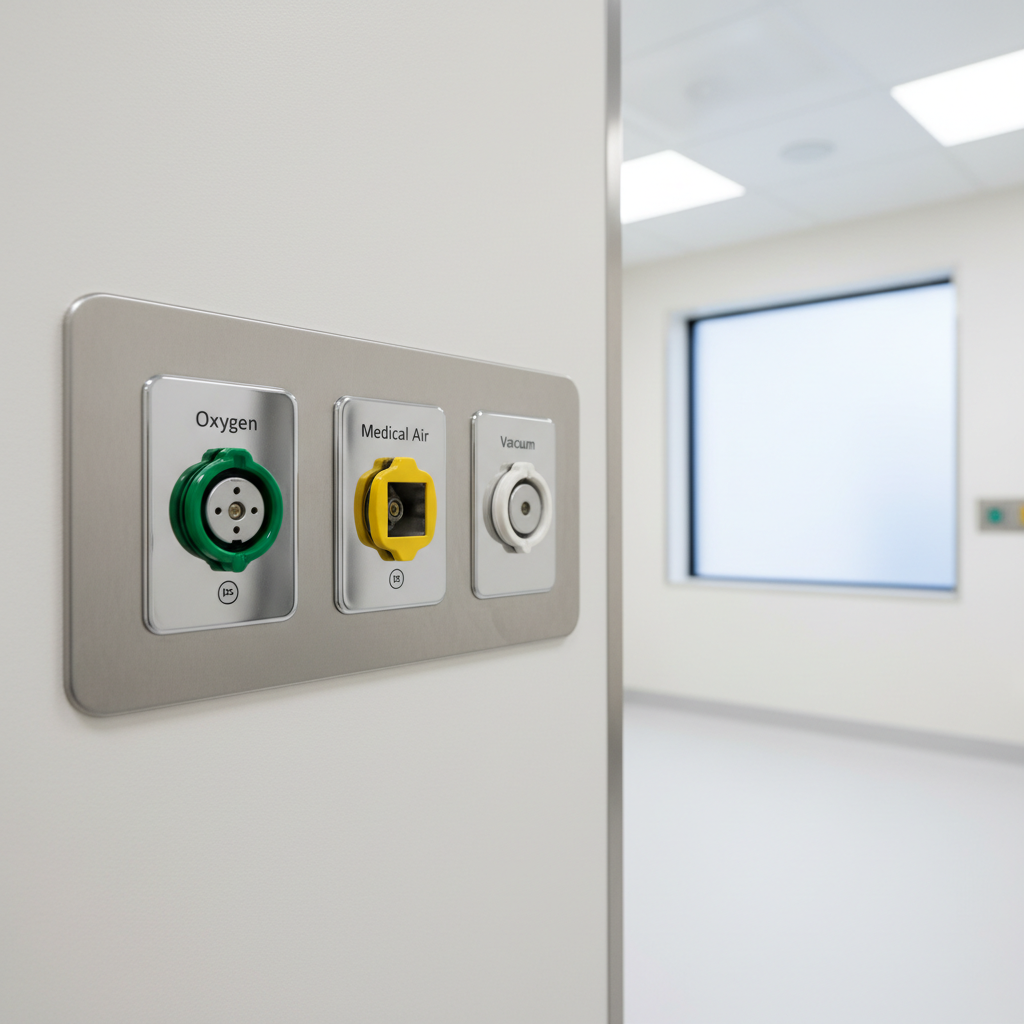
- Outlets and Inlets: The final outlets (for oxygen, air) and inlets (for vacuum) are installed in the walls or on ceiling columns. Each one is gas-specific, using a unique DISS (Diameter Index Safety System) connection to prevent accidental cross-connection.
Medical Gas System Comparison: NFPA 99 Categories
Not all healthcare facilities are treated the same. NFPA 99 classifies facilities based on the risk to patients if the medical gas system fails. ASCs performing invasive procedures are almost always Category 1.
| Category | Risk to Patients if System Fails | Typical Facility Type | System Requirements | Inspection/Testing |
|---|---|---|---|---|
| Category 1 | Death or serious injury | Hospitals, Ambulatory Surgery Centers (ORs) | Most stringent; duplexed equipment, full alarms | Full ASSE 6030 Verification Required |
| Category 2 | Minor injury | Physician'''s offices, dental clinics | Less stringent; single-source equipment may be allowed | Varies, but testing is still critical |
| Category 3 | No injury (but discomfort) | Outpatient clinics (no sedation) | Basic safety requirements | Limited testing |
| Category 4 | No impact on patient care | Laboratories, administrative areas | Standard building codes | N/A for medical gas |
Understanding your facility'''s category is fundamental to a compliant and cost-effective design and installation. Medical Testing Solutions can help you navigate these requirements from day one.