Building a new Ambulatory Surgery Center (ASC) is a complex undertaking, and the medical gas system is one of its most critical components. A properly designed and installed system is non-negotiable for patient safety and regulatory compliance. For ASCs in Virginia Beach, Virginia, navigating the specific codes, requirements, and logistics requires deep expertise. This guide provides a definitive overview of the entire process, from initial design and planning to final verification and Authority Having Jurisdiction (AHJ) sign-off, ensuring your facility's life-support systems are flawless from day one.
Medical Gas Service
Medical Gas Installation
Compliance & Standards
Ambulatory Surgery Center Medical Gas Install in Virginia Beach, VA: A Complete Guide
Medical Testing SolutionsOctober 17, 20265 min read
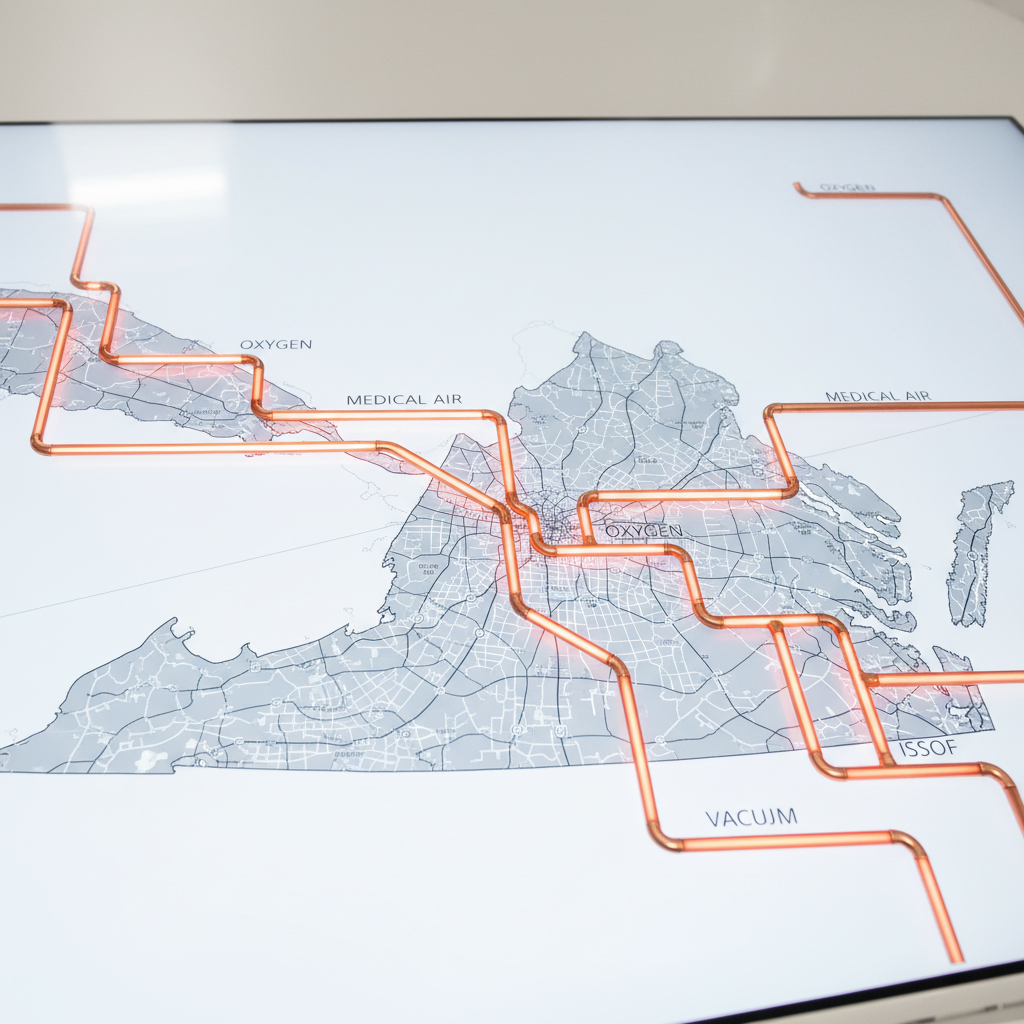
Why Medical Gas Systems are Critical in an ASC
Unlike a standard plumbing system, medical gas systems are considered a patient life-support system. They deliver critical gases like Oxygen, Medical Air, Nitrous Oxide, and Nitrogen, and remove waste anesthetic gases (WAG). A failure in this system can have catastrophic consequences. That's why federal, state, and local regulations, enforced by bodies like the Virginia Department of Health and the local fire marshal, mandate strict adherence to nationally recognized standards.
Why this matters for compliance: The primary governing standard for medical gas and vacuum systems is NFPA 99, Health Care Facilities Code. In Virginia, this code is not a suggestion, it's the law. Failure to comply can result in project delays, costly rework, failed inspections, and an inability to obtain your certificate of occupancy.
The 4 Phases of a Compliant ASC Medical Gas Installation
A successful installation is a multi-stage process. At Medical Testing Solutions, we manage this from the ground up, ensuring a seamless transition from blueprint to a fully operational and certified system.
Phase 1: Design & Engineering
This is the most critical phase. Proper planning here prevents expensive changes later. Key considerations include:
- Facility Layout: Where are the operating rooms, recovery bays, and procedure rooms? The piping network must be optimized for the shortest, most efficient routes.
- Gas & Vacuum Needs: What procedures will you perform? This determines the types and number of outlets needed. A multi-specialty ASC will have different requirements than a dedicated endoscopy center.
- Source Equipment Sizing: We calculate the peak demand for your facility to correctly size the source equipment (e.g., oxygen manifolds, medical air compressors, vacuum pumps). An undersized system can fail under load, while an oversized one is a waste of capital and energy.
- Code Compliance: Our designs are based on the latest editions of NFPA 99, ASSE 6000 series standards, and any specific Virginia Beach or Virginia state amendments.
Phase 2: ASSE 6010 Installation
Once the design is finalized and approved, the physical installation begins. This work must be performed by credentialed technicians.
- Piping: All piping is medical-grade, typically Type K or L copper, cleaned for oxygen service. All joints must be brazed, not soldered, using a nitrogen purge (the "flow"). This prevents the formation of carbonaceous deposits inside the pipe, which could be catastrophic if delivered to a patient.
- Source Equipment: Manifolds, pumps, and compressors are installed, typically in a dedicated, secure mechanical room with specific ventilation and electrical requirements.
- Alarm Panels: Master alarms, area alarms, and local alarms are strategically placed to provide immediate notification of any system issues, as mandated by NFPA 99.
- Outlets & Inlets: The patient-facing components are installed, color-coded and key-indexed for safety to prevent cross-connections.
At Medical Testing Solutions, our team includes ASSE 6010 Certified Installers who are qualified to perform this highly specialized work.
Phase 3: ASSE 6030 Verification
After the installation is complete, but before the walls are closed up, the system must be independently verified. This is not optional. The verifier must be a third-party, independent of the installer, to ensure unbiased testing.
Our ASSE 6030 Certified Verifiers conduct a battery of tests outlined in NFPA 99, Chapter 5, including:
- Initial Piping Purge: High-volume nitrogen is flushed through the pipes to remove any construction debris.
- Piping Particulate Test: We test the nitrogen exiting the system to ensure it is free of particulate matter.
- Pressure Testing: The system is pressurized to 150% of the working pressure to check for leaks in the piping.
- Gas Concentration & Purity Tests: We confirm that what comes out of the oxygen outlet is, in fact, 99% pure oxygen and that all other gases are correct.
- Alarm Testing: We functionally test every single alarm panel and sensor to ensure they activate at the correct setpoints.
Phase 4: Documentation & AHJ Sign-Off
Upon successful verification, we provide a comprehensive documentation package. This report is what the Authority Having Jurisdiction (AHJ), such as the Virginia Beach fire marshal or a state health inspector, will review to grant final approval. Without this certified report, your ASC cannot legally open.
Medical Gas System Components for an ASC
| Component | Function | NFPA 99 Consideration | Common Brands |
|---|---|---|---|
| Oxygen Manifold | Primary or reserve supply of oxygen cylinders. | Must be located in a secure, well-ventilated room. Automatic switchover is required. | BeaconMedaes, Powerex, Amico |
| Medical Air Compressor | Provides oil-free, dry medical air (often a duplex or triplex system). | Requires dedicated power, vibration isolation, and specific intake location. | Powerex, Atlas Copco, BeaconMedaes |
| Medical Vacuum Pump | Creates suction for surgical and other uses. | Must maintain specific vacuum levels. Exhaust must be vented properly. | Dekker, Busch, Powerex |
| Zone Valve Box | Allows isolation of specific zones/areas for maintenance or in an emergency. | Must be accessible and clearly labeled. Position must be monitored by alarm system. | Amico, BeaconMedaes, Tri-Tech Medical |
| Area Alarm Panel | Monitors pressure and vacuum in a specific zone (e.g., an OR). | Visual and audible alarms for high/low pressure. Required for all critical care areas. | BeaconMedaes, Amico, Tri-Tech Medical |
Partnering with the Right Team in Virginia Beach
Choosing your medical gas partner is a critical decision. You need a team with proven experience in Virginia, a deep understanding of NFPA and ASSE standards, and the credentials to back it up. Medical Testing Solutions provides a true turnkey service for ASCs in the Virginia Beach area. We are not just an equipment supplier; we are ASSE-certified professionals who manage the entire lifecycle of your medical gas systems, from the initial medical gas installation to ongoing annual inspections and maintenance.
Frequently Asked Questions
According to NFPA 99 and enforced in Virginia, medical gas systems must be installed by individuals holding an ASSE 6010 credential. This is not a standard plumbing job and requires specialized training in brazing, purging, and system assembly.
For a typical ASC, the ASSE 6030 verification process can take 2-5 days, depending on the size and complexity of the system. This involves a series of detailed tests on every single outlet and alarm component.
Common failure points include small leaks at brazed joints, incorrect alarm setpoints, a failed piping particulate test due to improper purging during installation, or incorrect pressure readings. These are almost always preventable with a qualified ASSE 6010 installer.
No. While your GC manages the overall project, the specific task of medical gas installation must be subcontracted to a specialized firm whose technicians are ASSE 6010 certified. Medical Testing Solutions works with general contractors throughout Virginia to ensure this portion of the project is done correctly.
Yes, NFPA 99 mandates that operating rooms and other "wet procedure locations" in an ASC must be equipped with isolated power systems to protect patients and staff from electric shock. We recommend a Line Isolation Monitor (LIM) test as part of your facility's ongoing safety and maintenance plan.
The first step is to engage a qualified medical gas design and installation partner as early as possible in your planning process. A well-defined plan from the start is the key to a smooth, on-time, and on-budget project.
Request a quote for your facility
Talk with Medical Testing Solutions about your next inspection, repair or equipment request.