Ambulatory Surgery Center Medical Gas Install in Hilton Head SC: A Complete Guide
Building a new ambulatory surgery center (ASC) in Hilton Head, South Carolina, is a major undertaking. Among the most critical systems you will design and install is the medical gas piping network. This system is a life-support utility, delivering vital gases like oxygen, medical air, and nitrous oxide to your operating rooms and recovery areas. A compliant installation is not just a matter of following codes; it's about ensuring patient safety and clinician confidence. This guide provides a definitive overview of the entire process, from initial design consultation to the final sign-off by the Authority Having Jurisdiction (AHJ).
You'll learn the specific roles of ASSE 6010 installers and ASSE 6030 verifiers, the critical NFPA 99 requirements you must meet, and the step-by-step process for bringing your medical gas system from blueprint to patient-ready.
1. Initial Design & Planning: The Blueprint for Safety
The success of your medical gas installation hinges on a meticulously planned design. This initial phase goes beyond simply placing outlets on a drawing. It involves a collaborative effort between architects, engineers, and a certified medical gas specialist to ensure the system is sized correctly, compliant from the start, and tailored to your facility's specific procedural needs.
Sizing the System: Source Equipment & Pipe Diameter
Your first step is to determine the simultaneous use factor for your ASC. How many operating rooms will be running at once? What types of procedures will be performed? The answers dictate the required flow rates and, consequently, the size of your source equipment (e.g., oxygen manifold, medical air compressor) and the diameter of the piping network. An undersized system can lead to pressure drops and inadequate gas delivery, while an oversized one results in unnecessary costs.
NFPA 99 Code Compliance
NFPA 99, Health Care Facilities Code, is the foundational document for medical gas systems. The design must adhere to its stringent requirements for materials, location of equipment, and system warnings.
- Source Equipment Location: Manifolds and compressors must be in a dedicated room with specific ventilation and fire-resistance ratings.
- Zone Valves: The system must be divided into zones, each controlled by a zone valve box, allowing sections to be isolated for maintenance or in an emergency.
- Alarms: Master and area alarms are required to provide immediate visual and audible warnings of system pressure changes or equipment failure.
Why this matters for compliance: A flawed design guarantees a failed inspection. Engaging a certified specialist like Medical Testing Solutions early in the process prevents costly change orders and delays. Proper design documentation is the first thing an ASSE 6030 verifier and the AHJ will review.
2. The Role of the ASSE 6010 Certified Installer
Once the design is finalized, the physical installation must be performed by a qualified technician. The industry standard for this qualification is the ASSE 6010 Medical Gas Systems Installer certification. Hiring an uncertified plumber or mechanical contractor is a significant risk that will lead to a failed verification.
An ASSE 6010 installer is trained in the specific procedures required by NFPA 99, including:
- Brazing Technique: All copper-to-copper connections in a medical gas pipeline must be brazed, not soldered. The installer must use a specific brazing alloy and purge the pipe with oil-free, dry nitrogen during the process to prevent the formation of toxic oxides inside the pipe.
- Pipe Cleanliness: All pipes and fittings must be "cleaned for oxygen service" from the manufacturer and handled with care to prevent contamination.
- Proper Labeling: Pipes must be correctly and clearly labeled with the gas type and direction of flow at specific intervals.
Our team at MTS holds ASSE 6010 certifications for medical gas installation, ensuring that every joint is brazed correctly and every component is installed according to code.
3. Key Components of an ASC Medical Gas System
Your medical gas system is a network of several key components working in concert. Here’s a look at the typical equipment in a new Hilton Head ASC.
Source Equipment
- Oxygen Manifold: This is the primary source for your oxygen. For an ASC, this is typically a high-pressure manifold with multiple cylinders. The manifold automatically switches from the primary bank to the secondary bank when pressure drops, ensuring an uninterrupted supply.
- Medical Air Compressor: Unlike the ambient air, medical air is a manufactured drug. A specialized, oil-free compressor with dryers and filters is required to produce clean, dry air that meets USP standards.
- Vacuum Pump: A medical-surgical vacuum system is used to remove fluids and debris during procedures. These are typically duplex or triplex pumps to ensure redundancy.
Distribution System
- Piping: The network of copper piping (Type K or L) that carries the gases from the source to the patient care areas.
- Zone Valve Boxes: These allow staff to shut off gas flow to a specific room or area in an emergency or for maintenance.
- Area Alarms: Located in nurses' stations or other monitored areas, these alarms provide immediate notification if the pressure in a specific zone deviates from the normal operating range.
Patient-Facing Equipment
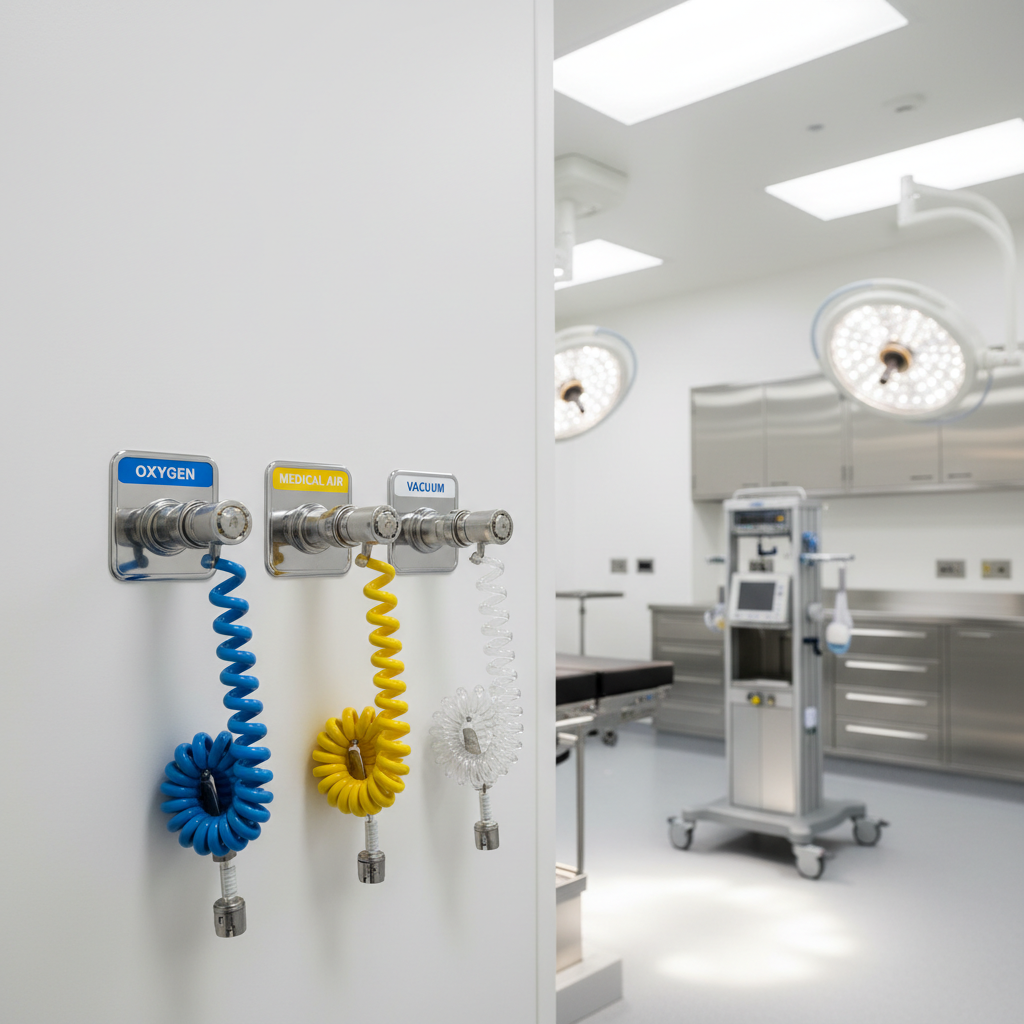
- Outlets/Terminals: These are the points in the wall where clinicians connect equipment. They are gas-specific (e.g., an oxygen hose cannot connect to a medical air outlet) thanks to a pin-indexing safety system.
- Hose Assemblies & Booms: Flexible hoses connect the outlets to anesthesia machines and other equipment. Ceiling-mounted booms provide a flexible and ergonomic way to manage these connections in an operating room.