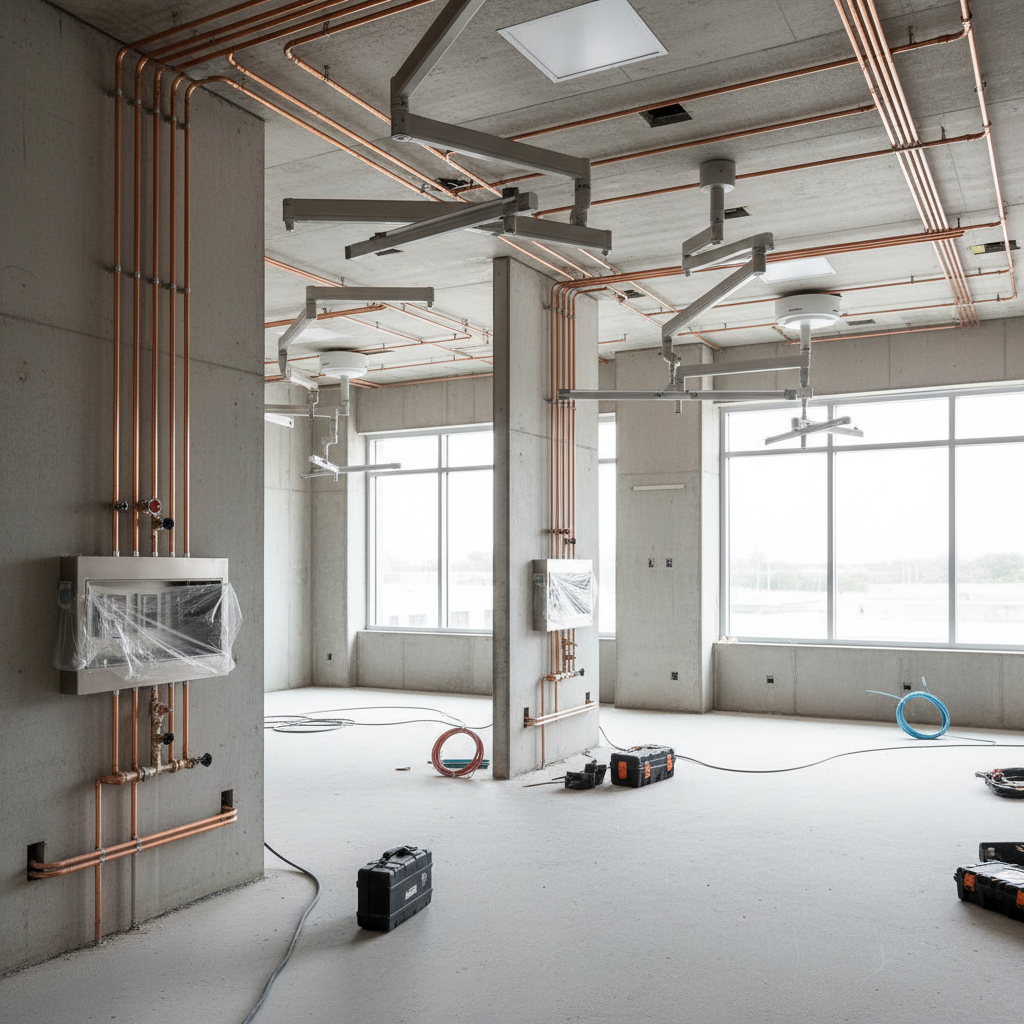
Building a ground-up ambulatory surgery center (ASC) requires balancing complex clinical workflows, patient safety mandates, and strict municipal building codes. When planning an ambulatory surgery center medical gas install in Covington, KY, healthcare developers and general contractors face multi-layered regulatory oversight. Facilities operating within Kenton County must strictly adhere to NFPA 99 (Health Care Facilities Code), ASSE Series 6000 qualifications, Kentucky Division of Plumbing rules, and local Authority Having Jurisdiction (AHJ) standards enforced by regional fire and life-safety officials.
A single oversight during the design, brazing, or testing phases can delay facility licensure, postpone surgical schedules, and cause expensive remediation work behind finished drywall. This guide breaks down the complete lifecycle of an ASC medical gas installation in Covington, covering Category 1 vs. Category 2 pipeline risk assessments, proper equipment sizing, clean-purge-braze installation practices, ASSE 6030 third-party verification, and final AHJ sign-off to ensure a seamless facility launch.
1. Navigating Code Frameworks for Northern Kentucky ASCs
Medical gas pipeline systems (MGPS) in ambulatory surgical settings are not standard commercial mechanical systems. In Northern Kentucky, medical gas infrastructure sits at the intersection of local, state, and national technical standards.
| Diagram text |
|, |
| NFPA 99 (2012/2018/2021/2024) |
| Health Care Facilities Code (Baseline) |
| ASSE Series 6000 Mandates State & Local Oversight |
| • ASSE 6010: Installers • KY Division of Plumbing |
| • ASSE 6020: Inspectors • Covington Fire Dept (AHJ) |
| • ASSE 6030: Verifiers • KY Dept of Housing/Building |
The Regulatory Landscape: NFPA 99 & Kentucky Building Code
Kentucky adopts iterations of the International Building Code (IBC) and NFPA 101 (Life Safety Code) through the Kentucky Building Code (KBC). For healthcare and outpatient surgical facilities, Kentucky references NFPA 99: Health Care Facilities Code. NFPA 99 shifts compliance away from facility types (e.g., "hospital" vs. "clinic") and toward the risk level of the procedures performed.
Under NFPA 99 Chapter 4, systems are classified based on the potential consequence of equipment failure:
- Category 1 (Deep Sedation & General Anesthesia): Failure is likely to cause major injury or death. Most ASC operating suites in Covington require complete Category 1 systems.
- Category 2 (Minor Sedation/Analgesia): Failure is likely to cause minor injury. Found in exam rooms or minor procedure rooms.
- Category 3 & 4: Failure has negligible or no clinical impact on patient safety.
ASSE Series 6000 Requirements
The national benchmark governing personnel competence is the ASSE Series 6000 Standard. To pass state and local inspection, specific roles must be held by certified individuals:
- ASSE 6010: Professional qualifications for medical gas pipeline installers. Anyone brazing or running pipe must maintain current 6010 credentials.
- ASSE 6020: Medical gas system inspectors working on behalf of the facility or AHJ.
- ASSE 6030: Independent medical gas verifiers who perform final quality testing.
Local AHJ Coordination in Covington, KY
In Covington, code enforcement flows through the City of Covington Fire Department (Fire Prevention Bureau), the Kenton County Joint Inspection team, and the Kentucky Department of Housing, Buildings and Construction (DHBC) Division of Plumbing. Early engagement with these agencies ensures all drawings, valve configurations, and source equipment placements are pre-approved before construction begins.
2. Category 1 vs. Category 2 Risk Assessments for ASCs
Determining whether your ASC requires Category 1 or Category 2 infrastructure impacts equipment selection, architectural square footage, piping redundancy, and total project cost.
| System Element | Category 1 Requirement (NFPA 99 Ch. 5.1) | Category 2 Requirement (NFPA 99 Ch. 5.2) |
|---|
| Clinical Scope | General anesthesia, life support, neuromuscular blockers | Moderate/conscious sedation, regional blocks |
| Medical Air Source | Duplexed compressor, desiccant dryers, dew point/CO alarms | Simplex or duplex depending on load; less stringent filtration |
| Surgical Vacuum Source | Duplex minimum, automatic alternate cycling | Duplex or simplex system if permitted by risk assessment |
| Emergency Oxygen Supply Connection (EOSC) | Required if source exceeds designated liquid/cylinder thresholds | Rarely required |
| Area Alarm Panels | Monitored inside and immediately outside each surgical suite | Centralized monitoring permitted for small suites |
| Zone Valves | Required outside each operating room for immediate shutoff | Required per zone; may cover multiple procedure rooms |
| Line Isolation Monitors (LIM) | Mandatory in wet procedure locations | Evaluated based on wet procedure determination |
If your Covington surgery center handles outpatient orthopedics, general surgery, endoscopy requiring propofol, or multi-specialty surgical suites, the AHJ will mandate a Category 1 build-out.
Why this matters for compliance: NFPA 99 Section 4.2 requires a documented clinical risk assessment signed by the facility governing body before mechanical design begins. Attempting to classify an ASC as Category 2 when general anesthesia is administered will result in immediate rejection by state surveyors, shutting down facility licensing.
3. Designing the Medical Gas System Infrastructure
A successful ground-up build requires coordinated mechanical engineering tailored to the unique physical layout of Northern Kentucky medical buildings, whether developing a brand-new facility or adapting an existing commercial structure.
| Diagram text |
|, |
| CENTRAL PLANT (Source Equipment) |
| • Medical Air (Duplex Scroll, NFPA 99 Level 1) |
| • Surgical Vacuum (Duplex Rotary Vane/Claw) |
| • Manifolds (High-Pressure O2, N2O, CO2 with Auto-Crossover) |
| Main Risers |
| PIPELINE & SAFETY DISTRIBUTION |
| • Master Alarm Panels (Dual-Location Annunciation) |
| • Zone Valve Boxes (Outside Each OR / Procedure Suite) |
| • Area Alarm Panels (Visual/Audible Pressure Transducers) |
| Branch Drops |
| POINT-OF-USE CLINICAL TERMINALS |
| • Surgical Booms & Ceiling Drops (O2, MedAir, Vac, WAGD, N2O) |
| • Isolated Power Systems (Line Isolation Monitors - LIM) |
| • Gas Outlets/Inlets (D.I.S.S. or Quick-Connect) |
Medical Air Compressor Systems
Medical air (USP) must never be supplied by industrial plant air compressors. Under NFPA 99 Chapter 5:
- Compressors must take suction from an outdoor location elevated at least 25 feet above ground level, far away from engine exhausts, loading docks, and plumbing vents.
- Duplex oil-less scroll or oil-free reciprocating compressors are standard to ensure 100% operational redundancy.
- Dual desiccant dryer towers, carbon monoxide (CO) monitors, and high-dew-point alarms must feed into the facility's master alarm system.
Explore our dedicated medical gas installation services to understand how central source plants are planned and laid out for clinical compliance.
Medical-Surgical Vacuum and WAGD
Surgical vacuum requires dedicated minimum-duplex mechanical pumps capable of holding at least 12 in-Hg at the most remote clinical terminal. In surgery centers performing laparoscopic or volatile anesthesia procedures, Waste Anesthetic Gas Disposal (WAGD) can be integrated into the central vacuum plant if the pumps are rated for oxygen-enriched mixtures, or handled via a dedicated high-volume, low-vacuum blower system. To ensure post-installation staff safety, centers also implement ongoing WAG chemical vapor monitoring across their operating suites.
Gas Manifolds and Bulk Storage
- Oxygen ($O_2$): Bulk liquid containers or high-pressure cylinder manifolds with automatic crossover headers.
- Nitrous Oxide ($N_2O$): Automatic switchover manifolds placed in dedicated, fire-rated rooms with continuous mechanical ventilation.
- Carbon Dioxide ($CO_2$): Manifolds designed to handle the continuous high-flow vaporization rates required for endoscopic insufflation.
Sizing Considerations for ASC Operating Rooms
A standard ambulatory OR typically requires:
- 2 Oxygen drops (booms and back wall)
- 2 Medical Air drops
- 3 to 4 Medical Vacuum terminals (anesthesia, surgical field, fluid waste collection)
- 1 WAGD connection
- 1 Dedicated Nitrogen ($N_2$) terminal or surgical instrument air line (operating at 160–185 psig) if pneumatic tools are utilized.
4. Line Isolation Monitors (LIM) and Isolated Power in Wet Procedure Suites
Operating rooms are legally defined as wet procedure locations unless an individualized risk assessment demonstrates otherwise. When water, blood, and conductive irrigation fluids mingle with electrical tools, patient electrocution and macro-shock risks rise sharply.
NFPA 99 Section 6.3.2.3 requires isolated power systems (IPS) with Line Isolation Monitors (LIM) in all wet procedure locations where power interruption cannot be tolerated. The LIM continually measures leakage current to ground from all line conductors.
| Diagram text |
|, |
| ┌─────────────────────────┐ |
| (LIM) |
| Continual Leakage Sensing |
During a ground-up build in Covington, isolated power panels must be installed, calibrated, and certified prior to patient care. Any leakage exceeding 5.0 milliamperes (mA) must trigger both audible and visual alerts without interrupting primary power to surgical life-support equipment.
Learn more about isolated power commissioning, ongoing calibration, and troubleshooting through our comprehensive Line Isolation Monitor testing services.
5. Step-by-Step Installation: ASSE 6010 Best Practices
Ground-up piping of medical gas systems demands immaculate contamination control. Contaminants inside an oxygen line can produce a flash fire or catastrophic patient respiratory toxicity.
Material Specs: ASTM B819 Copper
Medical gas distribution piping must be seamless copper tube conforming to ASTM B819 (Standard Specification for Seamless Copper Tube for Medical Gas Systems). It must be identified as either Type K or Type L, cleaned and sealed by the manufacturer for oxygen service. Standard plumbing-grade copper (ASTM B88) is strictly prohibited.
The Purging Mandate: Eliminating Oxidation
When copper is heated to brazing temperatures (exceeding 1100°F / 593°C) in the presence of ambient air, copper oxide forms on the interior wall. Later, when the system is pressurized and brought online, this brittle scale flakes off, clogging surgical ventilators, ruining anesthesia machine blenders, and scoring vacuum valve seats.
Under NFPA 99 (5.1.10.5.5), an active, continuous purge of oil-free dry nitrogen must flow through the tubing during all brazing operations:
- Purge gas must be vented to avoid backpressure.
- Installers utilize an oxygen analyzer to confirm that internal oxygen content is driven below 1% before applying heat.
- Joints are joined using BCuP series brazing filler metal (phosphorus-copper-silver) without the use of chemical flux on copper-to-copper joints. Flux is permitted only on copper-to-brass joints and must be applied sparingly.
Valve Box and Terminal Unit Placement
Zone valve boxes (ZVBs) must be placed outside each operating room so emergency personnel can access them without entering an active sterile field:
- Valves must be labeled to identify the specific gas and room controlled.
- Gauges must sit downstream of the shutoff valve.
- Outlets and inlets (D.I.S.S. or quick-connect) must be mounted in rough-in brackets, properly spaced to accommodate anesthesia machines, surgical columns, and articulating booms.
To review equipment options for your project, browse our medical gas products catalog for code-compliant zone boxes, manifolds, and terminal units.
6. ASSE 6030 Third-Party Verification & AHJ Sign-Off
Once the ASSE 6010 certified mechanical contractor completes all rough-ins, brazing, and initial pressure tests, an independent, third-party ASSE 6030 Medical Gas Verifier must be brought in before any walls are permanently sealed or patients are admitted.
| Diagram text |
|, |
Medical Testing Solutions (MTS) provides certified, independent verification to ensure your pipeline infrastructure meets all national and municipal standards.
The Verification Battery
An ASSE 6030 verifier runs a systematic battery of diagnostic assessments:
- Initial Standing Pressure Test: System tested at 20% above normal operating pressure for 24 hours using dry nitrogen.
- Cross-Connection Prevention Test: Physical proofing to guarantee that oxygen piping connects only to oxygen outlets, nitrous oxide lines never tap into medical air lines, and vacuum inlets pull only vacuum.
- Piping Purge and Particulate Analysis: High-volume flow testing at each outlet onto a 0.45-micron white filter paper to verify the absence of copper scale, dust, or metal shavings.
- Piping Cleanliness and Hydrocarbon Testing: Verifying that total volatile hydrocarbon levels are non-detectable or below allowable NFPA 99 limits.
- Gas Concentration and Purity Analysis: Confirming purity at every individual terminal drop (e.g., Medical Air dew point below -44°F, CO below 10 ppm, $O_2$ purity exceeding 99.0%).
- Alarm Matrix Testing: Simulating pressure drops and source faults to ensure the master alarm panels and area alarm panels light and chime in accordance with design schematics.
Explore our dedicated medical gas verification solutions to prepare your Covington site for a stress-free inspection.
Navigating the Final AHJ Inspection in Covington
Following testing, Medical Testing Solutions compiles a comprehensive verifier's binder. This dossier includes:
- ASSE 6010 brazer certifications and logbooks
- Medical gas component cut sheets
- Nitrogen purge logs
- ASSE 6030 test reports and purity records
- As-built mechanical drawings
During the final life-safety walk-through with the Covington Fire Prevention Bureau and the Kentucky Division of Plumbing inspector, this binder serves as legal proof of compliance, enabling prompt issuance of the Certificate of Occupancy.
7. Ongoing Maintenance: Post-Occupancy Compliance
Handing over the keys is not the end of medical gas compliance. NFPA 99 requires healthcare organizations to maintain an active operational maintenance and testing program throughout the life of the facility.
- Annual Testing: Annual recertification of all zone valves, alarm panels, terminal outlets, and source manifolds must be performed by certified personnel. Schedule your yearly review via our annual medical gas inspections program.
- Routine Preventative Maintenance: Source pumps, desiccant dryers, scroll heads, and filtration cartridges require ongoing scheduled service to preserve air delivery purity. See our medical gas maintenance services for tailored service agreements.
- Continuous System Certification: Every pipeline modification or room renovation triggers partial verification requirements under our medical gas certification workflows.
- Specialty Services: Outpatient surgery centers operating dedicated pharmacy compounding rooms can streamline their audits through our USP 797/800 compliance testing. Facilities featuring surgical dental, oral, or maxillofacial suites should also implement regular dental flowmeter repair and calibration for nitrous oxide administration equipment.
8. Summary Checklist: Ground-Up ASC Med Gas Timeline
To keep your Covington build-out on schedule, follow this sequential project roadmap:
Plan Your Covington ASC Medical Gas Build-Out
Achieving code compliance on a ground-up ambulatory surgery center requires close collaboration between mechanical contractors, engineering teams, certified equipment specialists, and independent verifiers.
Medical Testing Solutions (MTS) delivers end-to-end medical gas support, from high-efficiency source equipment and manifold packages to ASSE 6010 installation, Line Isolation Monitor testing, and ASSE 6030 third-party verification.
Contact our engineering team today to review your project plans, schedule a consultation, or request an upfront bid.