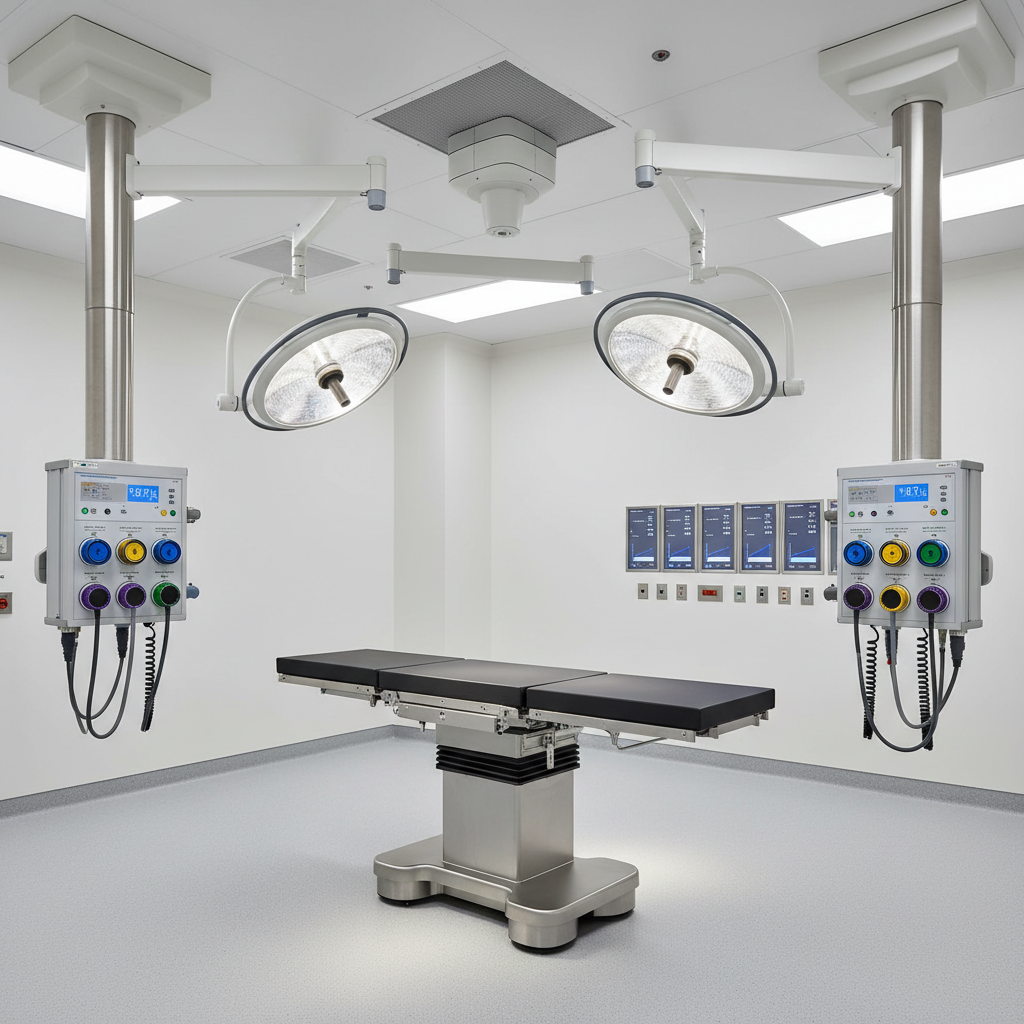
Ambulatory Surgery Center Medical Gas Compliance: NFPA 99 Guide
Medical Testing SolutionsNovember 8, 202612 min read
Share
Operating an Ambulatory Surgery Center (ASC) requires balancing complex clinical workflows with stringent life-safety mandates. Central to this responsibility is ensuring your piped piped gas distribution systems function safely without disruption. Ambulatory surgery center medical gas compliance is governed primarily by NFPA 99 (Health Care Facilities Code), Centers for Medicare & Medicaid Services (CMS) Conditions for Coverage, and accreditation standards from organizations like The Joint Commission (TJC), AAAHC, and AAAASF.
Unlike standard outpatient clinics or acute care hospitals, ASCs operate under unique risk category classifications that dictate exact mechanical, testing, and maintenance parameters. A failure to meet these standards can result in delayed accreditations, immediate jeopardy citations, costly facility shutdowns, or catastrophic clinical errors.
In this comprehensive guide, our ASSE-certified specialists at Medical Testing Solutions break down ASC-specific NFPA 99 requirements, risk category determinations, mandatory testing protocols, documentation standards, and how our specialized annual medical gas inspections keep your surgery suites fully compliant and audit-ready.
1. Regulatory Framework: Who Dictates ASC Medical Gas Standards?
Achieving compliance in an ambulatory surgical environment requires meeting the overlapping mandates of multiple regulatory bodies. While local Authorities Having Jurisdiction (AHJs) hold final enforcement power, several core codes establish the baseline:
NFPA 99 (Health Care Facilities Code): Outlines technical criteria for medical gas and vacuum piping systems (MGV), electrical systems, and gas equipment. Most state health departments and CMS enforce the 2012 edition of NFPA 99, while others have adopted the 2018, 2021, or 2024 editions.
CMS (Conditions for Coverage - 42 CFR § 416.44): Requires Medicare-certified ASCs to maintain physical environments that comply with federal life safety codes, specifically requiring full NFPA 99 compliance for piped gas delivery systems.
Accrediting Organizations (AAAHC, The Joint Commission, HFAP): Evaluate ongoing operational maintenance, testing logs, credentialing of service personnel, and emergency response plans during periodic surveys.
CGA (Compressed Gas Association): Standards like CGA C-9, CGA G-4.1, and CGA P-2.1 govern cylinder storage, cleaning for oxygen service, and safe handling procedures.
Why this matters for compliance: Accreditation bodies and CMS surveyors do not issue partial passes for piped gas failures. An outdated logbook, unverified pipeline modification, or missing annual inspection report can trigger a Condition-level deficiency, putting your facility's operating license and Medicare billing privileges at risk.
2. Risk Category Assessment: Category 1 vs. Category 2 in ASCs
Under Chapter 4 of NFPA 99, systems are no longer categorized solely by facility type; rather, they are defined by patient risk:
Category 1 (NFPA 99, Chapter 5): Facility systems in which failure of such equipment or system is likely to cause major injury or death to patients or caregivers.
Category 2: Facility systems in which failure of such equipment or system is likely to cause minor injury to patients or caregivers.
Category 3 & 4: Systems where failure causes discomfort or has no patient impact.
Because ASCs routinely perform procedures requiring general anesthesia, deep sedation, or life-support equipment, most ASC operating suites and recovery bays fall squarely under Category 1 mandates. If an oxygen supply cuts out during intubation, or if a medical surgical vacuum pump seizes during an open abdominal or orthopedic procedure, the risk is immediately life-threatening.
| Diagram text |
|, |
| ASC Medical Gas Risk Profile |
| +, + +, + |
| Category 1 Mandate Category 2 Allowance |
| - General Anesthesia Operating Rooms - Minor Procedure Rooms (Local/Oral Sedation) |
| - Class C Surgery Suites - Pain Management Injection Suites |
| - PACU / Phase I Recovery Bays - Pre-op Holding (Diagnostic Only) |
| +, + +, + |
A documented risk assessment conducted by your clinical director, safety officer, and medical gas specialist must be kept on file to justify whether any zones within your ASC are maintained to Category 2 rather than Category 1 standards.
3. Core System Requirements for ASC Medical Gas Infrastructure
Category 1 systems demand strict mechanical redundancy, continuous monitoring, and automated safety backups. Below are the core mechanical components required in an ambulatory surgery center:
Source Supply Systems
Medical Air Compressors: Medical air cannot be sourced from ambient mechanical rooms or standard shop air compressors. It must use duplexed or triplexed oil-less or oil-free compressors sized so that if the largest unit fails, the remaining unit(s) can carry 100% of the peak facility demand. Intakes must be located outdoors, at least 25 feet away from doors, windows, exhaust vents, and loading docks.
Medical-Surgical Vacuum: Must feature duplexed or triplexed mechanical vacuum pumps arranged in parallel, sized with full mechanical redundancy. Exhaust lines must terminate outdoors, protected from weather entry and away from personnel access points.
Manifold Systems (Oxygen, Nitrous Oxide, Carbon Dioxide): Cylinder headers must feature dual banks with automatic changeover valves. If the primary supply bank depletes, the reserve bank must take over seamlessly without pressure drops or interruption of flow to surgical suites.
Waste Anesthetic Gas Disposal (WAGD): Dedicated high-vacuum systems or active scavenging integrated into the medical vacuum plant to safely remove exhaled halogenated agents and nitrous oxide from the surgical suite. Maintaining safe indoor air quality also calls for routine WAG chemical vapor monitoring to protect clinical staff from chronic trace gas exposure.
Distribution Piping and Valves
All piping carrying medical gases must consist of seamless hard-drawn ASTM B819 copper tubing (Type L or K), cleaned and purged with oil-free, dry nitrogen during installation to prevent internal oxidation.
Zone valves must be strategically installed directly outside each operating room or procedure suite. They must be clearly labeled with:
The specific gas controlled.
The exact room or zone served.
Proper directional flow indicators.
Pressure gauges located down-stream of the valve to indicate real-time pipeline pressure within the suite.
| Diagram text |
|, |
Area and Master Alarm Panels
Master Alarms: NFPA 99 Section 5.1.9 requires two master alarm panels located in separate monitored locations (e.g., continuous nursing stations, facility engineering, or 24-hour security offices). They supervise main supply pressures, manifold changeovers, compressor dew point, carbon monoxide thresholds, and vacuum pump operations.
Area Alarms: Must be located at nurses' stations or clinical monitoring stations serving each specific surgical cluster. They provide visible and audible warnings if pipeline pressure varies by more than ±20% from normal operating setpoints (50–55 psi for Medical Air/Oxygen/Nitrous Oxide; 160–185 psi for Instrument Air).
4. NFPA 99 Mandatory Inspection & Testing Schedule for ASCs
Many ASC managers operate under the misconception that medical gas inspections are an "install once and forget" system. In reality, NFPA 99 Chapter 5 establishes an ongoing, strict cadence for periodic inspections, maintenance, and functional testing.
Test / Inspection Item
NFPA 99 Reference
Minimum Frequency
Required Documentation
Responsible Party
Annual Medical Gas System Certification
Chapter 5.1.14
Annually
Comprehensive technical report, outlet flow rates, dew point, purity
ASSE 6030 Verifier / 6040 Inspector
Zone Valve Inspection & Labeling
Chapter 5.1.14.2
Annually
Verification of operational closure, label accuracy, gauge calibration
ASSE 6040 Maintenance Tech or Specialist
Area & Master Alarm Testing
Chapter 5.1.14.4
Monthly to Annually
Actuation logs, visual/audible signal verification, remote transmission checks
Fault current trip thresholds, milliammeter readings, alarm audio/visuals
ASSE Certified Electrical Specialist
Gas Purity & Particulate Testing
Chapter 5.1.12.3
Annually / Post-Repair
Lab analysis for Dew Point, CO, CO2, Hydrocarbons, Total Hydrocarbons
ASSE 6030 Certified Verifier
Source Equipment PM (Compressors/Pumps)
Chapter 5.1.13
Quarterly / Annually
Belt wear, oil analysis, desiccant replacement, carbon filter changes
ASSE 6040 Maintenance Professional
To stay ahead of accreditation deadlines and protect facility uptime, ASCs partner with Medical Testing Solutions for routine medical gas maintenance services and comprehensive preventative maintenance programs.
5. Critical Special Systems: Line Isolation Monitors (LIMs) in ASC Operating Rooms
ASCs that utilize isolated power systems in anesthetizing locations (wet procedure locations or designated Category 1 suites) must adhere to NFPA 99 Chapter 6 and NFPA 70 (National Electrical Code) Article 517.
Line Isolation Monitors continuously track leakage current to ground from connected electrical components in the operating room. If an electro-surgical generator, surgical robot, or suction device develops an insulation fault, the LIM alerts surgical staff before an electrical shock hazard or spark can trigger a surgical fire in oxygen-enriched atmospheres.
Routine Testing Requirements: Operating personnel or facility directors must check the automated meter actuation monthly.
Annual Quantitative Testing: NFPA 99 requires annual functional verification of the isolated power system. This includes measuring line-to-ground resistance, total system hazard current, and verifying analog/digital trip thresholds (typically set to trigger at 5 mA or 2 mA depending on vintage).
For multi-suite surgical facilities, scheduling integrated line isolation monitor testing alongside your annual piped gas evaluation eliminates redundant downtime and consolidates life-safety records for your surveyor.
6. Cylinders, Manifolds, and Storage Rooms: Common Survey Traps
A high percentage of accreditation survey citations in ASCs stem not from buried copper piping, but from cylinder management and storage mechanical rooms. Surveyors scrutinize your gas storage rooms during walk-throughs:
Separation of Gases: Full and empty cylinders must be physically separated and clearly labeled. Flammable gases or combustible materials cannot be stored in the same enclosure as oxidizing gases like Oxygen and Nitrous Oxide (NFPA 99 Section 5.1.3.3.2).
Chaining and Restraints: Cylinders must be secured with non-combustible chains, racks, or straps at or above their midpoint. Placing unsecured tanks on dollies or leaning against walls is an immediate survey tag.
Ventilation Requirements: Central manifold storage rooms containing gas cylinders must be equipped with dedicated, continuous mechanical exhaust ventilation venting to the outside atmosphere (minimum 1 CFM per square foot) to prevent gas accumulation in the event of cylinder leakage.
Signage: Doors accessing manifold and medical gas storage rooms must have standardized warning signs stating: "CAUTION: Medical Gases Stored Within - NO SMOKING OR OPEN FLAME".
7. Modifications, Renovations, and ASSE 6030 Third-Party Verification
Whenever an ASC adds an operating room, relocates an existing gas outlet, or ties into an existing medical gas main, strict building code protocols take effect.
Under NFPA 99 Chapter 5.1.12:
Installation Credentialing: The installer must hold an active ASSE 6010 qualification, demonstrating proficiency in medical gas brazing procedures under continuous nitrogen purge. For compliant infrastructure, work with verified contractors through our specialized medical gas installation teams.
Independent Verification: Prior to any human clinical use, an independent, third-party verifier certified to ASSE 6030 must perform a complete battery of cross-connection tests, valve shutoff audits, pressure tests, and pipeline purity checks.
Medical Testing Solutions provides end-to-end, uncompromised medical gas verification services across the United States, giving your governing board and AHJ absolute peace of mind before first patient contact.
8. Step-by-Step ASC Medical Gas Audit Preparation Checklist
To ensure your ASC breezes through state surveys and accreditation renewals, use this structured actionable checklist:
Pre-Survey Documentation Audit
Confirm your facility's formal NFPA 99 Category Risk Assessment document is signed and updated within the last 12 months.
Ensure the past 3 years of third-party medical gas certification and annual testing reports are organized and accessible.
Compile calibration certificates for all source equipment sensors (dew point meters, carbon monoxide monitors, vacuum pressure switches).
Review staff training logs regarding emergency zone valve shutoffs and medical gas emergency response procedures.
Physical Facility Walk-Through
Check every zone valve box: Ensure clear acrylic windows are intact, emergency pull rings function, labels accurately designate specific suites, and gauges reflect 50–55 psi (or 160–185 psi for instrument air).
Inspect medical gas storage rooms: Confirm cylinders are chained to wall racks or held in approved cradles. Ensure full and empty cylinders are segregated with clear demarcation lines.
Clear obstructions: Verify that no surgical carts, linen hampers, or monitors block immediate, physical access to zone valve boxes or area alarm panels.
Inspect clinical terminal units: Check gas outlets and inlets for physical damage, audible hissing leaks, or loose indexing pins.
Verify Master and Area Alarms: Confirm no trouble lights (yellow/red) are active or muted on alarm faces without active maintenance tickets.
9. Common Deficiencies Cited in ASC Surveys and How to Prevent Them
1. Incomplete or Missing Traceability for Repairs
The Citation: Repairs, regulator replacements, or outlet rebuilds completed by maintenance staff without third-party ASSE 6030 verification or purity testing.
The Fix: Never allow uncertified personnel to break into medical gas lines. Retain an ASSE-certified firm to perform pressure testing and cross-connection checks whenever lines are breached.
2. Failure to Test Alarms Under Load
The Citation: Area alarm panels that were only visually inspected rather than physically pressure-tested to confirm trip setpoints.
The Fix: During annual testing, technicians must actuate high and low pipeline pressure switches using calibrated test manifolds to verify that alarms trigger precisely at ±20% deviations.
3. Blocked Zone Valves
The Citation: Storage racks, mobile workstations, or mayo stands parked in front of emergency zone valve shutoffs in the surgical hallway.
The Fix: Enforce facility floor markings: apply high-visibility floor tape indicating a mandatory 36-inch clearance zone in front of every emergency valve station.
4. Missing Annual Purity Verifications
The Citation: Failure to document that medical air compressors meet USP/NFPA dew point (-40°F) and carbon monoxide (<10 ppm) purity limits.
The Fix: Mandate annual analytical sampling by an accredited laboratory through your annual inspection provider.
Partner with Medical Testing Solutions for Complete ASC Compliance
At Medical Testing Solutions, we understand that your ASC cannot afford clinical interruptions, accreditation hiccups, or life-safety vulnerabilities. Headquartered in Fort Lauderdale, Florida, our nationwide team of ASSE 6030, 6035, and 6040 certified medical gas professionals provides the technical expertise and equipment support necessary to keep your facility 100% compliant.
Whether you need a full turnkey annual medical gas inspection, emergency repairs, certified isolated power testing, or equipment sourcing from our medical gas portfolio, we protect your patients and your operating license.
Ready to bring your ASC into full NFPA 99 compliance?
The applicable edition depends on your AHJ and reimbursement credentials. Most states and CMS currently inspect against the 2012 edition of NFPA 99, while newer facilities or states operating under updated building codes may enforce the 2018, 2021, or 2024 editions. If you bill Medicare/Medicaid, CMS dictates 2012 compliance unless state rules are more stringent.
Routine operational tasks can be performed by properly trained in-house personnel. However, mandatory annual inspections, system certifications, and verifications must be performed by certified specialists credentialed under ASSE 6030 (Medical Gas Verifiers) or ASSE 6040 (Medical Gas Maintenance Personnel).
If your ASC exclusively uses oral or local sedation without volatile inhalation agents, a dedicated WAGD network is generally not mandated. However, if inhalation anesthesia (such as sevoflurane or nitrous oxide) is administered, an active WAGD or compatible medical vacuum scavenging system is mandatory under NFPA 99 Chapter 5.
ASSE 6010 is for installers who braze and construct the piping; ASSE 6030 is for independent verifiers who test, commission, and certify systems; ASSE 6040 is for maintenance professionals who execute preventative maintenance and operational servicing on live facilities.
Generally, no. NFPA 99 Chapter 5 requires that testing and purity certification be conducted by individuals with specific third-party qualifications, calibrated and traceable test equipment, and accredited laboratory testing capabilities. Accreditation bodies strongly prefer independent third-party reports.
Request a quote for your facility
Talk with Medical Testing Solutions about your next inspection, repair or equipment request.