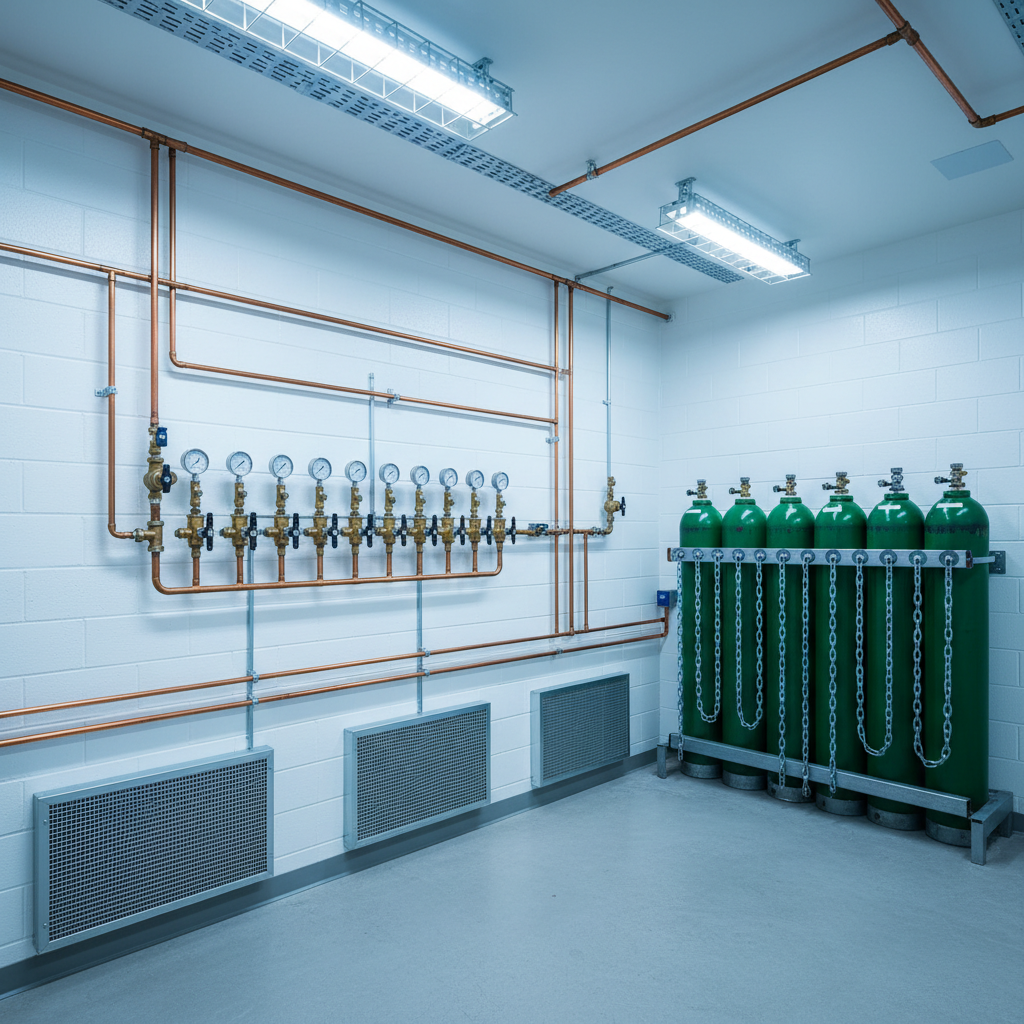
Medical gas storage rooms and bulk oxygen supply systems represent the highest physical hazard areas within any healthcare or clinical occupancy. In Sunrise, Florida, spanning regional acute care hospitals, ambulatory surgical centers, and outpatient clinics along the Sawgrass Expressway corridor, strict local and national life-safety codes govern pressurized medical gas storage.
Failing to maintain compliant oxygen storage environments exposes healthcare systems to joint commission deficiencies, local fire marshal stop-work orders, catastrophic structural fire risks, and spontaneous combustion events. Under NFPA 99 Health Care Facilities Code Section 5.1.3.5 and NFPA 55 Compressed Gases and Cryogenic Fluids Code, medical gas storage rooms must meet uncompromising architectural, ventilation, structural, and monitoring standards.
This technical guide outlines what facility managers, safety directors, and biomedical engineers need to know about preparing for, scheduling, and passing an oxygen tank room inspection in Sunrise FL. You will learn the exact mechanical and structural mandates under NFPA 99 (2012, 2018, 2021, and 2024 editions), the difference between high-pressure cylinder storage and bulk cryogenic liquid systems, how South Florida humidity and hurricane codes impact ventilation, and how Medical Testing Solutions conducts ASSE-credentialed verifications to keep your facility audit-ready.
The Legal and Regulatory Framework for Oxygen Storage in Sunrise, FL
In Florida, healthcare facilities fall under a layered regulatory hierarchy. The Agency for Health Care Administration (AHCA) enforces building and operational codes alongside local municipal authorities having jurisdiction (AHJ), such as the City of Sunrise Fire Rescue Department.
Federal compliance hinges on the Centers for Medicare & Medicaid Services (CMS), which currently mandates the 2012 edition of NFPA 99 and NFPA 101 (Life Safety Code). However, the Florida Fire Prevention Code (FFPC) adopts updated iterations of NFPA 1 and NFPA 55, while newer construction and renovations must conform to the 2024 Florida Building Code (8th Edition) and current NFPA standards. Navigating these overlapping layers requires an ASSE-credentialed inspection partner who understands both historical federal benchmarks and local South Florida enforcement.
Why this matters for compliance: A citation from the Sunrise Fire Marshal or an AHCA surveyor regarding cryogenic or high-pressure oxygen separation distances can halt surgical suite operations immediately. Regulatory compliance is not merely an annual checkbox, it is a continuous operational defense against institutional liability and patient hazard.
An ASSE 6030 verifier or ASSE 6020 inspector examines the physical envelope, electrical classifications, gas manifolds, pressure relief terminations, and mechanical exhaust rates to establish complete system safety under our annual medical gas inspections.
High-Pressure Cylinders vs. Bulk Cryogenic Liquid Storage
The term "oxygen tank room" frequently conflates two distinct engineering setups: manifolded high-pressure gas cylinder rooms and bulk liquid oxygen (LOX) cryogenic installations. Each has unique requirements under NFPA 99 Section 5.1.3.5 and NFPA 55.
| Diagram text |
|, |
| OXYGEN STORAGE CLASSIFICATION |
| High-Pressure Cylinder Rooms Bulk Liquid Systems (VIE/LOX) |
| - Gaseous storage (D, E, H, K cylinders) - Cryogenic liquid vessels (Vaporized to gas) |
| - Typically 2,000–20,000+ cubic feet gaseous - Exceeds 20,000 cu. ft. equivalent threshold |
| - Enclosed indoors or sheltered exterior court - Outdoor pad with perimeter security & setback |
| - Regulated under NFPA 99 5.1.3.5.11 - Regulated under NFPA 55 and NFPA 99 5.1.3.5 |
High-Pressure Manifold and Storage Rooms
Facilities storing more than 3,000 cubic feet (approx. 12 to 14 "H" cylinders) of nonflammable medical gas must house their supply within a dedicated, fire-rated enclosure. If the aggregate gaseous storage exceeds 20,000 cubic feet, the system enters the definition of a bulk system under CGA (Compressed Gas Association) standards and NFPA 55.
Bulk Cryogenic Supply Systems (LOX)
Bulk oxygen storage typically involves vacuum-insulated evaporator (VIE) vessels located outdoors. When auxiliary or reserve liquid micro-bulk vessels are housed within an interior manifold room, specialized cryogenic spill mitigation, foundation thermal isolation, and high-volume, low-point ventilation must be engineered to prevent sub-zero oxygen condensation pooling.
Core Inspection Requirements: NFPA 99 Section 5.1.3.5 Deep Dive
When Medical Testing Solutions conducts an oxygen storage inspection, our ASSE 6030 inspectors audit the room against a strict checklist derived from NFPA 99 Section 5.1.3.5. The critical parameters fall into structural, ventilation, electrical, and operational categories.
1. Structural and Fire Separation Integrity (NFPA 99 5.1.3.5.11)
The physical room housing oxygen manifolds, cylinders, or cryogenic reserves must act as an isolated pressure and fire envelope:
- Fire Resistance Rating: The walls, ceiling, and floors must have an independent minimum 1-hour fire resistance rating. If the room is not fitted with an automatic sprinkler system, this threshold increases to a 2-hour rating in many jurisdictions.
- Door Assemblies: Doors must be minimum 3/4-hour fire-rated assemblies, equipped with self-closing and positive-latching hardware. Gasketing and sweeps must maintain air isolation.
- Prohibited Contents: The room must be dedicated solely to medical gases. It cannot be used for general storage, biomedical supply overflow, cleaning reagents, janitorial supplies, or combustible cardboard boxes. Cylinders cannot be stored next to oils, greases, or hydrocarbon-based lubricants.
2. Dedicated Mechanical and Natural Ventilation (NFPA 99 5.1.3.5.11.4)
Oxygen-enriched atmospheres dramatically lower the flashpoint of surrounding materials and accelerate flame spread. Ventilation is the primary defense against undetectable oxygen leaks:
- Mechanical Exhaust System: An indoor location housing manifolded oxygen must be served by an active mechanical exhaust system that operates continuously.
- Airflow Rates: The ventilation must pull from within 1 foot of the finished floor level (to address cold, dense oxygen gas settling during venting) and exhaust directly to the exterior of the building, far from any HVAC intakes, openable windows, or exit doors.
- Makeup Air: A dedicated makeup air intake must be provided near the ceiling to allow cross-room laminar displacement.
- South Florida Considerations: In Sunrise and Broward County, mechanical supply air must balance moisture-laden ambient air to prevent condensation on manifold headers and valves, which invites rapid corrosion.
3. Electrical Equipment and Environmental Controls
Oxygen is an oxidizer, not a flammable gas, but an oxygen-enriched environment converts standard sparks into ignition sources:
- Electrical Classification: Switches, lighting fixtures, and electrical disconnects in oxygen storage rooms must conform to NFPA 70 (National Electrical Code). Electrical installations must be protected from physical impact.
- Temperature Maintenance: Per NFPA 99, the room temperature cannot exceed 125°F (52°C) or fall below 20°F (-7°C). In South Florida's sub-tropical climate, non-air-conditioned exterior concrete rooms frequently reach critical ambient temperatures if the building thermal envelope or ventilation fails.
- Grounding: Manifold racks and electrical pathways must be properly bonded and grounded to eliminate static potential.
4. Cylinder Restraint and Physical Storage
Every cylinder, whether full, in-use, or empty, presents an extreme projectile hazard if dropped or sheared at the neck:
- Rigid Restraint: Nonflammable medical gas cylinders must be restrained to prevent falling using noncombustible racks, heavy-duty chains, or welded collars. Plastic cords or loose bungees are instant violations.
- Separation of Full and Empty: Full cylinders must be physically segregated from empty cylinders with clear floor marking or signage.
- Separation of Gaseous Classes: Oxidizing gases (Oxygen, Nitrous Oxide) must be separated from flammable gases or combustible materials by a minimum distance of 20 feet (6.1 meters) or by an approved noncombustible barrier with a minimum 0.5-hour fire rating (minimum 5 feet tall).
Technical Comparison: NFPA 99 Oxygen Room Standards vs. Field Deficiencies
The table below contrasts NFPA 99 / NFPA 55 codified parameters against common non-compliant field conditions observed during real-world inspections across Sunrise, Fort Lauderdale, and South Florida facilities.
| Inspection Parameter | NFPA 99 Codified Standard (5.1.3.5) | Common Field Deficiency (Non-Compliant) | Corrective Action Required |
|---|
| Room Fire Separation | Minimum 1-hour rating (walls, floor, ceiling); self-closing latching doors. | Drywall penetrations from telecom cables; unrated fire door; wedged-open door. | Install UL-listed firestop sealants; restore self-closing door hardware; seal all unsealed penetrations. |
| Ventilation Exhaust | Continuous mechanical exhaust; minimum 1 CFM/sq. ft.; pull within 12" of floor. | Exhaust fan tied to local light switch; exhaust grille mounted only at ceiling height. | Rewire exhaust to an unswitched circuit on critical emergency power; drop ductwork to floor level. |
| Cylinder Physical Security | Rigid noncombustible racks, individual chains, or interlocking cradles. | Fabric straps; loose bungees; unchained "empty" tanks freestanding on floor. | Install wall-anchored steel unistrut with heavy-gauge chain assemblies or floor-mounted cylinder racks. |
| Combustible Storage | Strict prohibition: Zero cardboard, oil, paper, wooden pallets, or plastics. | Shipping cardboard boxes stored on or near cylinders; hydraulic oil rags in corners. | Remove all combustibles immediately; establish strict administrative access controls. |
| Emergency Signage | NFPA 704 placards, "No Smoking / No Open Flames", full/empty signage. | Faded stickers; missing NFPA hazard diamonds; unlabelled manifold banks. | Affix weather-resistant, reflective NFPA 704 signage and clear high-contrast brass/rigid plastic placards. |
| Relief Valve Venting | Dual relief lines piped independently to outside, terminating downwards. | Relief valves venting directly into room; terminating near building air intake. | Reroute ASME relief valve piping to clear exterior location with insect-screened downturns per medical gas installation. |
The Sunrise FL Field Context: Climate, Hurricanes, and Local AHJ Rules
Performing an oxygen tank room inspection in Sunrise FL requires accounting for regional geographic and environmental variables that generic compliance guides ignore.
High Heat and Coastal Humidity
The sub-tropical climate of Broward County presents severe challenges for oxygen rooms vented to the exterior. Unconditioned makeup air draws humid ocean air across brass regulators, copper headers, and steel tank collars. When high-pressure gas decompresses through a regulator, Joule-Thomson cooling drops the equipment temperature, condensing ambient water vapor onto the brass manifolds. Over time, galvanic corrosion degrades manifold check valves and pressure transmitters. Certified inspectors evaluate this hardware wear as part of regular medical gas maintenance services.
Hurricane Structural Integrity and Impact Codes
Broward County sits in the High-Velocity Hurricane Zone (HVHZ). Exterior relief valve vent lines, louvers, and outdoor bulk tank enclosures must meet strict wind-load and missile-impact resistance criteria under the Florida Building Code:
- Exterior vent terminations must withstand high-category hurricane winds without shearing.
- Outdoor pad fences surrounding bulk tanks must be secured with structural stainless-steel or hot-dipped galvanized anchors into verified concrete footings.
- Any through-wall ventilation louvers must have approved hurricane dampers that do not restrict mandatory mechanical airflow under normal operating conditions.
Emergency Generator Integration
Under NFPA 99 Section 5.1.3.5.11.4(3), mechanical exhaust fans serving interior oxygen storage areas must be connected to the emergency electrical system (Essential Electrical System - Equipment Branch). During frequent summer tropical storms and grid interruptions in Sunrise, an unpowered exhaust fan turns an enclosed oxygen manifold room into a high-risk pressurized environment within hours. An inspection verifies that room exhaust continues uninterrupted during power transfers.
Step-by-Step: The ASSE 6030 Inspection Protocol
When Medical Testing Solutions arrives on-site to inspect an oxygen cylinder manifold or bulk storage room, our certified personnel follow a standardized, repeatable ASSE 6030 engineering protocol.
| Diagram text |
|, |
Phase 1: Physical Envelope and Penetration Audit
- Inspect the room periphery, verifying that walls, ceiling, and floor conform to required 1-hour or 2-hour assembly details.
- Examine fire door label, closing speed, latch throw, and smoke seals.
- Perform a thorough sweep of mechanical and electrical penetrations using acoustic and visual inspection tools, verifying that all utility lines passing through fire barriers have code-compliant, documented firestop collars.
Phase 2: Ventilation and Environmental Testing
- Measure air velocities at floor-level exhaust ports using calibrated hot-wire anemometers or vane anemometers to calculate total Cubic Feet per Minute (CFM) against room volume.
- Confirm negative air pressure relative to adjacent interior corridors using differential pressure gauges or draft indicators.
- Inspect exhaust fan run status, disconnect-switch lockouts, and confirm electrical branch connection to emergency power panels.
- Verify ambient temperature and humidity levels within the enclosure.
Phase 3: Manifold and Piping Assembly Testing
- Inspect header bars, pigtails, master shutoff valves, and intermediate pressure regulators for physical deformation, thread galling, or oil/grease contamination.
- Verify that dual safety relief valves are current on hydrostatic or replacement dates and that relief discharge lines are routed independently to an approved exterior location.
- Test line pressure regulators, changeover mechanisms, and check valves using specialized leak-detection solutions that are certified non-combustible and oxygen-compatible per ASTM G93.
Phase 4: Restraint, Segregation, and Inventory Controls
- Confirm that cylinder racks, chains, and storage cradles are securely anchored to building structural members.
- Verify strict floor boundary separation between "In Use," "Full Reserve," and "Empty" containers.
- Inspect cylinder labels, valve seals, and color-coding against CGA C-9 guidelines.
Phase 5: Alarm and Monitoring Integration
- Trip low-pressure and changeover switches manually or through controlled test ports to confirm telemetry routing to local area alarms and master alarm panels per medical gas certification requirements.
- Check that alarm indicators distinctly announce "Oxygen - Reserve in Use" or "Oxygen - High/Low Pipeline Pressure" at constantly monitored locations (e.g., nurse stations, facility operations centers).
- If isolated power circuits or line isolation systems serve surgical suites immediately adjacent to gas delivery rooms, confirm baseline dielectric performance via line isolation monitor testing to ensure overall electrical system safety.
Phase 6: Formal Engineering Documentation
- Issue comprehensive digital field reports documenting specific NFPA 99, NFPA 55, and CGA code citations.
- Provide corrective action summaries with photographic evidence for any immediate life-safety non-conformances.
- Archive certificates in compliance formats designed for AHCA surveyors and accreditation audits (The Joint Commission, DNV, AAAHC).
Critical Safety Notice: Oxygen Hazards and Hydrocarbon Contamination
The most catastrophic hazard in an oxygen storage environment is hydrocarbon-induced auto-ignition. Oxygen does not burn; rather, it accelerates combustion to explosive velocities. At elevated pressures, such as the 2,200 PSI typical of full "H" cylinders, pure oxygen coming into contact with a microscopic film of oil, grease, silicone, or organic dust will trigger spontaneous combustion via adiabatic compression or friction heating.
Best Practices for Facility Staff
- No Lubricants: Never apply grease, pipe dope, oil, or WD-40 to oxygen cylinder valves, regulator stems, or manifold threads. Only specialized fluoropolymer-based lubricants (e.g., Krytox, Christo-Lube) approved for oxygen service may be used by certified technicians.
- Hand Cleanliness: Personnel changing out cylinders must have clean hands free of hand lotion, motor oil, or petroleum jelly.
- Valve Operation: Always crack cylinder valves momentarily before attaching regulators to blow out accumulated particulate, and then open the primary cylinder valve slowly to prevent temperature spikes caused by rapid gas compression.
Preparing Your Sunrise Healthcare Facility for an Audit
Whether you manage an ambulatory surgery center off University Drive, an urgent care facility, or a regional hospital near Pine Island Road, preparation prevents costly reinspection delays. Use this checklist ahead of your scheduled oxygen tank room inspection in Sunrise FL:
If your facility is adding new gas lines, relocating a storage manifold, or remodeling an existing gas closet, ensure the work is performed under medical gas installation standards and formally approved through third-party medical gas verification before re-introducing patients.
Why Choose Medical Testing Solutions for Your Sunrise FL Medical Gas Compliance
Medical Testing Solutions (MTS) is headquartered locally in Fort Lauderdale, Florida (501 E Las Olas Blvd, Ste 300), placing our field teams minutes from Sunrise healthcare facilities. We are an ASSE-credentialed organization delivering comprehensive medical gas solutions, spanning high-precision testing, routine maintenance, new construction commissioning, and full-scale equipment supply through our products division.
Certified Authority Across the Full Project Lifecycle
- ASSE 6030 Verifiers: Our testing personnel carry independent certification to validate medical gas systems under the most demanding NFPA standards.
- ASSE 6010 Installers: When mechanical piping, manifold headers, or safety relief runs need repair or rerouting, our team executes certified brazing and installation without code deviations.
- ASSE 6040 Maintenance Technicians: We perform planned preventative maintenance on regulators, terminal units, zone valves, and medical air/vacuum compressors.
- Turnkey Equipment Access: When an inspection identifies a faulty manifold, degraded pigtail, or failing pressure relief assembly, MTS supplies direct, code-compliant replacement parts without middleman lead times.
By partnering with a local, certified authority, Sunrise healthcare facilities eliminate the risk of accreditation failures while protecting patients and clinical staff.
Schedule Your Sunrise FL Oxygen Storage Inspection Today
Do not wait for a surprise AHCA audit or a Fire Marshal citation to discover deficiencies in your bulk oxygen or cylinder storage rooms. Medical Testing Solutions delivers rigorous, ASSE-certified inspections, detailed compliance reports, and immediate engineering solutions across Sunrise and the greater South Florida region.
Protect your patients, your staff, and your facility accreditation.