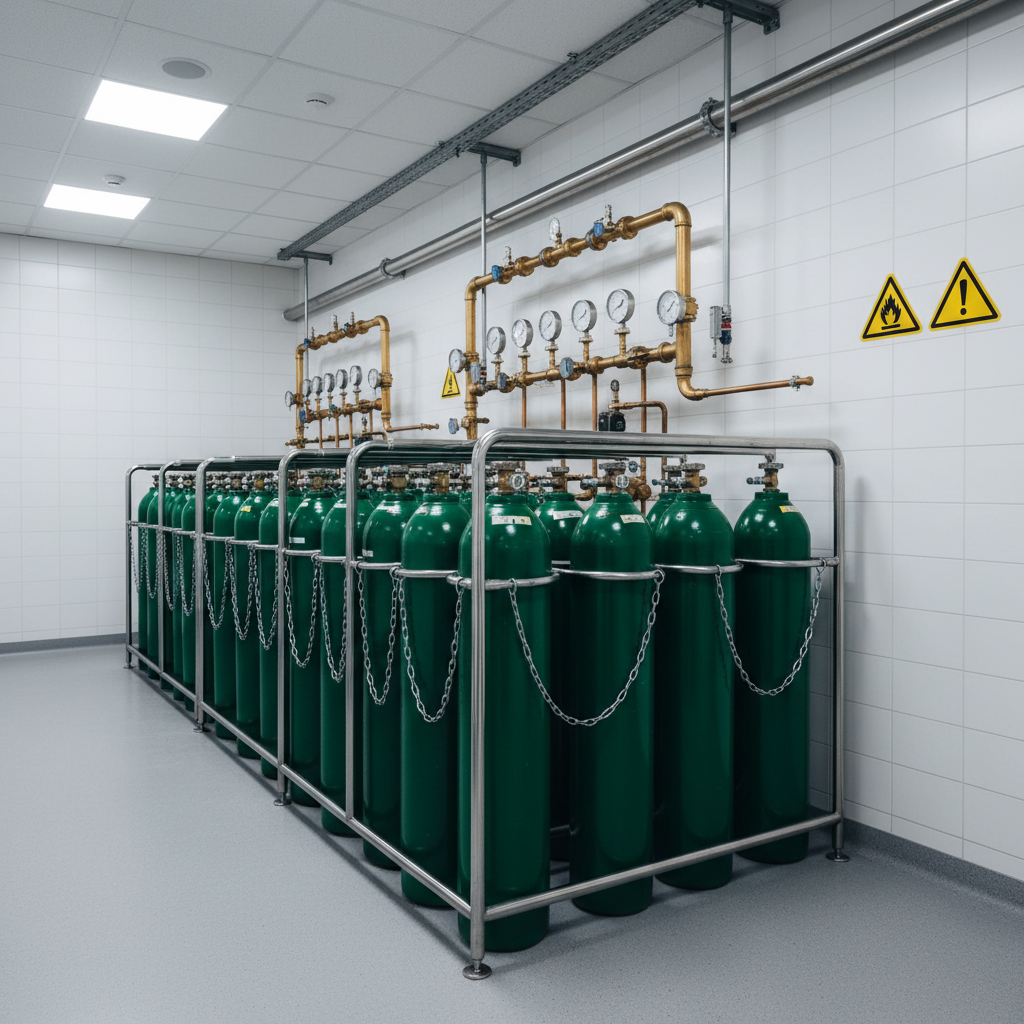
Medical facilities throughout St. Lucie County rely on pressurized, life-sustaining medical gases every single day. From surgical centers along US-1 to acute hospital networks and outpatient procedural clinics across Port St. Lucie, pressurized oxygen supplies require relentless regulatory vigilance. An oxygen tank room inspection Port St Lucie FL health systems undergo is not merely an administrative checkbox; it is a critical life-safety mandate governed by NFPA 99 (Health Care Facilities Code), NFPA 55 (Compressed Gases and Cryogenic Fluids Code), and the Compressed Gas Association (CGA).
In this guide, you will learn the precise technical requirements of NFPA 99 Section 5.1.3.5 for central supply storage rooms, how Florida building codes and AHCA regulations impact high-pressure cylinder and bulk storage compliance, the physical and operational inspection checklist used by ASSE 6000-certified inspectors, and common physical plant infractions that trigger immediate survey citations. Whether managing high-pressure manifolds or liquid cryogenic containers, maintaining an audit-ready medical gas infrastructure protects both staff and patients.
The Regulatory Framework: NFPA 99, CGA, and Florida AHCA Standards
Healthcare engineering in Florida operates under an overlapping matrix of regional and national codes. The primary governing document for pipeline systems is NFPA 99: Health Care Facilities Code (with local jurisdictions adopting specific editions, such as the 2012, 2018, or 2021 editions, harmonized under the Florida Fire Prevention Code and Florida Building Code).
For facilities operating in Port St. Lucie, enforcement is overseen by the local fire marshal alongside the Florida Agency for Health Care Administration (AHCA) for licensed healthcare environments. Central supply locations, rooms housing high-pressure gas manifolds, compressed gas cylinders, or cryogenic liquid containers, must comply strictly with NFPA 99 Section 5.1.3.5 ("Central Supply System Identification and Performance") as well as NFPA 55.
Why this matters for compliance:
Central gas supply enclosures house massive volumes of oxidizing agents. A failure in structural fire-resistance, electrical zoning, or mechanical ventilation does not just risk pipeline starvation; it creates catastrophic deflagration and fire propagation risks across critical hospital egress corridors.
Every physical inspection must be performed and documented by professionals holding credentialing under the ASSE 6000 Professional Qualifications Standard, specifically ASSE 6020 (Inspectors), ASSE 6030 (Verifiers), or ASSE 6040 (Maintenance Personnel). Engaging an uncertified technician invalidates your AHCA documentation trail during triennial Joint Commission or state licensure audits.
Physical Enclosure Requirements Under NFPA 99 Section 5.1.3.5
The core of an oxygen tank room inspection in Port St Lucie FL centers on the passive and active safety features of the physical enclosure. Whether you operate an in-building manifold closet storing ten H-cylinders or a dedicated central supply utility room feeding an entire surgical hospital, NFPA 99 5.1.3.5 mandates specific architectural parameters.
1. Fire-Resistance Ratings and Door Assemblies
Per NFPA 99 Section 5.1.3.5.2, central supply storage locations within an indoor healthcare facility must be constructed of materials providing a minimum 1-hour fire-resistance rating when connecting directly to occupied building spaces. If the room stores gases in quantities exceeding the maximum allowable quantity (MAQ) defined in NFPA 55, this requirement can elevate to a 2-hour separation.
Key checkpoints include:
- Door Ratings: Enclosure doors must be self-closing, latching fire assemblies (minimum 3/4-hour or 1-hour rated, depending on the wall rating).
- Penetrations: All mechanical, electrical, and piping penetrations through boundary walls must be sealed using listed UL firestop systems that maintain the hourly rating of the barrier.
- Security: Doors must be secured against unauthorized access via keycard or physical key lock, restricted exclusively to authorized biomedical or engineering personnel.
2. Environmental Separation and Prohibited Equipment
The oxygen tank room is a dedicated life-safety envelope. Under NFPA 99 5.1.3.5.6, these enclosures cannot be co-located with unrelated hospital infrastructure.
Inspectors verify that the space is strictly isolated from:
- Fuel-gas-fired equipment (e.g., boilers, domestic water heaters).
- Main electrical service panels or transformers.
- General storage items, combustible trash, cardboard packaging, or lubricating oils.
- Medical air compressors or vacuum pumps (unless specific separation walls or distances meet NFPA 99 5.1.3.5 exceptions for Category 1 systems).
Mechanical Ventilation and Air Changes: Critical Inspections
Oxygen is an oxidizer that violently accelerates combustion. A slow cylinder valve weep or manifold leak can quickly elevate the ambient oxygen concentration above the hazardous threshold of 23.5%. Consequently, mechanical ventilation testing is one of the most rigorous elements of any medical gas audit.
| Diagram text |
|, |
| NFPA 99 CENTRAL SUPPLY ROOM VENTILATION OVERVIEW |
| Air Movement: Continuous mechanical exhaust dedicated to the exterior (No recirculation) |
| Exhaust Grille Placement: Wall-mounted within 12 inches (300 mm) of the floor |
| Supply Air Intake: High on the opposing wall to create diagonal cross-ventilation |
| Air Change Rate: Minimum 1 CFM per square foot of room area, or not less than 50 CFM overall |
| Electrical Interlocks: Ventilation must run continuously or cycle via oxygen-sensing controls |
Inspectors utilize calibrated thermo-anemometers to capture airflow velocity (FPM) across the exhaust louvers, calculating total cubic feet per minute (CFM) against the room's total square footage. Crucially, the exhaust must pull air downward from the floor level, preventing pockets of dense, oxygen-rich cold gas (particularly relevant when handling liquid dewar boil-off) from accumulating around the cylinders.
When non-compliance or poor airflow is discovered, comprehensive annual medical gas inspections pinpoint duct static pressure drops, broken supply louvers, or unauthorized damper closures.
Cylinder Handling, Restraint, and Storage Compliance
How cylinders are positioned, grouped, and chained constitutes the most visible area of OSHA and NFPA scrutiny. Port St. Lucie sits in an active coastal wind zone; physical stability under seismic or lateral movement is strictly enforced.
Cylinder Restraint Mechanisms
Under NFPA 99 5.1.3.5.11, cylinders in service or in storage must be secured to prevent tipping over. Acceptable restraint methods include:
- Heavy-gauge galvanized or stainless steel chains bolted directly into masonry or structural studs.
- Individual cylinder nesting racks manufactured specifically for high-pressure industrial and medical gas containment.
- Non-combustible containment bars or gates.
Relying on bungee cords, single fabric straps, or leaning cylinders against walls is an automatic failure during an evaluation.
Inventory Segregation: Empty vs. Full
Cross-contamination of empty cylinders into the active reserve bank can cause sudden pipeline drops. Inspectors verify that the storage room features clear physical separation and permanent wall placards demarcating:
- Full Cylinders: Ready for deployment, valve caps securely hand-tightened.
- In-Use Cylinders: Connected to the active manifold pigtails.
- Empty Cylinders: Valves closed, tagged "EMPTY", and grouped apart from active inventory.
Furthermore, medical gases must never be grouped haphazardly. Non-flammable gases like oxygen and medical air can be stored together, but flammable materials, toxic industrial gases, or open solvents are unequivocally barred from the envelope.
Technical Comparison: High-Pressure Manifolds vs. Liquid Micro-Bulk Systems
Medical gas infrastructure throughout St. Lucie County varies based on facility demand. Ambulatory surgery centers frequently use high-pressure manifold banks, while small hospitals or heavy-use surgical clinics utilize cryogenic liquid dewars or bulk liquid systems. Inspection protocols shift depending on the equipment installed.
| Regulatory & Physical Parameter | High-Pressure Manifold Bank (H/K Cylinders) | Cryogenic Liquid Cylinders (Dewars / Micro-Bulk) | Bulk Cryogenic Tank Pad (Exterior) |
|---|
| Applicable Standards | NFPA 99 (5.1.3.5), CGA V-1, CGA G-4 | NFPA 99 (5.1.3.5), NFPA 55, CGA P-18 | NFPA 99 (5.1.3.5.12), NFPA 55, CGA G-8.1 |
| Working Pressure | 2,000 to 2,640 PSIG | 235 to 350 PSIG (Liquid vaporization) | 150 to 250 PSIG |
| Ventilation Strategy | Natural or mechanical exhaust (1 CFM/sq. ft) | Continuous mechanical exhaust at floor level | Open outdoor air; non-combustible canopy |
| Thermal Relief / Vent Lines | Relief valves piped to exterior or room (code dependent) | Pressure relief must vent to outdoor atmosphere | Dual safety reliefs piped upward to atmosphere |
| Foundation / Flooring | Level, concrete, non-combustible floor | Concrete floor; impervious to cryogenic liquid | Engineered concrete pad with asphalt clearance |
| Typical Failure Point | Damaged pigtails, missing chain restraints, bad check valves | High boil-off losses, uninsulated flex lines, iced regulators | Cryogenic frostbite zones, damaged perimeter fencing |
When systems are modified or newly commissioned, facilities must execute full medical gas verification under ASSE 6030 standards to ensure piping integrity before patients are connected.
Electrical Equipment, Hazardous Locations, and Grounding
A frequent point of confusion during facility inspections involves electrical fixtures inside oxygen tank rooms. While pure oxygen is not flammable on its own, it drastically lowers the ignition point of adjacent materials and causes conventional combustibles to burn with explosive speed.
Under NFPA 99 5.1.3.5.7:
- Switching and Receptacles: Electrical devices located within the storage room are not strictly required to be explosion-proof (Class I, Division 1) unless flammable anesthetics or gases are present. However, all standard switches, lighting ballasts, and receptacles must be installed at a minimum height of 5 feet (1.5 meters) above the finished floor to reduce contact with dense, cool oxygen-enriched zones, or comply with local electrical codes adopting NFPA 70.
- Open Flame Heating: Direct-fired open flame space heaters or electric resistance heaters with exposed coils are prohibited.
- Grounding: High-pressure headers and copper manifolds must maintain verified bonding to the building’s grounding electrode system to mitigate electrostatic discharge risks during cylinder swaps.
If your facility incorporates surgical suites or procedural rooms with isolated power, periodic line isolation monitor testing should be integrated into your annual life-safety testing rounds to protect the broader electrical distribution grid feeding these critical support systems.
Emergency Signage and Labeling Protocol
Clear, standardized labeling prevents operational errors during routine deliveries and alerts emergency responders during a structural fire. During an oxygen tank room inspection Port St Lucie FL survey, inspectors look for three distinct tiers of signage:
1. Exterior Enclosure Warning Placards
The entrance door to the central supply room must display bold warning signs that remain visible when the door is closed. Required verbiage must align with NFPA 99:
- "CAUTION: OXYGEN, NO SMOKING, NO OPEN FLAMES"
- NFPA 704 Standard System diamond placard (Health: 3 or 0 depending on hazard, Flammability: 0, Instability: 0, Special: OX for oxidizer).
2. Header and Piping Identification
Every supply pipe leaving the manifold must be labeled with:
- The gas name ("MEDICAL OXYGEN") in black lettering on a green background (or green lettering on white background conforming to CGA C-9 / NFPA 99 Table 5.1.11).
- Operating system pressure (e.g., "50–55 PSIG").
- Directional flow arrows indicating the path of gas travel toward the facility distribution riser.
- Labels placed at intervals of not more than 20 feet along the run, and at least once in every room or closet the pipe traverses.
3. Emergency Shutoff Valve Identification
If the source emergency shutoff valve (the main valve controlling the central supply output) is located within or adjacent to the room, it must be labeled clearly:
"CAUTION: MEDICAL GAS SOURCE VALVE, DO NOT CLOSE EXCEPT IN AN EMERGENCY."
The Inspector’s Checklist: What Medical Testing Solutions Evaluates
At Medical Testing Solutions (MTS), our ASSE-certified technicians execute comprehensive physical, mechanical, and analytical diagnostics during our inspections. When our field specialists inspect your medical gas supply room, we utilize an exhaustive protocol derived directly from ASSE Series 6000 competencies.
| Diagram text |
|, |
| MTS ASSE 6020/6030 ON-SITE INSPECTION PROTOCOL |
| [x] STRUCTURAL: Verify 1- or 2-hour fire barrier integrity and UL firestop seals |
| [x] VENTILATION: Measure exhaust CFM, verify lower 12" intake, check negative room pressure |
| [x] ACCESS: Validate self-closing/latching door mechanism and positive key/badge access lock |
| [x] MANIFOLD: Ultrasonic leak detection on headers, pigtails, and master regulator seats |
| [x] SIGNAGE: Confirm NFPA 704, CGA color codes, empty/full tags, and no-smoking warnings |
| [x] RESTRAINTS: Inspect structural anchoring of all chain/bracket cylinder retention assemblies |
| [x] ELECTRICAL: Verify fixture mounting heights, grounding continuity, and panel separation |
| [x] ALARMS: Function-test local/master alarm pressure transducers and changeover switches |
Beyond baseline inspections, Medical Testing Solutions performs field repairs and lifecycle medical gas maintenance services to resolve degraded flexible pigtails, failing relief valves, and uncalibrated digital manifold transducers before they trigger AHCA survey deficiencies.
If your facility requires new infrastructure, our team coordinates with licensed engineers for ASSE 6010-compliant medical gas installation to build code-compliant storage envelopes from the ground up.
5 Common Violations Found in St. Lucie County Facilities
During regional audits of healthcare facilities in Port St. Lucie, Fort Pierce, and surrounding Treasure Coast communities, field inspectors repeatedly encounter the same non-compliant conditions:
1. Combustible Material Stacking
The most frequent infraction is treating the oxygen storage room as an auxiliary custodial or storage closet. Stacking corrugated cardboard shipping boxes, plastic storage totes, or wooden pallets within 20 feet of oxygen cylinders violates both NFPA 99 and NFPA 55.
2. Compromised Fire Door Self-Closers
Door closers are often unhooked, propped open with wooden doorstops, or missing latching catches. An unlatched door completely negates the 1-hour fire barrier protecting surgical corridors from an interior oxygen hazard.
3. Blocked Floor-Level Exhaust Louvers
To maximize storage capacity, facilities sometimes shove spare cylinder racks directly against the low-level exhaust vent. This restricts the minimum required 1 CFM/sq. ft airflow, creating stagnant zones where leaking oxygen pools near the floor.
4. Pigtail Deterioration and Missing Safety Cables
Flexible metallic or Teflon-lined pigtails connecting high-pressure cylinders to the manifold header undergo extreme pressure cycling (0 to 2,200 PSIG). Inspectors frequently find micro-fissuring, kinked braids, or absent safety containment lanyards that protect workers if a pigtail bursts under pressure.
5. Inadequate Master Alarm Signal Transmission
When an oxygen manifold bank auto-switches from the primary reserve to the secondary bank, it must transmit an immediate signal to two separate master alarm panels (e.g., nurse station and engineering control room). Uncalibrated pressure switches frequently fail to trip the alarm, leaving staff oblivious to depleted central supplies.
Routine and meticulous medical gas certification identifies these telemetry lapses before they manifest as critical clinical failures.
Preparing for an AHCA or Joint Commission Medical Gas Survey
Preparation for an unannounced accreditation survey requires organized, continuous maintenance records rather than last-minute scramble. Healthcare engineers should keep a dedicated binder or electronic folder containing:
- Current ASSE 6040/6020 Annual Inspection Reports: Signed, dated reports showing flow calculations, manifold switchover verification, and physical plant safety checks.
- Source Equipment Maintenance Logs: Documentation of preventative maintenance performed on manifold changeover valves, pressure relief valves, and backflow preventers.
- Facility Valve and Alarm Schematics: An up-to-date single-line diagram indicating the location of the oxygen storage room, source valves, main risers, and downstream zone valve boxes.
- Cylinder Inventory and Vendor Traceability: Delivery logs verifying that medical-grade USP oxygen cylinders match purity requirements and hydro-test validation stamps (within 5 or 10 years per DOT specifications).
Schedule Your Port St. Lucie Oxygen Room Inspection Today
Maintaining compliance within your central gas supply rooms protects your healthcare facility against catastrophic fire events, regulatory shutdowns, and patient safety liabilities. Medical Testing Solutions delivers elite medical gas services across Port St. Lucie, Fort Pierce, Stuart, and the greater Treasure Coast. From complete annual surveys and leak detection to full ASSE 6030 verifications and preventative maintenance, our team ensures your systems exceed NFPA 99, CGA, and Florida AHCA standards.
Don't wait for a surprise Joint Commission or local fire marshal audit to discover non-compliant conditions in your oxygen supply infrastructure.
Contact Medical Testing Solutions: