Skip to content
    New: Medical Gas Outlet Retrofit & Rebuild Matrix — cross-reference legacy Chemetron, Ohio Diamond, Puritan-Bennett & more →
    ASSE Certified 24/7
    Medical Gas Service
    Compliance & Standards

    Oxygen Tank Room Inspection Kendall FL: NFPA 99 5.1.3.5 Guide

    Medical Testing SolutionsNovember 3, 202613 min read
    Share
    Oxygen Tank Room Inspection Kendall FL: NFPA 99 5.1.3.5 Guide

    Oxygen Tank Room Inspection Kendall FL: NFPA 99 5.1.3.5

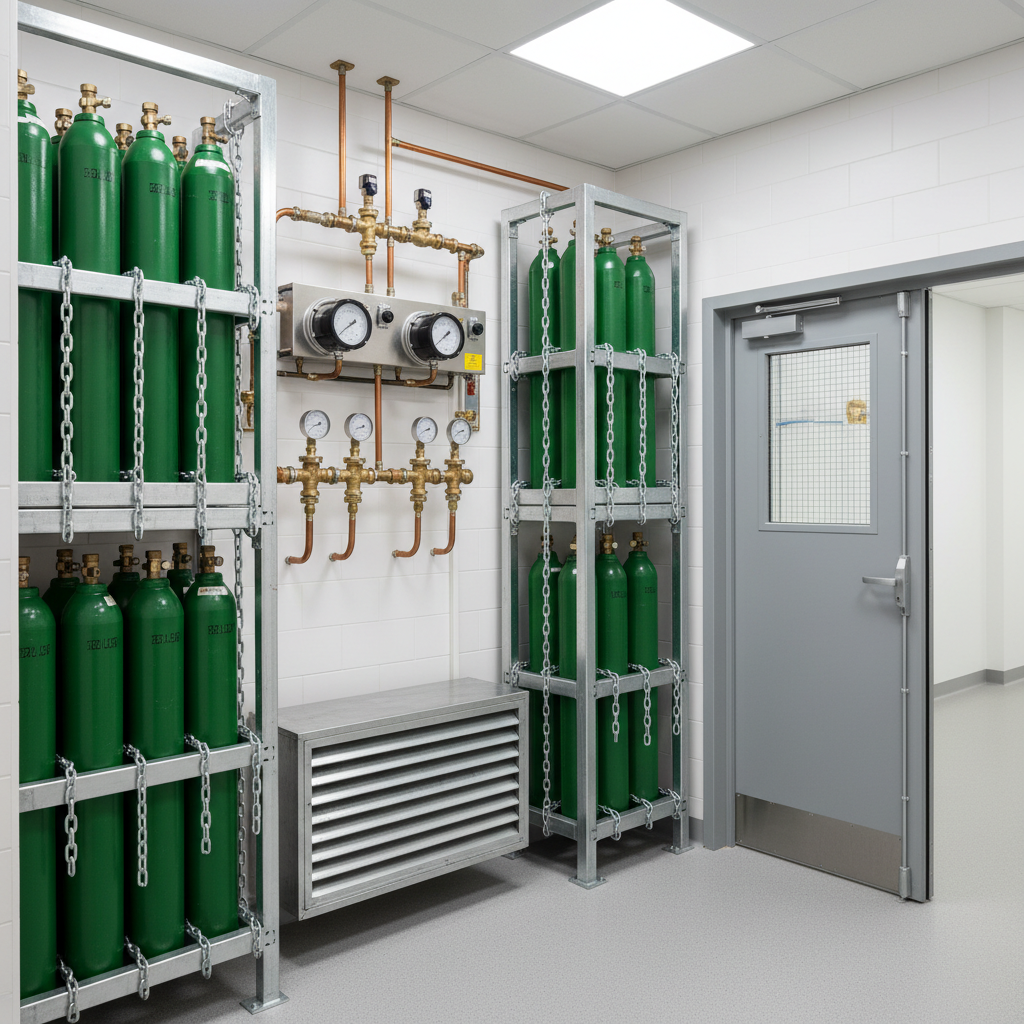
    Medical facilities throughout Kendall, Florida, ranging from outpatient surgical centers along North Kendall Drive to acute care clinics near Baptist Hospital, rely on central oxygen supply systems every single day. However, high-pressure compressed medical gas cylinders and cryogenic liquid containers introduce severe fire, over-pressurization, and displacement hazards if not housed in strictly regulated environments. Performing a compliant oxygen tank room inspection Kendall FL facility managers can trust requires an exhaustive evaluation of structural fire barriers, mechanical ventilation, emergency relief piping, electrical classifications, and cylinder security under NFPA 99 Section 5.1.3.5.

    In this technical compliance guide, you will learn the exact mechanical and structural mandates for central supply rooms, the physical inspection checklist used by ASSE 6030 and ASSE 6040 personnel, common code violations discovered during AHJ reviews in Miami-Dade County, and how to prepare your Kendall medical facility for uninterrupted compliance.


    The Regulatory Framework: NFPA 99 Section 5.1.3.5

    The National Fire Protection Association establishes strict guidelines for central supply storage locations housing compressed medical gases and cryogenic fluids. Under NFPA 99 (Health Care Facilities Code), specifically Section 5.1.3.5, locations for central supply systems and the storage of positive-pressure medical gases must meet rigorous architectural and engineering criteria to minimize combustion risks and prevent catastrophic system failures.

    In Kendall and the broader Miami-Dade jurisdiction, local authorities having jurisdiction (AHJs), municipal fire inspectors, and healthcare accreditation agencies (such as The Joint Commission, DNV, and AAAHC) cross-reference NFPA 99 alongside:

    • NFPA 55: Compressed Gases and Cryogenic Fluids Code
    • NFPA 101: Life Safety Code
    • CGA (Compressed Gas Association) Pamphlets: Including CGA P-1 (Safe Handling of Compressed Gases in Containers) and CGA G-4.1 (Cleaning Equipment for Oxygen Service)
    • Florida Building Code (Mechanical & Life Safety): Special flood and high-velocity hurricane zone (HVHZ) considerations applicable to South Florida facilities

    Central supply storage areas are categorized based on aggregate gas volumes. Any room containing medical gas cylinders or cryogenic vessels with a total volume exceeding 3,000 cubic feet (approximate threshold for small manifold rooms or dual micro-bulk vessels) falls under the most stringent architectural fire separation and mechanical exhaust mandates outlined in NFPA 99.

    Why this matters for compliance: A failure in an oxygen manifold room does not stay localized. An undetected high-pressure oxygen leak transforms ordinary non-combustible materials into volatile fuels, creating flash-fire hazards capable of breaching standard drywall partitions in seconds.


    Architectural and Fire Separation Mandates for Oxygen Enclosures

    NFPA 99 5.1.3.5.1 details the physical construction rules governing rooms that house central supply manifolds and gas cylinders. When Medical Testing Solutions performs an oxygen tank room inspection in Kendall, FL, our certified inspectors first examine the architectural envelope.

    1. Fire-Resistance Ratings

    Rooms housing central supply systems with an aggregate capacity exceeding 3,000 cu. ft. must be separated from the rest of the building by walls, floors, and ceilings having a minimum 1-hour fire-resistance rating. If the room is shared with flammable gases or anesthetic agents (which are rarely co-located today due to safety mandates), separation ratings can increase to 2 hours depending on facility classification.

    2. Door Openings and Latching

    Doorways accessing the oxygen supply room must feature self-closing, positive-latching fire doors rated for at least 45 minutes (for a 1-hour barrier) or 90 minutes (for a 2-hour barrier). Our technicians verify:

    • Functional closer hardware without manual hold-open wedges (a common violation cited by AHJs).
    • Intumescent smoke gaskets and seals around the frame perimeter.
    • Latching hardware that fully secures the door into the strike plate without binding.
    • Keyed or card-access security controls to prevent unauthorized access while allowing emergency egress from within without specialized keys.

    3. Interior Finishes and Surface Cleanliness

    Walls and ceilings within the oxygen room must be constructed of noncombustible or limited-combustible materials. Storage of combustible administrative supplies (cardboard boxes, wooden pallets, cleaning solvents, or maintenance trash) inside the central supply room is explicitly prohibited under NFPA 99 5.1.3.5.4. Oxygen accelerates combustion drastically; materials that merely smolder in ambient air burn with explosive velocity in oxygen-enriched atmospheres (>23.5% O₂).


    Mechanical Ventilation Requirements: Continuous Exhaust vs. Gravity Relief

    Ventilation failure is among the most frequent citations issued during life safety audits. NFPA 99 requires dedicated, reliable air exchange to prevent the accumulation of oxygen or asphyxiating inert gases (such as nitrogen or nitrous oxide) in the event of cylinder valve seepage or relief valve venting.

    Dedicated Mechanical Exhaust

    For interior central supply rooms without direct exterior walls, continuous mechanical exhaust ventilation is non-negotiable under NFPA 99 5.1.3.5.11:

    • Exhaust Rate: The ventilation system must draw a minimum of 1 cubic foot per minute per square foot (1 CFM/sq. ft.) of room floor area, or 50 CFM total, whichever is greater.
    • Continuous Operation: The fan must operate 24 hours a day, 7 days a week, and cannot be tied to local light switches or variable occupancy sensors.
    • Dedicated Ductwork: Exhaust ducts must be dedicated exclusively to the medical gas room and route directly to the exterior of the building without sharing runs with patient-care air handlers or general building returns.
    • Negative Pressure: The supply room must maintain continuous negative air pressure relative to adjacent corridors and interior occupied spaces.

    Makeup Air and Low-Level Louvers

    Because medical gases have varied vapor densities (oxygen is slightly heavier than ambient air at standard temperatures, while cold liquid oxygen boil-off gas sinks rapidly to the floor), makeup air supply openings must be positioned strategically. Low-level exhaust registers or passive intake louvers must sit within 12 inches of the finished floor to sweep heavy, cold gas off the surface and prevent pooling.

    Facilities with existing systems requiring modification or new builds require documented medical gas installation performed by ASSE 6010 qualified personnel to ensure all dampers, duct penetrations, and airflow calculations satisfy Florida Mechanical Code and NFPA standards.


    Electrical Safety, Grounding, and Temperature Limits

    The electrical infrastructure inside an oxygen storage room must prevent spark generation while maintaining strictly regulated environmental parameters.

    System ParameterNFPA 99 & NEC RequirementInspection Pass/Fail Criteria
    Room Temperature RangeMaintained between 20°F (-7°C) and 130°F (54°C)Fail if <20°F or >130°F; continuous temperature logging verified
    Electrical ReceptaclesProtected from physical impact; rated per NFPA 70No open junction boxes, exposed wires, or unprotected extension cords
    Lighting FixturesProtected, enclosed fixtures (vapor-tight preferred)Exposed incandescent bulbs without protective globes fail instantly
    Heating ElementsDirect flames prohibited; radiant/hydronic limitsNo open-coil electric space heaters or fuel-fired appliances allowed
    Grounding SystemRacks, manifolds, and cryogenic systems bondedBonded to facility electrical grounding grid to prevent static discharge

    Preventing Thermal Overpressurization

    Liquid oxygen containers (DOT-4L cryogenic dewars) naturally boil off small volumes of gas over time. If room temperatures exceed 130°F (a real hazard in South Florida's humid subtropical climate when rooftop HVAC or exhaust equipment falters), the internal pressure inside storage vessels spikes rapidly, activating safety relief valves and flooding the enclosure with high-purity oxygen gas. During our annual medical gas inspections, our ASSE 6040 inspectors evaluate thermal controls, auxiliary cooling, and mechanical exhaust CFM readings simultaneously.


    Medical Gas Cylinder Security and Storage Segregation

    Physical cylinder management within the manifold room is governed by both NFPA 99 5.1.3.5 and OSHA 1910.101 regulations. An unanchored high-pressure cylinder whose valve shears off during handling becomes an unguided projectile capable of penetrating concrete block walls.

    Cylinder Restraint Protocols

    Every high-pressure cylinder (H, G, or E cylinders) must be physically secured in an upright position at all times:

    • Noncombustible racks, heavy-gauge welded steel security cages, or wall-mounted uni-strut channels with individual steel chains or non-conductive heavy-duty straps.
    • Cylinders may not be chained together en masse; each cylinder must be individually restrained or secured within nesting configurations that prevent tipping if an adjacent cylinder is pulled.
    • Valve protection caps must remain securely hand-tightened on all non-connected cylinders until they are connected to the central manifold pigtail.

    Segregation of Full vs. Empty Containers

    NFPA 99 mandates that storage areas provide designated physical segregation between "FULL" and "EMPTY" cylinders to eliminate the risk of connecting an unpressurized vessel to an active life-support manifold header. Facilities must utilize durable, color-coded floor striping or clearly marked physical dividers indicating:

    • Full Cylinders (Ready for Service)
    • In-Use / Reserved Manifold Bank
    • Depleted / Empty Cylinders Awaiting Supplier Pickup

    Nitrous oxide and other medical gases housed in the same room must be kept in dedicated spaces, and empty tanks must never intermingle with active inventory.


    Cryogenic Liquid Systems and Relief Valve Vent Piping

    For larger Kendall hospitals and surgical centers operating micro-bulk or bulk liquid oxygen tanks, cryogenic liquid delivery systems introduce complex fluid dynamics that go beyond standard high-pressure manifolds.

    Cryogenic Economizer and Dual Relief Paths

    Liquid cylinders contain internal vaporizers and economizer circuits designed to utilize boil-off vapor before venting. However, when demand halts (such as over a weekend), the inner vessel pressure rises until the primary relief valve cracks (typically set between 230 and 350 psig depending on the vessel rating). NFPA 99 5.1.3.5.7 requires that pressure relief valves for bulk systems and central manifolds with liquid containers vent directly to the exterior atmosphere:

    1. Outdoor Termination Points: Relief discharge lines cannot terminate near pedestrian walkways, air handling unit (AHU) intakes, combustible overhangs, or electrical transformers.
    2. Vent Line Sizing: Relief line diameters must not be necked down; any constriction induces backpressure that prevents the safety valve from flowing its rated capacity.
    3. Screened End Caps: Outdoor vent terminations must feature downward-turned elbow fittings fitted with corrosion-resistant insect screens to prevent blockages from mud daubers or debris common to South Florida foliage.

    Facilities updating, expanding, or commissioning these installations must undergo comprehensive medical gas verification conducted by an independent ASSE 6030 certified verifier prior to putting lines into clinical service.


    Comprehensive Oxygen Tank Room Inspection Checklist

    When Medical Testing Solutions deploys to your medical center in Kendall, FL, our technicians execute an exhaustive multi-point protocol designed to satisfy AHJ fire marshals and federal accreditation bodies.

    Step 1: Architectural Envelope & Access Control

    • Measure fire barrier construction (verify 1-hour or 2-hour rating).
    • Inspect self-closing door hardware, positive latching, and door gap clearances.
    • Verify NFPA 704 hazard warning diamond placarding and NFPA 99 warning signage: "NO SMOKING / OXYGEN ENCLOSED / NO OPEN FLAMES".
    • Confirm room is restricted exclusively to medical gas supply equipment (no administrative storage, oil, grease, or electrical panel clearances blocked).

    Step 2: Environmental Controls & Ventilation Performance

    • Anemometer verification of mechanical exhaust flow rate (verify ≥ 1 CFM/sq. ft. or ≥ 50 CFM).
    • Check negative pressure differential relative to adjoining corridors using differential pressure sensors or smoke tubes.
    • Inspect low-level makeup air and exhaust grilles for lint, dust, or physical obstructions.
    • Test temperature monitoring devices to confirm environmental range remains between 20°F and 130°F.

    Step 3: Cylinder Restraints, Racks & Storage Safety

    • Confirm all free-standing cylinders are upright and individually secured with chains or approved racks.
    • Ensure non-connected cylinders have valve protection caps threaded tightly.
    • Verify explicit physical separation between marked "FULL" and "EMPTY" storage zones.
    • Inspect cylinder cart paths to confirm unobstructed egress lanes of at least 36 inches throughout the room.

    Step 4: Manifold, Header & Relief Valve Mechanics

    • Leak test manifold headers, pigtails, master shutoff valves, and check valves using an approved oxygen-compatible leak detector (fluorescent bubbling solution per ASTM G222 or electronic halogen/ultrasonic detectors).
    • Inspect copper pigtails for work-hardening, kinks, flattening, or stress cracks; inspect flexible stainless-steel braided PTFE pigtails for interior degradation.
    • Verify dual-line pressure regulators and auto-changeover functionality (pressure drops trigger automatic changeover to the reserve bank without downstream pressure dips).
    • Inspect relief valve vent lines for proper sizing, outdoor routing, and exterior termination screen integrity.

    Step 5: Master Alarm and Electrical Safety Integration

    • Test local and remote master alarm panel annunciator signals (Header Pressure High, Header Pressure Low, Bank Depleted, Reserve In-Use).
    • Ensure lighting fixtures are protected from mechanical breakage.
    • Inspect equipment grounding and structural bonding straps.

    To prevent premature equipment wear and regulatory lapses, healthcare systems must pair periodic walk-throughs with scheduled medical gas maintenance services to overhaul regulators, calibrate sensors, and replace high-pressure pigtails every 3 to 5 years per CGA recommendations.


    Common NFPA 99 5.1.3.5 Violations in Kendall Facilities

    During routine audits across Miami-Dade County healthcare facilities, Medical Testing Solutions frequently identifies preventable compliance oversights that trigger inspection citations.

    1. Using Central Supply Rooms for General Storage

    In space-constrained clinical offices, staff frequently stash extra cardboard cartons of PPE, cleaning supplies, or housekeeping mop buckets inside the oxygen tank room. NFPA 99 explicitly outlaws combustible material in medical gas rooms. Cardboard absorbs oil and oxygen, transforming into an extreme fire hazard.

    2. Ventilation Interrupted by Building Automation

    Many office complexes in Kendall shut down air handlers over weekends or off-peak hours via automated energy management systems (EMS). However, NFPA 99 requires uninterrupted 24/7 mechanical exhaust. If building automation systems cycle exhaust fans off, gas leaks go unpurged, creating an oxygen-enriched hazard.

    3. Hydrostatic Retest Date Expirations

    Every DOT-rated high-pressure gas cylinder must undergo periodic hydrostatic testing (typically every 5 or 10 years, marked by a stamped star or test date on the cylinder collar). While medical gas distributors handle recertification, facility managers remain legally responsible for ensuring that expired cylinders are not connected to active patient life-support manifolds on their premises.

    4. Non-Oxygen-Safe Lubricants and Tapes

    A dangerous violation is finding standard petroleum-based WD-40, industrial thread lubricants, or unapproved plumbers' PTFE tape on manifold connections. Hydrocarbon lubricants instantly combust, often explosively, in the presence of high-pressure oxygen without requiring an open spark. Only fluorinated lubricants (such as Krytox) and CGA-approved oxygen-compatible thread sealants may be used by technicians certified under ASSE 6000 standards.


    Why Kendall Medical Facilities Rely on Medical Testing Solutions

    Healthcare infrastructure requires zero room for error. Medical Testing Solutions (MTS) is headquartered locally in Fort Lauderdale, serving medical gas facilities across South Florida, including Kendall, Coral Gables, Doral, and downtown Miami.

    Credentials That Protect Your Accreditation

    • ASSE 6030 Certified Medical Gas Verifiers: Fully qualified to perform third-party verifications and annual compliance testing for hospitals, ASCs, and clinics.
    • ASSE 6040 Certified Medical Gas Maintenance Personnel: Trained to service, troubleshoot, and restore high-pressure manifolds, source valves, and control systems.
    • ASSE 6010 Certified Medical Gas Installers: Capable of correcting mechanical piping, relief lines, and manifold installations to exact NFPA 99 and CGA specifications.
    • Turnkey Equipment and Parts Supply: In addition to compliance testing, Medical Testing Solutions distributes medical gas equipment directly through our medical gas products catalog, allowing us to immediately replace leaking pigtails, outdated relief valves, and depleted alarms during the same service call.

    Facilities navigating facility alterations or planning their joint commission cycle can rely on our comprehensive medical gas certification programs to maintain airtight documentation and unyielding life-safety standards.


    Schedule Your Kendall Oxygen Tank Room Inspection Today

    Do not wait for a surprise AHJ visit, Joint Commission audit, or catastrophic pressure failure to discover compliance vulnerabilities in your central supply room. Medical Testing Solutions provides prompt, ASSE-certified oxygen tank room inspection in Kendall, FL, supplying you with the comprehensive test documentation, engineering airflow verifications, and corrective service needed to guarantee patient safety and regulatory peace of mind.

    To book your facility inspection, speak directly with an ASSE 6030 specialist, or request a detailed compliance estimate:


    Frequently Asked Questions

    Immediate failure triggers include inoperative mechanical exhaust ventilation, unchained or improperly restrained high-pressure cylinders, combustible storage (such as cardboard or wooden pallets) inside the room, failure of the fire door to self-close and latch securely, and the presence of petroleum-based lubricants or oils on oxygen-wetted piping and valves.

    NFPA 99 mandates that central supply systems and medical gas source equipment receive comprehensive inspections and operational testing at least annually by qualified personnel (ASSE 6040 or ASSE 6030 certified). Facility staff should also conduct weekly or monthly visual checks to ensure cylinders remain anchored, doors stay closed, and manifold reserve banks are pressurized.

    No. Because oxygen is an oxidizer rather than a flammable gas, Class I, Division 1 explosion-proof electrical fixtures are generally not required unless flammable anesthetic gases are stored in the same room (which is prohibited under modern design). However, fixtures must be fully enclosed or protected with vapor-tight globes to guard against physical damage and filament exposure per NFPA 70 and NFPA 99.

    No. Under NFPA 99 Section 5.1.3.5.11, the mechanical exhaust system for a medical gas storage room must be completely independent and dedicated. It cannot communicate with, return to, or tie into ductwork serving general building ventilation, patient care areas, or common exhaust stacks.

    The exterior of every doorway leading into a medical gas storage room must bear warning signage meeting NFPA 99 and NFPA 704 standards. Signage must clearly state: "CAUTION: MEDICAL GASES STORED WITHIN – NO SMOKING – NO OPEN FLAMES" along with specific warnings identifying the presence of compressed or cryogenic oxygen. The NFPA diamond must accurately reflect the specific chemical hazards (Oxygen = Yellow Reactivity 0, Blue Health 0, Red Flammability 0, White Specific "OX").

    This article is provided for educational purposes and reflects industry standards as of publication. Always verify against current NFPA 99, CGA, and AHJ requirements. Medical Testing Solutions is ASSE-certified and ready to help — contact us for facility-specific guidance.

    Request a quote for your facility

    Talk with Medical Testing Solutions about your next inspection, repair or equipment request.

    Get a quote in 1 business day

    I agree to receive text messages from Medical Testing Solutions, L.L.C. at the phone number provided, including informational and marketing messages. Consent is not a condition of purchase. Message frequency varies. Message & data rates may apply. Reply STOP to opt out or HELP for help. See our Privacy Policy and Messaging Terms.

    Prefer to talk? Call (754) 315-1078

    Related articles