Oxygen Tank Room Inspection Jupiter FL: NFPA 99 Compliance Guide
High-pressure oxygen cylinders and cryogenic liquid storage systems present unique fire, pressure, and operational hazards in healthcare environments. If your facility operates in Jupiter, Palm Beach Gardens, or throughout northern Palm Beach County, securing an oxygen tank room inspection in Jupiter FL is not merely a box-checking exercise, it is a critical life-safety and statutory mandate under Florida Administrative Code, AHCA (Agency for Health Care Administration), and national fire codes.
NFPA 99 (Health Care Facilities Code), specifically Section 5.1.3.5, outlines rigid technical criteria for the physical enclosures housing medical gas supply sources. An out-of-compliance storage room exposes clinical staff to catastrophic fire risks, threatens patient oxygen supply reliability, and leaves healthcare administrators vulnerable to severe regulatory citations.
In this guide, you will learn the exact physical, ventilation, mechanical, and fire-separation requirements of NFPA 99 5.1.3.5, common inspection failure points seen across Jupiter surgical centers and clinics, how local environmental factors impact high-pressure systems, and what an ASSE-certified surveyor audits during a professional physical inspection.
The Legal and Code Landscape: NFPA 99, NFPA 55, and CGA Standards
In Florida, hospital accreditation (The Joint Commission, DNV, HFAP) and state licensure via AHCA hinge directly on the enforceable edition of NFPA 99 (typically the 2012, 2015, or 2018 edition, depending on facility occupancy type and state baseline adoption). While NFPA 99 dictates how medical gases interface with patient health and facility engineering, it interacts tightly with two other major technical codes:
- NFPA 55 (Compressed Gases and Cryogenic Fluids Code): Dictates bulk gaseous and cryogenic fluid storage parameters, venting requirements, and outdoor-to-indoor separation boundaries.
- CGA (Compressed Gas Association) Standards: Documents like CGA G-4.1 (Cleaning Equipment for Oxygen Service), CGA P-2 (Characteristics and Safe Handling of Medical Gases), and CGA V-1 (Compressed Gas Cylinder Valve Outlet and Inlet Connections) dictate the physical components attached to the high-pressure manifold.
NFPA 99 divides medical gas systems into risk categories: Category 1 (interruption of supply could cause serious injury or death) down to Category 4 (interruption has no clinical impact). Any space feeding piped oxygen to clinical areas, operating suites, emergency bays, outpatient procedure rooms, or procedure recovery bays, is governed by stringent storage provisions.
Why this matters for compliance: AHCA and Joint Commission surveyors will cite the facility under NFPA 99 Section 5.1.3.5.1 if supply systems are stored in locations that double as general utility spaces. An oxygen storage room cannot share space with combustible materials, housekeeping supplies, mop sinks, or general maintenance equipment.
Deconstructing NFPA 99 Section 5.1.3.5: Physical Enclosure Mandates
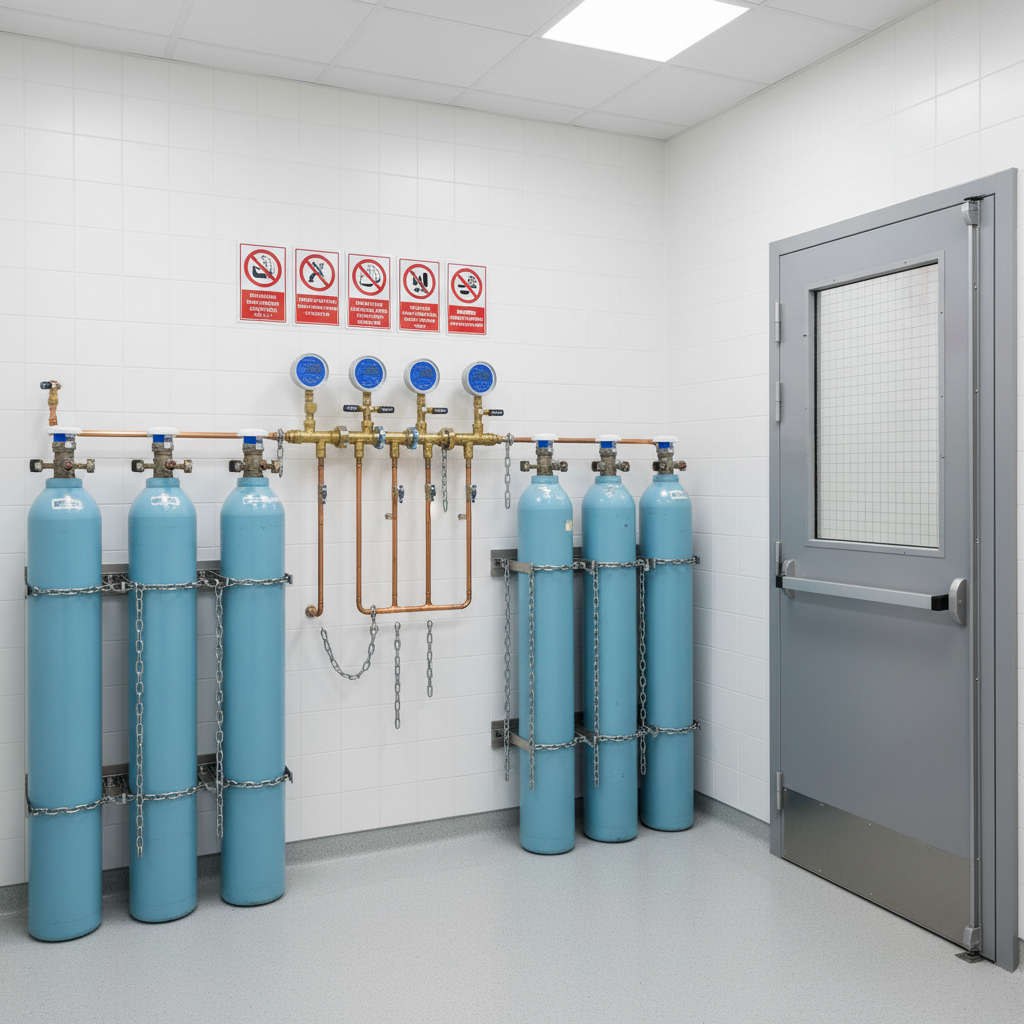
NFPA 99 Section 5.1.3.5 establishes the architectural and engineering requirements for central supply systems and storage of medical gases. When our team at Medical Testing Solutions conducts an on-site field evaluation, we audit the following physical parameters line by line. | Diagram text | |, | | NFPA 99 5.1.3.5 CORE AUDIT MATRIX | | Requirement Code Mandate (NFPA 99 5.1.3.5) | | Fire Resistance 1-hour minimum fire-resistance-rated enclosure (2-hour for certain | | large/bulk interior central supply locations). | | Doors & Latching 3/4-hour (45 min) fire-rated self-closing doors; latching hardware; | | lockable access restricted to authorized personnel only. | | Mechanical Ventilation Dedicated continuous mechanical exhaust: minimum 1 CFM/sq. ft. or | | 50 CFM total (whichever is larger), exhausting directly outdoors. | | Electrical / Lighting Protected electrical fixtures; switches and outlets positioned safely; | | compliance with NFPA 70 (NEC); no non-essential electrical equipment. | | Ambient Temperature Heated/conditioned to prevent interior ambient temp from exceeding | | 125°F (54°C) or falling below 20°F (-7°C) for cylinders. | | Storage Segregation Full cylinders segregated from empty cylinders; in-use cylinders | | connected to manifolds separated from reserve/unconnected stock. | | Restraint Systems Non-combustible racks, chains, or collars securing every high-pressure | | cylinder to structural wall framing; no freestanding tanks. |
1. Fire-Resistance Ratings and Spatial Demarcation
Interior supply systems, including manifolds for high-pressure cylinders and liquid cryogenic micro-bulk systems, must be installed inside an enclosure built with a minimum 1-hour fire-resistance rating. Doors must be self-closing, positive-latching, and bear a fire label showing at least a 3/4-hour (45-minute) rating. The room cannot be placed adjacent to storage areas containing combustible fluids or materials, boiler rooms, or high-voltage transformers.
2. Environmental Controls and Ventilation
Jupiter's coastal climate poses specific humidity and heat challenges. High-pressure oxygen cylinders exposed to excessive heat can suffer dangerous internal pressure spikes, causing the relief devices (rupture disks or spring-loaded safety valves) to lift and vent concentrated oxygen into the room.
NFPA 99 Section 5.1.3.5.11 dictates that locations for central supply systems and storage of positive-pressure gases must be ventilated to prevent the accumulation of gases from leaks or venting:
- Mechanical Ventilation: When outdoor natural ventilation louvers are not viable, the room must have a dedicated, continuously running mechanical exhaust system.
- Airflow Rates: The exhaust must pull a minimum of 1 CFM per square foot of room floor area or 50 CFM, whichever is greater.
- Exhaust Termination: The discharge must vent directly outside, located at least 10 feet away from any building air intake, openable window, or pedestrian door. The make-up air must enter through a dedicated transfer duct protected by a fire damper or louver from outside or a non-hazardous area.
3. Cylinder Restraints and Physical Protection
Under NFPA 99 5.1.3.5.7, cylinders must be secured to prevent falling, tipping, or rolling. Jupiter facilities must also consider building movement from tropical storm events. Strapping with zip-ties, non-rated bungee cords, or lightweight plastic ties is a direct code violation. Restraints must consist of robust, non-combustible chains, welded steel brackets, or specialized manifold storage racks anchored directly into structural masonry, studs, or concrete slab floors.
Medical Gas Testing and Certification Pathways
Maintaining code compliance requires professional testing at key stages of a facility's lifecycle. While an oxygen tank room audit inspects the storage envelope and cylinder integrity, it is integrated into a broader network of compliance services:
- Annual Medical Gas Inspections: Routine comprehensive evaluations of central manifolds, dew point monitors, carbon monoxide alarms, area alarms, and physical storage spaces to satisfy AHCA and CMS Joint Commission requirements.
- Medical Gas Certification: Operational documentation demonstrating that your entire system meets the requirements of NFPA 99, including source delivery, piping integrity, and alarm set-points.
- Medical Gas Verification: Performed by an ASSE 6030 certified verifier after any new construction, pipeline renovation, or manifold upgrade prior to patient use.
- Medical Gas Maintenance Services: Preventative replacement of flexible pigtails, regulator rebuilds, pressure transducer calibrations, and manifold changeover tests.
- Line Isolation Monitor (LIM) Testing: In surgical and wet procedure suites where oxygen and nitrous oxide are administered, isolated power systems require calibrated LIM auditing to protect clinical teams and patients from electrical micro-shocks and thermal ignition hazards.
Common Failures Uncovered During Jupiter FL Inspections
Across ambulatory surgery centers (ASCs), long-term acute care facilities (LTACs), outpatient imaging clinics, and private medical practices in Palm Beach County, our inspectors routinely uncover predictable, preventable infractions during safety audits. | Diagram text | |, | | TOP 6 OXYGEN STORAGE ROOM INFRACTIONS | | Infraction Observed NFPA 99 Reference Operational Risk | | "Full" and "Empty" Tanks NFPA 99 5.1.3.5.9 Clinical staff grab empty cylinder | | Mixed Together during patient transport emergency. | | Ventilation Fan Motor NFPA 99 5.1.3.5.11.2 Ambient O2 levels elevate; creating | | Failed or Powered Off extreme flash-fire condition. | | Corroded Brass/Pigtails NFPA 99 5.1.3.5.4 Marine salt air causes fitting | | from Salt Air Intrusion failure; high-pressure leaks. | | Unapproved Door Wedges NFPA 99 5.1.3.5.1 Defeats 45-minute fire-barrier; | | Defeating Self-Closing breaches room containment boundary. | | Non-Related Materials NFPA 99 5.1.3.5.2 Flammable cardboard, paper, or oils | | Stored in Enclosure create catastrophic fuel sources. | | Missing Valve Caps on CGA P-2 / NFPA 99 Sheared valve stem if tank falls; | | Disconnected Cylinders cylinder becomes a dangerous rocket. |
The Salty Coastal Atmosphere Factor in Palm Beach County
Medical facilities located within a few miles of the Atlantic Ocean in Jupiter face aggressive atmospheric corrosion. Inbound marine aerosols carry sodium chloride deep into non-hermetic ventilation intake systems.
When high-pressure manifold rooms ingest untreated marine air without proper filtration, exposed brass fittings, copper rigid pigtails, stainless steel braided hoses, and relief valves pit and oxidize rapidly. During our inspections, Medical Testing Solutions technicians examine thread degradation on CGA 540 connections and ensure that copper runs have not developed brittle green verdigris, which threatens fitting mechanical strength under 2,200 PSIG of cylinder pressure.
Step-by-Step: The ASSE 6030 Inspection Protocol for Oxygen Rooms
To achieve compliant, defensible reporting, your facility's survey must be conducted by technicians certified to ASSE Series 6000, specifically ASSE 6030 (Medical Gas Systems Verifier) or ASSE 6020 (Medical Gas Systems Inspector). A general commercial building inspector or HVAC technician does not carry the statutory credentials required by AHCA or CMS.
Here is the exact procedure followed during a professional audit:
Step 1: Physical Boundary & Passive Fire Protection Audit
The inspector checks the room envelope for penetrations around conduits, plumbing lines, and med gas supply pipes. Every annular space must be sealed with a certified UL-listed through-penetration firestop system matching the partition's 1-hour or 2-hour rating. The door label is checked, latch throw depth is measured, and self-closing hinges are adjusted to ensure the door latches reliably against positive room pressure.
Step 2: Mechanical Airflow Measurement
Using a calibrated hot-wire anemometer or balometer hood, the inspector captures volumetric exhaust flow (CFM) at the exhaust grille. The square footage of the room is measured, and CFM/sq. ft. calculations are verified against code minimums. Negative or positive room pressure relationships are verified using differential pressure gauges.
Step 3: High-Pressure Manifold & Header Assessment
The manifold assembly is inspected for mechanical wear, leaks, and operational changeover capability. We test:
- Automated changeover functionality between the primary bank and secondary bank.
- Intermediate and line pressure regulators to confirm pressure drop does not violate system flow demands.
- Visual and audible indicators on local manifold monitoring panels.
- Flexible pigtails: checked for kinks, frayed stainless braiding, worn check valves, and date-stamped replacement intervals.
Step 4: Storage Segregation, Labeling, and Security
The inspector audits cylinder signage. Under NFPA 99, designated signage stating:
"CAUTION: MEDICAL GASES - NO SMOKING - NO OPEN FLAMES"