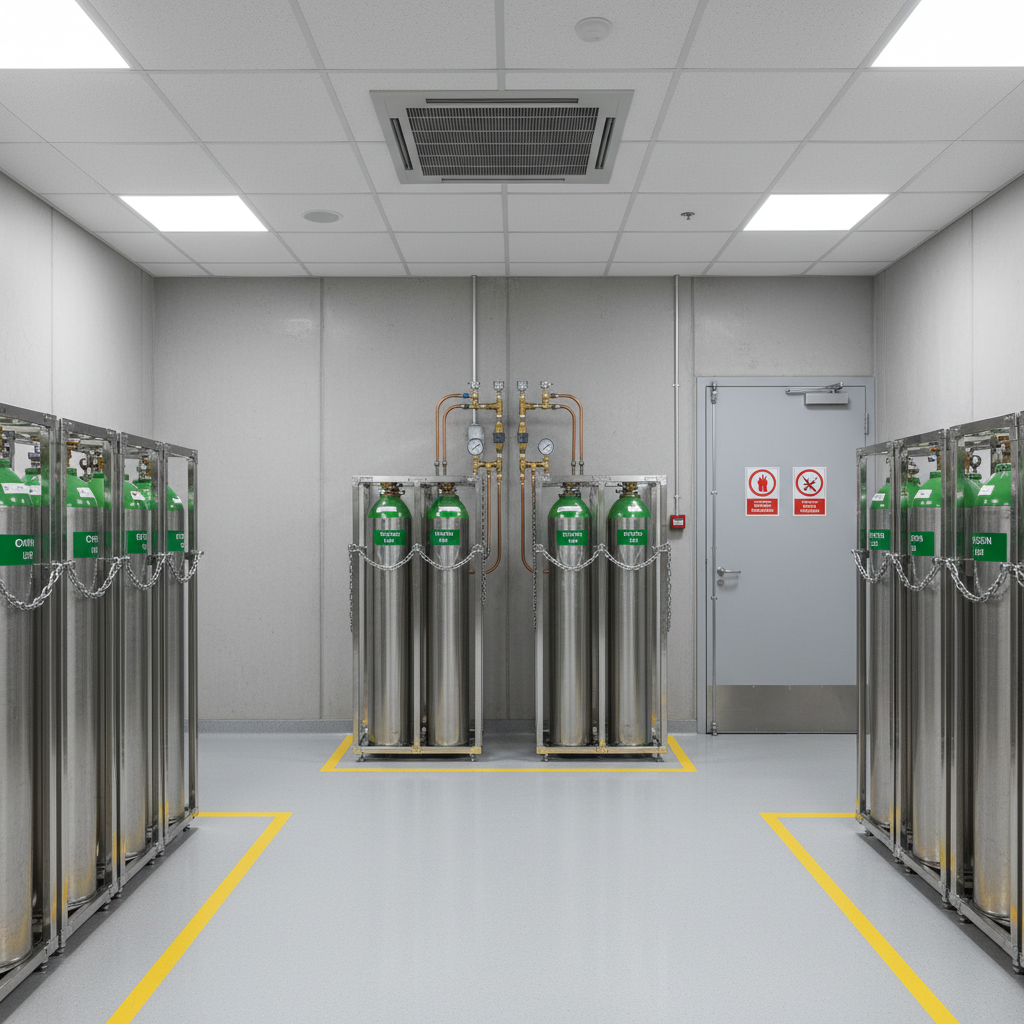
Oxygen Tank Room Inspection Doral FL: NFPA 99 Compliance
Medical Testing SolutionsNovember 3, 202613 min read
Share
Healthcare facilities, surgical suites, and emergency response centers across Doral, Florida face stringent regulatory scrutiny when storing, manifolding, or piping medical oxygen. Under NFPA 99 (Health Care Facilities Code) Section 5.1.3.5, central supply storage locations for medical gases, including cryogenic liquid containers, high-pressure cylinder rooms, and micro-bulk systems, must adhere to exacting structural, electrical, and mechanical life-safety mandates. Failure to meet these criteria exposes patients to catastrophic supply interruptions and facilities to severe fire code violations from Miami-Dade Fire Rescue, the Agency for Health Care Administration (AHCA), or The Joint Commission.
In this definitive guide, the ASSE-certified technicians at Medical Testing Solutions outline the technical inspection criteria, ventilation formulas, electrical boundary classifications, and AHJ requirements governing medical gas cylinder and bulk rooms. Whether you operate an ambulatory surgical center off NW 87th Avenue or an acute-care clinical department near NW 36th Street, this technical breakdown provides the exact blueprint for achieving and defending continuous compliance.
The Regulatory Framework: NFPA 99, CGA, and Florida Building Codes
A compliant oxygen tank room inspection in Doral FL must reconcile three layers of regulatory jurisdiction: national standards, state healthcare rules, and local municipal enforcement.
NFPA 99 (2012, 2018, 2021, or 2024 editions): Governs the design, installation, performance, maintenance, and testing of health care facility gas distribution systems. Section 5.1.3.5 establishes the direct physical baseline for central supply locations and cylinder storage.
NFPA 55 (Compressed Gases and Cryogenic Fluids Code): Governs bulk cryogenic storage installations, setback distances, and outdoor pad configurations (NFPA 99 5.1.3.5.11 cross-references NFPA 55).
Compressed Gas Association (CGA): Standards such as CGA P-2.1 (Standard for Medical Gas Storage and Handling) and CGA V-1 (Pin Index Safety Systems and valve outlet connections).
AHCA & Florida Building Code (Chapter 4): AHCA enforces rigorous life-safety criteria for licensed surgical centers and hospitals in South Florida, frequently conducting unannounced surveys that inspect medical gas rooms first.
Miami-Dade Fire Rescue Life Safety Division: Exercises local Authority Having Jurisdiction (AHJ) enforcement over structural fire ratings, sprinkler coverage, and placarding.
Why this matters for compliance: AHCA and The Joint Commission treat non-compliant medical gas supply rooms as immediate Life Safety Code deficiencies. An unrated penetration or an inoperative mechanical exhaust fan can instantly drop a facility into conditional status, risking facility licensure and accreditation.
Architectural and Structural Mandates: NFPA 99 Section 5.1.3.5.2
The physical enclosure housing your facility's primary or reserve oxygen supply cannot simply be treated as a janitorial closet or standard utility room. NFPA 99 establishes firm physical construction mandates based on gas volume and spatial placement.
Fire-Resistance Ratings
Under NFPA 99 5.1.3.5.2, rooms housing central supply systems and cylinders of positive pressure gases containing more than 3,000 cu ft (approximately 85,000 liters or ~12 H-cylinders) must meet strict fire separations:
Interior Rooms: Must be separated from the rest of the building by walls, floors, and ceilings having a minimum 1-hour fire-resistance rating (2-hour ratings frequently apply depending on total volume, occupancy type, and Florida Building Code occupancy classifications).
Doors and Openings: Doors must be rated for at least 3/4-hour fire protection (or 1.5-hour if within a 2-hour assembly), equipped with an approved self-closing and positive-latching device.
Fire Damper Exclusions: Per NFPA 99, ventilation ducts serving these rooms must not pass through other tenant spaces unless strictly insulated/rated, and ductwork penetrations must be properly protected without placing dampers in circuits where continuous exhaust is required for flammable/oxidizing atmospheres.
Security and Controlled Access
Rooms containing medical gas manifolds or bulk storage must be secured against unauthorized entry:
Physical locks or badge-access credentials restricted strictly to trained clinical and facilities personnel.
Cylinder rooms cannot be shared with combustible materials, general storage, chemicals, flammables, or open flames. Storing cardboard boxes, cleaning carts, or biohazard bins inside an oxygen tank room is a direct and frequent violation cited by surveyors.
Interior Finishes and Spill Mitigation
Floors, walls, and ceilings must be constructed of noncombustible or limited-combustible materials. Where cryogenic liquid oxygen (LOX) is handled or transferred indoors, floors must be noncombustible and non-reactive (e.g., uncoated, oil-free concrete) because liquid oxygen dripping onto asphalt, mastic, or organic floor sealers can create an explosive percussive hazard.
Ventilation Architecture: Calculating CFM for Medical Oxygen Rooms
Mechanical ventilation in medical gas rooms is engineered to prevent the accumulation of oxygen-enriched atmospheres (>23.5% O₂) and to exhaust inert gases (like nitrogen or carbon dioxide) that present asphyxiation risks.
Mechanical Exhaust vs. Natural Ventilation
NFPA 99 5.1.3.5.3 differentiates between outdoor-adjacent rooms with perimeter walls and buried interior rooms:
Interior Rooms (Required Mechanical Exhaust): Must be ventilated by a dedicated mechanical exhaust system operating continuously.
Electrical Interlocks: The exhaust fan must be connected to the emergency electrical system (Essential Electrical System - Critical or Life Safety branch).
Air Changes: Must provide a minimum of 1 CFM per square foot of room floor area, or meet specific local code requirements (often minimum 50–100 CFM regardless of small room footprint).
Air Inlets and Registers: Fresh air supply must be drawn from outside or an uncontaminated corridor. Exhaust registers must be positioned appropriately to evacuate heavier- or lighter-than-air concentrations based on the specific gases stored. For oxygen, exhaust is typically drawn near the ceiling or low depending on cryogen vapor clouds.
Climate and Environmental Controls
Doral experiences extreme humidity and elevated summer temperatures. Ambient storage temperatures must not exceed 125°F (52°C) or drop below 20°F (-7°C) (NFPA 99 5.1.3.5.4). Excessive heat elevates cylinder internal pressure, potentially triggering safety relief devices (rupture disks) and discharging pure oxygen into the enclosure. Our certified team inspects supply air dampers, duct integrity, and static pressures during annual medical gas inspections to guarantee thermal parameters remain compliant year-round.
Electrical Classification and Grounding: Preventing Ignition in Oxidizing Environments
Pure oxygen does not burn on its own, but it vigorously accelerates combustion. An ignition source that causes a minor spark in normal room air will produce explosive, rapid flame propagation in an oxygen-rich atmosphere.
Switch and Outlet Requirements (NFPA 99 5.1.3.5.6)
Electrical devices (light switches, outlets, emergency ballasts) in oxygen storage rooms with central supply systems must be protected from physical damage.
While typical medical oxygen cylinder storage rooms (without open cryogenic transfilling) are generally classified as ordinary electrical locations, all electrical devices must be located at least 5 feet (1.5 m) above floor level if flammable gases are also handled nearby.
Dedicated wiring must be installed inside rigid metal conduit or approved raceways to shield cables from direct mechanical impacts during heavy cylinder transport.
Wall-mounted heaters or radiant heating elements with open surface temperatures exceeding 266°F (130°C) are strictly prohibited.
If your facility operates clinical suites featuring wet-procedure areas or isolated power configurations directly tied to medical gas service zones, line isolation monitor testing must be coordinated concurrently to prevent hazardous current leakages into combustible or oxygen-rich pathways.
Medical Gas Cylinder Manifold and Racking Mandates
Cylinders must be managed with absolute physical stability. A knocked-over H-size cylinder whose valve shears off becomes a high-velocity, lethal projectile containing over 2,200 psig of compressed gas.
Restraint Systems (NFPA 99 5.1.3.5.7)
All cylinders, whether connected to a manifold, stored in reserve, or empty, must be individually or gang-restrained using heavy-duty chains, metallic wall brackets, or purpose-built cylinder racks anchored directly into structural masonry or steel wall studs. Fabric or nylon straps are generally scrutinized and frequently rejected by South Florida AHJs due to heat degradation risks.
Protective valve caps must remain securely threaded hand-tight on all cylinders not actively connected to an active manifold pigtail.
Separation of Full vs. Empty Inventory
Cylinders must be visibly and physically segregated into clear categories:
Full Cylinders
In-Use / Manifold Connected Cylinders
Empty Cylinders
Floor striping and prominent, durable wall signage indicating "FULL" and "EMPTY" must prevent cross-contamination of gas inventory. In emergency environments, grabbing an empty cylinder instead of a full backup can compromise patient ventilation in seconds.
Central Supply Systems, Manifolds, and Monitoring Integration
The heart of an oxygen room is often the automated changeover manifold. Regulators, headers, pigtails, and master alarm transducers must operate without mechanical failure.
Manifold Operation and Flexible Connectors (Pigtails)
Pigtail Construction: Flexible pigtails connecting cylinders to the manifold header must be constructed of oxygen-compatible, non-sparking materials (typically copper or stainless steel with PTFE liners), rated for a minimum working pressure of 3,000 psig.
CGA Connection Standards: Pigtails for oxygen must utilize standard CGA-540 connections for large cylinders (G, H, K) or CGA-870 yoke connections for small cylinders (E-tanks). Mixing CGA fittings or using adapters is an immediate, catastrophic safety violation.
Dual Header Auto-Changeover: Facilities must ensure their automated switchover mechanism transfers smoothly between the in-service bank and the reserve bank once header pressure drops to the changeover setpoint without interrupting pipeline line pressure (nominally 50–55 psig).
Master Alarm Transducers (NFPA 99 5.1.9.2)
Every manifold or bulk cryogenic system inside an oxygen room must tie directly into two separate Master Alarm Panels located in two distinct, continuously monitored areas (e.g., Nurse Station and Central Facilities Control/Security). During an inspection, Medical Testing Solutions verifies the functionality of:
Changeover Alarm: Actuates when the system switches from the primary bank to the secondary bank.
Reserve In-Use: Actuates if the reserve header begins supplying the facility.
Reserve Low: Actuates when the liquid or high-pressure cylinder reserve level drops below a 24-hour supply threshold.
Line Pressure High/Low: Actuates when main delivery pressure deviates ±20% from normal (e.g., dropping below 40 psig or exceeding 60 psig on a 50 psig system).
For new or renovated manifolds, a certified third-party ASSE 6030 verifier must perform comprehensive medical gas verification before the manifold is authorized to feed patient lines.
Inspection Checklist: Bulk Oxygen vs. High-Pressure Cylinder Rooms
Whether your Doral medical center utilizes a high-pressure manifold bank or an exterior bulk liquid oxygen vacuum-insulated evaporator (VIE), the regulatory inspection criteria diverge significantly.
Technical Parameter
High-Pressure Manifold Room (H/K Cylinders)
Bulk Cryogenic Liquid Oxygen Pad (VIE / Micro-Bulk)
Applicable Codes
NFPA 99 (5.1.3.5), CGA P-2.1
NFPA 99 (5.1.3.5.11), NFPA 55, CGA G-4.1
Storage Pressure
2,000 – 2,400 PSIG
150 – 250 PSIG (Liquefied at -297°F)
Physical Location
Interior room with dedicated mechanical exhaust or exterior
Outdoor open concrete pad with security fencing
Setback Distances
1- or 2-hour fire separation from interior occupancies
10 to 50 ft from combustible walls, parking, property lines
Spill Surface Mandate
Standard clean concrete
Solid, non-reactive concrete pad extending 3 ft past all joints
Readily accessible Main Line Shutoff Valve (MLSOV)
Reserve Requirement
Equal bank capacity or dedicated reserve header
Emergency Oxygen Supply Connection (EOSC) & Secondary VIE
Ventilation Target
Minimum 1 CFM / sq. ft. continuous exhaust
Natural atmospheric dispersion (no enclosed canopy traps)
Detailed Inspection Checklist for Facilities Managers
To ensure your facility passes its upcoming survey without corrective action notices, your engineering and facilities teams must enforce the following operational checklist:
1. Architectural & Signage Verification
Emergency signage on all room entry doors reads: "CAUTION: OXIDIZING GASES STORED WITHIN – NO SMOKING, NO OPEN FLAMES" using letters at least 1/2-inch high.
Emergency Shutoff Valve is clearly labeled and accessible; not obstructed by stored carts or ladders.
Door self-closes completely and latches positively against door frame gaskets.
Fire dampers are confirmed absent from dedicated medical exhaust ducts.
Wall, ceiling, and conduit penetrations are fire-stopped with approved, UL-listed intumescent materials.
2. Cylinder Management & Structural Safety
All cylinders securely restrained with non-combustible metallic chains or racks.
Cylinder caps threaded on all disconnected tanks.
Full, in-use, and empty storage zones clearly demarcated.
No non-medical gases, oils, grease, combustibles, cardboard, or solvents present in room.
3. Mechanical & Electrical Infrastructure
Dedicated exhaust fan confirmed running continuously; airflow verified via anemometer.
Exhaust fan power circuit tied directly to Essential Electrical System (EES).
Light fixtures, outlets, and disconnect switches mounted at code-specified heights and sealed.
Room ambient temperature maintained between 20°F and 125°F.
4. Manifold & Alarm Instrumentation
Pigtails inspected for kinks, wire braid fraying, leaks, and unapproved CGA adapters.
Master alarm switchover sensor tested mechanically and electrically.
Pipeline delivery pressure gauge reads within normal bounds (50–55 psig).
Dual master alarm panels confirmed receiving test signals simultaneously.
Executing routine medical gas maintenance services by certified specialists keeps internal manifold regulators, check valves, and relief mechanisms operating cleanly without drift.
Local AHJ Enforcement in Doral, FL: Miami-Dade County Nuances
Operating in Doral requires navigating local environmental and building authority challenges that national checklists overlook:
High-Velocity Hurricane Zone (HVHZ) Construction
Doral falls under the Florida Building Code's High-Velocity Hurricane Zone regulations. Exterior cylinder storage enclosures, bulk cryogenic pad fencing, and louvers for intake or exhaust ventilation must be hurricane-impact and wind-load rated (up to 175 mph design criteria). If you replace an exhaust louver or build an outdoor cylinder shelter, standard non-HVHZ materials will fail building inspection.
Miami-Dade Fire Rescue (MDFR) Inspections
Local fire marshals frequently verify NFPA 704 Diamond hazard placarding on the exterior of medical gas storage facilities:
Oxygen Placard: Health: 0 | Flammability: 0 | Instability: 0 | Special: OX (White quadrant).
MDFR inspectors verify that exterior emergency shutoff valves and bulk pads maintain rapid Knox Box access and unhindered approach corridors for fire engines.
AHCA Field Surveys
For licensed surgical facilities in Doral, AHCA surveyors require complete documentation verifying that annual system inspections, leak checks, and master alarm cross-verifications have been performed by technicians holding ASSE 6020 (Inspector), ASSE 6030 (Verifier), or ASSE 6040 (Maintenance Personnel) certifications. Uncertified internal maintenance logs rarely satisfy AHCA surveyors during triennial reviews. Partnering with a specialized provider for full medical gas certification gives your compliance director the sealed, auditable third-party documentation necessary to prevent survey citations.
Why Choose Medical Testing Solutions for Doral Medical Facilities
Medical Testing Solutions is South Florida's premier, ASSE-credentialed medical gas authority. Headquartered locally in Fort Lauderdale, our field specialists provide rapid dispatch and comprehensive service across Doral, Miami, and the surrounding regions.
Full-Scope Capabilities: We sell medical gas equipment, execute compliant medical gas installation under ASSE 6010, verify newly built infrastructure under ASSE 6030, and perform ongoing preventative maintenance under ASSE 6040.
Equipment Supply & Manifold Upgrades: If your storage room fails an inspection due to obsolete manifolds, worn pigtails, or failed regulators, we maintain an extensive inventory of NFPA 99-compliant parts through our products catalog, eliminating lengthy supply-chain downtimes.
Defensible Compliance Packets: Every inspection concludes with an auditable, serialized report detailing mechanical airflow measurements, cylinder restraint compliance, relief valve test dates, and master alarm verification timestamps ready for immediate AHCA, CMS, or Joint Commission review.
Schedule Your Doral Oxygen Room Inspection Today
Do not wait for an unannounced AHCA survey or local fire marshal inspection to identify hazardous storage conditions, leaking manifolds, or inoperative exhaust fans. Ensure patient safety and protect your facility's operational license with an expert, ASSE-certified assessment.
Contact Medical Testing Solutions today to schedule an on-site evaluation or request a quote for your facility. Call our Florida engineering team directly at (754) 315-1078 or submit an inquiry through our contact us page to speak with an ASSE 6030 verifier immediately.
Frequently Asked Questions
Under NFPA 99 5.1.3.5.2, an interior central supply room storing cylinders of oxidizers totaling more than 3,000 cu ft (roughly 12 H-cylinders) must have walls, floors, and ceilings constructed with a minimum 1-hour fire-resistance rating. Doors must be rated for at least 3/4-hour fire protection and be equipped with self-closing and positive-latching hardware. If connected to larger storage volumes or specific hospital occupancy types, local Florida Building Code amendments may require a 2-hour separation.
No. NFPA 99 strictly prohibits using medical gas storage rooms for general storage. Storing cardboard boxes, combustible packing supplies, janitorial equipment, open solvents, oils, flammable gases, or electrical carts inside an oxygen manifold room constitutes a severe life-safety violation.
NFPA 99 Section 5.1.14 requires healthcare facilities to inspect, test, and maintain their medical gas central supply systems and alarms at least annually. High-turnover facilities (such as ambulatory surgical centers and hospital emergency departments) often perform monthly or quarterly internal walk-throughs to confirm cylinder restraint, labeling, and ventilation performance between certified annual verifications.
Interior medical gas rooms require a dedicated, continuously operating mechanical exhaust system capable of moving at least 1 CFM per square foot of room floor area. The exhaust fan must be wired to the emergency electrical system (Life Safety or Critical branch) so that ventilation does not cease during utility power interruptions. The room must maintain negative relative pressure compared to adjacent occupied spaces.
While some generic industrial codes accept heavy-duty synthetic webbing for temporary securing, NFPA 99 and healthcare AHJs in Florida require noncombustible restraints. In an oxygen-enriched environment, fabric or nylon straps represent a combustible organic risk and can degrade or fail under heat. Miami-Dade Fire Rescue and AHCA surveyors strongly enforce metallic chains, rigid steel brackets, or bolted floor racks.
Request a quote for your facility
Talk with Medical Testing Solutions about your next inspection, repair or equipment request.