Skip to content
    New: Medical Gas Outlet Retrofit & Rebuild Matrix — cross-reference legacy Chemetron, Ohio Diamond, Puritan-Bennett & more →
    ASSE Certified 24/7
    Medical Gas Service
    Compliance & Standards

    Oxygen Tank Room Inspection Delray Beach FL: NFPA 99 Code Guide

    Medical Testing SolutionsNovember 4, 202614 min read
    Share
    Oxygen Tank Room Inspection Delray Beach FL: NFPA 99 Code Guide

    Oxygen Tank Room Inspection Delray Beach FL: NFPA 99 Compliance

    Operating a healthcare facility in South Florida requires balancing demanding clinical workflows with rigorous life-safety mandates. Central supply systems containing medical gases, particularly cryogenic and high-pressure gaseous oxygen, pose unique combustion and pressure-containment hazards. Navigating an oxygen tank room inspection in Delray Beach FL demands strict adherence to the National Fire Protection Association (NFPA) 99 Health Care Facilities Code, specifically Chapter 5.1.3.5.

    Whether you manage an ambulatory surgical center off Atlantic Avenue, an outpatient clinic near Linton Boulevard, or a regional hospital network, routine third-party testing guarantees patient safety and AHJ (Authority Having Jurisdiction) sign-off. This comprehensive guide covers regulatory mandates, structural and mechanical code requirements under NFPA 99 Section 5.1.3.5, common non-compliance triggers found during Delray Beach surveys, and the step-by-step procedures executed by certified inspectors.


    The Regulatory Framework: NFPA 99, CGA, and South Florida AHJs

    Medical oxygen storage is strictly governed to prevent catastrophic fire, asphyxiation, or over-pressurization events. In Palm Beach County, the local Authority Having Jurisdiction, encompassing municipal fire rescue fire marshals and building officials, enforces compliance through standard adoptions of NFPA 99, NFPA 55 (Compressed Gases and Cryogenic Fluids Code), and referenced Compressed Gas Association (CGA) standards.

    Central oxygen distribution systems rely on precise structural, mechanical, and operational controls. A thorough evaluation involves multiple cross-referenced standards:

    • NFPA 99 (Health Care Facilities Code): Sets criteria for Category 1 through Category 4 piped medical gas and vacuum systems. Section 5.1.3.5 dictates the physical environment of central supply locations.
    • NFPA 55: Governs bulk oxygen systems, defining clearances between bulk storage vessels and property lines, combustible materials, building openings, and patient egress paths.
    • CGA Pamphlet G-4.1 & CGA P-18: Directs safe handling and cleaning of equipment for oxygen service to avoid organic contamination.
    • ASSE Series 6000 Professional Qualifications: Dictates who may install, inspect, verify, and maintain these systems.

    Why this matters for compliance: AHJs in Delray Beach routinely coordinate with AHCA (Agency for Health Care Administration) inspectors. A failure in mechanical ventilation or partition fire-resistance ratings within your medical gas room can lead to immediate operational citations, halted surgeries, or failure to secure certificates of occupancy.

    Facilities often rely on comprehensive annual medical gas inspections to catch subtle pressure decays, cross-connections, and sensor drift before formal audits occur.


    Deconstructing NFPA 99 Section 5.1.3.5: Central Supply Location Mandates

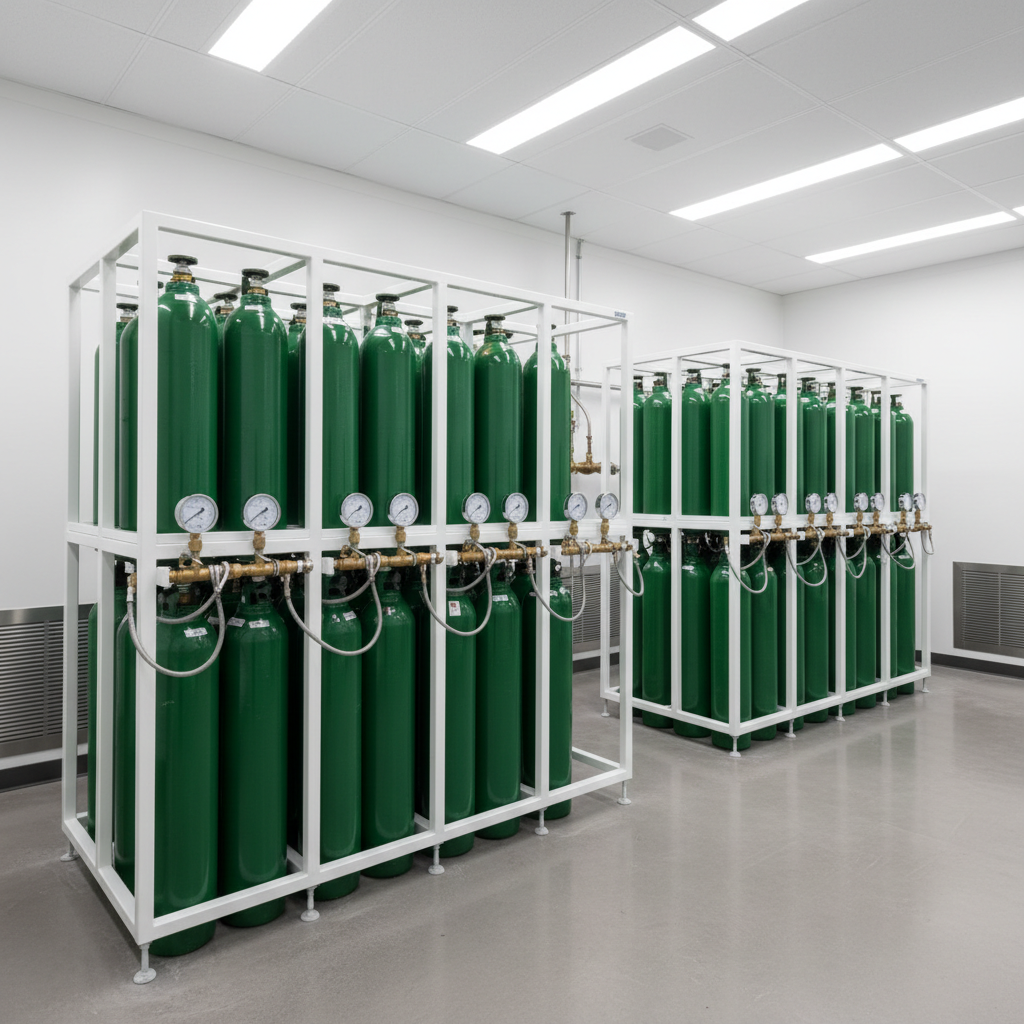
    Section 5.1.3.5 of NFPA 99 outlines requirements for central supply locations storing cryogenic fluids or compressed gas cylinders containing oxygen or nitrous oxide. Understanding these requirements protects your facility from systemic compliance failures. | Diagram text | |, | | NFPA 99 5.1.3.5 Central Supply Room | | [1-Hour or 2-Hour Fire-Rated Walls, Floor & Ceiling] | | [Self-Closing, Latching Fire Door (NFPA 80)] | | +, + +, + | | Full Cylinders Empty Cylinders | | Chained/Racked Separated & Marked | | +, + +, + | | Dedicated Mechanical Exhaust: Continuously Running | | Intake Louver <= 6" from Floor Exhaust at Floor Level | | Electrical: Class-compliant fixtures, protected switches |

    1. Fire-Resistance Ratings and Enclosures

    Under NFPA 99 5.1.3.5.1, indoor central supply rooms storing cylinders with total gas volumes exceeding the minor storage thresholds must be constructed of noncombustible or limited-combustible materials.

    • Storage thresholds > 3,000 cu. ft.: The room must be separated from the rest of the building by walls, floors, and ceilings with a minimum 1-hour fire-resistance rating.
    • Egress pathways and multistory structures: Depending on facility category and square footage, AHJs often mandate a 2-hour fire separation if adjacent to dedicated exit corridors.
    • Doors and Openings: Doors must be certified fire doors matching the wall rating (typically 45-minute minimum for 1-hour walls, or 90-minute for 2-hour walls), equipped with automatic self-closing and positive-latching hardware.

    2. Mechanical Ventilation Requirements

    Oxygen is heavier than air in cryogenic states and rapidly enriches enclosed environments, turning benign materials into volatile flammables. Section 5.1.3.5.2 sets unambiguous continuous ventilation standards:

    • Supply locations must be ventilated by a dedicated mechanical exhaust system designed to operate continuously.
    • Ventilation systems must achieve at least one air change per hour (ACH), though local Florida building codes and AHCA standards frequently require higher rates (typically 10 ACH during active design reviews).
    • Exhaust intake louvers must be located within 6 inches (150 mm) of the floor level to pull dense cold vapors or cryogenic boil-off directly outside, safely away from any public areas or fresh air intake plenums.

    3. Temperature Limits and Electrical Safety

    • The ambient room temperature must never exceed 125°F (52°C) or fall below 20°F (-7°C). In Delray Beach's subtropical climate, solar heat loads on exterior walls can push unconditioned supply rooms past the 125°F threshold, risking safety relief valve venting.
    • Electrical devices, switches, lighting fixtures, and outlets must comply with NFPA 70 (National Electrical Code). While high-pressure gaseous oxygen is non-flammable itself, it drastically lowers the ignition point of nearby substances. Electrical equipment must be physically protected against accidental impact from rolling cylinder carts.

    Gaseous vs. Cryogenic Bulk Liquid Storage Compliance

    Facilities in Palm Beach County utilize either high-pressure gaseous manifolds (H-cylinders) or bulk/micro-bulk liquid oxygen (LOX) vessels (dewars). Each installation carries distinct NFPA 99 5.1.3.5 and NFPA 55 parameters.

    Specification ParameterHigh-Pressure Manifold SystemsCryogenic Liquid (Bulk / Micro-Bulk)
    Typical Cylinder TypeH / K High-Pressure Carbon SteelVGL / Vacuum Insulated Dewars
    Working Pressures2,000 – 2,400 PSIG150 – 350 PSIG (Economizer dependent)
    Minimum Wall Rating1-Hour Fire-Rated (NFPA 99)1-Hour Indoor / Concrete Pad Outdoor (NFPA 55)
    Clearance RequirementsSecured in racks/chains, no contact with combustibles25 ft from combustible liquids, 15 ft from egress
    Vent Path RoutingHeader relief lines vented to outdoor atmosphereRupture disc/economizer lines piped outdoors
    Reserve System MandateSecondary bank with automatic changeoverEmergency Oxygen Supply Connection (EOSC)
    Leak Hazard ProfileHigh pressure jet, rapid room over-pressurizationCryogenic liquid burn, extreme vapor expansion (1:860)

    For clinics transitioning from small multi-cylinder banks to piped networks, securing precise medical gas installation by ASSE 6010-certified mechanics guarantees that headers, dual-stage pressure regulators, and vent lines meet pressure drop and safety metrics before active commissioning.


    Critical Checkpoints During a Delray Beach Inspection

    When certified specialists evaluate an oxygen storage room, they adhere to an empirical, step-by-step audit. Below are the core diagnostic areas evaluated during an on-site inspection.

    1. Structural Enclosure and Signage

    The room entrance must feature warning signage compliant with NFPA 99 and NFPA 704 hazard diamonds. The signage must state:

    CAUTION: MEDICAL GASES - NO SMOKING - NO OPEN FLAMES

    Inspectors examine door hardware to ensure doors latch fully without manual intervention, door sweeps are intact, and no unsealed penetrations exist in firewalls. Gaps around conduits or medical gas copper pipes must be sealed using listed firestop systems matching the assembly rating.

    2. Cylinder Management and Physical Restraint

    Unsecured cylinders represent serious projectile and crushed-limb hazards. Inspectors assess:

    • All cylinders, whether empty or full, must be secured with substantial noncombustible racks, individual chains, or wall-mounted brackets.
    • Cylinders must not be stored near oils, grease, flammable chemicals, or combustible materials.
    • Full and empty cylinders must be physically segregated within designated zones marked to prevent operational confusion during clinical emergencies.
    • Protective valve caps must remain firmly threaded on all high-pressure cylinders not actively connected to a manifold pigtail.

    3. Piping, Manifolds, and Pressure Relief Valves

    The manifold core requires detailed physical and pneumatic evaluation:

    • Headers must be equipped with factory-rated pigtails containing internal check valves to prevent backflow during cylinder changeouts.
    • Inspectors check the dual-line pressure regulators, ensuring intermediate and delivery pressure settings adhere to downstream requirements (typically 50–55 PSIG for oxygen networks).
    • Relief valves must be tested to ensure discharge vents are plumbed with copper tubing terminating outdoors, turned downward, and screened to prevent insect entry.

    When facilities upgrade, expand, or repair these assemblies, hiring an independent specialist for third-party medical gas verification under ASSE 6030 rules is required before life-support systems return to patient service.

    4. Continuous Alarm Integration

    NFPA 99 requires central supply systems to relay operational metrics to master alarm panels located in two separate, continuously monitored areas (e.g., nurses' stations and central maintenance control):

    • Low Line Pressure Alarm: Actuates when central supply line pressure drops 20% below normal delivery pressure.
    • High Line Pressure Alarm: Actuates when pressure surges 20% above nominal delivery pressure.
    • Secondary Bank in Use (Changeover): Signals when the manifold depletes its lead supply bank and shifts to reserve assets.
    • Reserve In-Use and Reserve-Low: Required for bulk installations to notify staff when primary liquid supply fails and reserves enter critical depletion stages.

    5 Common Non-Compliance Issues Found in Delray Beach Facilities

    Field audits of ambulatory surgical centers, cosmetic clinics, and urgent care centers in the Delray Beach area reveal several frequent compliance oversights:

    1. Exhaust HVAC Shut-Offs Tied to Comfort Loops: Medical gas exhaust systems are mistakenly tied to building automation systems that shut down overnight or cycle off on weekends to conserve energy. NFPA 99 mandates continuous mechanical exhaust 24 hours a day, 7 days a week, 365 days a year.
    2. Cylinder Storage Encroachment: Overcrowded supply rooms frequently house step stools, shipping pallets, cardboard boxes, vacuum cleaners, and janitorial supplies. Noncombustible medical gas supply rooms must contain only medical gases and related supply equipment. No general storage is permitted.
    3. Missing Outdoor Vent Lines for Relief Valves: Indoor headers are sometimes installed with local atmospheric discharge ports left open inside the room. In the event of a primary regulator seat failure, high-pressure gas discharges directly into the room, creating an immediate fire hazard.
    4. Improper Cylinder Restraint Systems: Fabric straps, bungee cords, or loosely hung single chains holding ten cylinders collectively do not pass inspection. Restraints must secure cylinders individually or within rigid, engineered matrix racks.
    5. Unsealed Wall Penetrations: IT, electrical, or plumbing lines installed after initial building construction often leave open interstitial voids through 1-hour or 2-hour partitions, compromising structural fire barriers.

    Routine scheduling of medical gas maintenance services resolves these structural and component deficiencies before life safety officers issue deficiency notices.


    ASSE 6000 Professional Qualifications: Why Certified Inspectors Matter

    Medical gas systems are life-support delivery vectors. Inspections, testing, and operational audits should be executed only by credentialed professionals. The American Society of Sanitary Engineering (ASSE) Series 6000 standard provides national qualifications for medical gas personnel:

    • ASSE 6010 (Installer): Qualified to braze, construct, align, and mount medical gas systems.
    • ASSE 6020 (Inspector): Designated to audit and inspect installations on behalf of authorities or health care systems.
    • ASSE 6030 (Verifier): Expert third-party specialists certified to perform comprehensive functional performance verifications, testing, and purity analyses before systems enter clinical service.
    • ASSE 6040 (Maintenance Technician): Trained to monitor, service, and maintain health care facility piping systems without compromising operational safety.

    Medical Testing Solutions (MTS) deploys certified ASSE 6030 Verifiers and ASSE 6040 Maintenance Technicians across South Florida. Partnering with an ASSE-certified team ensures that evaluations, calibration procedures, and testing metrics align with NFPA requirements and are fully defensible before Joint Commission, AAAHC, and AHCA surveys.


    Step-by-Step Medical Gas Room Compliance Inspection

    The following procedure outlines the field methodology used by Medical Testing Solutions during an oxygen tank room evaluation: | Diagram text | |, | | ASSE-Certified Room Compliance Inspection Process | | Step 1: Architectural Barrier Verification (Walls, Doors, Penetrations) | | Step 2: Continuous Mechanical Exhaust Analysis (Volumetric Hood Testing) | | Step 3: Cylinder Restraint & Physical Separation Audit | | Step 4: Manifold Switchover & Automatic Reserve Depletion Test | | Step 5: Pressure Relief Valve Vent Line Integrity & Routing Check | | Step 6: Master Alarm Transducer Calibration & Activation Verification | | Step 7: Gas Quality Analysis (Hydrocarbon, Moisture, Particulate Purity) | | Step 8: Comprehensive Documentation & Certificate of Compliance Issuance |

    1. Enclosure Audit: Verify the fire-resistance rating of boundary walls and verify self-closing latch integrity on all fire-rated entry doors.
    2. HVAC Performance Verification: Measure airflow across dedicated exhaust grilles using a calibrated flow hood, validating negative pressure relative to interior corridors and confirming that lower exhaust louvers sit within 6 inches of the floor.
    3. Physical Storage Audit: Inspect cylinder restraint frameworks, examine valve caps, confirm segregation of full and empty inventory, and verify the absence of combustible materials.
    4. Operational Manifold Testing: Manually initiate a changeover cycle across header banks to ensure seamless pressure regulation and test the functional operation of internal check valves.
    5. Vent Line Trajectory: Inspect the complete line run of primary and secondary relief systems to verify they discharge clear of exterior architectural features, windows, and outdoor air intakes.
    6. Alarm Circuit Verification: Systematically simulate line pressure drops and bank depletions, cross-checking that audible and visual signals actuate correctly at all local and remote master alarm panels.
    7. Purity and Particulate Check: Pull gas samples at central manifold test ports to confirm that pipeline oxygen adheres to standard medical-grade purity, free from moisture, total hydrocarbons, and particulates.
    8. Compliance Reporting: Deliver a formal inspection document signed and stamped by an ASSE 6030 or ASSE 6035 professional, establishing clear compliance records for local fire departments, accreditation bodies, and state authorities.

    For specialty surgical and sedating medical practices, facility infrastructure often intersects with surrounding diagnostic and clinical areas. In these environments, it is common to bundle central mechanical room audits with adjacent line isolation monitor testing in operating suites or complete medical gas certification across the pipeline network.


    Delray Beach Environmental Factors: Humidity, Heat, and Coastal Air

    Operating a healthcare facility in Delray Beach introduces regional environmental challenges rarely addressed in broad national guidelines. Coastal Atlantic environments accelerate system degradation through several specific vectors:

    • Corrosive Salt Air Intrusion: Delray Beach's proximity to the Atlantic Ocean exposes relief vent lines terminating outdoors to marine air. Salt deposition can corrode relief valve seats, gum up atmospheric vent flap screens, and cause premature oxidation on copper brazed joints. Inspectors evaluate these exterior exit terminals for corrosion and clogging.
    • High Humidity and Micro-Condensation: When cryogenic manifolds depressurize or liquid dewars experience boil-off, the rapid cooling of brass regulators and pigtails pulls moisture out of South Florida's humid ambient air. Thick ice formations can encase control manifolds, freezing diaphragm regulators in an open or closed state if economizers are improperly balanced.
    • Hurricane Readiness and Reserve Autonomy: AHCA and municipal authorities often evaluate your backup supply duration during hurricane season. Under NFPA 99 5.1.3.5, outdoor enclosures and EOSC (Emergency Oxygen Supply Connections) must remain secured, clear of loose wind debris, and elevated safely above local coastal flood zones.

    Delray Beach Inspection Checklist

    Use this quick-reference checklist during your internal safety rounds to maintain code-compliant central oxygen storage:

    • Room doors are closed, self-latch completely, and have valid fire rating labels.
    • NFPA 704 and medical gas warning signs are visibly mounted at each entry door.
    • Continuous mechanical ventilation is running; intake airflow is detected at lower exhaust louvers.
    • Room is free of all combustibles, cardboard boxes, cleaning carts, and trash.
    • Cylinders are individually chained or stored within approved structural matrix racks.
    • High-pressure valve protection caps are threaded securely on all stored offline tanks.
    • Full and empty cylinders are organized in separate marked areas.
    • Manifold intermediate and line delivery gauges read within normal operating bands (typically 50–55 PSIG).
    • Alarm indicator lights on local manifold interfaces are green; no fault signals are displayed.
    • Emergency contact numbers for medical gas suppliers and service partners are posted on-site.

    Partner With Florida's Medical Gas Compliance Leaders

    Central oxygen storage rooms require meticulous oversight. Neglecting small mechanical deviations, continuous exhaust issues, or cylinder restraint guidelines compromises clinical continuity and increases liability risks across your health care operations.

    Headquartered locally in Fort Lauderdale, Medical Testing Solutions (MTS) delivers complete life safety and medical gas management services to surgery centers, hospitals, dental clinics, and emergency facilities throughout Delray Beach and Palm Beach County. MTS provides ASSE 6030 verification, ASSE 6010 medical gas construction, comprehensive system preventative maintenance, and complete compliance documentation to keep your facility protected, operational, and audit-ready.

    Need to schedule an oxygen tank room inspection in Delray Beach FL?
    Call the Medical Testing Solutions team directly at (754) 315-1078 or submit a formal inquiry via our online request page to connect with an ASSE-certified specialist.


    Frequently Asked Questions

    NFPA 99 Section 5.1.3.5 mandates that indoor locations for central supply systems must be ventilated by a dedicated mechanical exhaust system designed to operate continuously. The system must draw air from intake louvers located within 6 inches of the floor level and exhaust it safely outdoors, away from building air intakes and pedestrian walkways. The system must maintain negative pressure relative to adjacent interior spaces and operate without interruption.

    Medical gas systems should receive routine internal weekly or monthly walkthrough inspections, alongside formal annual evaluations conducted by an ASSE-certified technician as recommended by NFPA 99 Chapter 5. In Delray Beach, annual inspections are standard for AHCA-licensed facilities, ambulatory surgical centers, and hospitals to demonstrate compliance to the fire marshal and healthcare accrediting bodies.

    No. Under NFPA 99 5.1.3.5, central supply locations storing medical gases can contain only medical gas cylinders, manifolds, associated piping components, and safety equipment. Storing combustible items such as cardboard packaging, janitorial chemicals, general clinical supplies, or combustible trash in the room is a direct code violation.

    An ASSE 6030 Verifier is certified to perform comprehensive, third-party functional performance verifications, testing, and component purity testing on new, retrofitted, or existing medical gas pipeline networks. An ASSE 6040 Maintenance Technician is certified to perform routine preventative maintenance, periodic operational testing, and ongoing mechanical upkeep of medical gas infrastructure.

    Yes, cryogenic liquid cylinders (such as dewars or liquid containers) stored indoors must meet NFPA 99 Section 5.1.3.5 parameters, including fire-rated room separations and dedicated low-level continuous mechanical ventilation. Cryogenic installations also face strict outdoor separation requirements under NFPA 55, governing minimum setback distances from combustible buildings, electrical substations, patient walkways, and oxygen relief discharge trajectories.

    This article is provided for educational purposes and reflects industry standards as of publication. Always verify against current NFPA 99, CGA, and AHJ requirements. Medical Testing Solutions is ASSE-certified and ready to help — contact us for facility-specific guidance.

    Request a quote for your facility

    Talk with Medical Testing Solutions about your next inspection, repair or equipment request.

    Get a quote in 1 business day

    I agree to receive text messages from Medical Testing Solutions, L.L.C. at the phone number provided, including informational and marketing messages. Consent is not a condition of purchase. Message frequency varies. Message & data rates may apply. Reply STOP to opt out or HELP for help. See our Privacy Policy and Messaging Terms.

    Prefer to talk? Call (754) 315-1078

    Related articles