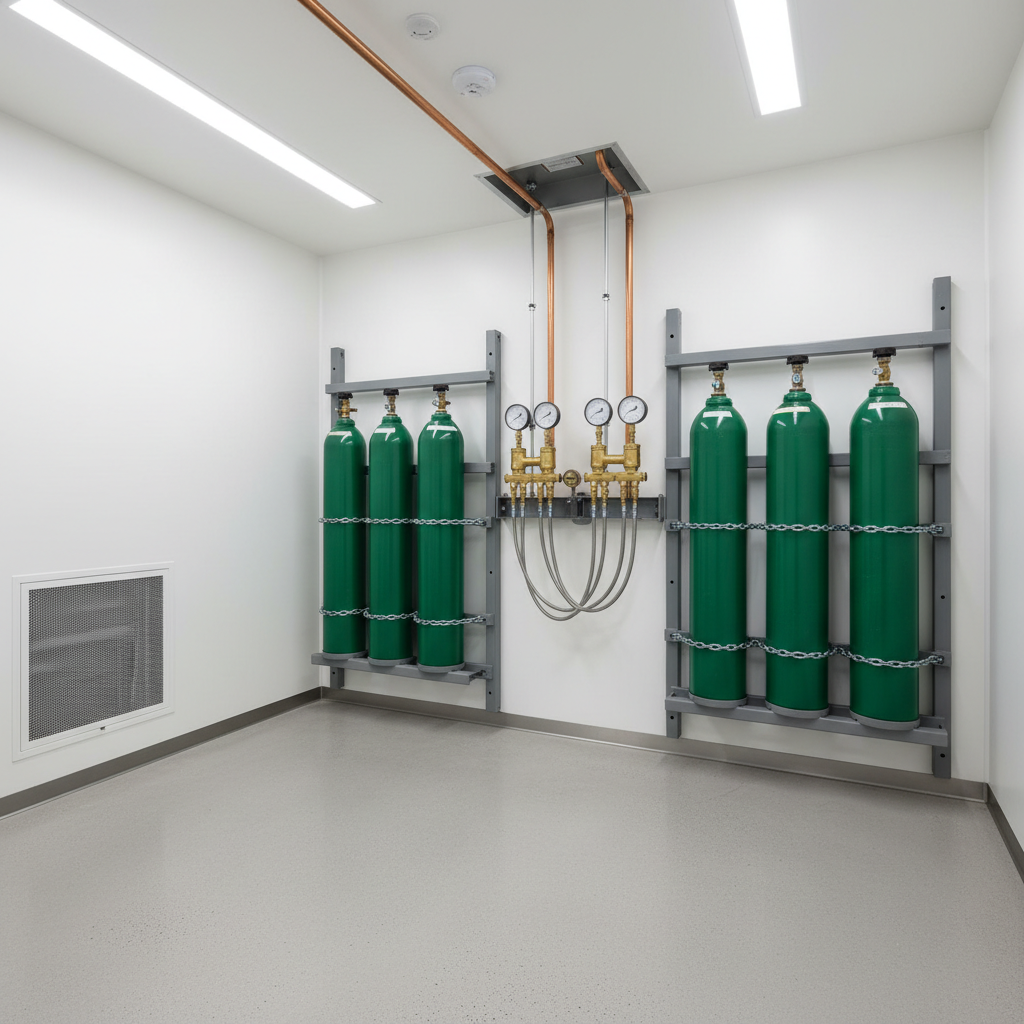
Medical oxygen supply systems are the lifeblood of clinical facilities, but when concentrated, compressed, or liquefied, oxygen poses severe fire and pressure hazards. For healthcare facilities across Palm Beach County, maintaining an oxygen storage enclosure is not merely a housekeeping chore, it is an enforced life safety mandate. Securing a professional oxygen tank room inspection in Boynton Beach FL ensures your facility meets the stringent criteria established by NFPA 99 (Health Care Facilities Code), NFPA 55 (Compressed Gases and Cryogenic Fluids Code), and the Compressed Gas Association (CGA).
Whether your facility operates a cryogenic bulk liquid oxygen (VIE) system, a micro-bulk supply, or an interior high-pressure cylinder manifold room, this guide covers the exact structural, mechanical, electrical, and operational requirements outlined in NFPA 99 Section 5.1.3.5. You will learn the mandatory fire-separation thresholds, mechanical ventilation volumes, electrical classification rules, and the inspection protocols required to keep your Boynton Beach facility accredited, fully compliant, and safe for patients and staff.
The Regulatory Framework: NFPA 99 Section 5.1.3.5 Explained
NFPA 99 sets strict requirements for central supply systems and the spaces housing them. Section 5.1.3.5 specifically governs the location, construction, and ventilation of central supply system enclosures for medical gases and cryogenic fluids.
In Florida, healthcare construction and facility management operate under the Florida Fire Prevention Code (FFPC) and the Agency for Health Care Administration (AHCA), both of which reference NFPA 99, NFPA 101 (Life Safety Code), and NFPA 55. A routine fire inspection or AHCA joint survey will immediately flag violations in oxygen storage rooms due to the sheer hazard of accelerated combustion in oxygen-enriched atmospheres.
Why this matters for compliance: NFPA 99 treats medical oxygen storage rooms as hazardous locations due to oxidizer concentrations. Non-compliant ventilation, unsealed wall penetrations, or unrated doors can cause an AHCA survey failure or an immediate stop-work order from the local Boynton Beach Fire Rescue authority. Routine annual medical gas inspections identify hidden deficiencies before AHCA or the Joint Commission arrives.
| Diagram text |
|, |
| NFPA 99 Enclosure Compliance (Section 5.1.3.5) |
Structural Requirements: Fire-Resistance and Enclosure Ratings
NFPA 99 5.1.3.5.1 establishes precise architectural rules for indoor rooms housing central supply manifolds, micro-bulk systems, or reserve cylinders. When an ASSE 6030 inspector from Medical Testing Solutions conducts an on-site evaluation, the physical barrier integrity is assessed first.
1-Hour vs. 2-Hour Fire-Resistance Ratings
The required fire-resistance rating depends on the aggregate volume of gas connected and stored within the room, as well as whether the room borders critical egress paths:
- 1-Hour Fire Resistance: Permissible for rooms containing an aggregate gas capacity less than the threshold established in NFPA 99 (or containing nonflammable, non-oxidizing gases in smaller volumes), provided the space does not open directly into an exit corridor or critical care zone.
- 2-Hour Fire Resistance: Required for rooms housing larger bulk capacities, high-pressure manifolds with substantial reserve banks, or when mandated by local building codes for high-hazard spaces.
Doors and Egress Hardware
- Door Fire Ratings: Openings into the supply room must be protected by self-closing fire doors matching the rating of the partition, typically a 3/4-hour door for 1-hour walls, or a 1.5-hour door for 2-hour walls.
- Positive Latching: Doors must latch automatically upon closure. Latch-hold devices, wedges, or unrated kickstops are strict code violations.
- Locking and Access Control: The enclosure must be secured against unauthorized access. Doors must remain locked with keycard or physical key access restricted to authorized facility and clinical personnel.
- Opening Clearances: Interior doors must not open into corridors without proper fire dampers and door ratings, and exterior doors must be located at least 5 feet away from operable building openings (windows, air intakes, exterior stairs).
Mechanical Ventilation: Air Changes and Exhaust Configurations
Ventilation failures are among the most common citations issued during an oxygen tank room inspection in Boynton Beach FL. Because medical oxygen is heavier than ambient air and promotes rapid combustion, trapped gas creates an extreme flash-fire condition.
NFPA 99 5.1.3.5.3 mandates specific mechanical or natural ventilation parameters depending on whether the room has an exterior wall exposure.
Indoor Rooms Without Exterior Wall (Mechanical Exhaust)
For interior oxygen manifold and storage rooms, dedicated mechanical ventilation is required:
- Continuous Operation: The ventilation system must run 24 hours a day, 7 days a week, 365 days a year. It cannot be tied to energy-saving building management system (BMS) setback routines.
- Exhaust Volume Requirements: The system must draw a minimum of 1 cubic foot per minute per square foot (1 CFM/ft²) of room floor area, or not less than 50 CFM, whichever is greater.
- Low-Level and High-Level Inlets: Because oxygen vapor is dense when cold (such as during venting or boil-off from cryogenic supplies), exhaust grilles must be positioned within 12 inches of the floor to capture settling oxidizers. High-level exhaust grilles are simultaneously required to remove heat generated by building exposure or manifold electrical components.
- Dedicated Ductwork: Exhaust ducts from medical gas enclosures must route directly to the building exterior without connecting to any other general HVAC, return air, or toilet exhaust ducts.
- Negative Pressure: The supply room must be maintained under negative pressure relative to adjacent occupied spaces to prevent escaping oxygen from migrating into patient corridors or offices.
Exterior Rooms (Natural Ventilation)
If the enclosure has exterior walls, natural ventilation through louvered wall openings is permitted under strict conditions:
- Two louvers must be installed, one located within 12 inches of the ceiling and one within 12 inches of the floor.
- Each louvered opening must provide an unobstructed free area of at least 72 square inches (or 1 square inch per 1,000 cubic feet of room volume, whichever is larger).
- Louvers cannot discharge near building air intakes, fire escapes, or public thoroughfares.
Comparison Table: Interior Manifold Rooms vs. Bulk Liquid Oxygen Enclosures
Selecting and maintaining the correct physical enclosure depends heavily on the storage modality. The table below illustrates the contrasting requirements under NFPA 99 and NFPA 55:
| Compliance Parameter | Interior High-Pressure Manifold Room | Bulk Liquid Cryogenic System (VIE) | Micro-Bulk Liquid System |
|---|
| Applicable Codes | NFPA 99 (5.1.3.5), CGA P-2.1 | NFPA 99 (5.1.3.5.9), NFPA 55, CGA M-1 | NFPA 99, NFPA 55, CGA P-18 |
| Location | Dedicated indoor mechanical/gas room | Outdoor pad or open-top walled enclosure | Indoor vented closet or exterior pad |
| Fire Resistance | 1-Hour or 2-Hour rated boundary | 2-Hour non-combustible exterior barrier | 1-Hour or 2-Hour enclosure |
| Ventilation Type | Dedicated mechanical exhaust (continuous) | Natural ambient airflow (outdoor) | Continuous mechanical exhaust to exterior |
| Vent Lines | Relinquished to exterior via dedicated line | System relief valves directly to atmosphere | Dedicated atmospheric relief line |
| Pad / Floor Material | Concrete (impervious, non-combustible) | Clean concrete pad; zero asphalt within 25 ft | Concrete pad (no combustible surfacing) |
| Electrical Class | Standard enclosed wiring / GFI; no heaters | Class I, Div 2 / Ordinary (outdoors) | Standard enclosure; zero spark sources |
| Security | Locked door, restricted key access | Minimum 6-ft chain-link fence or enclosure | Locked dedicated closet or chained cage |
| Verification Level | ASSE 6030 verification | ASSE 6030 verification & annual inspection | ASSE 6030 verification & annual testing |
Electrical Safety and Equipment Protection in Oxygen Rooms
The atmosphere inside an oxygen storage room can quickly transition from normal atmospheric oxygen (20.9%) to an oxygen-enriched state (>23.5%) if a regulator weeps or an automatic cylinder bank switches over abruptly.
Under NFPA 99 5.1.3.5.6:
- Electrical Fixtures: While standard oxygen supply rooms are generally designated as unclassified locations if properly ventilated, all electrical switches, convenience outlets, and disconnects must be placed in locations where they are protected from physical impact.
- Open Flames and Heating Elements: Open-flame devices, electric space heaters with exposed resistance coils, and fuel-fired heating appliances are prohibited inside the room. Heating must be provided indirectly, such as through closed steam coils or hot-water radiators, or via ducted warm air that has no combustion source in the room.
- Emergency Power Connection: If mechanical ventilation is utilized, the fan must be connected to the facility’s emergency essential electrical system (Life Safety or Equipment branch) so that a utility power interruption will not cause oxidizer build-up.
- Lighting and Visibility: Sufficient artificial illumination must be provided to ensure gauges, line pressure indicators, and cylinder markings can be read clearly without relying on temporary extension cords or flashlights.
Cylinder Restraint, Segregation, and Storage Practices
Improper cylinder handling is the primary source of OSHA and NFPA violations discovered during physical surveys in Boynton Beach clinics, surgical centers, and imaging facilities.
Proper Restraint Systems
Compressed gas cylinders contain pressures reaching 2,000 to 3,000 PSIG. If a cylinder falls and its valve sheers off, the tank becomes an unguided rocket capable of penetrating masonry walls.
- Positive Restraint: Cylinders must be secured by individual safety chains, non-combustible heavy-duty straps, or dedicated storage racks anchored directly to the concrete slab or wall studs.
- Chaining Limits: Chaining multiple cylinders together with a single loose chain across a 10-foot span is a violation. Cylinders must be individually secured or nested tightly in approved welded cylinder bays.
- Valve Protection Caps: When cylinders are not actively connected to a manifold header, their steel valve protection caps must be screwed firmly hand-tight down to the last thread.
Cylinder Segregation Rules (NFPA 99 5.1.3.5.11)
- Empty vs. Full Cylinders: Empty cylinders must be physically segregated from full or partially filled cylinders within the room. Clear, durable signage stating "FULL CYLINDERS" and "EMPTY CYLINDERS" must mark each designated zone.
- Incompatible Gases: Oxygen (an oxidizer) must not be stored within 20 feet of flammable gases (such as ethylene, acetylene, or propane) or combustible materials unless separated by a non-combustible, 1/2-hour fire-rated barrier wall at least 5 feet high.
- Oil and Grease Prohibition: Lubricants, motor oils, cleaning solvents, hand lotions, or hydraulic fluids must never be stored in or brought near an oxygen room. Hydrocarbons exposed to high-pressure pure oxygen can spontaneously ignite or explode without an external spark.
| Diagram text |
|, |
| NFPA Segregation Layout: Oxygen Enclosure |
Bulk Liquid Oxygen (VIE) and Pad Specifications
Facilities utilizing outdoor cryogenic bulk oxygen systems, such as large hospitals and regional care centers in Palm Beach County, must adhere to additional spatial and structural parameters under NFPA 55, NFPA 99, and CGA M-1:
The Asphalt Hazard
Cryogenic liquid oxygen (-297°F) that leaks or vents onto asphalt pavement can form an impact-sensitive explosive mixture. NFPA 99 and NFPA 55 strictly mandate that:
- The ground beneath bulk oxygen storage tanks, vaporizers, and tanker unloading connections must be constructed of non-porous, non-combustible concrete.
- No asphalt surfacing is permitted within 25 feet of any point where liquid oxygen can potentially spill during operation, venting, or transfilling.
- The concrete pad must be sloped away from combustible materials, building openings, and sewer drains.
Clearance and Exposure Distances
Bulk oxygen pads must maintain mandatory clearance envelopes:
- 50 feet from non-fire-rated buildings or large combustible storage areas.
- 25 feet from building openings (doors, operable windows, air conditioning intakes).
- 10 feet from public sidewalks and property lines.
- Enclosures must be secured by a minimum 6-foot industrial chain-link fence with at least two out-swinging exit gates equipped with panic hardware.
The Local Context: Boynton Beach, FL Environmental & Storm Hazards
Operating a medical gas enclosure in South Florida presents specific environmental challenges that national generic checklists overlook. High ambient temperatures, direct tropical sunlight, salt-air corrosion, and severe hurricane risks require specialized attention during an inspection.
High Ambient Temperatures and Cryogenic Boil-Off
Cryogenic liquid cylinders and micro-bulk tanks maintain internal pressure by balancing insulation against heat ingress. During South Florida summers, extreme ambient heat accelerates thermal expansion, leading to higher rates of normal pressure relief valve (PRV) venting.
Inspectors from Medical Testing Solutions check that exterior vent lines are unobstructed, properly sized, and terminated high enough above grade so that escaping cold gas cannot pool in low-lying exterior walkways or loading bays.
Salt-Air Corrosion on Regulators and Manifolds
Proximity to the Atlantic coastline in Boynton Beach accelerates atmospheric oxidation on exposed brass fittings, manifold headers, copper run-outs, and anchor bolts:
- Corroded pressure switches and transducer assemblies can fail to send low-line alerts to master alarm panels.
- Flexible high-pressure pigtails develop micro-cracks or braid degradation, increasing the risk of high-pressure blowouts.
- Threaded relief ports and cylinder connections collect salt crusting, compromising critical metal-to-metal seals.
Hurricane Anchoring and Emergency Preparedness
Palm Beach County building codes mandate rigorous wind-load compliance under the Florida Building Code (High-Velocity Hurricane Zones):
- Exterior bulk tank tie-down anchors, vaporizer bracing, and micro-bulk stands must be structurally verified to resist Category 5 hurricane wind loads.
- Emergency reserve manifolds must have functioning check valves and bypass systems tested under true simulated utility outages.
Step-by-Step Oxygen Tank Room Compliance Checklist
Facility managers and clinical directors can prepare for an upcoming survey by running through this pre-inspection checklist:
- Examine Signage: Verify that permanent warning signs are posted outside all entrance doors: "CAUTION: MEDICAL GASES - NO SMOKING - NO OPEN FLAMES".
- Test Door Self-Closers: Open the room door fully, halfway, and slightly ajar. Confirm the door closes smoothly and latches firmly without human intervention.
- Inspect Exhaust Fan Function: Verify that continuous mechanical exhaust is pulling air (check differential pressure indicator or air-flow switch). Check that both low-level (12" from floor) and high-level exhaust grilles are unobstructed by boxes or cylinders.
- Confirm Gas Segregation: Ensure empty cylinders are isolated from full cylinders. Confirm there are no flammable gas tanks, oil cans, cardboard trash, or cleaning supplies inside the room.
- Verify Cylinder Chains: Ensure every tank is secured by an individual chain or rigid rack. Check that protective valve caps are installed on all off-line tanks.
- Inspect Manifold Header Pigtails: Look for kinks, frayed stainless steel braiding, or corrosion on cylinder connection pigtails. Check that copper loop pigtails have not work-hardened or bent beyond manufacturer tolerances.
- Review Pressure Gauges: Ensure all primary, secondary, and line-delivery pressure gauges are within normal operating ranges and have current calibration stamps.
- Trace Relief Valve Vent Lines: Confirm that safety relief valves from regulators and manifolds vent directly to the outdoors and terminate with bug screens pointing downward.
- Confirm Alarm System Connectivity: Verify that pressure switches signal the local master alarm panel correctly for bank changeover, normal line pressure, and reserve depletion.
If your facility also manages surgical suites, wet procedure rooms, or specialized monitoring, ensure associated systems are addressed. For example, wet locations require isolated power compliance via line isolation monitor testing, and surgical areas must be assessed through waste anesthetic gas (WAG) chemical vapor monitoring to maintain complete Joint Commission alignment.
The Role of ASSE-Certified Inspectors: Why Self-Audits Are Not Enough
While internal facility audits prevent minor procedural oversights, they do not satisfy regulatory verification requirements. AHCA, the Centers for Medicare & Medicaid Services (CMS), and local fire marshals require independent, credentialed documentation.
| Diagram text |
|, |
| ASSE 6000 Medical Gas Credential Hierarchy |
The American Society of Sanitary Engineering (ASSE) Series 6000 standard defines the professional qualifications for medical gas personnel:
- ASSE 6010 (Medical Gas Installers): Certified to install piped gas lines, manifolds, and room equipment. If your facility expands its manifold or relocates lines, work must be completed by an installer certified in medical gas installation.
- ASSE 6030 (Medical Gas Verifiers): Third-party professionals certified to inspect, test, and formally document medical gas piping, source systems, and supply enclosures before patients are exposed to the system. Verifications cannot be conducted by the installing contractor.
- ASSE 6040 (Medical Gas Maintenance Personnel): In-house or contracted technicians qualified to execute scheduled preventive upkeep under medical gas maintenance services.
A comprehensive oxygen tank room inspection in Boynton Beach FL executed by Medical Testing Solutions pairs certified ASSE 6030 verifiers with calibrated instrumentation. Our technicians verify mechanical CFM ventilation, evaluate wall fire-stops, confirm manifold switchover differential pressures, calibrate line sensors, and produce audit-ready reports that withstand AHCA, DNV, and Joint Commission scrutiny.
If your facility has recently installed new supply headers, renovated storage boundaries, or added supplemental nitrous oxide manifolds, an updated formal medical gas certification must be executed prior to clinical reactivation.
What Happens During an MTS Compliance Inspection?
When our team arrives at your Boynton Beach healthcare center, our ASSE-certified technicians execute an exhaustive, multi-point protocol:
- Architectural & Enclosure Audit:
- Verification of wall and ceiling fire-rating documentation.
- Inspection of door ratings, self-closing hydraulic hinges, and positive-latching strike plates.
- Ultrasonic and visual inspection of pipe, conduit, and duct penetrations through rated fire walls to verify compliant, intact intumescent firestop systems.
- Mechanical Ventilation Flow Testing:
- Anemometer and balometer testing of exhaust CFM at both upper and lower exhaust louvers.
- Verification of 1 CFM/ft² minimum flow rate.
- Measurement of negative room static pressure relative to surrounding corridors.
- Verification of exhaust discharge points away from building air intakes.
- Source Equipment & Manifold Operational Checks:
- Pressure drop and leak testing of headers, master shutoff valves, and high-pressure flexible pigtails.
- Dynamic testing of automatic bank changeover mechanics.
- Calibration check on high-line and low-line pressure transducers.
- Inspection of dual line pressure regulators for creep or seal erosion.
- Alarm System Integration:
- Verification that enclosure manifold switches communicate fault conditions directly to master alarm panel #1 and master alarm panel #2.
- Simulated activation of primary bank depletion and reserve line drop.
- Cylinder Storage & Safety Review:
- Complete audit of cylinder restraint chains, labeling, segregation, and cap placement.
- Identification of any incompatible chemical, oil, or paper storage violations.
- Comprehensive Digital Reporting:
- Issuance of an exhaustive, itemized compliance report detailing all pass/fail points, code citations (NFPA 99, NFPA 55, CGA), photographic evidence, and recommended corrective action plans.
Schedule Your Boynton Beach Oxygen Room Inspection Today
Compliance is not an afterthought, it is the foundation of patient safety and facility accreditation. Whether you operate an outpatient surgery center, hospital, dental surgery clinic, or specialty medical practice in Boynton Beach, Medical Testing Solutions provides complete end-to-end medical gas services. From initial medical gas verification and equipment installation to ongoing testing, certification, and preventive maintenance, our ASSE-certified technicians ensure your facility operates safely and satisfies all NFPA 99 and AHCA mandates.
Don't wait for a surprise AHCA audit or fire marshal visit to discover hidden ventilation or storage violations. Protect your staff, your patients, and your operating license today.
Need an immediate inspection or compliance audit?
Contact Medical Testing Solutions today: