Oxygen Deficiency Monitoring for Liquid Nitrogen: What's Actually Required
Medical Testing SolutionsAugust 3, 20267 min read
Share
Liquid nitrogen (LN2) is a cornerstone of modern medicine and research, used in everything from cryopreservation in fertility clinics to dermatology and biological sample storage. While incredibly useful, its storage and use introduce a significant, often misunderstood, risk: oxygen displacement and asphyxiation. Facility managers are frequently caught between sales pitches from equipment vendors and the dense, overlapping text of regulatory codes. The result? Confusion, overspending on unnecessary equipment, or worse, non-compliance and a dangerous environment for staff.
This definitive guide cuts through the noise. We will separate vendor claims from verifiable code requirements, drawing on standards from OSHA, the NFPA, and the CGA. By the end, you will understand the science of asphyxiation, know when and where an oxygen monitor is actually required, and learn how to implement a compliant safety strategy that protects both your people and your budget.
The Science of Asphyxiation: Why Liquid Nitrogen is a Silent Threat
To understand the risk, you need to understand the physics. When liquid nitrogen vaporizes, it expands at a ratio of approximately 1-to-694. This means one liter of liquid nitrogen will turn into nearly 700 liters of nitrogen gas. In a poorly ventilated or confined area, this rapidly expanding, invisible, and odorless gas displaces the normal, breathable air.
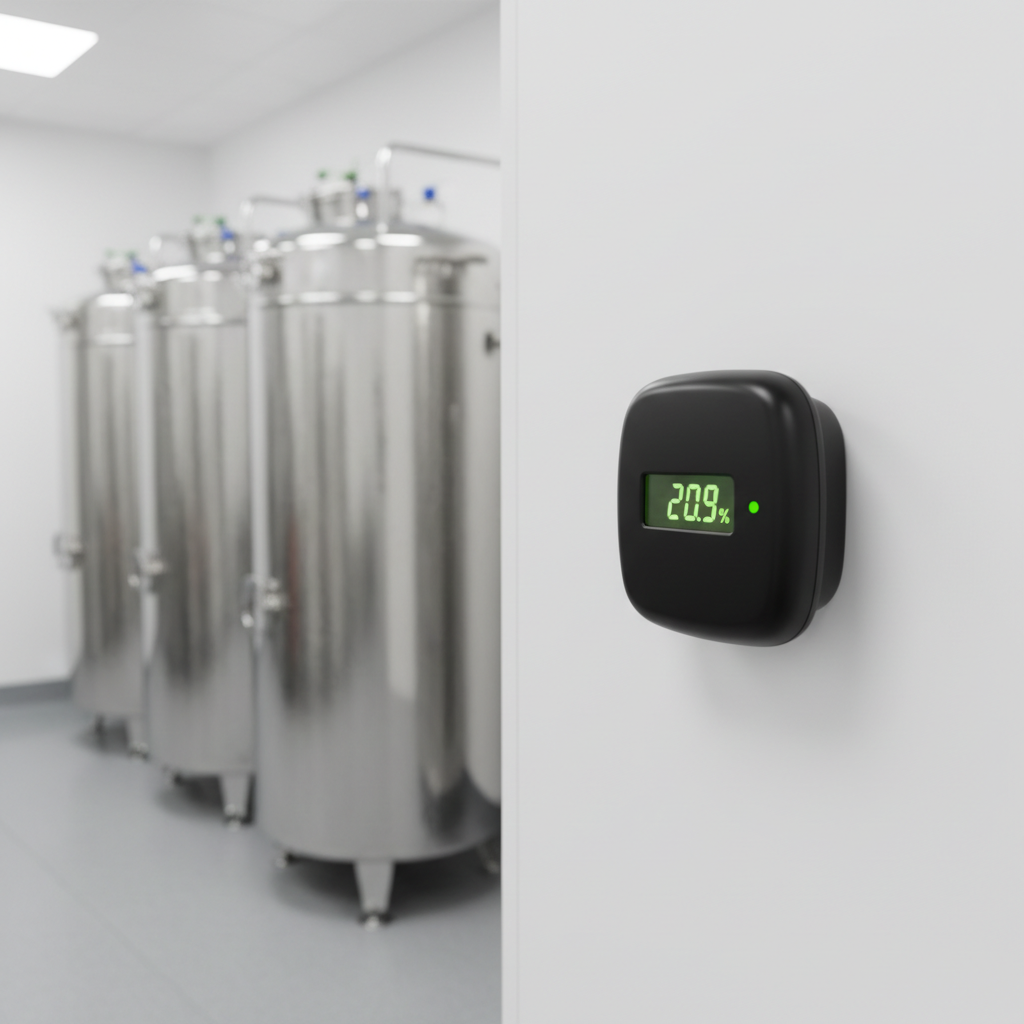
Standard air contains about 20.9% oxygen. When a large volume of nitrogen gas is released, that percentage drops. OSHA defines an oxygen-deficient atmosphere as one containing less than 19.5% oxygen. A sudden drop can lead to dizziness, impaired judgment, and, in severe cases, unconsciousness and death in a matter of minutes. Because there is no smell or visual cue, a person can be overcome without any warning, making it a true silent threat.
Decoding the Regulatory Alphabet Soup: OSHA, NFPA, CGA, and IFC
No single regulation explicitly states, "You must have an O2 monitor in every room with liquid nitrogen." Instead, the requirement is triggered by a combination of factors defined across several key standards. Your responsibility is to perform a hazard assessment to see if your specific situation meets these criteria.
OSHA and the "Confined Space" Designation (1910.146)
OSHA is the primary authority for worker safety. The key standard here is OSHA 1910.146, Permit-Required Confined Spaces. An oxygen monitor is mandatory if a room is classified as a permit-required confined space due to an actual or potential hazardous atmosphere. A space is considered "confined" if it:
Is large enough for an employee to enter and perform work.
Has limited or restricted means for entry or exit.
Is not designed for continuous employee occupancy.
If a room meets these criteria AND contains a material (like LN2) that could create a hazardous atmosphere (oxygen deficiency), then continuous monitoring is required. A small, unventilated closet where dewars are stored is a prime candidate. A large, open, mechanically ventilated laboratory may not be.
NFPA 55: Cryogenic Fluids Code
The National Fire Protection Association's NFPA 55, Chapter 7 provides detailed requirements for storing and handling cryogenic fluids. It states that for indoor storage or use, "gas detection shall be provided in the area" when the amount of cryogenic fluid exceeds a certain volume and the ventilation is not sufficient to prevent the accumulation of hazardous gas. This reinforces the OSHA requirement: it all comes back to a site-specific hazard assessment that considers room volume, ventilation rates, and the quantity of LN2.
CGA P-18 & P-14: The Industry Standard
The Compressed Gas Association (CGA) provides best-practice guidelines that are widely adopted as industry standards. CGA P-18 (Standard for Bulk Inert Gas Systems) and CGA P-14 (Accident Prevention in the Use of Liquid Nitrogen) both stress the importance of a thorough hazard analysis. They recommend atmospheric monitoring as a primary engineering control when the analysis indicates a risk of an oxygen-deficient atmosphere.
Vendor Claims vs. Code Requirements: A Head-to-Head Comparison
Let's address the most common points of confusion with a direct comparison.
Vendor Claim
The Reality (Based on Code & Standards)
Medical Testing Solutions Recommendation
"Every room with an LN2 dewar needs a monitor."
False. Monitoring is only required if a hazard assessment determines a risk of oxygen deficiency, often tied to a confined space classification or insufficient ventilation per NFPA 55.
Conduct a professional hazard assessment first. Don't buy hardware until you've analyzed the space.
"Place the sensor at 'breathing height' (4-6 ft)."
Misleading. Cold nitrogen gas is denser than air and will pool near the floor. As it warms, it becomes slightly lighter than air. Placement depends on the room's airflow and potential leak sources.
Place sensors near the primary storage/use point and consider a second sensor in a potential accumulation area, often 12-18 inches from the floor.
"Our alarms are pre-set to 19.5% and 20.9%."
Inadequate. A 19.5% alarm is the OSHA warning level. A second, lower alarm (e.g., 18% or 17.5%) is crucial to signal immediate evacuation before cognitive impairment begins. An alarm at 20.9% is mostly useless.
Use a two-stage alarm system: a non-latching "Warning" at 19.5% and a latching "Danger" alarm at 18.0%.
"Our sensors only need calibration every 18-24 months."
Risky. Most sensor manufacturers and safety standards recommend a calibration interval of 6-12 months. Waiting longer can lead to sensor drift and a failure to alarm in a real emergency.
Follow manufacturer recommendations and institute a 12-month calibration cycle as part of your facility's annual medical gas inspections.
Why this matters for compliance: Regulators like The Joint Commission or state health departments will not just look for a monitor on the wall. They will ask for the documented hazard assessment that justifies its placement (or lack thereof). Simply installing a monitor without an underlying risk analysis is a common, and easily avoidable, citation. It demonstrates a lack of a comprehensive safety program.
The Right Way to Implement Oxygen Monitoring
A compliant oxygen monitoring program is about more than just buying a product. It's a systematic process.
Perform a Professional Hazard Assessment: This is the non-negotiable first step. A qualified technician will calculate your room volume, analyze the maximum potential LN2 release, and assess your current ventilation rates. The experts at Medical Testing Solutions can perform this critical assessment to determine your true risk profile.
Strategic Sensor Placement: Based on the assessment, identify the optimal locations for sensors. This is typically near the main storage or fill area and in any low-lying spots where cold gas could accumulate.
Set Alarm Points Correctly: Implement a two-stage alarm system. A 19.5% O2 level should trigger a visual and audible warning. A drop to 18.0% O2 should trigger a louder, distinct evacuation alarm.
Professional Installation and Verification: Ensure the system is installed by qualified personnel. An ASSE 6010 certified technician understands the complexities of these systems. After installation, a full functional test is needed as part of a formal medical gas verification process to ensure alarms, relays, and remote notifications work as designed.
What an Oxygen Monitor Does NOT Replace
An O2 monitor is a critical but final line of defense. It is not a substitute for primary safety measures:
Adequate Ventilation: The best way to prevent an oxygen-deficient atmosphere is with robust mechanical ventilation that ensures sufficient air changes per hour.
Employee Training: Staff must be trained on the risks of cryogenics, proper handling procedures, and what to do if an alarm sounds.
Emergency Action Plan: A clear, drilled plan for evacuation is essential. Who receives the alarm? Who calls for help? Where is the muster point?
Medical Testing Solutions is more than an equipment vendor. Our ASSE-certified team provides comprehensive services, from initial risk assessments and professional medical gas installation to routine maintenance and certification. We help you build a complete safety ecosystem, not just sell you a box.
Frequently Asked Questions
It is required by OSHA if the area is deemed a permit-required confined space with a potential atmospheric hazard. NFPA 55 may also require it based on fluid quantity and ventilation. A hazard assessment is necessary to make the final determination.
It depends on the room layout, but generally near the potential leak source (dewar, fill station) and in low-lying areas where cold, dense nitrogen gas can accumulate, typically 12-18 inches off the floor.
While some vendors claim longer intervals, the industry best practice and most manufacturer recommendations suggest every 6 to 12 months to ensure accuracy.
An oxygen monitor measures the decrease in ambient oxygen concentration (from 20.9%). A nitrogen monitor would measure the increase in nitrogen. For life safety, oxygen monitoring is the direct and accepted method.
No. This is not a reliable or quantifiable method of ventilation. It cannot guarantee safety during a significant leak and does not meet the requirements for engineered controls found in NFPA or OSHA standards.
Best practice is a two-stage system: a warning alarm at 19.5% oxygen and a danger/evacuation alarm at 18% oxygen.
Request a quote for your facility
Talk with Medical Testing Solutions about your next inspection, repair or equipment request.