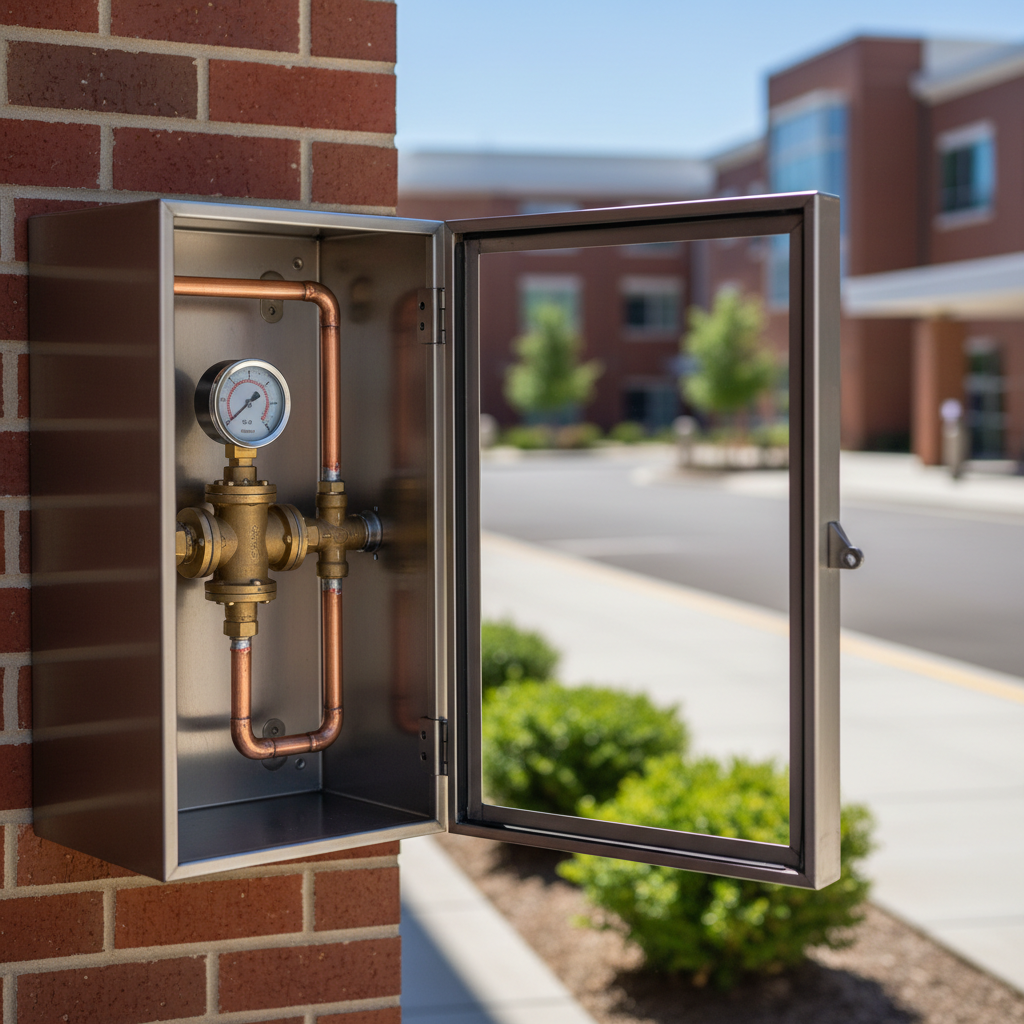
Emergency Oxygen Supply Connection NFPA 99: Pad & Valve Rules
Medical Testing SolutionsNovember 15, 202610 min read
Share
During a scheduled bulk liquid oxygen vaporizer overhaul at a regional trauma center, the cryogenics vendor backed a 9,000-gallon tanker up to the exterior wall only to find two security bollards blocking the delivery lane and a seized 1.5-inch bronze plug inside the emergency inlet cabinet. That facility had to cancel elective surgeries while an ASSE 6010 installer cut out the corroded inlet assembly and brazed a replacement under emergency conditions. An emergency oxygen supply connection NFPA 99 violation rarely shows up during routine daily operations, yet it becomes the single point of failure the moment your primary bulk supply goes offline for maintenance, telemetry repair, or catastrophic weather.
When your bulk oxygen system uses an in-building reserve or a cryogenic liquid reserve on the same pad, NFPA 99 mandates an exterior tie-in point so temporary mobile supply trailers can feed the hospital pipeline without interrupting patient care. Getting this assembly right requires coordinating civil site access, check valve geometry, relief valve sizing, and master alarm wiring long before an emergency tanker ever pulls onto your property.
When NFPA 99 Requires an Emergency Oxygen Supply Connection
NFPA 99 (Section 5.1.3.5.14) requires an Emergency Oxygen Supply Connection (EOSC) whenever a facility's bulk cryogenic liquid oxygen central supply system sits outside the building and relies on an in-building reserve, or when the reserve supply does not operate independently on a separate pad away from the primary liquid vessel. In practical terms, almost every acute-care hospital running a bulk liquid oxygen pad needs a compliant EOSC mounted on the exterior of the building served.
The code establishes this requirement to protect patients when the bulk tank pad itself becomes inaccessible or inoperable. If a vehicle strikes the main vaporizer manifold, a regulator freezes solid during peak winter draw, or a contractor must depressurize the pad to replace the main isolation valve, the hospital cannot rely on a reserve tank sitting three feet away on the same concrete slab. The EOSC allows a gas supplier to park a mobile tube trailer or micro-bulk skid at a safe distance from the primary pad, connect a flexible cryogenic-rated hose to the building exterior, and pressurize the main distribution main directly.
Site Access, Pad Placement, and Physical Clearance Rules
Physical placement determines whether a temporary oxygen trailer can actually use your EOSC during a crisis. NFPA 99 requires the connection to sit on the exterior of the building served in a location accessible by an emergency supply vehicle at all times. You cannot tuck the cabinet behind a locked dumpster corral, at the bottom of a steep loading dock ramp with low overhead pipes, or along a fire lane that routinely fills with delivery vans.
Engineers and facility directors must account for the turning radius and weight of a tractor-trailer carrying compressed gas tubes or a portable liquid tank plus an ambient vaporizer skid. A typical temporary liquid skid needs level pavement capable of supporting heavy axle loads and at least 15 to 20 feet of unobstructed hose routing to the wall box.
When evaluating your exterior wall placement during annual medical gas inspections, check these five physical site conditions:
Unobstructed vehicle access lane free of snow banks, landscaping boulders, or unremovable bollards
Minimum three feet of clear working space directly in front of the EOSC enclosure doors
Enclosure mounting height between three and five feet above finished grade for safe heavy-hose handling
Weatherproof, padlockable cabinet construction made of non-corrosive metal such as stainless steel or powder-coated aluminum
If your facility upgrades its loading dock or adds perimeter security fencing, bring in Medical Testing Solutions to evaluate whether the revised traffic pattern still permits realistic tanker hookup and meets current NFPA 99 clearance rules.
Inside the EOSC Box: Valves, Check Valves, and Relief Valves
An EOSC is much more than a brass fitting stubbed through a brick wall. Inside the protective enclosure, NFPA 99 mandates a specific sequence of mechanical components designed to handle high-flow gaseous oxygen at standard pipeline operating pressures (typically 50 to 55 psig) while preventing backflow in either direction.
Dual Check Valves and Isolation
The connection must connect to the main patient oxygen supply line immediately downstream of the main shutoff valve. To prevent the hospital's primary bulk supply from blowing out through the exterior EOSC port, and to keep temporary trailer pressure from back-feeding into a depressurized bulk pad undergoing repairs, the code requires two check valves. One check valve installs inside the EOSC line itself, and a second check valve installs in the main supply line between the main bulk source shutoff valve and the EOSC tee connection. Both check valves must be cast bronze or brass, cleaned for oxygen service per CGA G-4.1, and sized to match the full peak demand of the hospital pipeline.
Pressure Relief and Strainer Protection
Because temporary oxygen trailers regulate high-pressure gas down to pipeline delivery pressure at the truck, a regulator creep or failure on the trailer could send destructive pressure into the hospital's copper distribution system. NFPA 99 requires a pressure relief valve installed in the EOSC piping downstream of the inlet plug and upstream of the check valve. This relief valve is typically set at 75 psig (50 percent above normal 50 psig system operating pressure) and must vent safely to the outdoors away from walkways.
EOSC Component
NFPA 99 Requirement & Location
Typical Technical Specification
Inlet Fitting
Exterior cabinet connection for trailer hose
1-inch to 2-inch NPT female bronze thread with chained brass plug
Bronze Y-strainer with Monel screen (recommended best practice)
Check Valve #1
Inside EOSC branch piping
Dual-plate or swing check, bronze body, Viton or PTFE seat
Check Valve #2
In main bulk supply line upstream of EOSC tee
Full-port bronze check valve rated for peak hospital SCFM demand
Pressure Relief Valve
Between inlet valve and EOSC check valve
ASME-coded bronze relief valve set at 75 psig, piped to safe vent
Pressure Gauge
Visible inside cabinet for tanker operator
0–100 psig oxygen-cleaned dial gauge with 1/4-inch isolation port
Planning a bulk oxygen pad upgrade or replacing a corroded exterior inlet cabinet? Schedule code-compliant medical gas installation with our ASSE 6010 certified technicians to ensure your check valves and tie-in piping pass inspection on the first attempt.
Master Alarm Monitoring and Electrical Supervision
A mechanical connection alone does not satisfy modern editions of NFPA 99 when the temporary supply unit includes its own telemetry or operating alarms. When a mobile oxygen supply trailer connects to the hospital, the facility engineering team and nursing supervisors still need immediate notification if the temporary supply runs low or malfunctions.
Under NFPA 99, the EOSC assembly must include four-wire electrical connectivity or a dedicated junction box tied into the facility's master alarm system when required by the design edition and temporary supply configuration. Specifically, if a temporary micro-bulk skid is parked outside for an extended tank replacement project, its liquid level and reserve switches must report to both the hospital's local alarm panels and the central station.
Why this matters for compliance: During The Joint Commission or state AHJ surveys, inspectors frequently open the exterior EOSC cabinet and ask how the master alarm panel reacts when the main bulk tank is isolated and the building runs on the emergency inlet. If the main line pressure sensor sits upstream of the EOSC tee, isolating the bulk pad will trigger a false "Main Line Low Pressure" alarm even while the trailer maintains a steady 52 psig in the hospital. The main line pressure transducers and switches must sit downstream of the EOSC tie-in point so they continuously monitor true hospital distribution pressure.
ASSE 6010 Installation and ASSE 6030 Verification Protocols
Every braze joint between the exterior EOSC cabinet and the main oxygen distribution riser falls under strict NFPA 99 Chapter 5 installation rules. Only installers holding a current ASSE 6010 Professional Qualification Standard credential may assemble and braze these pipelines. Installers must use ASTM B819 medical-grade copper tube, purge the interior with oil-free dry nitrogen during all silver-brazing operations, and maintain full material cleanliness documentation.
Once installation wraps up, the assembly cannot be placed into service until an independent ASSE 6030 verifier performs comprehensive medical gas verification testing. Medical Testing Solutions conducts these third-party verifications to confirm that the EOSC will perform safely under emergency load without contaminating the hospital pipeline.
The verification process for an EOSC installation includes five mandatory tests:
Initial pressure test at 1.5 times system operating pressure (150 psig with oil-free dry nitrogen) with all joints examined for leaks before concealment
Standing pressure test for 24 hours showing zero pressure decay after accounting for ambient temperature shifts
Cross-connection and piping purge tests verifying that the EOSC connects exclusively to the oxygen main
Purity and particulate testing per NFPA 99 Section 5.1.12 to confirm zero hydrocarbons, correct moisture dew point, and clean internal pipe walls
Operational check valve seating test and pressure relief valve verification to ensure main pipeline pressure does not leak back into the exterior cabinet
Even when an EOSC passes its initial commissioning, decades of weather exposure, landscape changes, and moisture intrusion take a heavy toll on exterior wall boxes. When Medical Testing Solutions performs medical gas maintenance services across hospitals in Florida and nationwide, our technicians regularly uncover mechanical hazards that would delay an emergency tanker hookup.
Weeping Check Valves and Pressurized Plugs
The most dangerous failure mode in an aging EOSC is a leaking inline check valve. Over time, small metal particulates or degraded elastomeric seats allow 50 psig hospital oxygen to seep past the EOSC check valve and accumulate against the manual isolation valve or the threaded brass inlet plug. If the manual ball valve is also slightly open or leaking, the heavy bronze plug at the hose connection becomes pressurized at 50 psig. A truck driver unscrewing that unvented plug with a wrench can turn the brass fitting into a projectile. Every EOSC should have a working pressure gauge and a bleed valve between the check valve and the inlet plug so technicians can verify zero trapped pressure during routine checks.
Corroded Enclosures and Missing Plugs
Exterior stainless cabinets located near coastal air or irrigation sprinklers suffer from rusted hinges, seized padlocks, and wasp nests packed inside the open NPT threads. If the chained brass dust plug is left unthreaded, humidity and insects enter the piping up to the isolation valve seat. Connecting a high-flow oxygen hose to a contaminated inlet blows organic debris straight into the check valve seat and main hospital strainer.
Unverified Main Line Isolation Valves
During a bulk pad shutdown, your team relies on the main supply line check valve and manual isolation valve to hold back the temporary trailer pressure while workers cut into the bulk pad piping. If that main line check valve has never been tested or exercised, temporary oxygen will blow backward onto the construction pad, creating an immediate oxygen-enriched fire hazard for welders and braziers working on the primary vaporizers. Regular medical gas certification and preventative valve exercising keep these critical boundaries tight.
Whether you need to replace a deteriorating exterior cabinet, verify a new bulk pad tie-in, or bring your facility's documentation up to Joint Commission standards, Medical Testing Solutions supplies code-compliant EOSC assemblies and provides turnkey ASSE 6010 installation and ASSE 6030 testing. Contact our team today to request a quote or call (754) 315-1078 for immediate technical assistance.
Frequently Asked Questions
NFPA 99 (Section 5.1.3.5.14) requires an Emergency Oxygen Supply Connection (EOSC) whenever a bulk cryogenic liquid oxygen central supply system is located outside the building and relies on an in-building reserve, or when the reserve supply is not located on an independent pad separate from the primary bulk source.
NFPA 99 requires two check valves for an EOSC installation: one check valve installed in the EOSC branch piping downstream of the inlet and pressure relief valve, and a second check valve installed in the main oxygen supply line upstream of the EOSC tee connection to prevent backflow in either direction.
The pressure relief valve inside an EOSC assembly is set at 50 percent above normal system operating pressure, which typically equals 75 psig for a standard 50 to 55 psig hospital oxygen pipeline.
The main line pressure sensors for the master alarm panel must be installed downstream of the EOSC tie-in point. This ensures the hospital continues to monitor actual pipeline distribution pressure even when the primary bulk pad is isolated and the facility is running on a temporary mobile oxygen trailer.
Any new or modified EOSC piping must be installed by an ASSE 6010 certified installer and verified by an independent ASSE 6030 certified medical gas verifier. Testing includes a 150 psig initial pressure test, a 24-hour standing pressure test, cross-connection verification, particulate and purity testing, and check valve leak testing.
Request a quote for your facility
Talk with Medical Testing Solutions about your next inspection, repair or equipment request.