Medical Testing SolutionsNovember 15, 202610 min read
Share
At 2:15 a.m. during a multi-patient ventilator weaning trial in Leon County, an intermediate header regulator on an automatic change-over manifold sticks three PSI below its setpoint. Your master alarm panel at the nurses' station erupts with a "Reserve in Use" alert, yet the primary liquid cylinder bank still reads 180 PSIG on the Bourdon gauge. When you manage an extended-stay facility with twenty-four ventilator-dependent beds running heated high-flow nasal cannulas at 50 liters per minute each, an unexpected LTACH oxygen manifold switchover Tallahassee event is not a minor facilities nuisance. It is an immediate life-safety vulnerability that tests whether your changeover valves, pressure transducers, and line regulators can sustain 50 to 55 PSIG pipeline delivery without dropping a single ventilator's low-oxygen inlet alarm.
Long-Term Acute Care Hospitals (LTACHs) operate under a completely different oxygen demand profile than ambulatory surgery centers or general med-surg floors. While an outpatient center sees peak flow rates during morning blocks and zero flow overnight, an LTACH pulls a relentless, unyielding baseline draw 24 hours a day. Validating your manifold's intermediate header differential and secondary bank cutover under that sustained load requires deliberate, code-driven testing by ASSE-certified specialists who understand high-flow dynamics.
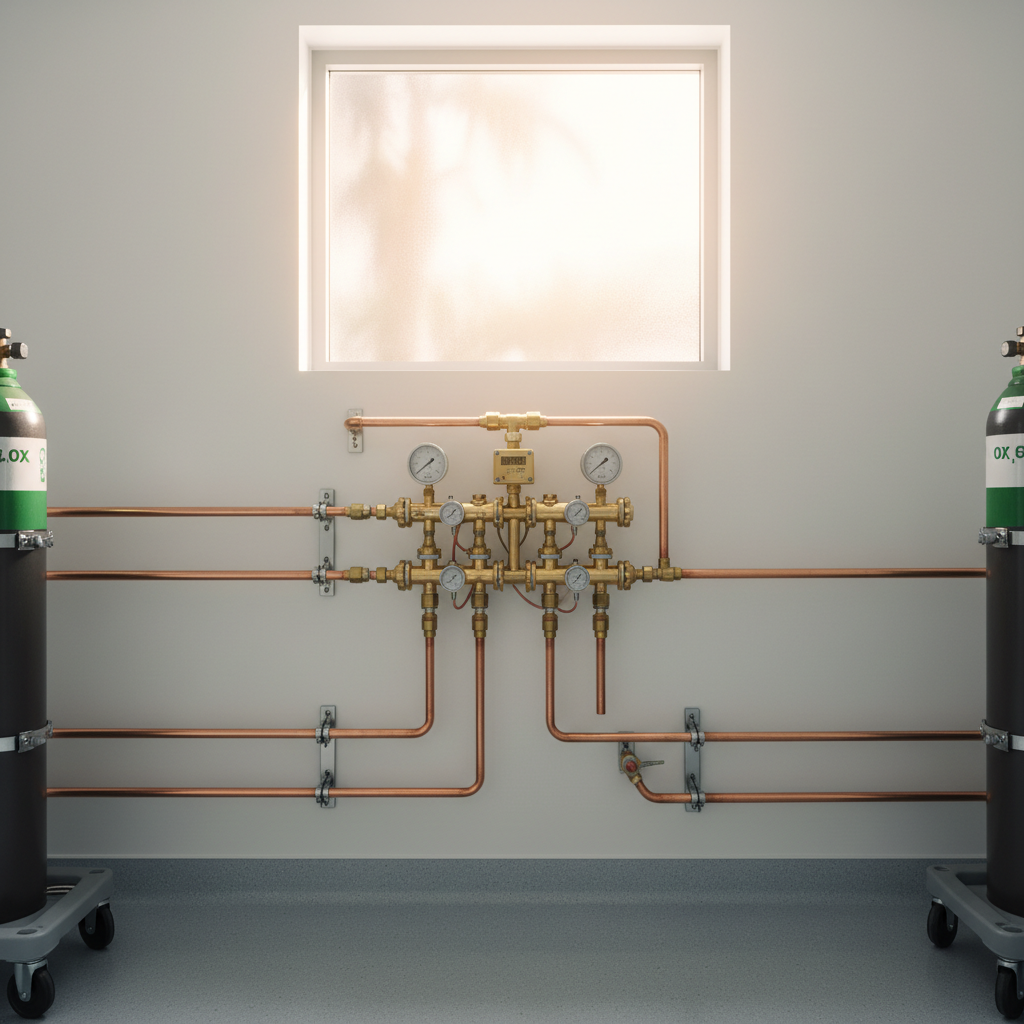
Continuous mechanical ventilation creates two simultaneous mechanical problems at your central supply source: rapid joule-thomson cooling across primary regulating stages and narrowed pressure differentials between operating and reserve banks. Most Category 1 medical gas manifolds, whether high-pressure cylinder banks or liquid-by-liquid cryogenic headers, rely on a stepped pressure-differential scheme to execute an automatic switchover without human intervention.
When twenty ventilators draw continuous oxygen alongside high-flow therapies, the flow velocity through the primary bank regulator causes localized seat cooling and diaphragm stiffness. If the primary regulator droops even slightly under peak respiratory therapy rounds, the intermediate header pressure dips toward the secondary bank's cut-in threshold. Instead of a crisp mechanical changeover when the primary bank is genuinely exhausted, the manifold enters a "shared-draw" state where both banks bleed down simultaneously. You lose your protected reserve without ever realizing the primary switchover valve failed to isolate.
Why this matters for compliance: Under NFPA 99 Section 5.1.3.5.10, manifolds for gas cylinders without reserve supplies must shift automatically from the primary supply to the secondary supply when the primary supply is exhausted, activating a local signal and a master alarm. If both banks deplete together due to intermediate regulator drift, your facility violates Category 1 source reserve mandates and faces an immediate Condition-Level deficiency during a Joint Commission (TJC) or AHCA survey.
Anatomy of Intermediate Header Pressure Drops Under Load
Every automatic changeover manifold uses three distinct pressure zones to manage bank transition while keeping the main facility pipeline rock-steady at 50 to 55 PSIG. Understanding how these three zones interact explains why static testing with zero flow fails to catch 80 percent of real-world LTACH manifold failures.
Primary vs. Secondary Intermediate Regulator Staging
In a standard dome-loaded or mechanical differential manifold, the primary bank intermediate regulator is typically calibrated between 110 and 140 PSIG, while the secondary (reserve) bank intermediate regulator sits slightly lower, often between 90 and 110 PSIG. Downstream of both intermediate stages sits the dual line-pressure regulator assembly, which steps that intermediate header pressure down to the final 52 PSIG hospital delivery pressure.
During a simulated static test where an uncertified technician simply closes a cylinder valve with minimal pipeline flow, the intermediate pressure drops cleanly and triggers the pressure switch. During an actual LTACH high-demand load, however, friction loss across dirty sintered-bronze pigtail check valves or undersized header blocks creates artificial backpressure drops. The pressure switch located on the intermediate header senses a momentary dip below the 95 PSIG threshold, trips the "Reserve in Use" relay on the master alarm, and latches the alarm even though the liquid vessels or high-pressure cylinders are still half full.
Manifold Component Stage
Standard Operating Pressure (PSIG)
Cutover / Alarm Setpoint (PSIG)
Common High-Demand LTACH Failure Mode
NFPA 99 Code Reference
Primary Bank Header
180 – 2,200 PSIG (Liquid vs HP)
Depletes to ~115 PSIG
Frosting on vaporizer coils or pigtail check valve restriction
Seat vulcanization preventing full CFM flow at cutover
NFPA 99 5.1.3.5.12
Dual Final Line Regulators
50 – 55 PSIG
Low/High Line Alarm ±20% (40/60 PSIG)
Outlet droop below 45 PSIG during simultaneous vent cycles
NFPA 99 5.1.3.5.5
Master Alarm Switch (Reserve In Use)
Closed above 105 PSIG
Opens/Trips at 95–100 PSIG
Pressure transducer deadband mismatch vs mechanical valve
NFPA 99 5.1.9.2.4
To catch intermediate regulator droop before it interrupts patient care, schedule your annual medical gas inspections and preventative manifold calibration with an ASSE 6030 and 6040 credentialed team.
Validating Secondary Bank Cutover Alarms per NFPA 99
Testing an LTACH oxygen manifold switchover in Tallahassee requires verifying that the mechanical valve transition and the electrical alarm actuation happen at the exact same pressure point. NFPA 99 (2018 and 2021 editions, Section 5.1.9.2.4) dictates that master alarm panels must monitor two distinct source conditions for automatic manifolds: when the secondary supply operates ("Reserve in Use") and when the reserve supply drops below an average day's supply ("Reserve Low").
Many older manifolds use mechanical Bourdon-tube pressure switches with wide deadbands, while newer digital manifolds rely on 4–20 mA pressure transducers wired to a microprocessor control board. When an ASSE 6030 verifier from Medical Testing Solutions validates your switchover, we do not just press the "test" button on the manifold cabinet door. Pressing the cabinet test button only proves continuity of the dry-contact alarm wiring between the manifold room and the master alarm panels; it tells you nothing about whether the physical pressure switch will actuate when intermediate pressure falls.
Dynamic Cutover Verification Protocol
A compliant dynamic cutover verification under live LTACH hospital conditions follows strict isolation steps so patient delivery pressure never wavers:
Verify Reserve Bank Integrity First: Before touching the primary bank, confirm the secondary bank has full cylinder or liquid vessel pressure, all pigtail check valves are leak-free, and the secondary final line regulator is calibrated to hold 52 PSIG under full facility flow.
Connect Calibrated Digital Reference Gauges: Attach NIST-traceable digital test gauges to the intermediate test ports and the main line gauge port downstream of the source valve to monitor real-time pressure decay down to 0.1 PSIG resolution.
Simulate Controlled Primary Exhaustion: Slowly throttle the primary bank isolation valve (or bleed the primary intermediate test port under controlled purge) while observing actual ventilator demand flow.
Record Exact Mechanical vs. Electrical Trip Points: Log the exact PSIG where the secondary intermediate regulator opens to sustain pipeline flow, and verify that the "Reserve in Use" contact opens within 2 to 3 PSIG of mechanical cutover.
Validate Main-Line Stability: Confirm that main line delivery pressure downstream of the final line regulators never drops more than 2 PSIG during the transition and stays well clear of the 40 PSIG low-line alarm threshold.
AHCA Chapter 59A and Joint Commission Survey Readiness in Florida
In Florida, LTACH facilities face intense regulatory oversight from both the Joint Commission (TJC) and the Florida Agency for Health Care Administration (AHCA). When AHCA field engineers from the Office of Plans and Construction (OPC) inspect a facility in Tallahassee or anywhere across the Big Bend region, your medical gas verification documentation must satisfy Chapter 59A-3 of the Florida Administrative Code and AHCA OPS Form 3110 requirements whenever a manifold is replaced, renovated, or breached.
During routine annual TJC Environment of Care (EC.02.05.09) surveys, surveyors zero in on manifold switchover logs. If your facility maintenance logs only say "Manifold alarm tested - PASS" without documenting the actual cutover actuation pressure in PSIG, the intermediate regulator pressures, and the relief valve discharge piping integrity, a savvy surveyor will flag the testing as incomplete.
Medical Testing Solutions provides documentation built specifically for Florida AHCA and TJC compliance. Whether we are performing medical gas verification on a brand-new duplex manifold installation or executing medical gas maintenance services on aging source equipment, every report lists calibrated gauge serial numbers, specific NFPA 99 code clauses, and exact psi actuation values. Major health systems across the state, including UF Health, AdventHealth, Baptist Health, and Broward Health, rely on this level of granular reporting to pass state and federal licensure audits on the first pass.
Hurricane Re-Verification and Emergency Source Recovery (NFPA 99 5.1.12)
Tallahassee and North Florida facilities know firsthand how quickly tropical systems moving out of the Gulf of Mexico can knock out municipal power, damage exterior bulk oxygen storage pads, or prevent bulk cryogenic liquid delivery trucks from reaching the hospital. When an LTACH transitions onto its emergency high-pressure reserve manifold during a hurricane or suffers a temporary loss of source pressure due to storm damage, you cannot simply swap out empty cylinders and resume normal operations without formal re-testing.
Under NFPA 99 Section 5.1.12, any medical gas system that undergoes a breach, emergency repair, or loss of source pressure after storm damage requires formal verification testing before returning to normal patient service. Furthermore, rapid decompression of high-pressure reserve banks during prolonged power outages often freezes regulator seats, causing permanent internal leaks that bleed off replacement cylinders.
Because Medical Testing Solutions is headquartered in Florida, our ASSE 6010 installers, ASSE 6030 verifiers, and ASSE 6040 maintenance technicians mobilize rapidly post-storm. While out-of-state testing contractors are grounded by commercial flight cancellations, our Florida crews drive directly to affected hospital campuses to perform emergency manifold rebuilds, regulator replacements from our products inventory, and post-storm NFPA 99 5.1.12 re-verification.
The Florida Cost Advantage: Zero Travel Fees from Fort Lauderdale to Tallahassee
Hiring an out-of-state medical gas testing firm from Georgia, Alabama, or the Midwest to service a Tallahassee LTACH inflates your compliance budget with hidden airfare, rental cars, hotel nights, and technician per-diem charges. Medical Testing Solutions is headquartered at 501 East Las Olas Blvd, Suite 300, Fort Lauderdale, FL 33301. We operate dedicated service routes covering the entire state of Florida with a straightforward promise: NO travel fees, NO lodging charges, and NO per-diem anywhere in Florida.
Most Florida hospitals, LTACHs, and surgery centers save 10 to 25 percent immediately compared to out-of-state ASSE 6030 verifiers. Whether your health system operates acute and post-acute facilities in Tallahassee alongside sister campuses requiring Fort Lauderdale medical gas services, Miami medical gas services, or West Palm Beach medical gas services, you receive uniform pricing and statewide dispatch from a single Florida-based partner. Explore our full Florida medical gas services coverage to see how we streamline compliance across multi-facility networks.
Waiting for an annual inspection to look at your oxygen manifold is a recipe for an off-hours emergency callout. Your facility engineering staff should integrate three proactive checks into weekly rounds to keep high-demand LTACH manifolds stable:
Log Intermediate Header Differential Daily: Record not just the left and right bank cylinder pressures, but the intermediate header pressure gauge reading during peak morning ventilator rounds. A downward trend of 5 PSIG over a month indicates an aging primary regulator diaphragm.
Inspect Pigtail Check Valves During Every Cylinder Change: Under NFPA 99 Section 5.1.3.5.5.1, every flexible cylinder connector (pigtail) must contain an integral check valve so a leaking or disconnected cylinder does not vent the entire bank. Replace rigid copper or braided stainless pigtails immediately if you hear back-bleeding during tank swaps.
Rebuild Final Line Regulators Every Five Years: Elastomer seats and diaphragms inside final line regulators degrade under constant high-volume oxygen flow. Alternating between your primary and secondary final line regulators every six months prevents seat sticking and verifies that the backup line regulator can carry 100 percent of your LTACH's ventilator load.
If your manifold exhibits pressure droop, premature reserve alarms, or sticky changeover valves, do not wait for a complete source failure or an AHCA citation. Call our Fort Lauderdale office at (754) 315-1078 for statewide scheduling or same-day dispatch in South Florida, or request a quote online to schedule your ASSE 6030 manifold verification and preventive maintenance anywhere in Florida.
Frequently Asked Questions
Under NFPA 99 Section 5.1.3.5.10 and 5.1.9.2.4, the secondary supply must engage automatically before main line delivery pressure drops below the standard 50 to 55 PSIG operating range. Typically, the primary intermediate regulator is set around 115–135 PSIG and the secondary intermediate regulator cuts in around 95–105 PSIG, tripping the 'Reserve in Use' master alarm simultaneously.
When 20 or more mechanical ventilators and high-flow nasal cannulas draw continuous oxygen, high flow velocity causes Joule-Thomson cooling and diaphragm droop inside the primary bank regulator. If the primary intermediate pressure droops near the secondary bank cut-in setpoint, the manifold pressure switch senses the dip and triggers a 'Reserve in Use' alarm even when primary cylinders still hold gas.
Yes. Both the Joint Commission (under EC.02.05.09) and the Florida Agency for Health Care Administration (AHCA Chapter 59A) require annual medical gas system testing per NFPA 99, including functional testing of manifold automatic switchover valves and master alarm actuation setpoints. Any new manifold installation or breach also requires ASSE 6030 verification documented for AHCA OPS Form 3110.
An ASSE 6030 verifier or ASSE 6040 maintenance specialist connects calibrated digital test gauges to the intermediate header and main line ports, verifies the reserve bank is full and operational, and slowly throttles or bleeds the primary bank intermediate stage while monitoring downstream line pressure. Because the dual final line regulators remain online at 50–55 PSIG, patient ventilators experience zero pressure fluctuation during the test.
No. Medical Testing Solutions is headquartered at 501 E Las Olas Blvd in Fort Lauderdale and operates statewide across Florida with zero travel fees, zero lodging fees, and zero per-diem charges. Tallahassee LTACHs and hospitals typically save 10 to 25 percent compared to out-of-state testing companies.
Request a quote for your facility
Talk with Medical Testing Solutions about your next inspection, repair or equipment request.