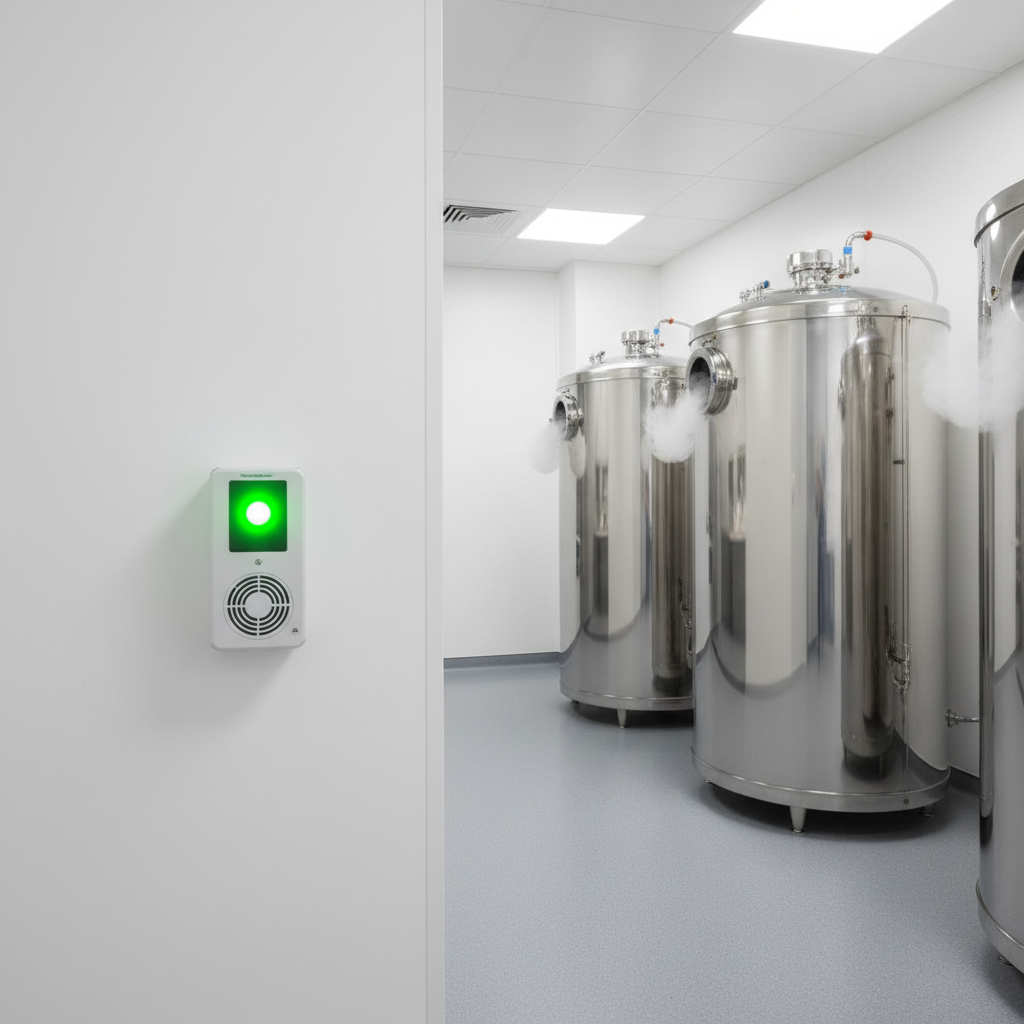
Oxygen Deficiency Monitor Placement for Liquid Nitrogen Rooms
Medical Testing SolutionsAugust 5, 20267 min read
Share
Oxygen Deficiency Monitor Placement for Liquid Nitrogen Rooms: A Definitive Guide
Liquid nitrogen (LN2) is invaluable in medical and laboratory settings, but its use introduces a significant and often underestimated risk: asphyxiation from oxygen displacement. A sudden release can rapidly lower the oxygen concentration in a room to fatal levels. Properly placed oxygen deficiency monitors are not just a best practice; they are a critical life-safety device. This guide provides definitive, code-compliant instructions on oxygen deficiency monitor placement in liquid nitrogen rooms, ensuring the safety of your personnel and compliance with national standards.
You will learn the specific requirements for sensor mounting height, how to account for room air stratification, the correct number of sensors to install, and the appropriate alarm setpoints. We will also cover remote annunciation and safety interlocks, providing a complete framework for a safe environment.
Why Oxygen Monitoring is Non-Negotiable with Liquid Nitrogen
Liquid nitrogen, when it vaporizes, expands at a ratio of approximately 1:700. A small spill of LN2 can quickly displace a massive volume of breathable air in an enclosed space. Since nitrogen is colorless, odorless, and makes up 78% of the air we breathe, humans cannot detect a dangerously nitrogen-rich, oxygen-deficient atmosphere. The effects of oxygen deprivation are swift and unforgiving, leading to impaired judgment, loss of consciousness, and death in minutes. This is why ambient oxygen monitoring is mandated and essential.
Why this matters for compliance: Regulatory bodies like OSHA, and standards organizations such as the National Fire Protection Association (NFPA) and the Compressed Gas Association (CGA), have specific guidelines for working with cryogenic fluids. Failure to provide adequate oxygen monitoring can result in severe penalties and, more importantly, tragic accidents.
Sensor Mounting Height: The Critical Question
One of the most debated topics is the correct mounting height for an oxygen sensor in a liquid nitrogen storage area. The answer depends on the physical properties of nitrogen gas at different temperatures.
Cold Nitrogen Gas: When LN2 first vaporizes, the resulting nitrogen gas is extremely cold and dense, significantly denser than the surrounding air. This cold, heavy gas will pool at the lowest point in the room.
Warmed Nitrogen Gas: As the nitrogen gas absorbs heat from the ambient air, it warms up and becomes lighter than air, eventually rising towards the ceiling.
Given this behavior, a single sensor's placement is a compromise. However, leading safety practices and standards like the CGA P-18 and NFPA 99 (Health Care Facilities Code) point towards placing the sensor in the "breathing zone." The breathing zone is typically defined as 4 to 6 feet from the floor. For rooms with liquid nitrogen, placement is often recommended on the lower end of this scale.
Medical Testing Solutions recommends placing the primary oxygen sensor 1 to 3 feet (0.3 to 0.9 meters) from the floor. This placement prioritizes the detection of the initial, dense gas cloud that forms immediately after a leak, which poses the most immediate threat to a person who may have fallen or is working near the floor.
How Many Sensors Are Needed?
The number of sensors required depends on the size and complexity of the room. A small, simple storage closet may only need one sensor. However, larger or irregularly shaped rooms require more comprehensive coverage.
Single Sensor: For a standard, small room (e.g., under 150 sq. ft.) with no significant airflow obstructions, a single, well-placed sensor is often sufficient.
Multiple Sensors: For larger rooms, areas with partitions, or facilities with high-volume LN2 usage, multiple sensors are necessary. A good rule of thumb is to place sensors near each potential major leak source (e.g., large dewars, filling stations) and to ensure no part of the room is "unseen" by a sensor.
Room ventilation and air movement play a crucial role in how nitrogen gas disperses.
Stagnant Air: In rooms with poor ventilation, the cold nitrogen gas is more likely to stratify and pool at the floor for an extended period.
Active Ventilation: In rooms with active ventilation systems, the gas will mix with the air more quickly and may be detected by a sensor placed higher up. However, ventilation should not be a substitute for correct sensor placement, as a large, rapid leak can overwhelm the ventilation system.
Your sensor placement strategy must account for the room's specific airflow patterns. Avoid placing sensors directly in the path of fresh air supply vents, as this will dilute the measurement and delay an alarm.
Feature
Low Sensor Placement (1-3 ft)
High Sensor Placement (4-6 ft)
Recommendation
Leak Type Detected
Catches initial, cold, dense gas pools from a spill.
Catches gas after it has warmed and started to rise.
Low placement is safer for immediate spill detection.
Personnel Safety
Protects fallen or crouched personnel.
Aligns with the "breathing zone" of a standing person.
A combination is ideal, but low placement is critical.
Code Alignment
Aligns with best practices for dense gas hazards.
General "breathing zone" definition.
Prioritize dense gas detection as per CGA guidance.
Alarm Setpoints and Annunciation
Correct alarm setpoints are as important as sensor placement. Oxygen monitors should have a two-stage alarm system as recommended by OSHA and NFPA guidelines.
Low-Level Alarm (Warning): 19.5% Oxygen - This is the OSHA-defined threshold for an oxygen-deficient atmosphere. This first alarm warns personnel of a developing hazardous condition, prompting them to investigate or evacuate.
High-Level Alarm (Danger): 18% Oxygen (or lower) - This second, more urgent alarm indicates a life-threatening situation. It should trigger immediate evacuation and activate any connected emergency systems.
Remote Annunciators and Interlocks
The alarms must be unmistakable. For any room where a hazard is present, a remote annunciator (strobe light and horn) must be placed outside the entrance to the room.
Audible and Visual Alarms: The remote unit ensures that no one enters a hazardous environment and alerts personnel in the vicinity to the emergency. The alarm should be distinct from other building alarms.
Safety Interlocks: For high-risk applications, the high-level alarm should be interlocked with the building's ventilation system to activate emergency exhaust fans. It can also be connected to shut-off valves to stop the flow of nitrogen from the source.
Medical Testing Solutions provides comprehensive oxygen deficiency monitoring services, including the installation and ASSE 6010 certified verification of these critical alarm and interlock systems.
Step-by-Step Installation Guide
Here is a checklist for the proper installation of an oxygen deficiency monitoring system:
Assess the Room: Identify all potential LN2 leak sources and note the room's size, shape, and ventilation patterns.
Determine Sensor Locations: Based on the assessment, choose the optimal number and location for sensors, prioritizing placement 1-3 feet from the floor near potential leak sources.
Install the Monitor and Sensor(s): Mount the central monitor in a visible location and run conduit to the sensor mounting points. Ensure all wiring complies with local electrical codes.
Mount the Remote Annunciator: Install the audio/visual alarm unit outside the primary entrance to the monitored area, at eye level.
Configure Alarm Setpoints: Program the monitor with alarm setpoints at 19.5% (Warning) and 18.0% (Danger).
Test and Verify the System: Perform a full system test. This involves using a certified zero-gas (pure nitrogen) to challenge the sensor and confirm that both local and remote alarms activate at the correct setpoints. This verification should be performed by an ASSE 6030 certified technician.
Train Personnel: Ensure all staff who work in or near the area understand what the alarms mean and know the evacuation procedure.
Schedule Regular Maintenance: Like any life-safety device, oxygen monitors require regular calibration and maintenance. Follow the manufacturer's recommendations and include it in your facility's medical gas maintenance services schedule.
For a seamless and compliant installation, consider professional medical gas installation services from certified experts.
Conclusion: Safety is Paramount
Correct oxygen deficiency monitor placement in liquid nitrogen rooms is a complex but critical task that leaves no room for error. By prioritizing low-level sensor mounting, understanding room dynamics, and implementing robust alarm and annunciation systems, you create a safe environment that is compliant with national standards.
Don't leave safety to chance. The experts at Medical Testing Solutions are ASSE-certified to install, verify, and maintain your oxygen monitoring systems. We ensure your facility is not only compliant but, most importantly, safe for your entire team.
Ready to ensure your facility is safe and compliant? Contact Medical Testing Solutions today for a free quote or call us at +1 (754) 315-1078 to discuss your oxygen monitoring needs.
Frequently Asked Questions
Most manufacturers recommend calibration every 6 to 12 months. However, you should always check the manufacturer's specific guidelines. Regular calibration is critical for ensuring the monitor provides accurate readings and is a key part of any safety protocol.
No. Each room or distinct area where an oxygen deficiency hazard exists must have its own dedicated sensor(s) and alarm system. A central monitor can sometimes display readings from multiple sensors, but each monitored space needs its own sensing point.
Absolutely not. Smoke detectors and carbon monoxide detectors cannot measure oxygen concentration. You must use a dedicated oxygen deficiency monitor designed specifically for this life-safety application.
Some electrochemical oxygen sensors can be affected by other gases, which can lead to false readings or alarms. Gases like carbon dioxide, hydrogen sulfide, or certain cleaning solvents can interfere. It's important to understand the technology of your sensor and the chemical profile of the environment.
Yes. Because an oxygen monitor is a life-safety device, it is critical that it remains operational during a power failure. Per NFPA 99, these systems should be connected to the facility's emergency power system (essential electrical system).
Request a quote for your facility
Talk with Medical Testing Solutions about your next inspection, repair or equipment request.