Skip to content
    New: Medical Gas Outlet Retrofit & Rebuild Matrix — cross-reference legacy Chemetron, Ohio Diamond, Puritan-Bennett & more →
    ASSE Certified 24/7
    Compliance & Standards
    Medical Gas Service

    Oxygen Cylinder Storage Rules for Medspas and Clinics

    Medical Testing SolutionsAugust 7, 20267 min read
    Share
    Oxygen Cylinder Storage Rules for Medspas and Clinics

    Oxygen Cylinder Storage Rules for Medspas and Clinics: A Complete Guide

    Medical spas and outpatient clinics are increasingly offering services that require the use of compressed medical gases, most notably oxygen. While essential for patient care, oxygen cylinders introduce significant fire and safety risks if not stored and handled correctly. For facility managers and clinical staff in Florida, understanding and adhering to the specific storage regulations outlined by the National Fire Protection Association (NFPA) isn't just best practice, it's a legal requirement. This guide provides a definitive overview of the oxygen cylinder storage rules that medspas and clinics must follow to ensure compliance, safety, and operational readiness.

    In this post, you will learn the critical requirements for storing E-cylinders and larger tanks, including quantity thresholds that trigger stricter rules, specifications for storage room construction, proper signage, cylinder segregation, and how to avoid common deficiencies found during inspections.

    Why Oxygen Storage Compliance Matters

    Oxygen is not flammable, but it is a powerful oxidizer. This means it can cause other materials to ignite more readily and burn hotter and faster. An oxygen-enriched atmosphere (above 23.5%) can make materials like hair, grease, and even some metals flammable. A leak from a poorly maintained or improperly stored cylinder can quickly create a hazardous environment, where a small spark from static electricity or faulty equipment could lead to a serious fire. Adhering to storage rules mitigates these risks, protecting your patients, staff, and facility.

    Why this matters for compliance: Local fire marshals and accreditation agencies (like AAAHC, The Joint Commission) enforce NFPA 99 standards. Non-compliance can lead to failed inspections, costly fines, operational shutdowns, and in the worst-case scenario, catastrophic accidents. Proper storage is a cornerstone of your facility's safety program and is reviewed during any annual medical gas inspection.

    NFPA 99: The Governing Standard

    The primary source for medical gas storage rules in the United States is NFPA 99, the Health Care Facilities Code. This code is legally mandated in most jurisdictions, including Florida. It outlines detailed requirements for the storage, use, and handling of medical gas cylinders in different types of healthcare settings.

    For medspas and clinics, the key chapters to consider are:

    • Chapter 5: Gas and Vacuum Systems: This chapter details requirements for central supply systems.
    • Chapter 11: Gas Equipment: This provides guidance on cylinder-specific equipment.
    • Chapter 15: Other Health Care Facilities: This chapter applies to facilities like clinics and medspas that may not have the same level of patient acuity as hospitals.

    Storage Quantity Thresholds: How Many Cylinders Trigger Stricter Rules?

    NFPA 99 sets specific volume thresholds for medical gases. Once your total volume of stored nonflammable gases (like oxygen and nitrous oxide) exceeds a certain limit, more stringent storage requirements are triggered.

    • Less than 3,000 cubic feet (cf): For small quantities, cylinders can be stored in an unenclosed location or a dedicated room, but they must still be secured and segregated. This is a common scenario for facilities using only a few E-cylinders.
    • Between 3,000 cf and 20,000 cf: This is the threshold that many growing medspas and surgical suites will meet. Once you exceed 3,000 cf of stored gas, you are required to store the cylinders in a dedicated, properly constructed storage enclosure or room.
    • Greater than 20,000 cf: This volume typically applies to hospitals and large surgical centers and requires an outdoor primary storage location.

    To calculate your total volume, sum the capacity of all cylinders in storage (both "full" and "in-use"). Here are some common cylinder sizes and their volumes:

    • E-Cylinder: ~23.5 cubic feet
    • H-Cylinder: ~244 cubic feet

    So, if your facility stores a dozen H-cylinders, you have 2,928 cf. But if you add one more, you cross the 3,000 cf threshold, and the rules change significantly.

    Medical Gas Storage Room Requirements (Over 3,000 cf)

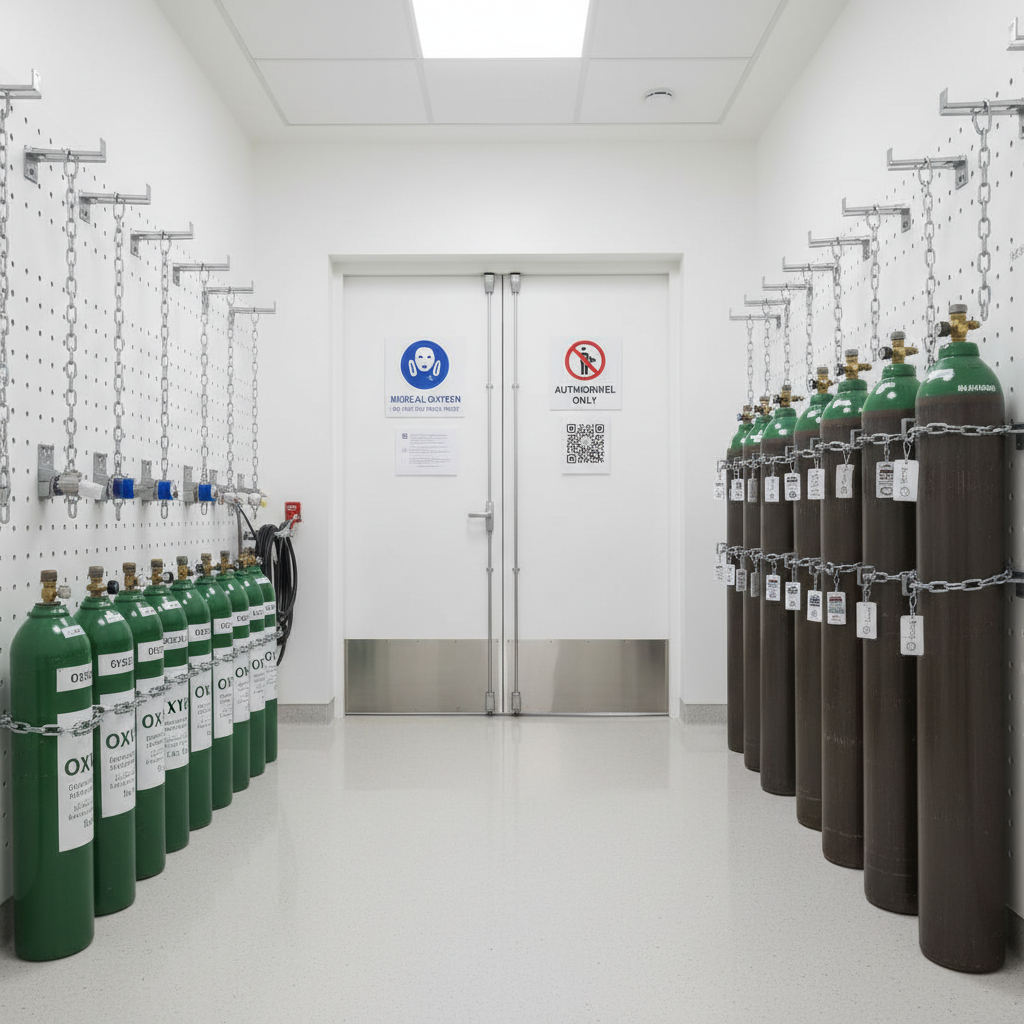
    If your facility stores over 3,000 cubic feet of oxygen and other nonflammable gases, they must be kept in a dedicated room or enclosure with the following features:

    • One-Hour Fire Rating: The room must be constructed with materials that provide a one-hour fire-resistive rating. This includes the walls, floor, and ceiling.
    • Self-Closing, Locking Door: The door must also have a one-hour fire rating, be self-closing, and be equipped with a lock.
    • Proper Ventilation: The space must be ventilated, either naturally via louvers or mechanically, to prevent the buildup of an oxygen-enriched atmosphere. Vents should be located near the floor and ceiling.
    • No Flammable Materials: The room cannot be used for any other purpose. Storage of combustible materials like paper, cardboard boxes, or flammable liquids (e.g., alcohol-based sanitizers) is strictly prohibited.
    • Electrical Fixtures: All electrical fixtures and outlets must be at least 5 feet above the floor to minimize ignition risk.

    Comparison of Storage Rules: Below vs. Above 3,000 cf Threshold

    FeatureBelow 3,000 cfAbove 3,000 cf
    LocationCan be in an unenclosed, designated areaMust be in a dedicated, enclosed room/enclosure
    ConstructionNo specific fire rating required1-hour fire-rated walls, floor, ceiling, and door
    VentilationNot explicitly required (but good practice)Required (natural or mechanical)
    DoorNo specific requirementSelf-closing, locking, 1-hour fire-rated
    Other StorageProhibitedStrictly prohibited
    SignageRequiredRequired (more extensive)

    Securing and Segregating Cylinders: The "Full vs. Empty" Rule

    Whether in a dedicated room or an open area, all cylinders must be properly managed:

    • Secure All Cylinders: Cylinders must be secured upright at all times to prevent tipping or falling. Use chains, brackets, or approved cylinder stands. A falling cylinder can break its valve, turning it into a dangerous projectile.
    • Segregate Full and Empty Cylinders: Designate separate areas within your storage space for "Full" and "Empty" cylinders. This is crucial for inventory management and preventing the accidental use of an empty tank during a procedure.
    • Separate Oxygen from Other Gases: Oxygen should be separated from flammable gases. While not common in medspas, if you store any flammable gases, they must be stored separately from oxidizers like oxygen.
    • Keep Valve Caps On: Protective valve caps must be secured on all cylinders that are not in use. This protects the fragile valve assembly from damage.

    Medical Testing Solutions provides a range of medical gas equipment, including cylinder racks and restraints, to help facilities meet these requirements. For new clinics, our medical gas installation teams ensure that your storage setup is compliant from day one.

    Required Signage for Oxygen Storage Areas

    Clear and prominent signage is a non-negotiable requirement. All medical gas storage areas must have signs that include:

    1. "Medical Gases"
    2. "No Smoking"
    3. "No Open Flames"
    4. A warning sign prohibiting the storage of combustible materials.

    If the storage room is over the 3,000 cf threshold, additional signage may be required by the local fire code. The goal is to ensure that anyone entering the area, including staff and emergency responders, is immediately aware of the potential hazards.

    Common Inspection Findings and How to Avoid Them

    During accreditation surveys or fire marshal inspections, cylinder storage is a major focus. Common deficiencies include:

    • Unsecured Cylinders: Cylinders found freestanding without chains or stands.
    • Improper Segregation: Full and empty tanks are mixed together.
    • Combustible Materials in Storage Area: Finding cardboard boxes, office supplies, or cleaning chemicals in the gas room.
    • Door Propped Open: The self-closing door to a gas room is wedged open, defeating its purpose.
    • Missing or Incorrect Signage: Lack of proper warning signs at the entrance to the storage area.

    Pro Tip: Conduct your own quarterly audit using this list. It’s a key part of maintaining a safe facility and preparing for any unannounced inspection. For comprehensive support, consider the ASSE 6030 verification services offered by Medical Testing Solutions to certify your systems.

    Your Partner in Compliance

    Navigating the complexities of NFPA 99 can be challenging. Medical Testing Solutions is more than just an equipment supplier; we are your partner in compliance. Our ASSE-certified technicians provide expert guidance on storage design, installation, and maintenance to ensure your medspa or clinic meets all regulatory standards.

    Don't leave safety to chance. If you are unsure whether your oxygen cylinder storage meets current codes, or if you are planning a new facility build-out in the Fort Lauderdale area or across Florida, contact our team for a consultation. Proper planning and professional installation are the best ways to protect your practice.

    Ready to ensure your facility is safe and compliant? Contact Medical Testing Solutions today at +1 (754) 315-1078 or request a quote online for a comprehensive review of your medical gas systems.

    Frequently Asked Questions

    If the total volume of all your stored cylinders is less than 3,000 cubic feet, you can store them in a designated, unenclosed area. However, they must still be secured to prevent falling, and full cylinders must be separated from empty ones.

    No. Oxygen cylinders cannot be stored with combustible materials like paper, cleaning supplies, or cardboard boxes. Storage areas must be dedicated to medical gases only to minimize fire risk.

    If you store more than 3,000 cubic feet of medical gas, NFPA 99 requires the storage room to be ventilated, either with a mechanical fan system or with passive vents near the floor and ceiling to prevent the accumulation of oxygen.

    NFPA 99 requires that cylinders be stored away from heat sources like radiators, steam pipes, or boilers. A safe distance is generally considered to be at least 20 feet, or separated by a fire-resistant wall.

    The Pin Index Safety System (PISS) is a standard for small cylinders (E-size and smaller) that uses a specific arrangement of two pins on the regulator yoke that fits into corresponding holes on the cylinder valve. This system prevents an oxygen regulator from being mistakenly connected to a cylinder of another gas, like nitrous oxide.

    For expert assessment and certification of your medical gas systems, including storage, you should contact an ASSE 6030 certified verification company. Medical Testing Solutions provides medical gas certification and services throughout Florida, including the Fort Lauderdale area.

    This article is provided for educational purposes and reflects industry standards as of publication. Always verify against current NFPA 99, CGA, and AHJ requirements. Medical Testing Solutions is ASSE-certified and ready to help — contact us for facility-specific guidance.

    Request a quote for your facility

    Talk with Medical Testing Solutions about your next inspection, repair or equipment request.

    Get a quote in 1 business day

    I agree to receive text messages from Medical Testing Solutions, L.L.C. at the phone number provided, including informational and marketing messages. Consent is not a condition of purchase. Message frequency varies. Message & data rates may apply. Reply STOP to opt out or HELP for help. See our Privacy Policy and Messaging Terms.

    Prefer to talk? Call (754) 315-1078

    Related articles