NFPA 99 Annual Inspection Checklist PDF: The Complete Guide
Every healthcare facility manager knows the anxiety that precedes a Joint Commission, CMS, or local Authority Having Jurisdiction (AHJ) audit. When it comes to piped medical gas and vacuum systems, documentation is not merely a bureaucratic requirement, it is a critical life-safety protocol. NFPA 99: Health Care Facilities Code mandates rigorous, periodic testing across all Category 1 and Category 2 piped gas systems.
Navigating the granular requirements of NFPA 99 Chapter 5 can overwhelm even experienced facilities teams. Between master alarm calibration, zone valve pressure drops, gas purity assays, and vacuum pump cut-in points, missing a single testing vector can result in immediate accreditation conditional findings or costly emergency repairs.
In this comprehensive guide, Medical Testing Solutions breaks down every operational component required for code-compliant annual testing. Below, you will find the step-by-step technical requirements governing bulk sources, manifolds, alarms, zone valves, and terminal outlets. You can also download our free, field-ready NFPA 99 annual inspection checklist PDF to streamline your facility's preventive maintenance workflow and guarantee audit-ready records.
Understanding NFPA 99 Annual Inspection Requirements
NFPA 99 establishes risk-based criteria rather than occupancy-based rules. Under Chapter 4, systems are classified from Category 1 (where system failure can cause major injury or death to patients) down to Category 4 (where failure has no patient impact). For Category 1 and 2 facilities, including surgical hospitals, ambulatory surgery centers (ASCs), and critical care clinics, NFPA 99 Section 5.1.14 dictates strict maintenance and testing cadences.
While routine operational checks happen daily or monthly, NFPA 99 requires comprehensive annual testing of mechanical sources, alarm systems, emergency shutoffs, and distribution networks. Crucially, these periodic inspections must be performed by or under the direct supervision of qualified personnel credentialed to ASSE 6020 (Medical Gas System Inspectors) or ASSE 6030 (Medical Gas System Verifiers).
Why this matters for compliance: Accreditation bodies such as The Joint Commission (Environment of Care standard EC.02.05.09) and CMS do not accept unverified internal logs without certified competency documentation. Having an ASSE 6030 certified technician conduct your annual survey prevents formal citations, eliminates liability blind spots, and validates that patient delivery points maintain clinical purity.
For facilities planning pipeline expansions or full-scale system modernizations, these annual evaluations also expose underlying mechanical wear before it demands an unbudgeted medical gas installation or emergency system shutdown.
Core Components of the NFPA 99 Annual Inspection
A thorough inspection evaluates the entire pipeline path, progressing systematically from the central supply source down to the patient outlet. An actionable NFPA 99 annual inspection checklist PDF breaks down across five critical operational zones:
1. Central Supply Source Equipment Inspection
Central supply systems represent the heart of your facility's life-support distribution. Under NFPA 99 Section 5.1.3, annual testing must confirm that primary, secondary, and reserve headers cycle seamlessly without dropping pipeline pressure.
Medical Air Compressor Systems
Medical air (Section 5.1.3.6) must be delivered at 50 to 55 psi and maintained free of liquid water, hydrocarbons, and particulates. The annual review must verify:
- Compressor Cycling and Alternation: Test operating sequence to ensure lead/lag alternation and automatic starts under high-load simulation.
- Air Quality Instrumentation: Test and calibrate carbon monoxide (CO) continuous monitors and high-dew-point sensors. NFPA 99 mandates alarms at 10 ppm CO and dew points exceeding 39°F (3.9°C) at 50 psig.
- Filtration and Aftercoolers: Inspect pre-filters, coalescing filters, and desiccant dryers; document differential pressure across filter banks.
- Intake Integrity: Verify that medical air compressor intakes remain at least 25 feet away from exhaust flues, loading docks, and medical-surgical vacuum discharges.
Medical-Surgical Vacuum and WAGD Pumps
Medical-surgical vacuum systems (Section 5.1.3.7) and dedicated Waste Anesthetic Gas Disposal (WAGD) producers (Section 5.1.3.8) require dynamic performance validation:
- Vacuum Pump Redundancy: Verify operational reserve capacity, the system must satisfy peak facility demand with the largest single pump out of service.
- Cut-In Switch Settings: Calibrate low-vacuum lead/lag pressure switches (typically set to trigger lag pumps at 16" to 19" Hg).
- Exhaust Piping: Verify that discharge lines terminate outdoors away from potential personnel exposure or supply air intakes, complete with downward screen caps. If your facility uses non-piped scavenging systems, consider incorporating periodic waste anesthetic gas (WAG) chemical vapor monitoring to protect clinical operating rooms.
Bulk Gas Systems and High-Pressure Cylinder Manifolds
- Liquid Oxygen (LOX) Reserves: Inspect bulk cryogenic tank liquid levels, economizer circuits, ambient vaporizers, and auxiliary supply connections (EOSC).
- Manifold Auto-Changeover: For cylinder banks (N2O, CO2, high-pressure O2), simulate depletion on the service side to verify fail-safe pneumatic changeover to the secondary header without downstream pressure drops below 40 psig.
- Relief Valves: Inspect venting safety relief valves for corrosion, damage, and inspection date compliance.
2. Master, Area, and Local Alarm Panel Verification
Alarm infrastructure alerts personnel before life-threatening pressure drops or reserve depletions reach the patient interface. Under NFPA 99 Section 5.1.9, every alarm switch, indicator, and transducer must undergo operational verification at least once every 12 months.
Master Alarm Panels
Category 1 facilities must operate two separate master alarm panels wired to distinct electrical circuits, one powered through the critical branch of the emergency electrical system.
- Signal Actuation: Physically actuate all source sensors (e.g., bulk liquid level, line pressure transducers, reserve in use, compressor high-temp, dryer high-dew-point) to ensure both audible and visual signals actuate at both panels.
- Wiring Supervisions: Validate that disconnected sensor loops display a distinct fault condition rather than remaining silent.
Area Alarm Panels
Located in anesthetizing locations, critical care suites, and operating rooms, area alarms monitor pressure variations in local pipeline feeds (Section 5.1.9.4):
- High/Low Pressure Limits: Test pipeline switches to verify actuation when distribution pressure shifts by ±20% from normal baseline (e.g., triggering at 40 psi low and 60 psi high for 50-psi systems).
- Visual/Audible Function: Test lamp displays, mute functionality, and automated audible re-activation intervals.
For specialized surgical settings containing line isolation monitors or isolated power structures, facilities must couple their gas testing with dedicated line isolation monitor (LIM) testing to satisfy NFPA 99 Chapter 6 electrical safety requirements.
3. Zone Valves and Distribution Piping Assessment
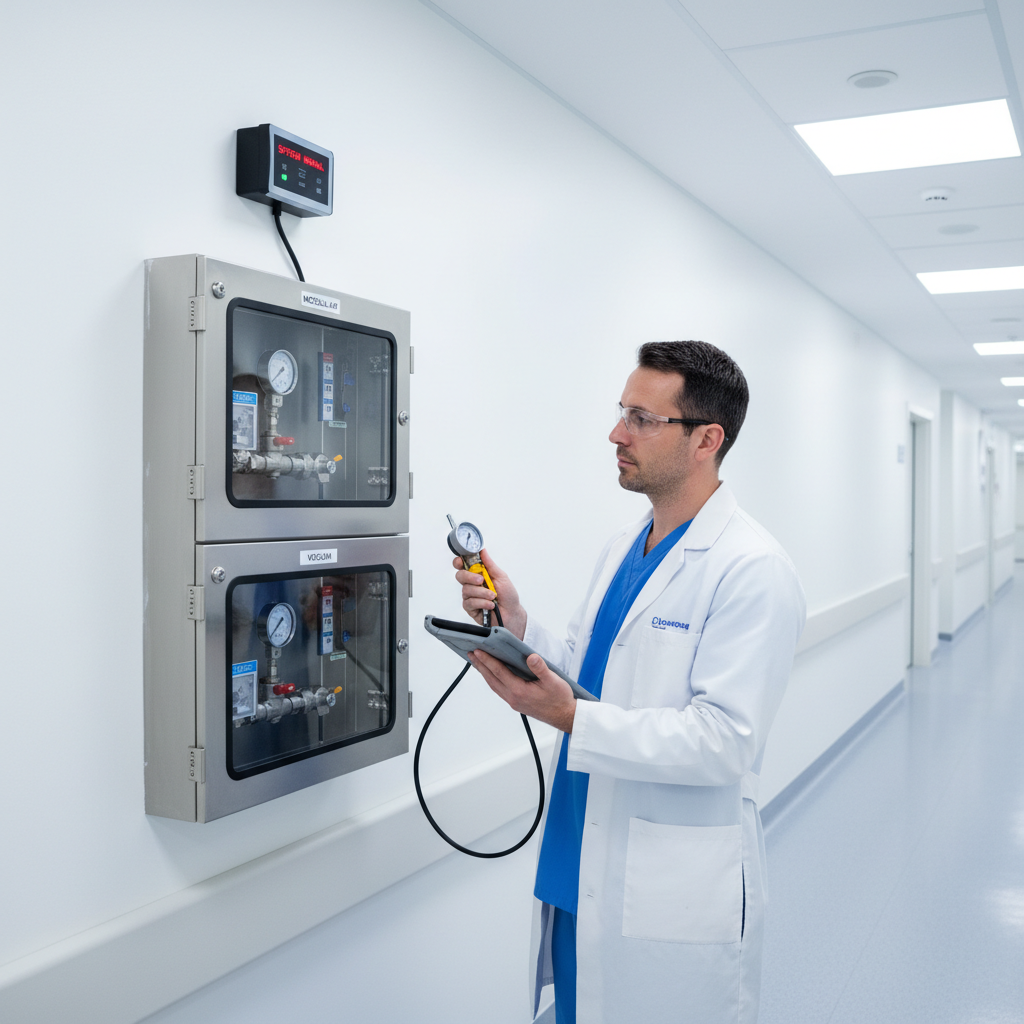
Zone valve boxes (ZVBs) isolate specific patient wings, operating suites, or departments during emergencies or line repairs (NFPA 99 Section 5.1.4).
During your annual review:
- Accessibility and Obstructions: Confirm that no carts, drywall, or aesthetic panels block immediate physical access to zone valve handles.
- Proper Labeling: Check that valve box placards explicitly state the gas type and the precise rooms or corridors controlled (e.g., "Medical Oxygen – OR Suites 1 through 4 only").
- Gauge Calibration: Verify that integrated zone gauges reflect actual line pressures within code tolerances.