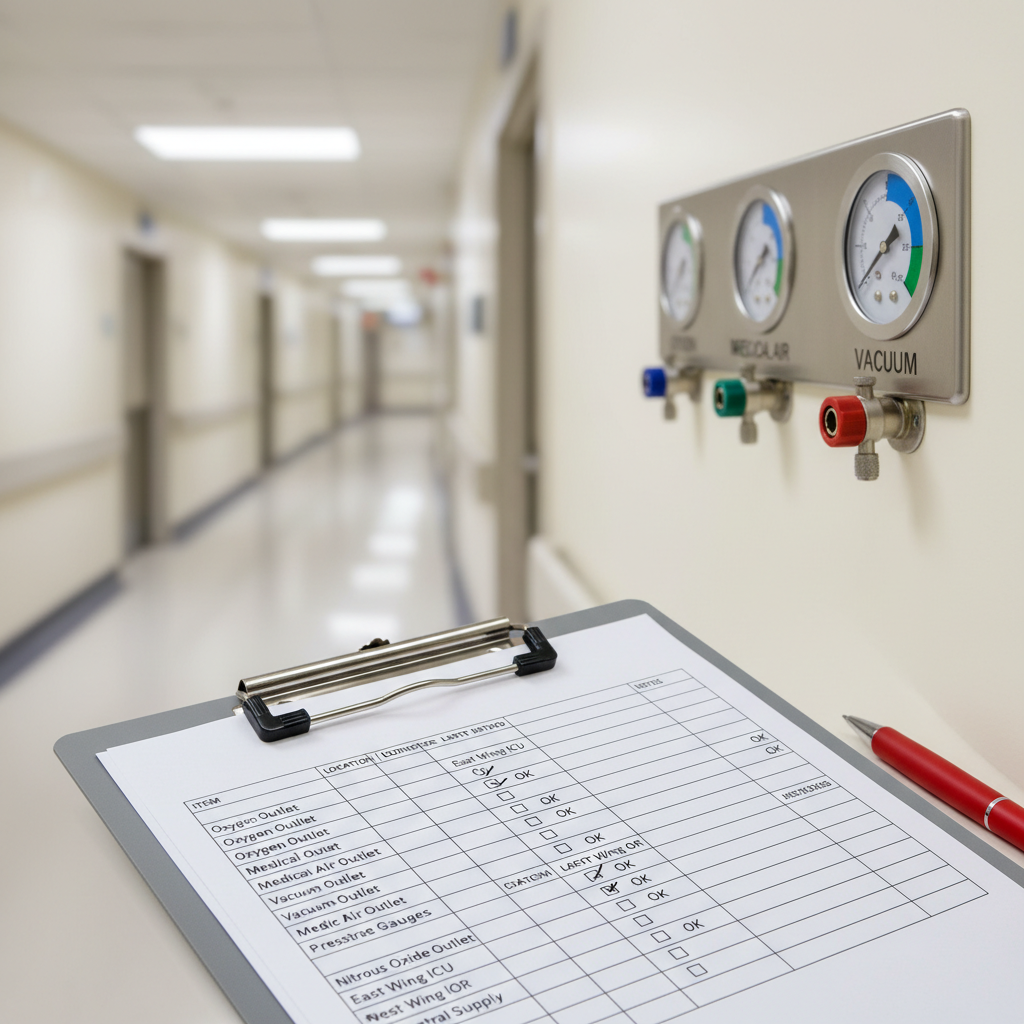
Medical Gas Testing Frequency: An Annual, Quarterly & Monthly Checklist
Medical Testing SolutionsAugust 28, 20265 min read
Share
Navigating the complex web of medical gas system testing requirements can be a significant challenge for any healthcare facility manager. Ensuring patient safety and maintaining regulatory compliance hinges on a precise and consistent testing schedule. This guide provides a definitive checklist for the annual, quarterly, and monthly medical gas testing frequencies mandated by the National Fire Protection Association (NFPA) 99, Health Care Facilities Code. Understanding these intervals is the first step toward building a robust compliance calendar and safeguarding your patients and staff.
In this post, you will learn:
The specific medical gas tests required at annual, quarterly, and monthly intervals.
Key differences between maintenance, testing, and certification.
The NFPA 99 and ASSE 6000 standards that govern these frequencies.
How to structure a compliance calendar for your facility.
Annual Medical Gas Testing Requirements
Annual testing forms the cornerstone of your medical gas system's safety and compliance program. These comprehensive checks ensure the system's integrity and performance over the long term. Per NFPA 99, all piped medical gas and vacuum systems must undergo a thorough inspection and testing procedure every year. This is where an annual medical gas inspection by an ASSE 6040 certified technician is crucial.
Source Equipment: Complete performance evaluation of all central supply systems, including compressors, vacuum pumps, manifolds, and bulk storage units. Technicians verify proper operation, check for leaks, and ensure automatic changeovers function as intended.
Alarms: All local and master alarm systems must be tested to confirm they activate under the specified fault conditions (e.g., pressure high/low, changeover). This is a critical safety function.
Outlets and Inlets: A representative sample of station outlets and inlets for each gas are tested for flow, pressure, and mechanical function. In patient care areas, at least one outlet in each room is typically tested.
System Labeling: Verification that all pipelines, valves, and station outlets are correctly and legibly labeled according to the gas they carry.
Why this matters for compliance: The annual inspection is your primary documentation proving the system was safe and functional throughout the year. It's a core requirement audited by regulatory bodies like The Joint Commission (TJC) and CMS.
Quarterly Medical Gas Testing Requirements
Quarterly checks are more focused and are designed to catch potential issues before they escalate. While less comprehensive than the annual inspection, they are vital for maintaining system reliability. These tests can often be performed by trained in-house staff, but must be documented rigorously.
Key Quarterly Inspection Points:
Area Alarms: All area alarm panels must be tested quarterly. This involves simulating a fault condition (e.g., by shutting off a zone valve) to ensure the alarm activates correctly, both audibly and visually.
Zone Valves: The accessibility and proper labeling of all zone valves should be confirmed. Staff must be able to locate and operate these valves quickly in an emergency.
Pressure Gauges: Visual inspection of all pressure and vacuum gauges on the central supply system and at area alarm panels to ensure they are providing accurate readings.
Monthly Medical Gas Testing Requirements
Monthly inspections are primarily visual and are intended to provide a regular snapshot of the system's operational status. These are typically performed by facility maintenance personnel.
Key Monthly Inspection Points:
Bulk Cryogenic Systems: For facilities with bulk liquid oxygen systems, monthly checks of the supply levels and system pressure are required by NFPA 99 (5.1.3.3.3). This ensures an uninterrupted supply of this life-critical gas.
Manifold Pressure: Check the pressure gauges on automatic changeover manifolds to ensure they are within the normal operating range.
Source Equipment Log Review: Review the operational logs for air compressors and vacuum pumps. Look for any unusual trends in runtime, temperature, or shutdown faults.
System Maintenance vs. Testing vs. Certification
It's important to understand the distinction between these three related, but distinct, activities.
Activity
Purpose
Performed By
Standard
Frequency
Maintenance
Proactive upkeep and repair of equipment (e.g., changing oil, replacing filters).
Facility Staff or Contractor
Manufacturer Specs
As recommended
Testing
Verifying system performance and alarm function against code requirements.
ASSE 6040 Certified Technician
NFPA 99
Annual, Quarterly, Monthly
Verification
Comprehensive testing of a new, modified, or repaired system before patient use.
ASSE 6030 Verifier
ASSE 6000 Series
Upon installation/modification
For any new construction or modification to your piped gas system, a full medical gas verification is non-negotiable. This process, performed by a company like Medical Testing Solutions, ensures that the system is safe for patient use and meets the stringent requirements of the ASSE 6000 series standards.
Creating Your Compliance Calendar
A well-organized compliance calendar is essential for keeping track of these varied requirements.
Step 1: Inventory Your System: Create a comprehensive list of all medical gas system components, including source equipment, alarm panels, and zone valves.
Step 2: Assign Frequencies: Using this guide, assign the appropriate monthly, quarterly, and annual testing frequency to each component.
Step 3: Assign Responsibility: Clearly designate whether a task is to be performed by in-house staff or a certified third-party vendor like Medical Testing Solutions.
Step 4: Document Everything: Maintain a detailed logbook for all testing and maintenance activities. This documentation is your proof of compliance for surveyors.
For facilities with "wet procedure locations" like operating rooms, LIM testing is another critical compliance task. NFPA 99 requires that these devices, which monitor the integrity of isolated power systems, are tested and documented at regular intervals. While specific frequency can vary, it's often performed in conjunction with other system checks. Proper Line Isolation Monitor testing is essential for protecting both patients and staff from the risk of electric shock.
Your Partner in Compliance
Staying on top of medical gas testing frequencies is a demanding but non-negotiable responsibility. The safety of your patients and the compliance of your facility depend on it. Medical Testing Solutions, an ASSE-certified company, provides comprehensive medical gas services, from installation and verification to routine maintenance and annual inspections.
Don't leave your compliance to chance. Contact our team of experts today for a free consultation or to request a quote for your facility's next inspection. Call us at (754) 315-1078 to ensure your systems are safe, reliable, and fully compliant.
Frequently Asked Questions
According to NFPA 99, inspections, testing, and maintenance of medical gas systems must be performed by qualified, competent individuals. The industry standard for this qualification is an ASSE 6040 Medical Gas Systems Verifier credential.
Missing a required test can result in a finding of non-compliance during a survey by The Joint Commission, CMS, or other accrediting organizations. This can jeopardize your facility's accreditation and reimbursement.
Medical gas certification generally refers to the initial verification of a new system (by an ASSE 6030 verifier) or the ongoing credentialing of the personnel who work on these systems (e.g., ASSE 6010 installers or 6040 verifiers). The periodic testing discussed here is part of maintaining that system's certified state.
Not always. While both are critical for safety, WAG monitoring is a separate requirement focused on OSHA exposure limits for staff. However, it is often convenient and cost-effective to schedule WAG chemical vapor monitoring at the same time as your annual medical gas system inspection.
Request a quote for your facility
Talk with Medical Testing Solutions about your next inspection, repair or equipment request.