Medical gas outlets are the critical final connection point between a facility's gas distribution system and the patient. A leaking, damaged, or malfunctioning outlet for oxygen, medical air, or vacuum can compromise patient safety, disrupt procedures, and lead to costly compliance issues. For healthcare facilities in Kendall, Florida, understanding the essentials of medical gas outlet repair is not just about maintenance, it’s about risk management. This guide provides a definitive overview of identifying common outlet failures, understanding the repair process according to NFPA 99 standards, and knowing when to call in ASSE-certified professionals for zone valve, outlet, and inlet repairs.
Medical Gas Service
Compliance & Standards
Medical Gas Outlet Repair in Kendall FL: A Complete Guide
Medical Testing SolutionsSeptember 12, 20268 min read
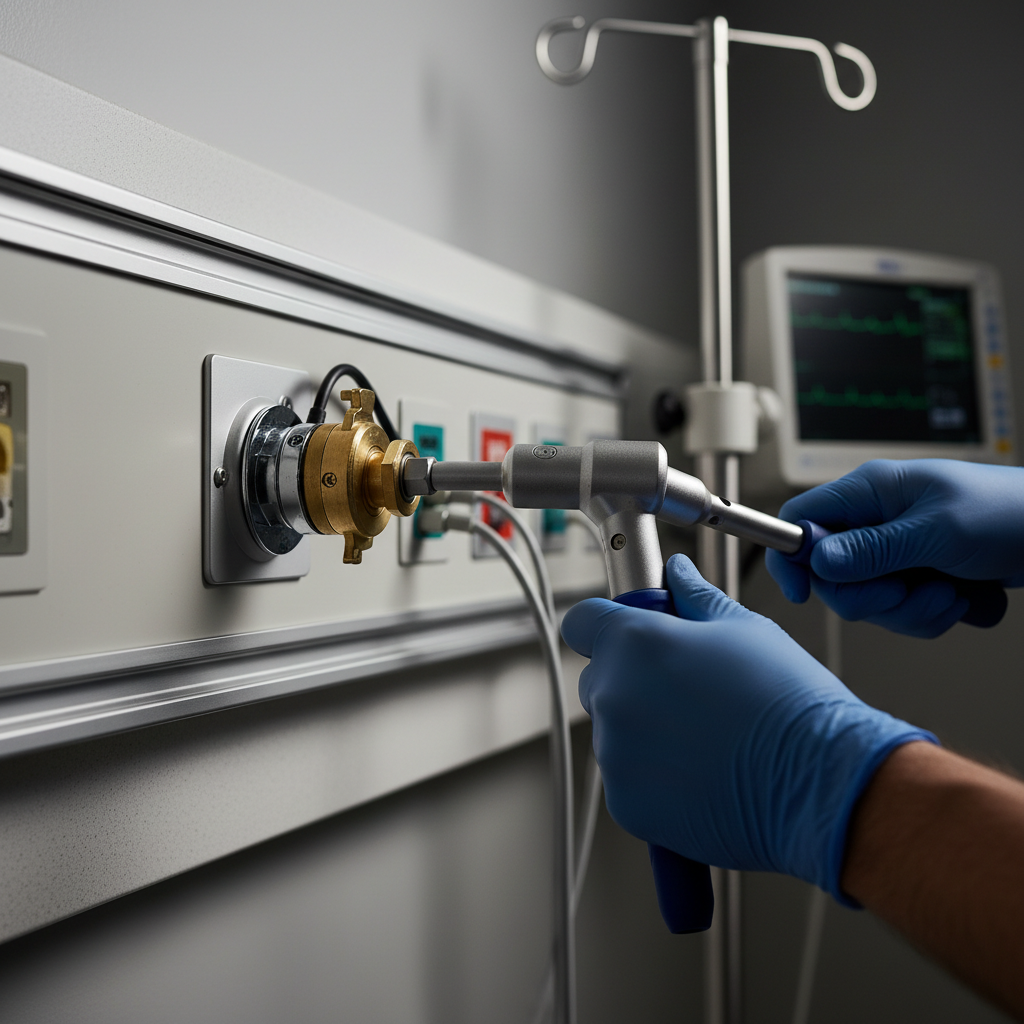
Understanding Medical Gas Outlets and Their Components
Medical gas outlets are sophisticated, gas-specific assemblies designed to prevent cross-connections. Each outlet, whether for Oxygen, Medical Air, Nitrous Oxide, or Vacuum, has a unique indexing system. The most common brands found in South Florida facilities are Ohmeda (now part of GE Healthcare), Chemetron (owned by Allied Healthcare Products), and Puritan-Bennett (part of Medtronic).
An outlet assembly consists of two main parts:
- The Rough-In Assembly: This is the portion installed within the wall or headwall unit, connected directly to the facility's copper piping. It includes the gas-specific valve body and pipeline connection.
- The Finishing Assembly (Latch Valve Assembly): This is the visible, user-facing part. It contains the primary seal, the secondary check valve, and the indexed faceplate that accepts the corresponding gas adapter.
Failures can occur in either part, but they most frequently happen in the finishing assembly due to the wear and tear of daily use.
Common Causes of Medical Gas Outlet Failure
Outlet failures are rarely spontaneous. They typically result from gradual wear, accidental damage, or improper use. Recognizing these signs early is key to preventing a critical failure.
Top 5 Reasons Your Outlets Are Failing:
- Worn Seals and O-Rings: The primary seal inside the outlet is a common failure point. Over time, these elastomeric components can dry out, crack, or become deformed, leading to persistent leaks.
- Damaged Faceplate or Indexing Pins: Dropping equipment, forceful insertion of adapters, or using the wrong adapter can damage the outlet's faceplate or the gas-specific indexing pins. This can lead to a poor seal or make it impossible to connect equipment.
- Secondary Check Valve Failure: The secondary check valve is a safety feature designed to stop gas flow when no adapter is inserted. If this valve fails, gas can leak freely from the outlet, creating a significant safety hazard.
- Physical Damage: Outlets located in high-traffic areas are susceptible to being struck by beds, carts, or other mobile equipment. This can crack the faceplate, damage the internal mechanism, or even compromise the pipe connection within the wall.
- Incorrect Latch-Release Motion: Users yanking adapters out at an angle instead of using the proper release mechanism (e.g., twisting the collar on an Ohmeda outlet) can strain and eventually break the internal latching components.
Why this matters for compliance: Leaking gas outlets are a direct violation of NFPA 99, Health Care Facilities Code. Section 5.1.14.2.3.4 requires that "Leaks in the piping distribution system...shall be located and repaired." A robust medical gas maintenance program is essential for staying compliant.
Identifying a Faulty Outlet: Troubleshooting Steps
Before calling for service, facility maintenance personnel can perform initial troubleshooting. You will need a low-pressure gauge and an adapter for the specific gas type.
- Audible Hissing: The most obvious sign of a leak. Pinpoint the source, is it from the outlet itself or the connected equipment?
- "Soft" Connection: Does the adapter feel loose or fail to "click" securely into place? This indicates a problem with the latching mechanism.
- Fluctuating Flow: If a connected flowmeter or ventilator shows pressure drops, the outlet may be providing inconsistent gas flow.
- Soap Bubble Test: For a suspected slow leak, a leak-detecting solution (like Snoop) can be carefully applied around the front of the outlet (with an adapter inserted) to visualize bubbling.
If you identify a leak or malfunction, the outlet should be immediately placed out of service, clearly labeled as "DO NOT USE," and professional repair should be scheduled.
The Repair Process: What to Expect
Repairing a medical gas outlet is not a standard plumbing job. It requires specialized knowledge and certification. At Medical Testing Solutions, our ASSE 6040 Certified Medical Gas Maintenance Personnel follow a strict protocol.
- Notification & Shutdown: The first step is coordinating with the affected department (e.g., patient room, OR, dental suite) to schedule the repair. The upstream zone valve for that area must be closed to isolate the outlet from the main gas line.
- Verification of Shutdown: The technician will verify that the line is depressurized by attempting to connect to the faulty outlet. This confirms the correct zone has been shut down.
- Disassembly & Inspection: The finishing assembly is carefully removed. The technician inspects the internal components, the rough-in valve body, and the seals for wear or damage.
- Repair or Replacement: Depending on the findings, the technician will either replace the worn components (seals, o-rings, latch parts) using an OEM repair kit or, if the damage is severe, replace the entire finishing assembly. The rough-in assembly is rarely replaced unless it has sustained major physical damage.
- Reassembly & System Repressurization: The repaired outlet is reassembled, and the zone valve is slowly reopened to repressurize the line.
- Testing & Verification: This is the most critical phase. The technician performs multiple tests to ensure the repair was successful:
- Outlet-Specific Static Pressure Test: Verifies the outlet holds pressure.
- Leak Testing: Checks for any leaks at the faceplate and seals.
- Component & Indexing Check: Ensures the correct gas-specific components are in place and that only the correct adapter can be inserted.
After a successful repair, the technician will complete the required documentation, and the outlet can be returned to service. Any major modification or replacement may require a mini-verification by an ASSE 6030 Certified Verifier as part of a comprehensive medical gas certification program.
Zone Valves, Outlets, and Inlets: Brand Comparison
While they serve the same function, the three major brands have different designs, which affects the repair process. Understanding these differences is key for technicians.
| Feature | Ohmeda Diamond™ | Chemetron (Allied) | Puritan-Bennett |
|---|---|---|---|
| Connection Style | Twist-and-lock collar | Push-to-connect, single-handed | Push-to-connect with a "DISS" style threaded housing |
| Indexing System | Gas-specific pin and hole configuration in faceplate | Latch-keyed faceplate with different shapes for each gas | Diameter Index Safety System (DISS) threading |
| Common Failure Point | Internal latching mechanism from improper removal | Primary o-ring seal wear | Damaged threads on the outlet or adapter |
| Repair Kit | Typically includes latch assembly, springs, and o-rings | Focuses on replacing the main poppet valve and seals | Often requires replacement of the entire front body assembly |
Medical Testing Solutions technicians are certified and experienced in repairing all major brands, ensuring the correct OEM parts and procedures are used every time. We also offer complete medical gas installation services for new facilities or renovations.
The Importance of ASSE 6040 Certification for Repairs
NFPA 99 (Section 5.1.14.2.2.5) states that repairs to medical gas systems shall be performed by individuals who are "qualified to perform such work." The industry standard for this qualification is the ASSE 6040 Medical Gas Maintenance Personnel certification. An ASSE 6040 certified technician has been trained and tested on:
- The specific requirements of NFPA 99 for maintenance and repair.
- The function and mechanics of outlets, zone valves, and alarms.
- Proper shutdown, isolation, and repair procedures.
- Testing protocols to verify the integrity of a repair.
Hiring a non-certified plumber or general maintenance person for these repairs puts your facility and patients at significant risk. An improper repair can lead to leaks, cross-connections, or catastrophic failures.
Preventative Maintenance: The Best Repair is the One You Avoid
Proactive maintenance is far more cost-effective than reactive repair. A scheduled maintenance program, as part of your annual medical gas inspections, can identify and address potential outlet issues before they become critical failures. A typical preventative maintenance check includes:
- Flow and pressure testing of a statistical sampling of outlets.
- Checking for leaks at each outlet.
- Verifying proper latching and release of adapters.
- Ensuring clear and correct labeling.
Your Trusted Partner for Medical Gas Repair in Kendall, FL
For healthcare facilities in Kendall and across South Florida, Medical Testing Solutions is the go-to provider for compliant medical gas services. Our team of ASSE-certified technicians provides expert repair, maintenance, and installation for all your medical and surgical gas systems. We have the expertise to service Ohmeda, Chemetron, Puritan-Bennett, and other brands, ensuring your facility remains safe, compliant, and fully operational.
Don't wait for a critical failure. If you have concerns about your medical gas outlets, need a repair, or want to establish a robust maintenance plan, contact the experts at MTS today.
Ready to ensure the safety and compliance of your medical gas systems? Request a quote online or call us directly at (754) 315-1078 to schedule your service.
Frequently Asked Questions
NFPA 99 requires that medical gas systems be inspected and tested annually. As part of this, a representative sampling of outlets should be checked for pressure, flow, and leaks. Outlets should also be tested any time a repair or modification is made.
It is strongly discouraged. NFPA 99 requires repairs to be done by qualified personnel (e.g., ASSE 6040 Certified). Using incorrect parts or procedures can create a life-threatening situation. Always use a certified professional like Medical Testing Solutions.
An outlet is the point of use where equipment is connected (e.g., in a patient room). A zone valve is an upstream ball valve, usually in a valve box in the hallway, that controls the gas supply to an entire area or "zone" containing multiple outlets.
Immediately label the outlet "DO NOT USE." If the leak is significant and you can hear it, close the zone valve for that area and contact a certified repair service immediately. An oxygen-enriched atmosphere creates a severe fire hazard.
For major repairs or new installations, an ASSE 6030 Certified Verifier performs a series of tests to confirm system integrity. This is more in-depth than a maintenance check and includes verifying gas purity, checking for cross-connections, and ensuring all pressures and flows meet code. It's a key part of our medical gas verification services.
A standard repair of the finishing assembly by a certified technician usually takes 30-60 minutes, including shutdown, testing, and documentation. This assumes the necessary repair kit is on hand.
Request a quote for your facility
Talk with Medical Testing Solutions about your next inspection, repair or equipment request.