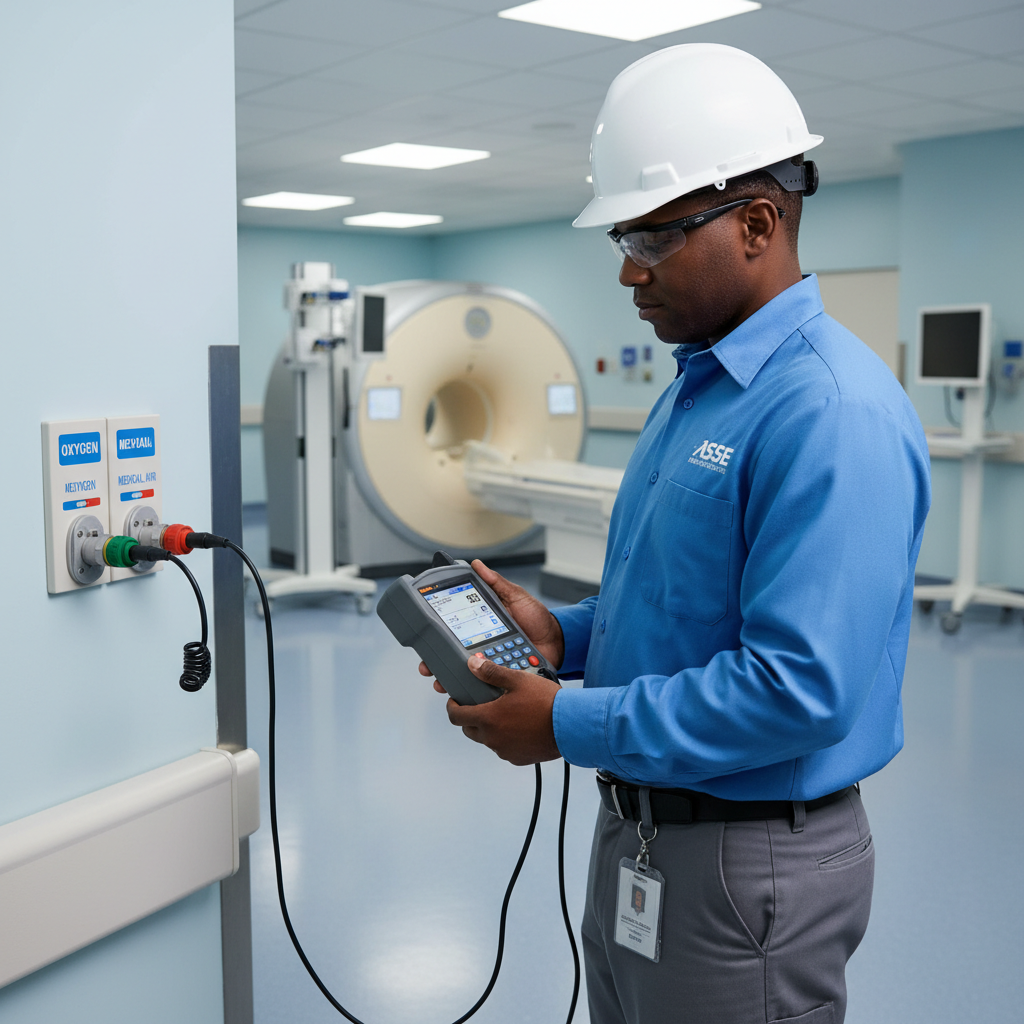
Medical Gas Inspection Checklist: Annual Audit Walkthrough
Medical Testing SolutionsOctober 31, 202614 min read
Share
Annual medical gas testing is a vital regulatory requirement and a critical life-safety mandate. Under NFPA 99 (Health Care Facilities Code), healthcare systems must demonstrate that patient-breathing gases, surgical vacuum lines, and supporting alarms perform within strict design and purity parameters. Failing an inspection can trigger immediate accreditation findings from The Joint Commission (TJC), CMS, or local Authorities Having Jurisdiction (AHJs), or worse, jeopardize patient safety during life-critical operations.
This definitive walkthrough breaks down the medical gas inspection checklist: annual audit walkthrough step by step. Whether you are an ASSE 6040 maintenance technician, facility engineer, safety director, or compliance manager, you will learn how an ASSE 6020/6030/6040 certified team conducts a line-by-line evaluation of Category 1 and Category 2 piping networks. We will cover source equipment, main line valves, zone valve boxes, master and area alarms, terminal units, cross-connection prevention, gas purity baselines, and how to maintain an audit-proof inventory.
1. Regulatory Governance: NFPA 99, ASSE 6000, and The Joint Commission
Annual testing of piping networks is not optional. Multiple standards enforce mandatory annual and periodic maintenance protocols:
NFPA 99 (Health Care Facilities Code): Chapter 5 defines Category 1 through Category 4 piped systems. Category 1 systems, where equipment failure causes major injury or death, require strict routine maintenance, preventative testing, operational documentation, and annual re-verification.
ASSE 6000 Series (Professional Qualifications Standard):
ASSE 6010: Medical Gas Systems Installers.
ASSE 6020: Medical Gas Systems Inspectors.
ASSE 6030: Medical Gas Systems Verifiers.
ASSE 6040: Medical Gas Systems Maintenance Personnel.
The Joint Commission (TJC) Environment of Care (EC.02.05.09): Mandates that hospitals inspect, test, and maintain critical piping, alarms, and source equipment, retaining complete maintenance records for AHJ review.
Why this matters for compliance: An uncertified contractor testing your facility exposes your hospital to citations under EC.02.05.09. Accrediting organizations require that testing personnel possess documented credentials conforming to ASSE 6020, ASSE 6030, or equivalent jurisdictional standards. Partnering with Medical Testing Solutions ensures all field technicians are fully ASSE-credentialed and up to date on current code editions.
2. Pre-Audit Preparation and System Documentation Review
Before stepping into mechanical rooms or surgical suites, an inspector reviews physical schematics, valve charts, and past maintenance records.
Document & Asset Verification
Piping Schematics & As-Builts: Confirm updated riser diagrams accurately show branch runs, isolation valves, and zone valve locations.
Equipment Inventory: Compare the asset list against physical hardware (source pumps, manifolds, area alarm panels, emergency oxygen supply connections).
Historical Testing Records: Verify past annual test reports, particulate/purity lab data, and corrective action logs for resolved discrepancies.
Preventive Maintenance (PM) Logs: Review routine filter changes, dew point sensor calibrations, oil changes, and desiccant replacements executed under medical gas maintenance services.
3. Medical Gas Source Equipment Inspection
Central supply systems provide continuous, life-supporting pressure. A failure here affects an entire facility wing or operating pavilion.
| Diagram text |
|, |
| CENTRAL SUPPLY INSPECTION MAP |
| [ Bulk Liquid / Manifolds ] [ Medical Air Plant ] [ Medical Vacuum / WAGD ] |
| • Cylinder securement • Desiccant dryers • Duplex/Triplex pumps |
| • Relief valve vents • Dew point & CO sensors • Exhaust ducting |
| • Line pressure regulators • Auto-drain traps • Fluid traps |
High-Pressure Manifolds & Bulk Cryogenic Systems (NFPA 99, 5.1.3.5)
Cylinder Storage and Restraints: Verify all cylinders (Oxygen, Nitrous Oxide, Carbon Dioxide, Medical Air) are chained or secured in approved racks. Segregate full and empty cylinders per CGA P-2.
Manifold Automatic Switchover: Test the changeover mechanism by bleeding the active header to verify seamless transition to the reserve bank without system pressure drops below nominal limits.
Relief Valves & Vent Piping: Ensure relief valves are vented outdoors away from intake air louvers, personnel walkways, and ignition sources.
Bulk Liquid Oxygen (VIE): Check liquid levels, head pressures, economizer circuits, and the Emergency Oxygen Supply Connection (EOSC) pad for accessibility and clear signage.
Medical Air Compressor Systems (NFPA 99, 5.1.3.6)
Medical air must meet stringent purity standards because it enters patient lungs directly.
Compressor Configuration: Confirm a duplex (or multi-unit) arrangement where the system handles peak load with the largest compressor off-line.
Intake Location: Ensure the outdoor air intake is located a minimum of 25 feet from building exhausts, sewer vents, engine exhausts, and incinerators, and at least 10 feet from doors or windows.
Air Treatment Train:
Air Dryers: Check twin-tower regenerative desiccant dryers or refrigerated units for switching cycles.
Filtration: Inspect pre-filters, coalescing filters, and particulate after-filters for differential pressure.
Condensate Drains: Test automatic timed or zero-loss mechanical float drains for proper discharge.
Continuous Monitors: Test and calibrate carbon monoxide (CO) alarms (alarm setting: $\ge 10\text{ ppm}$) and dew point monitors (alarm setting: $\ge -4^\circ\text{C}$ or $39^\circ\text{F}$ at 50 psig).
Medical Vacuum and WAGD Pumps (NFPA 99, 5.1.3.7 & 5.1.3.8)
Pump Redundancy: Check duplex, triplex, or quadruplex configurations under simulated full-load capacity.
Vacuum Level Stability: Ensure the source sustains minimum operational vacuum ($\ge 12\text{ inHg}$) during peak demand.
Exhaust Lines: Confirm vacuum pump and Waste Anesthetic Gas Disposal (WAGD) exhausts terminate outdoors, turned down, with insect screens installed, separated from outside air intakes.
Fluid Separator / Traps: Drain and clean collection canisters ahead of the vacuum pumps. For related clinical scavenger lines, facility teams often verify anesthetic limits using professional WAG chemical vapor monitoring.
4. Master and Area Alarm Systems Walkthrough
Alarms provide the warning window between a minor mechanical anomaly and a critical patient outage.
| Diagram text |
|, |
| ALARM TESTING PROTOCOL |
| [ Master Alarm Panels ] [ Area Alarm Panels ] |
| • Redundant locations (24/7 staffed) • Visible from nurses' stations |
| • Dual power sources • ±20% pressure/vacuum drift trip |
| • Discrete signal testing • Audible/visual cancel actions |
Master Alarm Panels (NFPA 99, 5.1.9.2)
NFPA 99 mandates two master alarm panels in separate locations: one in the main engineering control room and one in an area staffed 24/7 (such as security dispatch or telephone switchboard).
Signal-by-Signal Verification: Never rely solely on the panel "lamp test" button. Physical switches or sensor transducers must be tripped at the source:
Medical Air high dew point.
Medical Air high carbon monoxide.
Bulk cryogenic liquid level low.
Reserve in-use / reserve failure.
Compressor / vacuum pump operating on alternate unit.
Line pressure high/low ($\pm 20%$ deviation from normal).
Wiring & Communication: Verify continuous supervised wiring; open-loop or short-circuit faults must trigger immediate trouble alarms.
Area Alarm Panels (NFPA 99, 5.1.9.3)
Area alarms protect critical care areas (Operating Rooms, Post-Anesthesia Care Units, ICUs, Emergency Departments, and Labor & Delivery).
Location & Visibility: Panels must sit outside critical zones, directly in line of sight of the primary nursing station.
Sensor Calibration: Calibrate pressure transducers against calibrated pressure standards:
Positive gases (Oxygen, Medical Air, Nitrous Oxide, Carbon Dioxide): Alarm must activate at $\pm 20%$ of nominal system pressure (e.g., $50\text{ psig} \rightarrow \text{alarms at } 40\text{ psig and } 60\text{ psig}$).
Vacuum: Alarm must actuate when pressure drops below $12\text{ inHg}$.
Audio/Visual Silencing: Test the silence push button. The visual LED indicator must remain red until the pressure condition normalizes.
5. Main Line, Riser, and Zone Valve Box (ZVB) Inspection
Isolation valves are crucial for emergency shutdowns during fire emergencies or piping work.
Component
Standard Reference
Primary Inspection Parameter
Critical Failure Mode
Source Valve
NFPA 99, 5.1.4.2
Immediate accessible shutoff at the plant
Seized quarter-turn ball valve
Main Line Valve
NFPA 99, 5.1.4.3
Located in machinery room / point of entry
Missing label or locked out incorrectly
Riser Valve
NFPA 99, 5.1.4.4
Base of each vertical riser supply pipe
Blocked ceiling tile access; no tag
Zone Valve Box (ZVB)
NFPA 99, 5.1.4.5
Placed outside critical areas on same floor
Mislabeled zones; trapped door hinge
In-Line Valve
NFPA 99, 5.1.4.9
Isolates sub-branches without stopping zone
Hidden behind drywall without access doors
Zone Valve Box (ZVB) Field Checks
Physical Accessibility: Confirm zero physical obstructions within 3 feet of the box face.
Pressure Gauge Accuracy: Ensure gauges read within $\pm 5%$ of actual line pressure.
Label Verification: Ensure the label correctly designates:
Gas name and chemical symbol.
Color code compliant with CGA C-9.
Specific room or zone served (e.g., "OR Suites 1–4 Only").
Operational Function: Exercise the quarter-turn handle to confirm smooth shut-off without binding, valve stem leakage, or packing blowout.
6. Terminal Units: Outlets, Inlets, and Cross-Connection Testing
Connection Compatibility: Test for physical wear on Diameter Index Safety System (DISS) threads or proprietary quick-connects (Chemetron, Ohmeda, Puritan-Bennett, Schrader).
Anti-Interchangeability Check: Physically verify that adapters designed for one gas cannot engage an alternate gas outlet.
Dynamic Flow and Static Pressure Drops (NFPA 99, 5.1.12.3.10)
Inspectors attach a calibrated gas flow analyzer and test load to measure:
Static Pressure: Confirm nominal baseline ($50\text{–}55\text{ psig}$ for air, oxygen, $\text{N}_2\text{O}$; $160\text{–}185\text{ psig}$ for surgical instrument air or nitrogen).
Dynamic Flow: Impose a high flow rate:
Medical Air / Oxygen: Continuous flow of $3.5\text{ SCFM}$ ($100\text{ LPM}$) with a pressure drop not exceeding $5\text{ psig}$.
Vacuum Inlets: Flow rate of $3.0\text{ SCFM}$ ($85\text{ LPM}$) while maintaining a working vacuum $\ge 12\text{ inHg}$.
Secondary Valve Checks: Remove the male adapter to confirm the spring-loaded secondary poppet seals instantly without continuous micro-leaks.
7. Medical Gas Purity, Particulate, and Concentration Testing
Piping degradation, failed filter media, or desiccant breakdown can introduce dangerous contaminants into breathing gas streams. Annual analytical testing confirms purity down to parts-per-million (ppm).
| Diagram text |
|, |
| PURITY TESTING MATRIX |
| Gas Type Parameter NFPA 99 / CGA Limit |
| ───────── ───────── ─────────────────── |
| Medical Air Carbon Monoxide ≤ 10 ppm |
| Medical Air Dew Point ≤ -4°C (39°F) at 50 psig |
| Medical Air Carbon Dioxide ≤ 500 ppm |
| Medical Air Gaseous Hydrocarbons≤ 25 ppm (as Methane) |
| Medical Air Halogenated Solvents≤ 2 ppm |
| Medical Air Particulates Zero visible, < 1 mg/m³ at 1 µm |
| Oxygen (USP) Concentration ≥ 99.0% (Bulk) / ≥ 93.0% (93-Gen) |
| Nitrous Oxide Concentration ≥ 99.0% |
| Carbon Dioxide Concentration ≥ 99.0% |
Particulate Testing: Flow terminal gas through a $0.45\text{-micron}$ filter membrane at high velocity to detect copper scale, metal filings, or desiccant dust.
Moisture Content: Test lines for dew point elevation indicating moisture accumulation, which can cause fungal growth or bacterial biofilm formation inside distribution piping.
8. Specialty Systems: LIMs, Dental Units, and Environmental Isolation
Line Isolation Monitors (LIM): Operating rooms and wet procedure locations rely on isolated power systems. Routine testing is critical to avoid electrical micro-shocks to patients on conductive tables. Annual inspections require testing hazard currents and meter responsiveness via specialized line isolation monitor testing.
Dental Sedation Equipment: Outpatient clinics, oral surgery suites, and dental operatories using nitrous-oxygen delivery systems require calibrated precision. Flowmeters require certified maintenance under dedicated dental flowmeter repair and calibration protocols.
Barrier Isolation: Facilities compounding sterile pharmaceuticals require compliance checks under cleanroom environmental standards like USP 797/800 compliance.
Secondary check poppets tested for zero leakage when demounted
Anti-cross-connection testing confirmed across every single gas drop
E. Analytical Purity Testing
Oxygen concentration verified ($\ge 99.0%$ or $\ge 93.0%$ for Oxygen 93 systems)
Medical Air verified for CO ($\le 10\text{ ppm}$) and $\text{CO}_2$ ($\le 500\text{ ppm}$)
Nitrous Oxide and Carbon Dioxide concentration verified ($\ge 99.0%$)
Particulate and halogenated solvent tests completed with zero particulate retention
10. Turning Audit Findings into a Complete Compliance Dossier
An annual inspection is only as good as the documentation that defends it during a survey. Following field evaluations, your certified inspector should assemble an audit binder containing:
Executive Summary: A clear breakdown of system status, immediate life-safety issues, and prioritized corrective actions.
Asset Inventory: A catalog of all tested outlets, valves, panels, and source systems, referenced by floor, wing, and department.
Calibration Certificates: Factory or NIST-traceable certificates for all analytical instrumentation, multi-gas analyzers, and pressure transducers used during the audit.
ASSE Credentials: Proof of the inspector's active ASSE 6020/6030 certifications.
Regulatory compliance is a continuous operational discipline. Medical Testing Solutions (MTS) provides healthcare facilities, surgical hospitals, and clinics nationwide with comprehensive, ASSE-certified medical gas testing, maintenance, and verification. Our team uses NIST-traceable digital instrumentation to keep your facility compliant, audit-ready, and safe for patients.
Ready to bring your medical gas networks into full NFPA 99 compliance?
Inspectors must be certified under ASSE Professional Qualification Standard 6020 (Medical Gas Systems Inspector) or ASSE 6030 (Medical Gas Systems Verifier). These credentials verify demonstrated competence in NFPA 99, NFPA 55, and related CGA safety parameters.
NFPA 99 mandates periodic inspection of all terminal units. Most healthcare facilities inspect 100% of outlets/inlets annually to ensure proper mechanical latching, zero leakage, dynamic flow rates, and anti-cross-connection compliance.
For patient medical gases (Oxygen, Medical Air), static pressure must remain around 50-55 psig. Under an applied flow rate of 3.5 SCFM (100 LPM), the line pressure drop must not exceed 5 psig at the terminal fitting.
Facility technicians holding ASSE 6040 certification can handle routine PMs. However, third-party annual audits, cross-connection prevention, and analytical purity profiles are best performed by independent ASSE 6020/6030 certified specialists for uncompromised compliance.
If an area alarm fails to signal within +/-20% of operational pressure, the pressure transducer must be calibrated or swapped immediately. If patient monitoring is affected, an Interim Life Safety Measure (ILSM) must be implemented until repaired.
Request a quote for your facility
Talk with Medical Testing Solutions about your next inspection, repair or equipment request.