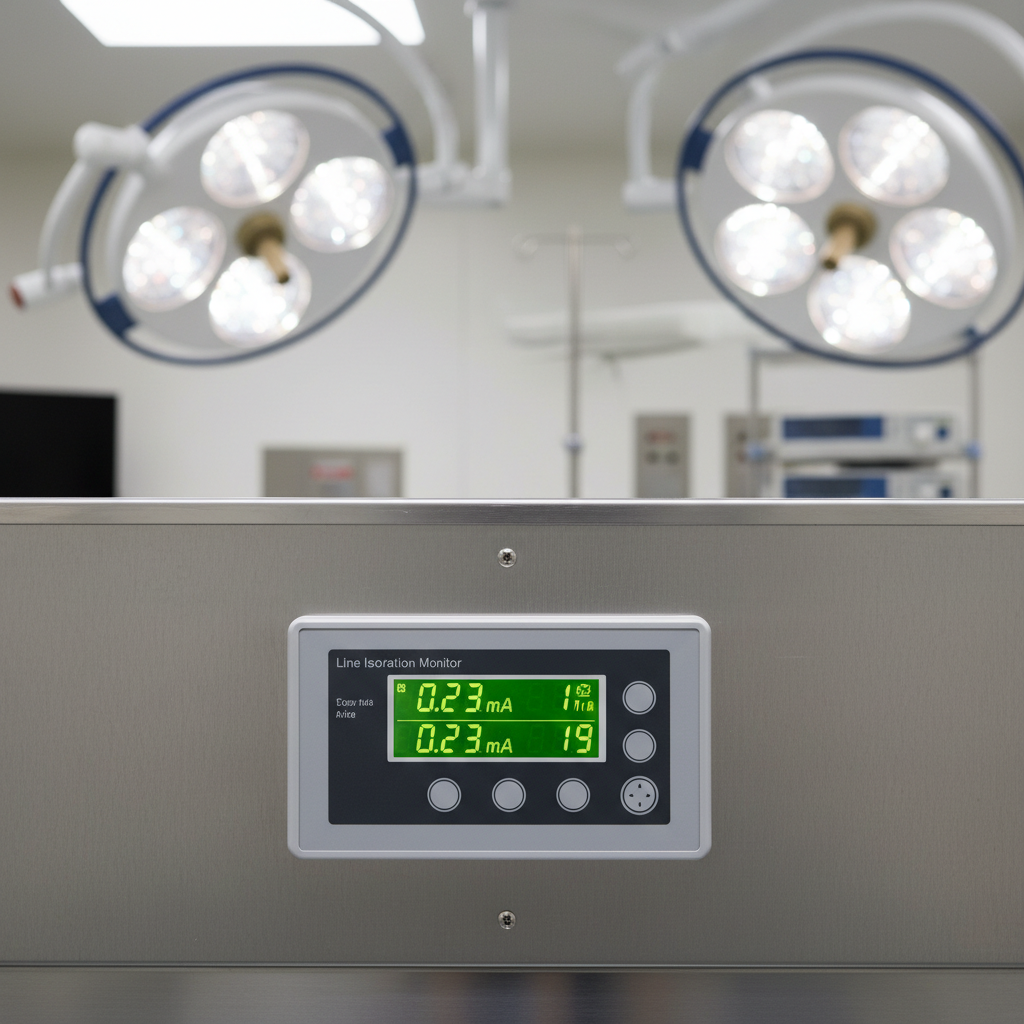
Line Isolation Monitor Total Hazard Current Explained
Medical Testing SolutionsNovember 14, 20269 min read
Share
When a surgical boom technician plugs a fourth high-definition video tower into an operating room wall receptacle and the alarm panel immediately screams at 5.2 milliamperes, nothing is necessarily broken. There is no dead short. No breaker has tripped, and power continues flowing to the patient table. Instead, the cumulative capacitive and resistive leakage of the room's wiring and medical devices has pushed the line isolation monitor total hazard current past its statutory threshold.
Clinical engineers and facility managers frequently misdiagnose this alarm as a single catastrophic ground fault. In reality, a Line Isolation Monitor (LIM) measures a predicted value rather than active fault current flowing to ground. Understanding how transformer capacitance, wiring runs, and portable surgical equipment combine into Total Hazard Current (THC) is essential for keeping operating rooms compliant with NFPA 99 without disrupting surgical schedules.
Defining Total Hazard Current in Isolated Power Systems
Total Hazard Current is the theoretical maximum current that would flow through a low-impedance fault if either isolated conductor (Line 1 or Line 2) were directly connected to ground. Because an isolated power system (IPS) uses an isolation transformer with an ungrounded secondary winding, normal line-to-ground leakage is extremely small.
However, the LIM itself must connect to both lines and reference ground to continuously measure the system's impedance. That measurement circuit injects a minuscule amount of current of its own. Therefore, NFPA 99 Chapter 6 and UL 1022 define Total Hazard Current as the vector sum of two distinct components:
Fault Hazard Current (FHC): The hazard current of a given isolated system with all devices, branch circuits, and the isolation transformer connected, excluding the monitor itself.
Monitor Hazard Current (MHC): The hazard current contributed solely by the Line Isolation Monitor's internal sensing circuitry.
Mathematically, Total Hazard Current equals Fault Hazard Current plus Monitor Hazard Current. In modern digital micro-processor LIMs (such as Bender Isowatch or PG LifeLink units), the Monitor Hazard Current is exceptionally low, typically around 25 microamperes (0.025 mA). Older analog switching monitors from the 1980s and 1990s can contribute up to 1.0 mA of MHC on their own, eating up 20 percent of your total alarm budget before a single surgical light is turned on.
Why this matters for compliance: Under NFPA 99 (Health Care Facilities Code) Section 6.3.2.6.3.3, the Line Isolation Monitor must be designed to alarm when the Total Hazard Current reaches a threshold of 5.0 mA (with an allowable tolerance band between 3.7 mA and 5.0 mA) under nominal line voltage conditions. It must explicitly not alarm for a fault hazard current of less than 3.7 mA minus the monitor hazard current.
How Capacitive and Resistive Leakage Combine
An ungrounded secondary circuit in an operating room is not completely divorced from earth ground. Even with pristine insulation, alternating current interacts with the physical geometry of the copper conductors and the steel conduit surrounding them. This interaction splits Fault Hazard Current into two electrical vectors that sit 90 degrees out of phase with one another: capacitive leakage and resistive faults.
Capacitive Reactance in Branch Circuits
Every foot of branch circuit wiring running from the isolated power panel to the operating room receptacles acts like a miniature capacitor. The copper wire is one plate, the grounded steel conduit or equipotential ground bus is the other plate, and the conductor insulation serves as the dielectric material. At 60 Hz AC, this natural capacitance allows a tiny alternating current to couple to ground.
Because capacitance is directly proportional to surface area and inversely proportional to insulation thickness, long wire runs and older THHN conductors generate noticeably higher baseline capacitive readings. That is why NFPA 99 specifies using low-leakage, cross-linked polyethylene (XHHW) insulation with a low dielectric constant for isolated power branch circuits. Every linear foot of XHHW wire adds roughly 0.003 mA (3 microamperes) of capacitive hazard current. A surgical suite with 800 total feet of branch wiring starts with nearly 2.4 mA of baseline capacitive current on the display before any equipment is plugged in.
Resistive Line-to-Ground Faults
Resistive leakage occurs when physical insulation degrades, moisture penetrates a floor box, or carbon dust builds up inside an electro-surgical unit's power supply. Unlike capacitive current, resistive current is in phase with the system voltage. When a saline bag spills onto a power strip in a wet procedure location, it creates a direct resistive bridge between an isolated hot conductor and the grounded chassis.
Phasor Addition vs. Arithmetic Addition
Because capacitive current leads voltage by 90 degrees and resistive current is in phase with voltage, the two do not add up using simple arithmetic. Instead, modern LIMs calculate the vector sum (hypotenuse of a right triangle) of resistive and capacitive impedance. If a room has 3.0 mA of pure capacitive leakage and a piece of equipment introduces a 3.0 mA pure resistive fault, the resulting Fault Hazard Current is not 6.0 mA, it is the square root of ($3^2 + 3^2$), which equals 4.24 mA.
If your facility is struggling with nuisance alarms or failing annual audits, schedule line isolation monitor testing with Medical Testing Solutions to verify your panel calibration and branch circuit impedance.
Comparing THC Breakdown Across System States
To visualize how baseline wiring, monitor generation, and medical devices interact against the 5.0 mA threshold, review the comparison table below. It contrasts three real-world operating room scenarios during an inspection.
System Parameter
Modern Digital IPS (Normal State)
Legacy Analog IPS (High Baseline)
Active Hybrid Fault Scenario
Monitor Hazard Current (MHC)
0.025 mA
0.85 mA
0.025 mA
Branch Wiring Capacitance
1.10 mA (XHHW wire)
2.40 mA (Aged THHN)
1.35 mA
Connected Device Leakage
1.20 mA (4 devices)
1.60 mA (4 devices)
2.10 mA (6 devices)
Active Resistive Ground Fault
0.00 mA
0.00 mA
2.90 mA (Saline intrusion)
Total Hazard Current (THC)
2.33 mA
4.85 mA
5.12 mA
LIM Status (NFPA 99 6.3.2.6)
Green (Normal)
Green (Near Threshold)
Red / Audible Alarm (>5.0 mA)
Notice how the legacy analog system sits at 4.85 mA with zero defective equipment. Plugging in a single blood warmer with 0.3 mA of normal RF filter leakage will trip the room into alarm. Upgrading an outdated analog gauge to a modern digital LIM instantly drops the MHC by over 0.8 mA, restoring usable head-room for surgical devices without rewiring the room.
Why the 5 mA Alarm Threshold Exists
The 5.0 mA ceiling is rooted in physiological ventricular fibrillation studies and equipment protection standards. In a standard grounded electrical system, a line-to-ground fault pulls tens or hundreds of amps until the 20-amp thermal-magnetic circuit breaker trips. In an operating room defined as a Wet Procedure Location under NFPA 99 Section 6.3.2.2.8, a tripped breaker plunges the surgical team into darkness or shuts down perfusion pumps mid-procedure.
An isolated power system prevents that first fault from tripping the breaker. Because the secondary neutral is not bonded to ground, a single line-to-ground fault simply grounds that one leg, converting the ungrounded system into a functioning grounded system while keeping all equipment running. The LIM alarms at 5.0 mA to warn the clinical staff that their isolation safety margin is gone. If a second fault occurs on the opposite line conductor while the first fault is still active, a line-to-line short circuit will occur, tripping the breaker.
Furthermore, UL 544 and UL 60601-1 standards limit the allowable chassis leakage current of individual medical devices (typically 0.1 mA to 0.5 mA per unit). The 5.0 mA system budget allows an operating room to safely power roughly 8 to 12 pieces of life-support equipment simultaneously before reaching the warning limit.
Field Troubleshooting High Total Hazard Current Alarms
When a Line Isolation Monitor goes into alarm during a procedure or an annual medical gas and electrical safety inspection, technicians must determine whether the spike is caused by cumulative capacitance (too many devices) or a true resistive insulation failure.
Isolating Portable Equipment Faults
When the alarm sounds in an active room, clinical staff should always look at the last device plugged in. Unplugging equipment one by one while watching the LIM meter bar is the fastest diagnostic method. If unplugging a portable C-arm drops the THC from 5.3 mA to 1.8 mA, that C-arm has a compromised power cord or failing EMI filter and must be tagged out for biomedical repair. However, if unplugging five different carts drops the reading by 0.7 mA each time, there is no defective device, the surgical team has simply overloaded the capacitive budget of that single isolated panel.
Diagnosing Branch Circuit Degradation
If the LIM displays a high Total Hazard Current (for example, 3.5 mA or higher) with every receptacle in the room empty, the issue lies inside the walls or the panelboard. Our field technicians at Medical Testing Solutions isolate the fault by opening the branch circuit breakers inside the isolated power panel one at a time:
Record the baseline THC with all branch breakers closed and all room receptacles unplugged.
Open each two-pole branch breaker sequentially while observing the LIM display.
Identify the disproportionate drop: Normal branch circuits will drop the THC reading by 0.1 to 0.3 mA per breaker due to wire capacitance. If opening Breaker 4 drops the reading by 2.8 mA, that specific branch has moisture intrusion, pinched insulation in a junction box, or a damaged receptacle.
Measure insulation resistance on the isolated conductors using a calibrated megohmmeter (with the LIM disconnected) to pinpoint the breakdown.
Facility directors frequently combine their isolated power testing with comprehensive medical gas maintenance services and ASSE 6030 medical gas verification to streamline operating room downtime. During a single scheduled night-shift window, Medical Testing Solutions can verify your OR zone valves, outlets, alarms, and isolated power panels, delivering unified documentation for Joint Commission or AHCA surveyors. Whether your facility requires medical gas certification or replacement monitoring hardware from our products catalog, keeping THC readings documented and within code tolerances protects both your patients and your accreditation.
Ready to bring your operating room isolated power systems and medical gas networks into full NFPA 99 compliance? Request a quote online or call Medical Testing Solutions directly at (754) 315-1078 to schedule your certified inspection.
Frequently Asked Questions
Total Hazard Current (THC) is the sum of Fault Hazard Current (FHC) and Monitor Hazard Current (MHC). Fault Hazard Current comes from the natural capacitive leakage of the branch circuit wiring plus any resistive or capacitive leakage from plugged-in medical equipment. Monitor Hazard Current is the small internal current injected by the Line Isolation Monitor itself to measure system impedance.
Per NFPA 99 Section 6.3.2.6.3.3, a Line Isolation Monitor must alarm when the Total Hazard Current reaches 5.0 milliamperes (mA) under nominal voltage conditions, with a permissible tolerance floor down to 3.7 mA. It must not alarm when the fault hazard current is below 3.7 mA minus the monitor hazard current.
Yes. Every piece of medical equipment contains EMI filters and power supplies that leak a small amount of current (typically 0.1 to 0.5 mA) to ground. When a surgical team plugs too many high-draw devices into a single isolated power panel, the cumulative leakage adds to the branch wiring capacitance and pushes Total Hazard Current over 5.0 mA without any single device being defective.
When a LIM alarms at 5 mA, circuit breakers do not trip and power remains on. The alarm warns staff that the first line-to-ground fault (or excessive cumulative leakage) has occurred, converting the ungrounded system into a grounded system. Staff should unplug the most recently connected non-life-support device to see if the THC drops below 5.0 mA.
Older analog switching LIMs often have a Monitor Hazard Current (MHC) of 0.5 mA to 1.0 mA, which consumes up to 20 percent of the 5.0 mA alarm budget before any wiring or devices are accounted for. Modern digital microprocessor LIMs have an MHC of roughly 0.025 mA, giving operating rooms nearly a full milliampere of extra capacity for surgical equipment.
Request a quote for your facility
Talk with Medical Testing Solutions about your next inspection, repair or equipment request.