Cardiac Cath Lab Isolated Power Testing Orlando: NFPA 99 Compliance
Medical Testing SolutionsNovember 13, 202610 min read
Share
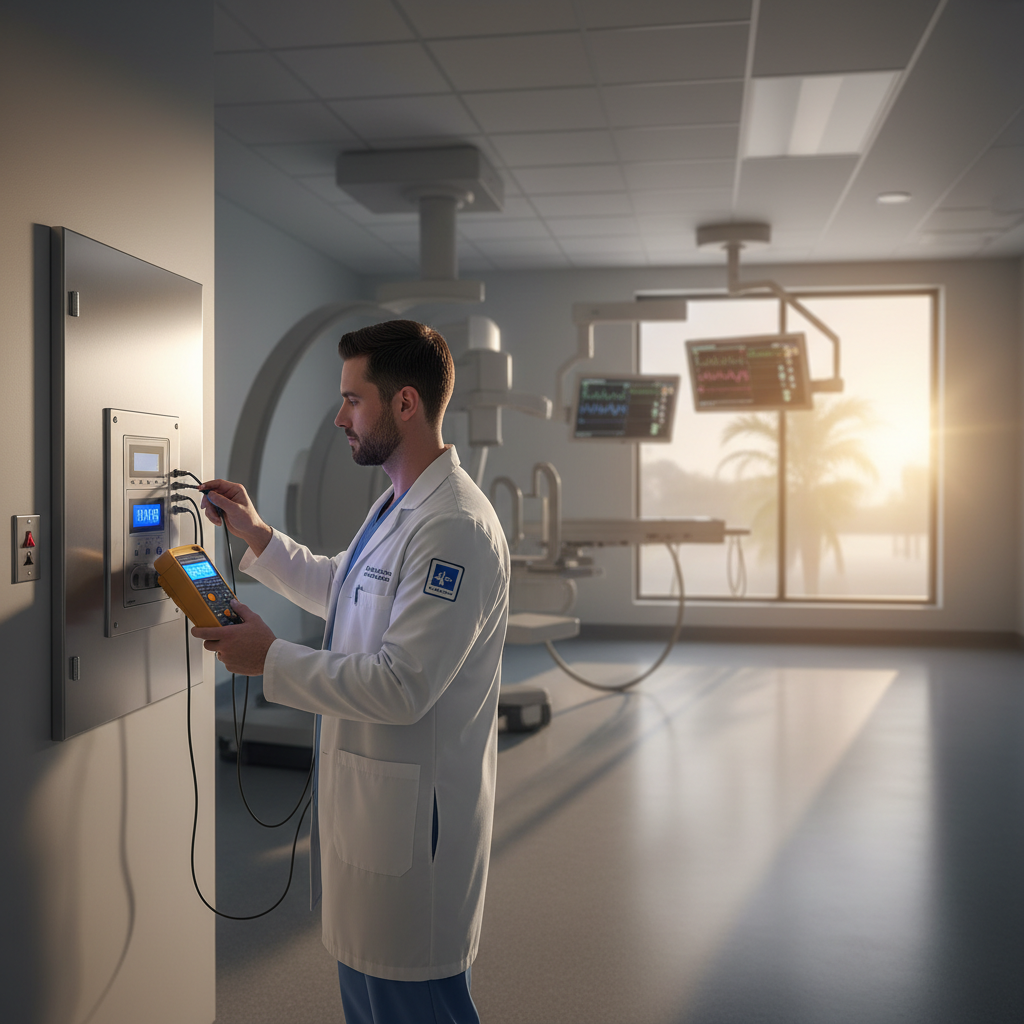
During a 2:00 AM test inside a hybrid interventional suite in downtown Orlando, a Bender MK2430 line isolation monitor flashed amber at 4.8 milliamps the moment a portable contrast injector plugged into receptacle circuit IP-3. The cardiologist hadn't scrubbed in yet, and no ground fault existed on the injector cord. Instead, twenty-two high-frequency switch-mode power supplies feeding C-arm monitors, hemodynamic recorders, and intravascular ultrasound racks had quietly pushed cumulative capacitive leakage to the brink of the alarm ceiling. When you schedule cardiac cath lab isolated power testing Orlando hospitals rely on to stay open, you aren't just pressing the local test button on the wall faceplate. You are verifying that microshock protection holds when a saline-filled guidewire sits directly inside a patient's right ventricle.
Interventional cardiology suites operate at the intersection of invasive catheterization, conductive contrast media, and massive electrical density. Unlike standard general-care rooms, an Orlando cath lab packs C-arms, fluoroscopy tables, defibrillators, and heart-lung bypass consoles onto a single isolated power system (IPS) panel. Keeping those rooms compliant with NFPA 99 and Florida Agency for Health Care Administration (AHCA) mandates requires precise fault injection, neutral-to-ground impedance checks, and dielectric breakdowns on every receptacle.
Why Cardiac Cath Labs Require Isolated Power Under NFPA 99
Cardiac catheterization and electrophysiology (EP) labs create a direct conductive pathway to the myocardium. Under normal conditions, intact human skin provides roughly 10,000 to 100,000 ohms of resistance against electrical current. Once an interventionalist threads a pacing lead or fluid-filled catheter into a coronary artery, that skin barrier is bypassed entirely. A leakage current as small as 10 microamperes (0.01 mA) applied directly to heart muscle can trigger ventricular fibrillation without tripping a standard 20-amp branch circuit breaker.
Under NFPA 99 (Health Care Facilities Code) Section 6.3.2.2.8, governing bodies must designates wet procedure locations and invasive Category 1 spaces. Furthermore, NFPA 70 (National Electrical Code) Article 517.19 and Article 517.20 govern the wiring and grounding of critical care and wet procedure environments. In an ungrounded isolated power system, the secondary winding of the isolation transformer floats free of earth ground. If a single line-to-ground fault occurs inside a C-arm power supply, fault current has no return path to the transformer source. The power remains uninterrupted while the catheter stays inside the patient's chest, and the Line Isolation Monitor (LIM) sounds an audible and visual alarm to alert the clinical staff.
Why this matters for compliance: During an AHCA life safety licensure inspection or Joint Commission (TJC) survey, an undocumented risk assessment or expired annual LIM calibration report in a Category 1 interventional suite draws an immediate citation under NFPA 99 Chapter 6 and Florida Administrative Code Chapter 59A-3.
If your biomedical engineering or facilities team manages annual compliance across Central Florida, schedule certified line isolation monitor testing to document every transformer panel before your next survey window opens.
NFPA 99 Section 6.3.2.6.3 Trip Thresholds and Leakage Current Limits
Testing an isolated power panel in a modern catheterization lab demands exact adherence to NFPA 99 threshold criteria. The Line Isolation Monitor continually measures the total hazard current (THC), which combines both resistive and capacitive leakage across the isolated conductors L1 and L2 relative to ground.
According to NFPA 99 Section 6.3.2.6.3, every LIM installed in a healthcare facility must meet strict operational parameters during field verification:
Total Hazard Current Alarm Setpoint: The monitor must alarm when total hazard current (consisting of possible resistive and capacitive leakage currents) reaches a threshold of 5.0 mA under nominal line voltage conditions.
No-Trip Floor: The LIM must not alarm when fault hazard current is less than 3.7 mA. Newer digital monitors using a lower internal monitor hazard current often calibrate the non-alarm ceiling closely between 4.5 mA and 4.9 mA.
Internal Monitor Hazard Current: Modern microprocessor-based LIMs (such as the Bender MK2430 or PG LifeLink Mark V) add no more than 0.025 mA (25 microamperes) to the system, whereas legacy analog meters added up to 1.0 mA of internal load.
Reference Ground Conductor Continuity: The voltage between the reference grounding point and any exposed conductive surface or receptacle ground pin in the room cannot exceed 20 millivolts under no-fault conditions, and impedance must remain at or below 0.1 ohm per NFPA 99 6.3.2.5.
Below is how field inspection parameters break down across testing intervals and equipment generations during an Orlando cath lab audit.
Test Parameter / Component
NFPA 99 / NEC Requirement
Pass Criteria in Cath Lab
Typical Failure Mode in Orlando Suites
LIM Trip Threshold (Resistive/Capacitive)
NFPA 99 6.3.2.6.3.2
Alarms between 3.7 mA and 5.0 mA (L1-G and L2-G)
Drifted analog calibration potentiometers tripping above 5.2 mA
Hospital-Grade Receptacle Tension
NFPA 99 6.3.3.2.3
Minimum 4 ounces (113 grams) retention force per slot
Loose ground blades on boom outlets from heavy imaging carts
Equipment Grounding Impedance
NFPA 99 6.3.3.1.2
≤ 0.1 ohm (or ≤ 0.2 ohm for existing installations)
Corroded ground bus terminals inside older Square D panels
System Isolation Impedance
NFPA 99 6.3.2.6.2
≥ 200,000 ohms (≥ 200 kΩ) from L1 or L2 to ground
Accumulated carbon dust on secondary transformer windings
Annual Calibration Interval
NFPA 99 6.3.4.1.3
Tested at least every 12 months (or 6 months if modified)
Missing test logs for newly added hybrid OR/cath booms
Why High-Density Cath Labs Fail Leakage Current Checks
Walk into an interventional suite at AdventHealth Orlando or Orlando Health Heart & Vascular Institute, and you won't find an empty electrical bus. Modern cardiac cath labs rely on ceiling-suspended equipment booms loaded with 120V and 208V hospital-grade receptacles.
Even when every piece of medical equipment is completely free of defects, alternating current induces capacitive leakage across the insulation of every power cord and EMI filter connected to the panel. Every foot of secondary branch wiring in the conduit contributes roughly 1 microampere of capacitive leakage. Add eight ultra-high-definition surgical displays, a fluoroscopy table control unit, an optical coherence tomography (OCT) console, and an anesthesia machine, and your baseline standing leakage climbs from 0.8 mA to 3.9 mA before the case even starts.
Boom Articulation and Pinched Secondary Conductors
Ceiling booms rotate hundreds of times each month. Inside the articulating knuckle of a cath lab boom, flexible conductors rub against metal chase bushings. Over three to five years, insulation breakdown on L1 or L2 creates an intermittent high-resistance short to the boom chassis. The LIM alarms only when the radiology tech swings the monitor arm to a specific 45-degree angle over the patient table. Using a calibrated fault current box and megohmmeter, our technicians isolate individual branch breakers on the IPS panel while articulating the boom to pinpoint the compromised circuit.
Contrast Dye and Saline Intrusion in Pedestal Outlets
Floor pedestals and table-mounted receptacle strips sit directly beneath the sterile drape drip zone. Heparinized saline and iodinated contrast dye are highly conductive fluids. When fluid wicks past a worn faceplate gasket into a duplex hospital-grade receptacle, dried sodium crystals form a permanent resistive bridge between the hot terminal screw and the stainless-steel mounting yoke. During annual testing, these outlets show normal voltage polarity but drop the entire panel's isolation impedance well below the 200,000-ohm minimum.
Step-by-Step Field Protocol for Cath Lab Isolated Power Verification
Pressing the "Push to Test" switch on the LIM faceplate only checks the internal alarm relay and indicator lamps, it does not prove that the monitor accurately reads a fault on the isolated bus. True NFPA 99 compliance requires external calibrated fault injection at the transformer panel and receptacle level.
After-Hours Scheduling and Clinical Coordination: Because testing trips the audible alarm and requires momentary de-energization of individual branch circuits, testing takes place during off-peak hours (typically 7:00 PM to 4:00 AM) in coordination with the cath lab nurse manager and plant operations.
Baseline Standing Hazard Current Recording: Before unplugging any diagnostic gear, the technician logs the ambient microamp/milliamp reading on the LIM with all standard room equipment plugged in and energized.
Unloaded System Leakage and Insulation Check: With equipment disconnected or branch breakers systematically opened, the technician verifies the unloaded capacitive leakage of the panel and wiring to establish the true baseline of the secondary transformer.
Calibrated Variable Fault Injection (L1-G and L2-G): Using a NIST-traceable fault simulator connected to the furthest receptacle on the circuit, the technician injects incremental resistive and capacitive faults from Line 1 to Ground and Line 2 to Ground, recording the exact milliamp level where the audible and visual alarms trigger.
Ground Continuity and Retention Force Testing: Every red or ivory isolated ground receptacle on the walls, ceiling booms, and surgical tables undergoes a 4-ounce mechanical retention pull test on the hot, neutral, and ground slots, followed by a millivolt/ohm impedance test back to the room's reference grounding point.
Navigating AHCA, Joint Commission, and Hurricane Re-Verification in Central Florida
Hospital facilities across Orange, Seminole, and Osceola counties answer to two strict authorities: The Joint Commission (TJC) and the Florida Agency for Health Care Administration (AHCA). When AHCA Office of Plans and Construction (OPC) engineers walk a new cath lab buildout or renovation, your verification paperwork must satisfy AHCA OPS Form 3110 and Chapter 59A of the Florida Administrative Code. Incomplete serial numbers, missing NIST calibration certificates on the technician's test instruments, or lumped pass/fail sheets that omit individual receptacle impedance numbers will delay room occupancy.
In addition to electrical isolation, hybrid cath labs that administer general anesthesia require full medical gas support, including oxygen, medical air, nitrous oxide, vacuum, and waste anesthetic gas disposal (WAGD). Medical Testing Solutions pairs electrical LIM testing with ASSE 6030 medical gas verification and annual medical gas inspections in a single overnight mobilization, cutting vendor downtime in half.
Florida facilities also face severe weather disruptions. Under NFPA 99 Section 5.1.12, medical gas and life-safety systems require immediate re-verification after any loss of source pressure, flood intrusion, or structural storm damage. When hurricanes push across the I-4 corridor or hammer coastal hospital campuses, generator transfers and surge events frequently damage LIM sensing boards and medical gas master alarm panels. Because our crews are staged in-state, we mobilize rapidly post-storm to get offline interventional suites cleared for emergency cardiac cases.
The Local Florida Cost Advantage: Zero Travel or Per-Diem Fees
Many biomedical engineering directors in Orlando unknowingly hire national compliance brokers who fly technicians in from out of state to test their isolated power panels and medical gas outlets. Those vendors bury airfare, rental cars, hotel nights, and daily per-diem charges inside inflated per-panel rates.
Medical Testing Solutions is headquartered at 501 East Las Olas Blvd, Ste 300, Fort Lauderdale, FL 33301. Because our ASSE-certified verifiers, installers (ASSE 6010), and maintenance specialists live and work across the state, we charge NO travel fees, NO lodging, and NO per-diem anywhere in Florida. Most hospital networks, from AdventHealth and Orlando Health in Central Florida down to Jackson Memorial, Baptist Health, Broward Health, and Cleveland Clinic Florida in the south, save 10% to 25% compared to out-of-state ASSE 6030 verifiers.
We support hospital systems, freestanding emergency departments, and ambulatory surgery centers through our statewide Florida medical gas and compliance hub, with rapid local coverage linked across our Fort Lauderdale medical gas services, Miami service team, and West Palm Beach dispatch. Beyond testing, Medical Testing Solutions supplies replacement Bender and PG LifeLink retrofit kits, grounding cords, and medical gas pipeline hardware directly through our technical catalog.
Schedule Your Orlando Cath Lab Isolated Power Inspection
Don't wait for a nuisance LIM alarm mid-angioplasty or an unexpected AHCA citation to evaluate your interventional panels. Call our Fort Lauderdale office at (754) 315-1078 for same-day dispatch in South Florida and scheduled overnight mobilizations across Orlando, or request a quote online to bundle your annual isolated power and NFPA 99 medical gas inspections with zero travel fees.
Frequently Asked Questions
Under NFPA 99 Section 6.3.4.1.3, Line Isolation Monitors (LIMs) in cardiac cath labs and operating rooms must be tested at least annually (every 12 months). Additionally, the functional test button on the LIM faceplate should be verified regularly by staff, and a full calibrated fault-injection test is required whenever the isolated power panel is modified or repaired.
Per NFPA 99 Section 6.3.2.6.3, a Line Isolation Monitor must alarm when the total hazard current (combining resistive and capacitive leakage) reaches 5.0 milliamps (mA) under nominal voltage. It must not alarm when fault hazard current is below 3.7 mA.
High-density cardiac cath labs connect dozens of switch-mode power supplies for C-arms, imaging monitors, contrast injectors, and hemodynamic consoles to a single isolated panel. Each power cord and EMI filter adds normal capacitive leakage current. When cumulative standing leakage approaches 4.0 to 4.5 mA, plugging in one additional piece of equipment pushes total hazard current over the 5.0 mA alarm ceiling.
Yes. Every hospital-grade receptacle connected to the isolated power system on walls, ceiling booms, and surgical tables must undergo physical retention force testing (minimum 4 ounces per blade slot) and grounding impedance testing (maximum 0.1 ohm for new systems or 0.2 ohm for existing installations) back to the room's reference grounding point.
Medical Testing Solutions is headquartered in Fort Lauderdale, Florida, and deploys in-state ASSE-certified technicians across Orlando and Central Florida with zero travel fees, no hotel charges, and no per-diems. Bundling LIM testing with ASSE 6030 medical gas inspections typically saves Florida hospitals 10% to 25% compared to out-of-state compliance contractors.
Request a quote for your facility
Talk with Medical Testing Solutions about your next inspection, repair or equipment request.