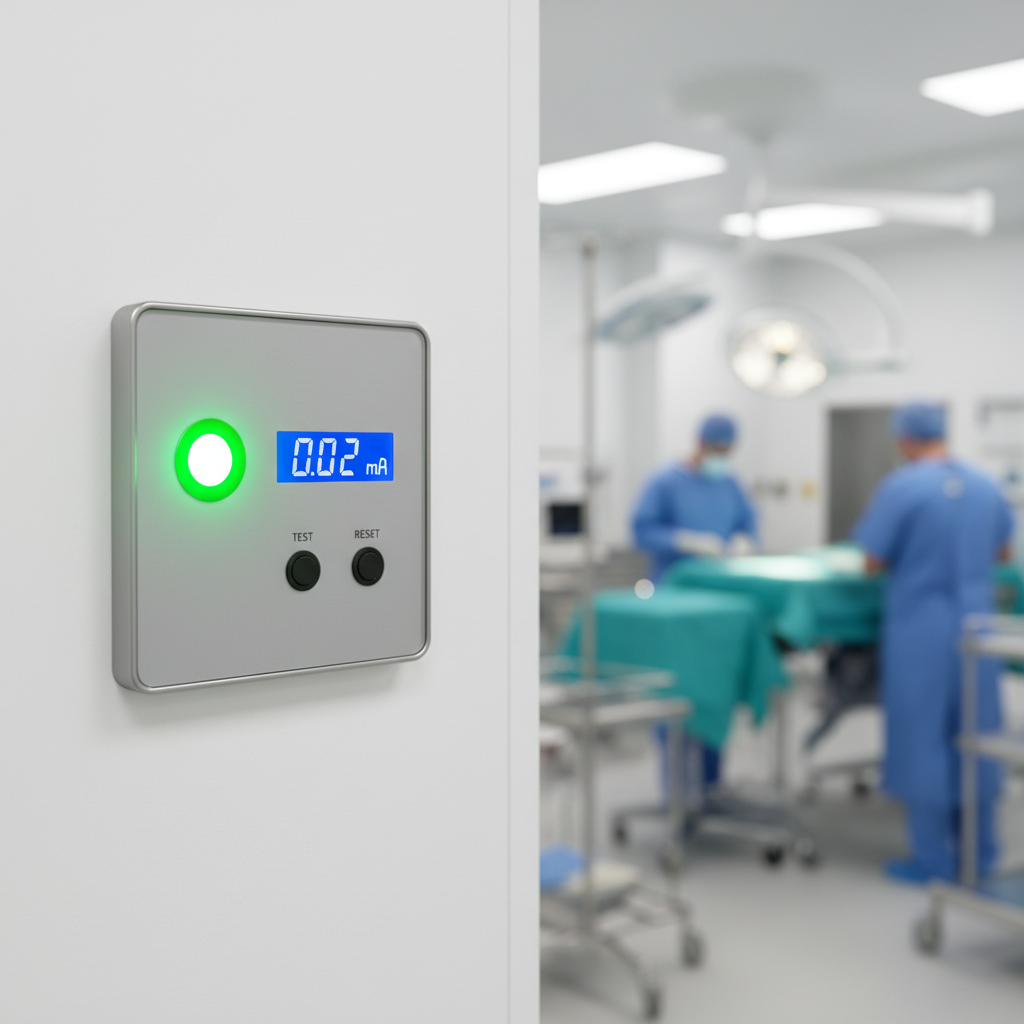
A Line Isolation Monitor, or LIM, is a predictive device that continuously monitors the integrity of an ungrounded electrical system, commonly known as an Isolated Power System. Unlike a standard circuit breaker that trips on an overcurrent condition, a LIM provides an early warning of potential ground faults without interrupting the power supply. Its primary function is to detect hazardous levels of electrical leakage current, alerting staff to a potential first fault condition before it can become a life-threatening shock hazard.
In hospital operating rooms and other critical care areas, especially those designated as "wet procedure locations," Isolated Power Systems are mandated by NFPA 99. The LIM is the central component of this system, providing the crucial intelligence to maintain electrical safety. It measures the Total Hazard Current (THC), the cumulative leakage current from all connected equipment, and triggers an alarm if the THC exceeds a preset threshold, typically 5 milliamperes (mA) for operating rooms.
Why this matters for compliance: NFPA 99, the Health Care Facilities Code, mandates the use of LIMs in specific healthcare settings to mitigate the risk of electric shock. Failure to install, maintain, and test these systems properly can result in non-compliance, jeopardizing patient safety and facility accreditation.
Where Are Line Isolation Monitors Required? NFPA 99 Wet Location Rules
The National Fire Protection Association (NFPA) provides clear guidance on where isolated power, and therefore LIMs, are required. The primary driver is the designation of a space as a "wet procedure location."
According to NFPA 99 (2021 Edition), a wet procedure location is defined as "a patient care area that is normally subject to wet conditions while patients are present," including "the standing of liquids on the floor or drenching of the work area, either of which is intimate to the patient or staff."
NFPA 99, Section 6.3.2.2.8.4, states that operating rooms shall be considered a wet procedure location unless a risk assessment conducted by the health care governing body determines otherwise. This effectively makes LIMs a standard requirement for virtually all modern operating rooms.
Other areas that may be designated as wet locations include:
Certain emergency department rooms
Cystoscopy and urology suites
Labor and delivery rooms
Dialysis units
An engineering risk assessment is the formal process to determine which areas require this level of protection. Medical Testing Solutions can assist facilities in performing these crucial assessments to ensure proper electrical safety and code compliance.
How Line Isolation Monitors Work
An LIM functions by continuously monitoring the impedance to ground of each conductor in an isolated power system. In a healthy system, the impedance is very high, and leakage currents are minimal. However, if a piece of equipment begins to fail or insulation breaks down, a "first fault" can occur, creating a leakage path to ground.
The LIM detects this change in impedance and calculates the potential fault current. If this calculated current, the Total Hazard Current, rises above the NFPA-mandated alarm threshold (e.g., 5.0 mA for ORs), the LIM activates audible and visual alarms.
This "first fault" does not trip the circuit or interrupt power to life-sustaining equipment. It is simply an alarm. This gives staff the critical time to identify and remove the faulty piece of equipment from the isolated power circuit before a second fault occurs, which could be dangerous.
LIM Testing Requirements: NFPA 99 Cadence
Properly functioning LIMs are a cornerstone of electrical safety in operating rooms. NFPA 99 outlines specific testing and maintenance requirements to ensure these devices are always ready to perform their life-saving function.
ASSE Series 6000 certified professionals, like the technicians at Medical Testing Solutions, are qualified to perform these critical tests.
NFPA 99 LIM Testing Frequency Table
Test Frequency
NFPA 99 Section (2021)
Required Action
Performed By
After Installation
6.3.3.3.2
The LIM and its associated alarms must be tested to ensure they function as designed.
ASSE 6030 Certified Technician
Monthly
N/A (Manufacturer Rec.)
The LIM's self-test or push-to-test button should be activated to verify alarm functionality.
Trained Facility Staff
Annually (or after repair)
6.3.4.1.4, 6.3.4.1.5
A qualified technician must perform quantitative testing to verify the LIM triggers at the correct mA threshold.
ASSE 6030 Certified Technician
Here’s a breakdown of the steps involved in formal testing:
Visual Inspection: Check for physical damage, proper installation, and clear labeling.
Functional Test: Press the "push-to-test" button on the LIM to verify that the audible and visual alarms activate.
Quantitative Test: This is the most critical part, performed by a certified technician. Using specialized equipment, the technician simulates leakage currents to verify the LIM alarms at the precise trip point specified by NFPA 99 (e.g., 5.0 mA).
Documentation: All test results must be documented and maintained for review by accreditation bodies like The Joint Commission.
A LIM alarm can be unsettling, but it's important to remember that it is not an emergency in itself. It is a warning. It signals a "first fault" and provides an opportunity to act before a hazardous condition develops. Power will NOT be interrupted.
Follow these steps:
Acknowledge the alarm. Do not ignore it.
Identify the last piece of equipment plugged in. Often, the most recently connected device is the source of the leakage current.
Unplug equipment one by one, starting with the last one connected. The alarm should clear when the faulty device is disconnected.
Remove the faulty equipment from service immediately and label it for inspection by biomedical engineering.
If the alarm persists after all portable equipment is unplugged, the fault may lie in the fixed wiring. In this rare case, the procedure may need to be concluded, and a qualified technician from a company like Medical Testing Solutions should be called to diagnose the system.
ASSE 6000 Standards and Qualified Personnel
NFPA 99, Section 6.3.4.1.4, explicitly states that LIM testing must be performed by "qualified personnel." The industry standard for demonstrating qualification is certification to ASSE Series 6000, "Professional Qualifications Standard for Medical Gas Systems Personnel."
Specifically, an ASSE 6030 Medical Gas Verifier is trained and certified to test complex medical gas and related electrical systems, including LIMs. When you engage a service provider, always ask for their ASSE credentials to ensure they are qualified to work on your critical life-safety systems. Medical Testing Solutions employs a team of ASSE 6010, 6030, and 6040 certified technicians, ensuring the highest level of expertise for medical gas verification and maintenance.
Ensure Your Facility’s Compliance and Safety
Line Isolation Monitors are a fundamental component of electrical safety in the modern operating room. Ensuring they are properly installed, tested, and maintained according to NFPA 99 is not just a matter of compliance, it's a critical patient and staff safety imperative.
If you have questions about your facility's LIMs, need to schedule annual medical gas inspections, or require ASSE-certified testing and verification, Medical Testing Solutions is here to help. Our certified technicians provide comprehensive LIM testing services to keep your facility safe and compliant.
Contact us today for a free quote or to schedule a service call. Call (754) 315-1078 or request a quote online.
Frequently Asked Questions
A circuit breaker interrupts power during an overcurrent (short circuit) condition. A line isolation monitor (LIM) does not interrupt power; it detects potential ground faults in an isolated power system and provides an alarm, allowing staff to address the issue before a dangerous situation arises.
The 5.0 mA threshold is set by NFPA 99 as the maximum allowable Total Hazard Current for wet procedure locations. This level is considered a safe warning point, well below the current level that could cause harm, providing a margin of safety for both patients and staff.
Facility staff can and should perform monthly "push-to-test" functional checks. However, the quantitative testing required after installation and annually must be performed by personnel qualified and credentialed to ASSE 6030 standards, using specialized calibrated equipment.
Not necessarily. A LIM alarm indicates a "first fault," which is a warning, not a critical failure. The power to life support equipment will not be cut off. The clinical team can usually identify and remove the faulty device without interrupting the procedure.
Request a quote for your facility
Talk with Medical Testing Solutions about your next inspection, repair or equipment request.