Line Isolation Monitor Inspection Pompano Beach FL: Your Guide
Medical Testing SolutionsJune 25, 20267 min read
Share
Operating rooms, intensive care units, and other wet procedure locations in Pompano Beach medical facilities are electrical-hazard-intensive environments. The failure of a single piece of equipment can have dire consequences for patients and staff. This is why isolated power systems, monitored by a Line Isolation Monitor (LIM), are not just best practice, they are mandated by code. Understanding the annual inspection requirements for these critical life-safety devices is paramount for ensuring both patient safety and regulatory compliance.
This guide provides a definitive overview of line isolation monitor inspection for healthcare facilities in the Pompano Beach, FL area. You will learn what a LIM is, the specific NFPA 99 testing requirements, what a proper inspection entails, and how to select a certified provider to protect your patients, staff, and facility. We will demystify the codes and standards to give you actionable insights for your compliance strategy.
What is a Line Isolation Monitor (LIM)?
A Line Isolation Monitor is a device that continuously monitors the integrity of an ungrounded Isolated Power System (IPS). Its primary function is to measure the potential for electric shock in areas where liquids and electricity are in close proximity, such as operating rooms and other "wet procedure locations."
The Role of Isolated Power Systems in Healthcare
In a standard, grounded electrical system, the first fault (e.g., frayed wiring touching a metal casing) will cause a circuit breaker to trip, shutting off power. While this is a safety feature in a typical setting, an abrupt power loss during a critical medical procedure could be catastrophic.
Isolated Power Systems, used in critical patient care areas, are different. They are ungrounded, meaning the secondary circuit is electrically isolated from the primary. In an IPS, a single fault will not cause a power interruption. Instead, it effectively turns the ungrounded system into a grounded one. The LIM detects this first fault, triggering an audible and visual alarm to alert staff that the system is compromised, all while keeping the power on so the medical procedure can be completed safely. The LIM provides the crucial warning that the next fault will pose a significant shock hazard and could interrupt power.
How LIMs Protect Patients and Staff
The LIM is the sentinel of the isolated power system. It continuously measures the system's "hazard current", the leakage current that could flow from the isolated conductors to ground. If this hazard current exceeds a predetermined threshold (typically 5 milliamperes for ORs as per NFPA 99), the LIM alarm activates. This warns healthcare professionals of a potential electrical hazard before it can cause harm, allowing them to address the issue without interrupting critical patient care.
NFPA 99 Requirements for LIM Testing and Inspection
The National Fire Protection Association (NFPA) 99, Health Care Facilities Code, is the primary standard governing the installation, performance, and maintenance of medical gas and electrical systems. For LIMs, compliance is not optional.
Chapter 6: Electrical Systems Explained
NFPA 99, Chapter 6, "Electrical Systems," provides the foundational requirements for all electrical equipment and systems in healthcare facilities. It explicitly mandates the use of Isolated Power Systems (and thus LIMs) in all "wet procedure locations."
Why this matters for compliance: Failure to comply with NFPA 99 can result in significant penalties, loss of accreditation (e.g., from The Joint Commission), and increased liability. Most importantly, it puts patients and staff at unnecessary risk. An annual medical gas inspection program that includes LIMs is a cornerstone of a facility's safety and compliance program.
Annual Testing Mandates: What the Code Says
NFPA 99 (2012 edition, reference 6.3.4.1.4) states that Line Isolation Monitors must be tested at regular intervals. Specifically, section 6.3.3.3.2 requires that LIM test circuits be tested at least annually. This test ensures two things:
The monitor's alarm activates when the test button is pressed.
The monitor alarms at the correct trip point (e.g., 5 mA), a quantitative measurement that requires specialized test equipment.
This annual verification is critical to ensure the device will function as designed in the event of a fault. Technicians performing this service must be qualified, which is why ASSE 6000 series certification is the industry benchmark.
The Annual Line Isolation Monitor Inspection Process
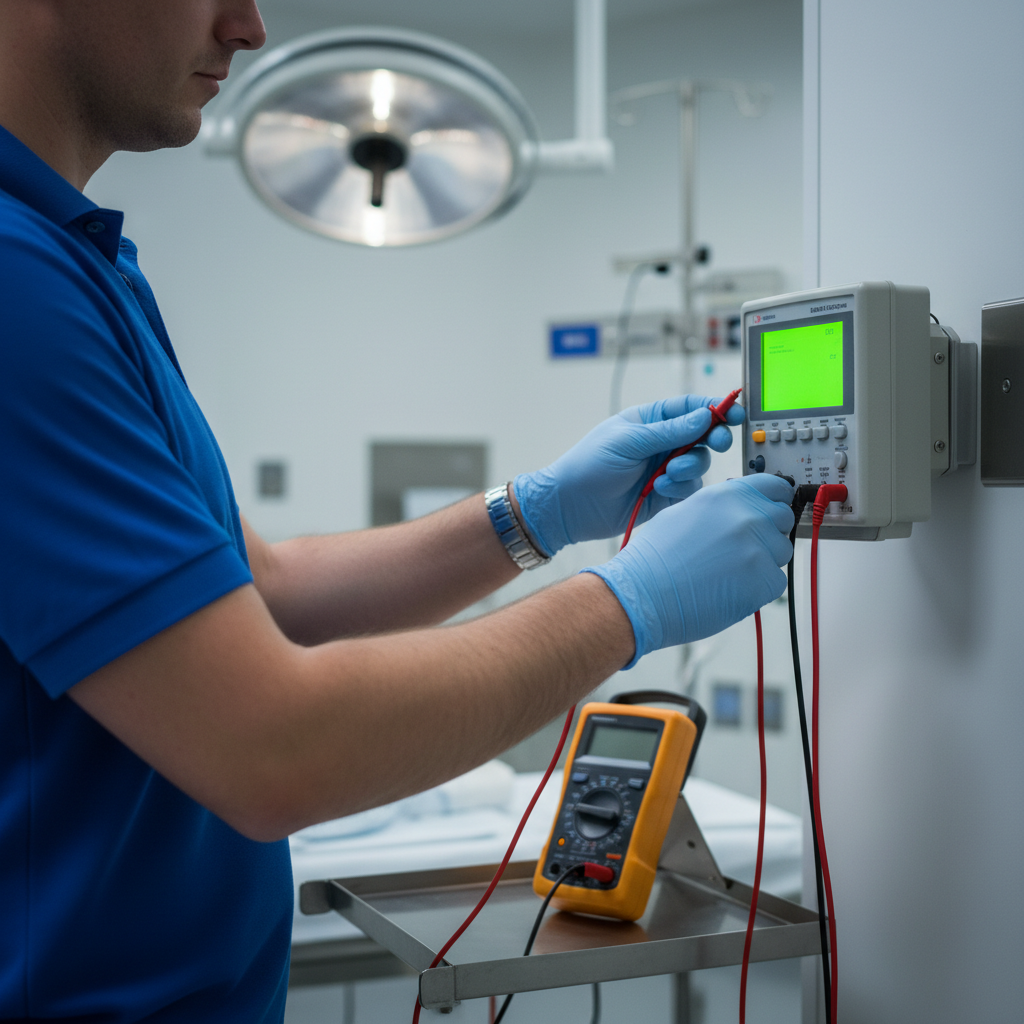
A proper LIM inspection is a systematic process performed by a certified technician. While the specifics may vary slightly based on the equipment brand (Bender, Post-Glover, etc.), the core procedure follows a strict protocol to ensure accuracy and compliance. At Medical Testing Solutions, our ASSE-certified technicians follow a comprehensive checklist.
Here are the key steps involved:
Documentation Review: The process begins by reviewing the facility's records, previous inspection reports, and any logged alarms.
Physical Inspection: The technician visually inspects the LIM unit for any signs of physical damage, loose connections, or environmental concerns.
Functional (Qualitative) Test: The technician presses the "push-to-test" button on the LIM. This simulates a fault and should trigger the audible and visual alarms. This confirms the alarm indicators are working.
Quantitative Alarm Test: Using specialized, calibrated test equipment, the technician introduces a controlled fault current into the system. They precisely measure the current required to trip the alarm, ensuring it aligns with the NFPA 99 threshold (e.g., 5.0 mA).
Alarm Silence and Reset Test: The technician verifies that the alarm silence button works and that the LIM resets correctly once the fault is cleared.
Labeling and Documentation: The technician applies a dated certification label to the unit and provides a detailed inspection report for the facility's records. This documentation is essential for demonstrating compliance to accrediting bodies.
While several manufacturers produce LIMs, three brands are commonly found in Pompano Beach facilities. Each has its own strengths, but all must be inspected to the same NFPA 99 standard.
Feature
Bender LIM2010
Post-Glover (IPC)
Schneider Electric
Display Type
Advanced LCD
LED Digital
Digital/LED options
Network Capable
Yes (Modbus/Ethernet)
Yes
Yes
History Logging
Extensive event logging
Basic fault logging
Varies by model
Common Use
Newer installations, high-end
Widely installed base
Common in new construction
Key Consideration
Advanced diagnostics
Robust and reliable
Integrated system solutions
No matter the brand installed in your facility, Medical Testing Solutions has the expertise and equipment to test and certify all major LIM models.
Who is Qualified to Perform LIM Inspections?
NFPA 99 requires that inspections be performed by "qualified" personnel. The industry standard for demonstrating qualification is certification to the ASSE 6000 series. An ASSE 6030 Medical Gas Verifier or an ASSE 6040 Medical Gas Maintenance Personnel certification indicates a technician has undergone rigorous training and examination on medical gas and electrical systems, including LIMs.
Never allow uncertified personnel to test your life-safety systems. Using a certified provider like Medical Testing Solutions ensures that the work is performed correctly, safely, and in full compliance with the code.
Get Your Pompano Beach Facility Inspected
Ensuring your Line Isolation Monitors are functioning correctly is a critical responsibility for every Pompano Beach healthcare facility manager. Annual, certified inspection is the only way to verify performance, protect patients, and meet NFPA 99 requirements. Don't leave the safety of your critical care areas to chance.
The certified professionals at Medical Testing Solutions provide comprehensive, code-compliant medical gas verification and LIM inspection services throughout Pompano Beach and South Florida. We are headquartered right here in the area and are ready to be your compliance partner.
Ready to schedule your inspection or get a quote?Contact our team today or call us directly at +1 (754) 315-1078 to ensure your facility is safe and compliant.
Frequently Asked Questions
Per NFPA 99, all Line Isolation Monitors must be tested and certified at least annually by a qualified technician.
If a LIM fails inspection, it indicates a problem with either the monitor itself or the isolated power system. The faulty component must be diagnosed and repaired or replaced immediately to ensure the area is safe for patient care.
They can only perform the inspection if they hold the proper ASSE 6000 series certification (e.g., ASSE 6040) and have the calibrated equipment required for quantitative testing. Simply pushing the "test" button is not a complete inspection.
A wet procedure location is an area in a patient care space where procedures involving liquids are performed that could come into contact with the patient or staff, creating a higher-risk electrical environment. This typically includes operating rooms, cardiac catheterization labs, and certain ICU beds.
The time required depends on the number of LIMs to be tested. A single LIM inspection is typically efficient, often taking 30-45 minutes, including documentation. We work with you to schedule testing to minimize disruption to your operations.
No. Medical Testing Solutions schedules all testing during times that are convenient for your facility, often during off-peak hours, to ensure there is no disruption to patient care or scheduled procedures. The power to the area is not interrupted during the test.
Request a quote for your facility
Talk with Medical Testing Solutions about your next inspection, repair or equipment request.